For most U.S. businesses paying foreign contractors, the right approach is a hybrid: use a specialist FX rail or multi-currency platform for the actual money movement, and pair it with a formal onboarding process that collects the correct IRS documentation before the first dollar leaves your account. That combination keeps costs low, payments fast, and your company protected from withholding surprises.
Three things you can do in the next 24–72 hours to get started:
-
Collect the right tax form. Ask every new foreign contractor to complete a W-8BEN (individuals) or a W-8BEN-E (entities) before payment. U.S. contractors complete a W-9 instead.
-
Confirm where the work is physically performed. Services performed entirely outside the U.S. by a nonresident alien are generally foreign-source income and typically not subject to U.S. withholding, per IRS sourcing rules. Getting this confirmed in writing saves headaches later.
-
Pick a primary payment rail. For one-off or low-volume payments, a SWIFT wire works. For recurring cross-border payments for contractors, a specialist FX platform or contractor payment service usually cuts total cost meaningfully.
Key Takeaways
The most compliant and cost-effective approach to international contractor payments combines a specialist FX rail for money movement with formal IRS documentation collected before the first payment.
| Point | Details |
|---|---|
| Collect W-8 forms first | Get W-8BEN or W-8BEN-E from every foreign contractor before sending any payment. |
| Confirm work location in writing | Services performed outside the U.S. by nonresident aliens are generally not subject to U.S. withholding. |
| Match method to volume | SWIFT works for one-off payments; specialist FX rails or contractor platforms save money at recurring volume. |
| Track FX margin separately | The FX spread is usually the largest cost in cross-border payments and rarely appears on a fee statement. |
| Amazing Devs for Brazil | Amazing Devs centralizes contracts, billing, and compliance for U.S. companies hiring Brazilian developers. |
Table of Contents
-
What are the main methods for international contractor payments?
-
How do the payment methods compare on cost, speed, and compliance?
-
What U.S. tax and reporting rules apply to paying foreign contractors?
-
How do you choose the right payment method for your situation?
-
When does a staffing partner handle payments and compliance better than you can?
-
What finance teams actually learn after doing this for a while
-
Amazing Devs takes the payment and compliance load off your plate
-
What finance teams get wrong about this (and what actually works)
What are the main methods for international contractor payments?
The full menu of options breaks into six categories. Each fits a different profile of volume, geography, and compliance need.
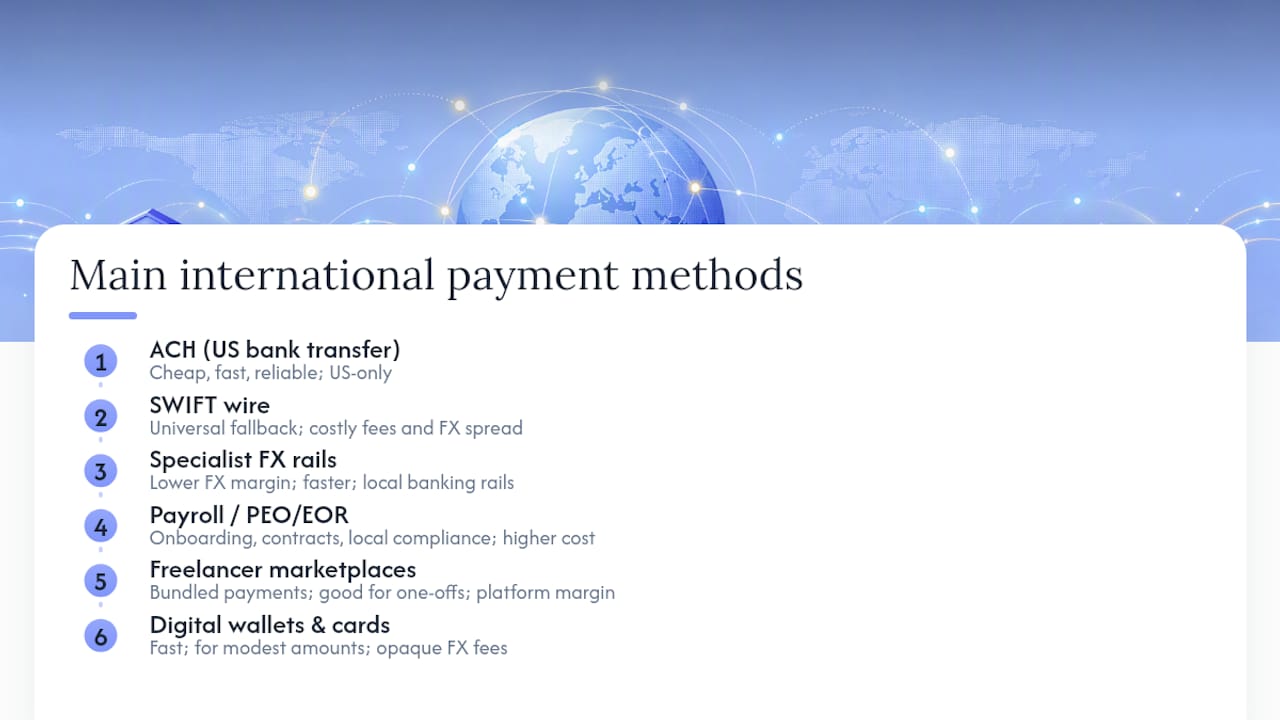
ACH / domestic bank transfers work only for U.S.-based contractors. Cheap, fast, and reliable, but completely irrelevant the moment your contractor is in another country.
International wire transfers (SWIFT) are the universal fallback. Every major bank supports them, and they reach virtually any country. The problem is cost: sender fees, intermediary bank deductions, and a wide FX margin can make SWIFT expensive, especially for smaller amounts or emerging-market corridors. A $5,000 payment to a contractor in Brazil or India can lose $150–$300 to the combined friction of fees and spread.
Specialist FX rails and multi-currency platforms are where most scaling businesses land. These providers route payments through local banking networks rather than the traditional SWIFT chain, quoting rates closer to the mid-market and settling faster. The FX margin is the biggest hidden cost in global contractor payments, and this category is specifically designed to reduce it.

Payroll/contractor platforms and PEO/EOR services go further: they handle onboarding, contracts, local compliance, and payments in one workflow. The trade-off is higher per-seat cost, but for companies managing contractors across multiple jurisdictions, the compliance lift they remove is worth it.
Freelancer marketplaces (platforms where you hire and pay in one place) bundle payment into the engagement. Convenient for one-off projects, but you lose control over contractor classification and often pay a platform margin on top of the FX spread.
Digital wallets and card-based payouts (think PayPal, Payoneer, or similar services) work well when the contractor already has an account and the amounts are modest. Speed is a genuine advantage. The downside is that FX fees can be opaque, and not every country supports easy local withdrawal.
The single most overlooked cost across all these categories is the FX margin embedded in the exchange rate, not the wire fee. A wire fee is visible; the FX spread on a payment can be a significant hidden cost and rarely appears on any invoice line.
How do the payment methods compare on cost, speed, and compliance?
International wire (SWIFT)
SWIFT is the most widely available option and the default for businesses that haven’t yet built a dedicated cross-border payments stack. Typical sender fees run $25–$50 per wire at most U.S. banks, but intermediary bank deductions can reduce what the contractor actually receives, and the FX spread adds another layer of cost. Settlement usually takes 2–5 business days. Country coverage is essentially global. Compliance documentation support is minimal: the bank sends the money, but it doesn’t help you collect W-8 forms or manage contractor records. Best for: infrequent, large payments where the fixed fee is a small percentage of the total.
Specialist FX rails and multi-currency platforms
These services route through local payment networks where available, which cuts both settlement time and FX cost. Rates typically sit much closer to the mid-market than a bank wire, and many platforms offer transparent fee structures. Settlement can be same-day to 2 business days for major corridors. Country coverage varies by provider but commonly spans 50–150+ countries. Most platforms in this category offer basic onboarding workflows and some documentation support, though they generally do not provide full contractor compliance management. Best for: recurring payments to contractors in the same corridors, where FX savings compound over time.
Contractor platforms and EOR/PEO services
These are the most operationally complete option. A contractor platform handles onboarding (including W-8 collection), contract management, invoice processing, and payment in a single workflow. Some platforms support payments to many countries and assist with correct W-8 form collection for foreign contractors. EOR services go further and actually employ the worker locally, removing misclassification risk entirely. Cost is higher: typically a monthly per-contractor fee or a percentage of compensation. Integration with accounting systems (QuickBooks, NetSuite, Xero) is usually available. Best for: companies managing five or more international contractors, or any situation with legal complexity across multiple jurisdictions.
Digital wallets (PayPal, Payoneer, and similar)
Fast and familiar. If your contractor already has an account, you can fund a payment in minutes. FX fees vary and can be higher than they appear, particularly on the withdrawal side. Country coverage is broad but uneven: some markets have restrictions on how much can be withdrawn or converted locally. No compliance support. Best for: small, one-off payments to contractors in countries where wallet penetration is high and the amounts don’t justify a wire.
Freelancer marketplace payouts
When you hire through a platform, payment is built in. The platform handles currency conversion and remittance. No direct compliance support for your own records. Best for: truly one-off engagements where speed of hire matters more than cost efficiency.
What U.S. tax and reporting rules apply to paying foreign contractors?
This is where most businesses make expensive mistakes, usually by applying the wrong rules or skipping the form collection step entirely.
The three questions that determine everything
Three decision questions determine which forms you collect and which payment rail makes sense: Is the worker a U.S. person or a foreign person? Where is the work physically performed? What currency does the contractor want to receive? Services performed entirely outside the U.S. by a nonresident alien are generally foreign-source income and not subject to U.S. withholding. Get those three answers in writing before you set up any payment.
Which IRS forms apply
W-9: For U.S. persons (citizens, residents, or entities formed in the U.S.). Collect this before paying any U.S.-based contractor. It certifies their taxpayer identification number and confirms they are not subject to backup withholding.
W-8BEN / W-8BEN-E: For foreign individuals and entities, respectively. These forms document the contractor’s foreign status and, where applicable, allow them to claim reduced withholding under a tax treaty. Collecting the correct W-8 before payment is the single most important compliance step for foreign contractor payments.
1099-NEC: Required for U.S. persons paid $600 or more for services in a calendar year, per IRS instructions. Foreign contractors with a valid W-8 on file are generally exempt from 1099-NEC reporting. Note that the reporting threshold for 1099-NEC is subject to ongoing legislative change; confirm the current threshold each filing year.
Form 1042-S: Used to report payments to foreign persons that are U.S.-source income subject to withholding. If any portion of a foreign contractor’s work is performed in the U.S., that portion may be U.S.-source income requiring withholding at 30% (or a lower treaty rate) and reporting on Form 1042-S.
Withholding triggers
The default withholding rate on U.S.-source payments to foreign contractors is 30%, reduced by treaty where applicable. If the contractor’s work is performed entirely outside the U.S. and you have a valid W-8 on file, withholding is generally not required. If services are split between U.S. and foreign locations, you need to apportion the income and withhold on the U.S.-source portion.
| Scenario | Form to collect | Reporting form | Withholding required? |
|---|---|---|---|
| U.S. contractor, any location | W-9 | 1099-NEC (if $600+) | No (unless backup withholding triggered) |
| Foreign contractor, work outside U.S. | W-8BEN or W-8BEN-E | None (generally) | No |
| Foreign contractor, work inside U.S. | W-8BEN or W-8BEN-E | Form 1042-S | Yes, 30% or treaty rate |
| Foreign contractor, mixed location | W-8BEN or W-8BEN-E | Form 1042-S (U.S. portion) | Yes, on U.S.-source portion |

Pro Tip: If a contractor works partly from the U.S. and partly from their home country, get a written statement from them breaking down the percentage of work performed in each location. That document is your audit defense if the IRS ever questions your withholding calculation.
What documents should you collect before the first payment?
A repeatable onboarding process protects you from retroactive tax issues and makes audits manageable. Here is the sequence to follow for every new international contractor.
-
Signed contractor agreement. Include a statement of work (SOW), IP assignment clause, governing law (specify U.S. state), payment currency, and a clause requiring the contractor to notify you if their country of work changes.
-
Correct IRS tax form. W-9 for U.S. persons; W-8BEN (individual) or W-8BEN-E (entity) for foreign contractors. Do not send the first payment until this is on file.
-
Proof of identity and banking details. Government-issued ID and bank account details (IBAN or SWIFT/BIC for international transfers). This satisfies KYC requirements and prevents misdirected payments.
-
First invoice. Confirm the invoice includes: contractor’s legal name and address, your company name, a unique invoice number, the services rendered, the payment currency, and the amount. Inconsistent invoices create reconciliation problems downstream.
-
Confirmation of work location. A written statement (email is fine) confirming where the work will be physically performed. This is the key input for your sourcing analysis under U.S. tax rules.
-
Local tax or VAT registration number (where applicable). Some countries require contractors to include their local tax ID on invoices. Collecting this upfront avoids invoice rejections later.
Once collected, group all six items into a single contractor packet: signed agreement, IRS form, ID/banking details, first invoice, work-location statement, and local tax ID. Store these together and retain them for at least seven years, which covers the standard IRS audit window.
Pro Tip: Mandate in the contractor agreement that the contractor must notify you within 14 days if their country of work changes. A contractor who moves from Brazil to the U.S. mid-engagement changes your withholding obligations immediately, and you need that information in writing.
The invoice-to-payment matching process for contractor payments is fundamentally different from payroll. Invoices arrive at irregular intervals, amounts vary, and each payment needs its own approval trail. Build a maker-checker approval flow from the start: one person approves the invoice, a second authorizes the payment. That two-step control is what auditors look for.
Key contract clauses to include
Governing law: Specify which U.S. state’s law governs the agreement. This matters if a dispute arises.
Payment currency: State the currency explicitly (USD is simplest for your records). If the contractor prefers local currency, note that the conversion happens at the time of payment and specify who bears the FX risk.
IP assignment: All work product created under the agreement is assigned to your company upon payment. This clause is non-negotiable for software development engagements.
Termination and deliverables acceptance: Define what “done” means and how disputes over deliverable quality are resolved before payment is released.
How do you choose the right payment method for your situation?
The right method depends on three variables: where the contractor banks and what currency they need, how often and how much you pay, and how much compliance complexity the engagement carries.
One-off consultant payment
A consultant in India completes a two-week project. You owe $3,000. The work was performed entirely in India; you have a W-8BEN on file. A SWIFT wire from your bank works fine here. The fixed fee is a small percentage of the total, and you won’t repeat this payment often enough to justify setting up a specialist FX account. File the wire confirmation with the contractor’s packet and move on.
Monthly retainer for contractors in Latin America
Three contractors in Colombia and Mexico each invoice $2,500 per month. That’s $7,500 per month, $90,000 per year, flowing through the same corridors repeatedly. A specialist FX rail or multi-currency platform pays for itself quickly in this scenario. Set up bulk payment batches, hold a small multi-currency buffer in the platform to smooth rate volatility, and export the transaction data monthly for reconciliation.
High-volume technical staff in Brazil
Ten developers on ongoing retainer, each billing $5,000–$8,000 per month. At this scale, the operational load of managing invoices, approvals, FX conversions, and tax documentation manually becomes a real cost. A contractor platform or a nearshore staffing partner that handles contract management and centralized billing removes that load entirely. The per-contractor fee is offset by the AP hours saved and the compliance risk eliminated.
Operational considerations at scale
When managing foreign contractor payments across multiple corridors, a few practices matter:
-
FX pooling: Consolidate payments to the same currency corridor into a single batch rather than sending individual wires. This reduces fixed fees and gives you a single FX rate to track.
-
Multi-currency balances: Holding a buffer in BRL, MXN, or COP for predictable corridors protects you from rate spikes on payment day.
-
Maker-checker approval flows: Two-person authorization on every outbound payment is standard practice and a basic audit control.
-
Reconciliation exports: Choose a platform that exports payment data in a format your accounting system (QuickBooks, NetSuite, Xero) can ingest directly. Manual reconciliation at scale is where errors accumulate.
When does a staffing partner handle payments and compliance better than you can?
Three situations reliably signal that managing international contractor payments in-house has become a liability rather than a cost-saving measure.
First, when you cross five or more contractors in more than two countries, the compliance surface area expands faster than most AP teams can track. Each new jurisdiction adds potential local tax obligations, different banking rails, and new documentation requirements.
Second, when your AP headcount is thin. A two-person finance team managing payroll, vendor payments, and international contractor invoices simultaneously is a recipe for missed withholding triggers and late payments.
Third, when legal complexity is high: contractors who split time between countries, engagements that could be reclassified as employment under local law, or projects where IP ownership is ambiguous.
Amazing Devs addresses exactly these situations for companies hiring nearshore developers from Brazil. The services that directly reduce payment and compliance risk include:
-
End-to-end contract management: Country-appropriate agreements drafted and managed, so your SOW and IP clauses are correct from day one.
-
Centralized billing: One invoice from Amazing Devs rather than individual invoices from each developer, which collapses the AP workload significantly.
-
Onboarding and documentation: Amazing Devs handles the recruitment, assessment, and administrative onboarding, including the documentation that supports your IRS compliance obligations.
-
Compliance navigation: Managing the bureaucratic complexity of Brazilian contractor relationships, so U.S. clients don’t need to understand local labor law to stay protected.
A U.S. startup scaling from two to eight Brazilian developers typically faces a sharp increase in invoice volume, FX exposure, and documentation overhead right at the moment when the engineering team is most stretched. Centralizing that through a managed nearshore partner keeps the finance team focused on the business rather than on payment logistics.
What finance teams actually learn after doing this for a while
The gap between how companies think international contractor payments work and how they actually work in operations is wider than most founders expect.
The most common mistake is treating contractor payments like payroll. Payroll runs on a fixed schedule with predictable amounts. Contractor invoices arrive when the contractor sends them, for amounts that vary by deliverable or hours logged, and they require individual approval before payment. Bolting a payroll mindset onto a contractor workflow creates approval bottlenecks, reconciliation errors, and, occasionally, payments that go out before the invoice is formally approved. The invoice-driven nature of contractor payments demands a different operational model: flexible approval workflows, exportable transaction data, and the ability to handle variable amounts and timing for FX planning.
The second mistake is not tracking FX margin separately from fixed fees. Most AP teams see the wire fee on the bank statement and assume that’s the full cost of the payment. The FX spread is invisible unless you compare the rate you received against the mid-market rate at the time of the transfer. For high-volume corridors, that invisible cost is often larger than all the visible fees combined.
The third mistake is misclassification. The IRS applies specific tests to determine whether a worker is an employee or an independent contractor, and the consequences of getting it wrong include back taxes, penalties, and interest. The risk is highest when a contractor works exclusively for one company, follows a set schedule, and uses company-provided tools. If your engagement looks more like employment than contracting, get a legal opinion before the relationship deepens.
A short warning on misclassification: If you’re unsure whether a long-term, dedicated contractor relationship crosses the line into employment under U.S. or local law, consult a tax attorney or employment lawyer before the next payment. Retroactive reclassification is far more expensive than proactive advice.
For AP teams managing recurring global contractor payments, three operational habits make the biggest difference: standardize payment references on every invoice (contractor name, invoice number, period), hold a small multi-currency buffer for your highest-volume corridors, and run a monthly reconciliation that matches every outbound payment to a specific approved invoice. Those three habits catch errors before they become audit findings.
Amazing Devs takes the payment and compliance load off your plate
Hiring nearshore developers from Brazil gives U.S. startups access to strong engineering talent at a lower total cost than domestic hiring. The friction point is everything that comes after the hire: contracts, invoices, FX conversions, IRS documentation, and ongoing compliance as the team scales.

Amazing Devs handles that friction end-to-end. Instead of managing individual contractor invoices, FX transfers, and documentation packets for each developer, you get a single managed engagement: one contract, one invoice, one point of contact. The company’s rigorous sourcing and assessment process means you’re not trading compliance certainty for talent quality.
-
Reduced AP load: One consolidated invoice replaces multiple individual contractor invoices, cutting the approval and reconciliation workload.
-
Country-appropriate contracts: Agreements drafted for Brazilian contractor relationships, with IP assignment and governing law clauses that protect U.S. clients.
-
Centralized billing and payment management: Amazing Devs manages the payment logistics on the ground, so your finance team doesn’t need to navigate Brazilian banking rails or local tax requirements.
If your team is scaling and the payment overhead is starting to slow you down, talk to Amazing Devs about a managed nearshore engagement. A brief conversation is usually enough to scope what a custom solution looks like for your headcount and budget.
What finance teams get wrong about this (and what actually works)
Most of the guidance on paying international contractors focuses on which platform to use. That’s the wrong starting point. The platform choice is the last decision, not the first. The first decision is always the same: is this person a U.S. person or a foreign person, and where is the work being performed? Get that wrong and no payment platform saves you from a withholding problem.
The second thing finance teams consistently underestimate is the operational difference between contractor payments and payroll. Payroll is predictable. Contractor invoices are not. Building a rigid, payroll-style process for contractor payments creates friction at every step: invoices get held up waiting for approval cycles designed for fixed amounts, FX rates are locked in at the wrong moment, and reconciliation becomes a manual exercise. The teams that handle this well treat contractor payments as their own workflow category, with its own approval logic, its own FX planning cadence, and its own documentation standards.
The third underestimated factor is how quickly compliance complexity compounds as you add contractors in new countries. One contractor in Brazil is manageable. Three contractors across Brazil, Colombia, and Argentina, each with different local tax considerations and banking rails, is a different problem. The businesses that scale international contractor relationships without accumulating compliance debt are the ones that build the onboarding checklist before they need it, not after.
This article is general information, not a substitute for advice from a qualified financial advisor. Consult a qualified financial professional about your own circumstances before acting on anything here.
Sources
This article provides general information about U.S. tax and payment rules for international contractor payments. It is not legal or tax advice. Confirm current IRS requirements and your specific obligations with a qualified tax professional or attorney.