The fastest, lowest-risk way to hire production-ready AI engineers right now is to engage a vetted nearshore staffing partner that sources, technically vets, and pilots Brazilian AI talent before you commit to a full hire. This sidesteps the two slowest parts of AI hiring: sourcing candidates with real ML experience, and confirming they can actually ship inside your stack.
Three things to do today: request candidate profiles with recent MLOps or model-deployment work, schedule a two to four week paid pilot instead of committing to a permanent offer up front, and confirm what data access and cloud credentials the engineer will need before day one. Ask your partner for technical assessment scorecards, reference checks, and a written SLA before signing anything.
Pro Tip: Never skip the pilot. A two-week trial on a real ticket tells you more about an AI engineer’s actual skill than five rounds of interviews.
Key Takeaways
The most reliable way to hire AI engineers is through a nearshore partner that runs technical vetting and a paid pilot before any permanent commitment.
| Point | Details |
|---|---|
| Recommended route | Engage a vetted nearshore partner that sources, technically vets, and pilots Brazilian AI engineers before a full hire. |
| Run a real pilot | Test candidates on actual tickets for two to four weeks instead of relying on interviews alone. |
| Score on four axes | Rate technical correctness, reproducibility, code quality, and communication separately, with minimum thresholds on each. |
| Lock in contract terms | Require IP assignment, data-access rules, termination terms, and a written SLA before signing. |
| Amazing Devs fits this route | Amazing Devs sources, vets, and manages contracts for Brazilian AI engineers with a pilot option and post-placement support. |
Table of Contents
- Why Nearshore Hiring in Brazil Works for AI Roles
- How Does the Nearshore Hiring Process Actually Work?
- What Skills Should You Require From AI Engineering Candidates?
- How Do You Work Effectively With Brazilian Nearshore Engineers?
- What Do Nearshore AI Engineers Typically Cost?
- Assessment Templates You Can Use This Week
- What Contract Terms Protect You When Hiring Nearshore?
- How Amazing Devs Supports Nearshore AI Hiring
- Get Vetted AI Engineers Without the Six-Month Search
- Sources
- FAQ
Why Nearshore Hiring in Brazil Works for AI Roles
Brazil built a genuinely deep engineering bench, with regional hubs in São Paulo, Florianópolis, and Recife producing a steady stream of ML-capable graduates, and median developer compensation that runs well below US salary levels for comparable experience. That combination of supply and cost is why nearshore has become the default route for teams that need AI talent fast without inflating headcount budgets.

A staffing partner earns its fee when you’re facing a short timeline, need someone who already understands MLOps pipelines rather than someone who will learn on your dime, or want to test a hire before extending a full offer. It’s the wrong tool if you legally must employ someone as a direct local hire in a specific jurisdiction for regulatory reasons that a staffing arrangement can’t satisfy.
Common scenarios where a partner pays for itself:
- Single contributor fill — you need one senior ML engineer now, not in three months.
- Turnkey pod — you want a small team (data engineer, ML engineer, MLOps lead) delivered as a unit.
- Long-term team extension — you’re scaling an existing AI team and need repeatable sourcing.
- Specialist hire — you need someone who lives in model monitoring and drift detection, not general software work.
How Does the Nearshore Hiring Process Actually Work?
A well-run nearshore engagement follows a predictable sequence, and knowing the stages ahead of time keeps expectations honest on both sides.
- Brief and role definition (2 to 3 days) — you define the role, required frameworks, and seniority level in writing.
- Sourcing and shortlisting (1 to 2 weeks) — the partner surfaces 3 to 5 candidates with matched experience.
- Technical vetting (3 to 5 days) — live system design, take-home projects, and code review sessions.
- Pilot or trial period (2 to 4 weeks) — the candidate works on real tickets under a short contract.
- Contract and onboarding (3 to 5 days) — terms, IP assignment, and access provisioning get finalized.
- Ramp to steady state (2 to 4 weeks) — full integration into sprints and ownership of a workstream.
At each stage, ask for concrete outputs: a written position brief, sample assessment questions, candidate scorecards comparing at least two finalists, and explicit pilot acceptance criteria agreed before the trial starts, not after.
Pro Tip: During the pilot, measure three things: whether the engineer’s pull requests need heavy rework, how they handle an ambiguous ticket without hand-holding, and whether their model or pipeline choices come with a written rationale.
What Skills Should You Require From AI Engineering Candidates?
Technical fluency and communication discipline matter roughly equally for AI roles, because a brilliant model that nobody can maintain is worse than a mediocre one that ships reliably.
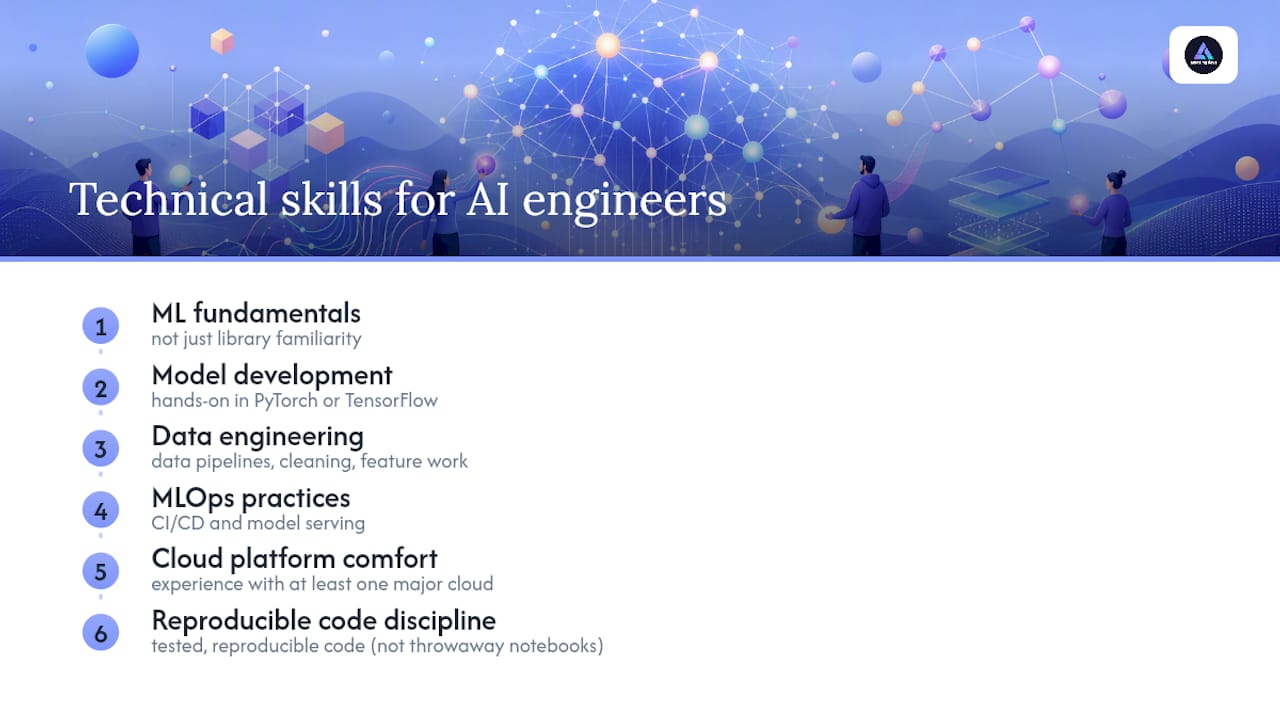
On the technical side, demand evidence across six buckets: ML fundamentals (not just library familiarity), hands-on model development in PyTorch or TensorFlow, data engineering competence, MLOps practices including CI/CD and model serving, comfort with at least one major cloud platform, and the discipline to write reproducible, tested code rather than notebook experiments that never leave a laptop.
On the soft-skill side, require product thinking (can they explain why a model choice serves the business, not just the metric), code review discipline, and clear asynchronous communication given time zone gaps. English proficiency should match the role: conversational is fine for an individual contributor, but a lead role needs someone who can present tradeoffs to a non-technical stakeholder without an interpreter in the room.
Map expectations by level. A junior candidate should show a completed capstone or bootcamp project with clean tests. A mid-level candidate should show one production deployment they owned end to end. A senior candidate should show a documented case where they caught a data drift issue before it hit production, not after.
Pro Tip: Ask every candidate to review a intentionally flawed pull request during the interview. How they phrase the feedback tells you more about team fit than any resume line.
How Do You Work Effectively With Brazilian Nearshore Engineers?
Small cultural adjustments prevent most of the friction that derails distributed AI teams in the first month.
Brazilian meetings commonly open with five to fifteen minutes of personal conversation before business starts, and skipping that ritual reads as cold rather than efficient. Build it into the agenda instead of treating it as wasted time.
Brazilian professionals often communicate in a high-context, relationship-oriented style, which means direct pushback on a bad idea may show up as a hesitant question rather than a flat “no.” Managers who create explicit space for clarifying questions catch these signals before they become missed deadlines.
Confirm the engineer’s city and state early. Brazil spans multiple time zones, and most hubs sit two to three hours ahead of US Pacific time, which usually leaves a workable overlap window for pair programming and live debugging.
Onboarding rituals worth adopting in week one:
- A virtual coffee chat with no agenda before the first sprint planning call.
- An on-camera kickoff so the team sees faces, not just usernames in Slack.
- A shared emoji or shorthand glossary to reduce tone misreads in async chat.
- Friday demo sessions and a standing 1:1 during the first two weeks of remote onboarding.
Pro Tip: If an engineer says “sim, mas” (yes, but) or hedges an answer, treat it as a flag to ask a direct follow-up question, not as agreement.
What Do Nearshore AI Engineers Typically Cost?
Three pricing models dominate nearshore AI hiring: hourly contract rates for short-term needs, monthly salaried placement through a partner for ongoing roles, and fixed-price pilots that let you test fit for two to four weeks before committing to either.
The biggest cost drivers are seniority and specialty. An MLOps specialist who can build a full monitoring and rollback pipeline commands a premium over a generalist model-prototyping engineer. Cloud access requirements, paid certifications, and statutory benefits (if the engineer becomes a local hire rather than a contractor) all add to the total cost.
Expect sourcing to shortlist in one to two weeks, vetting in under a week, and a pilot running two to four weeks before a full commitment. Machine learning engineer salary benchmarks are a useful starting point for budgeting, and Brazilian nearshore rates typically land well under US equivalents for comparable seniority, which is the core economic case for the model in the first place.
- Hourly/contract: best for short, defined-scope work.
- Monthly salaried via partner: best for ongoing team extension.
- Fixed-price pilot: best for de-risking a first hire before either commitment.
Assessment Templates You Can Use This Week
Structured assessments beat open-ended “tell me about a project” interviews because they let you compare candidates on identical criteria.
For live interviews, ask candidates to design a system for a specific constraint (say, a recommendation pipeline that must retrain weekly on a fixed compute budget) and walk through their reasoning out loud. Follow with a data validation question: given a dataset with a subtle label leak, how would they catch it before training?
For a take-home project, assign a small model prototyping task paired with a reproducible training pipeline (version-controlled data splits, a requirements file, a README a stranger could run) and require a rough cost estimate for running it at scale. This single exercise reveals technical skill, reproducibility discipline, and communication quality at once.
- Score on four axes: technical correctness, reproducibility, code quality, and communication clarity.
- Set a minimum threshold on each axis, not just an average, before extending a pilot invite.
- Weight MLOps tasks separately: check for CI/CD awareness, monitoring instincts, and whether they mention model rollback or data drift detection unprompted.
- A candidate who scores high on modeling but skips reproducibility is a maintenance risk.
- A candidate who scores high on communication but weak on technical depth may still fit a junior role with mentorship.
What Contract Terms Protect You When Hiring Nearshore?
Every nearshore AI engagement needs five non-negotiable contract elements: IP assignment naming the employer as sole owner of work product, explicit data-access rules covering what the engineer can see and for how long, a mutual nondisclosure clause, clear termination and trial-exit terms, and an SLA defining availability and delivery expectations.
Watch for these red flags before signing: opaque or bundled fee structures that hide the real hourly cost, a partner that refuses to share assessment artifacts or scorecards, no pilot option offered at all, and vague answers about whether the engineer is an employee or contractor under labor code and payroll obligations.
Confirm operationally who owns production credentials, who’s authorized to deploy, and what the handoff plan looks like once a pilot converts to a permanent placement.
Pro Tip: Ask directly: “If this doesn’t work out during the pilot, what’s the exit process?” A partner that hesitates on this answer is a partner to avoid.
How Amazing Devs Supports Nearshore AI Hiring
Amazing Devs handles the parts of nearshore hiring most engineering managers don’t have bandwidth for: sourcing Brazilian AI engineers, running technical and cultural fit assessments, managing contracts, and staying engaged after placement rather than disappearing once the invoice clears.
The process runs through role mapping to understand exactly what the role needs, curated candidate shortlists instead of a resume dump, structured technical assessments, trial or pilot management with clear acceptance criteria, and onboarding support that continues into the first weeks of the engagement.
Trust signals worth confirming with any partner, including Amazing Devs: trial periods before full commitment, verifiable reference checks, written SLAs, explicit IP assignment clauses, and proactive engineering oversight rather than a hands-off handoff. Amazing Devs builds these into every placement rather than treating them as optional add-ons.
- Sourcing focused specifically on ML, MLOps, and data engineering profiles.
- Cultural fit evaluation alongside technical scoring, not as an afterthought.
- Contract management that removes payroll and compliance friction for the hiring company.
- Ongoing support after placement, not just a one-time introduction.
A note from Amazing Devs
A vetted nearshore process, backed by real technical vetting and a genuine pilot period, removes most of the guesswork that makes AI hiring feel risky. If you want a shortlist of Brazilian AI engineers matched to your stack, request a pilot conversation and we’ll walk you through candidates this week.
Get Vetted AI Engineers Without the Six-Month Search
Posting a job listing and hoping the right AI engineer applies can take months, and most of that time gets spent filtering resumes that look strong on paper but fall apart in a technical screen. Amazing Devs cuts that timeline down by handling sourcing, technical vetting, and cultural fit assessment before a candidate ever reaches your calendar, so the people you interview have already cleared a real bar.
Every engagement includes a pilot option, so you work with the engineer on real tickets before committing to anything permanent, and contract management (IP clauses, payroll, compliance) is handled so your legal team isn’t drafting nearshore agreements from scratch. This fits teams that need an AI engineer in weeks, not a quarter, and want technical proof before a full offer rather than a resume and a hunch.
If you’re ready to see qualified candidates, start the process with Amazing Devs and request a shortlist this week.
Sources
- Brazilian Work Culture: A Guide for Global Teams
- 4 important things to understand about Brazilian business culture
- From Samba to Software: How Brazil’s Culture Builds Agile Dev Teams – Blog about the development bench
- Machine Learning Engineer Salary 2026 — AI & Deep Learning Pay
FAQ
How long does it take to hire an AI engineer through a nearshore partner?
Most engagements move from brief to pilot start within two to three weeks, with the pilot itself running an additional two to four weeks before a permanent decision.
What’s the difference between hiring nearshore and offshoring?
Nearshore hiring in Brazil typically offers closer time zone overlap for real-time collaboration, while offshore arrangements in distant time zones often rely more heavily on asynchronous handoffs.
Do I need a pilot period for every AI hire?
A pilot isn’t strictly required, but skipping it removes your best signal for whether a candidate’s modeling and MLOps skills hold up on real production tickets.
What should be in the contract for a nearshore AI engineer?
At minimum, the contract needs IP assignment, data-access rules, a nondisclosure clause, termination and trial-exit terms, and a written SLA covering availability and delivery.
Can Amazing Devs help with both technical vetting and contracts?
Yes. Amazing Devs manages sourcing, technical and cultural assessment, contract terms, and ongoing support after placement as part of one engagement.