AI-Native Development: What It Means for Engineering Teams
AI-native development means building software where AI is an embedded architectural and delivery-first element, not a bolt-on feature. That distinction changes the code, the pipeline, and the org chart around it. Once a model informs how a system routes decisions, retrieves context, and executes multi-step work, you can’t strip it out without breaking the product.
The immediate implication: if you’re planning a pilot, don’t treat this as “adding a chatbot.” It touches your architecture, your software development lifecycle (SDLC), and how your team is staffed and evaluated.
Here’s what to do this quarter if you’re weighing a pilot:
- Pick one workflow with clear success metrics (cycle time, defect rate, or throughput).
- Write a spec before touching code, and let it drive the AI-generated output.
- Stand up a basic evaluation harness before you ship anything to production.
- Staff a small, dedicated team rather than spreading the work across everyone’s 20% time.
Key Takeaways
AI-native development succeeds when specs drive AI output, evals run continuously in CI, and a dedicated team owns agent reliability from day one.
| Point | Details |
|---|---|
| Define AI-native precisely | The AI core must be non-removable from the architecture, not an add-on feature. |
| Rewrite specs before code | Spec-driven development keeps AI output aligned to actual business intent. |
| Build evals before scaling | Continuous evaluation in CI/CD catches model drift before users notice. |
| Expect real productivity gains | Documented cases show up to 6x commit throughput on spec-driven, agentic workflows. |
| Staff a focused pilot team | Amazing Devs provides vetted nearshore developers to staff a pilot without a lengthy hiring cycle. |
Table of Contents
- What Makes Software Truly AI-Native vs. AI-Enabled
- How Does the Software Development Lifecycle Change?
- Core Engineering Practices: Agents, RAG, and Guardrails
- What Roles and Skills Does an AI-Native Team Need?
- Choosing the Right Tooling and Architecture
- Benefits and Risks: Weighing ROI Against Technical Debt
- A 90-Day Roadmap for Piloting AI-Native Development
- How Amazing Devs Supports AI-Native Pilots
- Author Perspective: What Actually Trips Up Adoption
- Get Your AI-Native Pilot Staffed Faster
- Authoritative Resources for Deeper Study
- Sources
- FAQ
What Makes Software Truly AI-Native vs. AI-Enabled
AI-enabled software bolts a model onto an otherwise unchanged deterministic stack. AI-native software embeds AI in the architecture and lifecycle from day one, and the system’s core intelligence would collapse without it. That’s the core distinction between AI-native and AI-enabled systems and it’s a more useful test than any marketing label a vendor slaps on a product page.
Four signals tell you which side of the line a system actually sits on:
- The AI core is non-removable. Pull the model out, and the product doesn’t degrade gracefully. It stops functioning.
- Agents orchestrate multi-step work. Instead of a single prompt-response loop, a planner sequences tool calls, manages state, and hands off subtasks. IBM’s overview of agentic orchestration patterns describes this planner-and-executor structure well.
- Datasets and prompts are versioned like code. Context, retrieval sources, and model configs live in source control, not in a Slack thread someone remembers eventually.
- Outputs are evaluated continuously, not just tested once at launch.
A customer support tool that calls an LLM to draft canned replies is AI-enabled. A system that autonomously triages a ticket, pulls account history through retrieval, decides whether to escalate, and logs its own reasoning for audit is AI-native.
Pro Tip: Run this quick test on any system you’re evaluating: ask what happens if the model returns garbage for one hour. If the product just shows a stale fallback, it’s AI-enabled. If the whole workflow stalls, you’re looking at AI-native architecture, and it needs AI-native governance.
How Does the Software Development Lifecycle Change?
Every phase of the traditional SDLC gets rewritten when AI sits at the core instead of the edge. The requirements phase stops being a loose PRD and becomes a formal artifact the AI actually reads.
Spec-driven development (SDD) replaces informal requirements. Structured specifications become the shared source of truth, so AI-generated outputs stay grounded in actual business intent rather than the model’s best guess at what you meant, according to Microsoft’s work on spec-driven development. Vague tickets that used to work fine for a human engineer produce inconsistent, sometimes dangerous output from an agent.
Implementation shifts from writing code to reviewing it. Engineers spend less time typing syntax and more time judging whether an AI-generated pull request actually solves the right problem, matches the spec, and doesn’t quietly introduce a security gap.
Testing becomes evals-first. Traditional unit tests check for correctness against fixed inputs. Evals check for behavioral consistency across a distribution of inputs, catching drift before it reaches users.
The payoff for teams that get this right is real. A 2026 AWS internal case documented a team using spec-driven, agentic workflows that achieved roughly 6x higher commit throughput and compressed a 90-week project into 24 weeks. That’s not a marginal process tweak. That’s a different delivery model.
What changes in practice:
- Requirements docs become executable specs, not PDFs nobody reads.
- Code review expands to include reviewing agent reasoning traces.
- QA gains a new job: writing evals, not just test cases.
Core Engineering Practices: Agents, RAG, and Guardrails
Four practices separate teams that ship reliable AI-native software from teams that ship demos that fall apart under real traffic.
Agent design and orchestration. A one-shot prompt asks a model to do everything in a single pass. An agentic workflow breaks the task into steps, lets the model call tools, and checks its own work between steps. For anything beyond a simple lookup, agentic orchestration produces more reliable results because errors get caught mid-process instead of buried in a single long response.

Retrieval-augmented generation (RAG) and context engineering. Hallucinations mostly come from models answering without grounding. RAG retrieves relevant documents, records, or code before generation, cutting down on invented answers. Context engineering, which means deciding exactly what gets fed into the prompt window and in what order, matters as much as the retrieval mechanism itself.
Schema-constrained outputs and function calls. Free-text responses are hard to validate programmatically. Forcing a model to return structured JSON against a defined schema, or to call a specific function with typed arguments, makes downstream behavior predictable. This is the difference between a model that “usually” returns something parseable and one that reliably does.
Evals and guardrails wired into CI/CD. Treat model evaluation the way you treat test coverage: something that runs automatically on every change. OpenAI’s developer guidance on production AI applications puts agents, evals, RAG, and guardrails together as the baseline stack for anything shipping to real users, not optional extras.
Practical starting points for a team building this out:
- Log every agent decision with the reasoning trace attached, not just the final output.
- Set a hallucination rate threshold and block deploys that exceed it.
- Version your prompts and retrieval sources alongside your application code.
- Build a small “golden set” of test cases that represent your hardest edge cases, and run it on every model or prompt change.
Pro Tip: Don’t wait for a security incident to add guardrails. Build a rate limiter and an action allowlist for any agent that can call external tools or write to a database before you let it touch production data, not after.
What Roles and Skills Does an AI-Native Team Need?
The org chart for an AI-native pilot looks different from a standard feature team, and pretending otherwise is one of the fastest ways to stall adoption.
New or reshaped roles worth defining explicitly:
- Spec author: owns the structured requirements that drive agent behavior, closer to a technical product manager than a traditional business analyst.
- Agent owner: responsible for a specific agent’s reliability, prompt versions, and tool permissions.
- Evals engineer: builds and maintains the automated evaluation harness, a discipline that barely existed on most teams two years ago.
- ML infrastructure engineer: manages model serving, retrieval pipelines, and the compute budget that agentic workflows tend to consume faster than expected.
The skill shift matters as much as the titles. Engineers need to get comfortable validating probabilistic output instead of deterministic output, writing specs precise enough for a model to follow, and reading evaluation metrics the way they used to read stack traces.
For staffing, resist the urge to spread this thin across your existing team’s spare cycles. A dedicated pilot team, even a small one, moves faster and produces cleaner signal than a rotating cast of part-timers. Three staffing paths work in practice:
- Reassign a small internal team fully, pulling them off other roadmap work for the pilot’s duration.
- Bring in nearshore augmentation to fill specific gaps like evals engineering or agent orchestration without a lengthy hiring cycle.
- Blend the two: internal domain owners paired with augmented engineering capacity for the technical build.
Nearshore staffing works particularly well here because AI-native skills are new enough that internal hiring pipelines often lag behind what a pilot needs on a three-month timeline. A closer look at staffing model trade-offs is worth reading before committing to any single approach.
Choosing the Right Tooling and Architecture
Platform choice for AI-native work comes down to one trade-off: speed of prototyping versus depth of production control. No-code agent builders get a demo in front of stakeholders fast. Full-stack frameworks with real infrastructure control win once you need governance, custom integrations, and predictable cost at scale. Databricks makes this point directly: platform fit depends on whether you’re validating an idea or committing to sustained production value, and the two call for different tools.
A structured process spanning model strategy, prompt design, agent orchestration, and data preparation creates a repeatable path from idea to production, according to Databricks’ framework for AI app development. Skipping that structure means rebuilding infrastructure from scratch for every new use case, which is exactly what kills momentum after the first successful pilot.
Data governance deserves early attention, not a retrofit. Patterns worth evaluating:
- A lakehouse architecture with unified governance (Databricks’ Unity Catalog is one example) for teams that need consistent access control across structured and unstructured data.
- Managed Postgres patterns purpose-built for operational AI workloads, sometimes called a “Lakebase” approach, when you need transactional consistency alongside AI features.
- Vector databases or hybrid search layers when RAG quality depends on retrieval precision.
When evaluating any platform or framework, check four things before you commit: native agent support, checkpointing so long-running agent tasks survive failures, persistent memory across sessions, and integration depth with your existing data sources. A platform that scores well on demos but weak on checkpointing will fail you the first time a production agent runs for more than a few minutes.
Benefits and Risks: Weighing ROI Against Technical Debt
The productivity upside is documented, not theoretical. Gains like that come from a specific pattern: agents handling low-judgment, repetitive work while engineers spend more time on high-judgment decisions and get near-instant access to domain knowledge the agents have already captured in specs and context files.
That upside comes with a matching risk profile. SEI researchers caution that AI accelerates implementation speed but can also accelerate technical debt unless engineering principles are deliberately adapted for probabilistic, non-deterministic outputs. Speeding up bad architecture just gets you to a worse place faster.
The specific risks to plan for:
- Hallucination and factual drift in generated content or decisions, especially in RAG systems with weak retrieval quality.
- Model drift over time, where a system that passed evals at launch degrades silently as usage patterns shift.
- Runaway agents that loop, over-call external tools, or make irreversible actions without a human checkpoint.
Governance essentials that address all three: continuous evals wired into your deployment pipeline, live monitoring on production agent behavior, and a human-in-the-loop approval gate on any action with real-world consequences (financial transactions, customer communications, data deletion). None of this is optional once an agent touches production.
A 90-Day Roadmap for Piloting AI-Native Development
Most pilots fail from moving too fast to real code, not too slow. Here’s a sequence that front-loads the work that actually determines success.
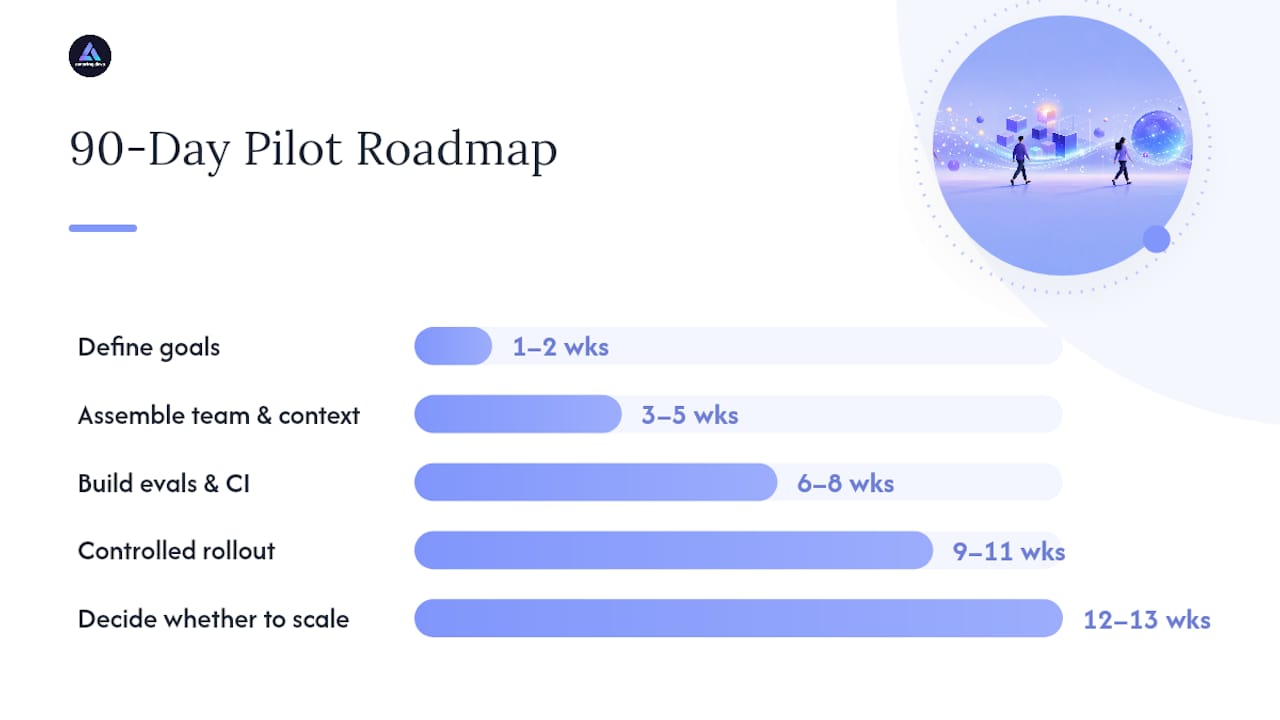
- Weeks 1 to 2: Define pilot goals and metrics. Pick one workflow. Set numeric targets for throughput, cycle time, and a quality threshold you won’t ship below.
- Weeks 3 to 5: Assemble the team and build agent context. This is the phase most teams skip, and it’s the one that matters most. Successful rollouts typically spend several weeks building steering files, spec templates, and monorepo layouts before writing a single line of production code.
- Weeks 6 to 8: Build the evals harness and wire it into CI. No pilot code ships without an automated check for behavioral regression.
- Weeks 9 to 11: Run a controlled rollout. Start with internal users or a small customer segment, watching your quality thresholds closely.
- Weeks 12 to 13: Decide whether to scale. Compare actual throughput and quality against your Week 1 targets, not against how impressive the demo looked.
The criteria for moving from pilot to production should be decided before the pilot starts, not argued about after it ends. If your evals pass consistently, your throughput gain holds under real load, and your team can operate the system without constant firefighting, you’re ready to expand scope.
Pro Tip: Resist scaling a pilot just because leadership is excited. If your evals harness only covers the happy path, expanding to more users just multiplies your blind spots faster than your team can find them.
How Amazing Devs Supports AI-Native Pilots
Standing up an AI-native pilot fast usually runs into the same wall: you need engineers who already understand agentic workflows and evals, and your normal hiring pipeline takes months you don’t have.
Amazing Devs sources vetted nearshore developers from Brazil, screened for technical skill and cultural fit before a client ever sees a resume, and handles the contracts and onboarding bureaucracy that otherwise slow a pilot down. That cultural-fit screening matters more than it sounds. Governance in an AI-native pilot depends on tight collaboration between spec authors and engineers, and a team that communicates smoothly from day one preserves that discipline instead of eroding it under deadline pressure.
Engagement patterns that fit most pilots:
- Staff a focused pilot team for the 90 day roadmap without a lengthy internal hiring cycle.
- Ramp from pilot staffing to a full nearshore team once you’ve validated the workflow.
- Keep ongoing engineering support in place for maintenance, evals upkeep, and the next pilot in your queue.
Details on how the AI-enabled staffing approach works are worth a look if you’re scoping team composition now.
Author Perspective: What Actually Trips Up Adoption
Small pilots don’t fail because the model is bad. They fail because nobody wrote a real spec, or the evals harness got skipped to hit a demo date. Both are cheap to fix early and expensive to fix after launch.
Watch for ownership gaps too. If nobody’s job is specifically to own agent reliability, it becomes nobody’s job when something breaks.
On timeline: expect meaningful throughput gains to show up around the 8 to 12 week mark, not week one. Measure cycle time and defect rate weekly, and don’t judge the pilot on vibes.
— Gabriel
Get Your AI-Native Pilot Staffed Faster
Building an evals harness and spec-driven workflow takes engineering hours you may not have sitting idle. Amazing Devs staffs vetted nearshore developers from Brazil who can join a pilot team quickly, with contracts and onboarding handled so your internal team stays focused on the spec and the architecture decisions that actually determine whether the pilot works.
The engagement model is built for exactly this kind of runway problem: you get engineers who understand agentic workflows and evaluation practices without a three-month hiring cycle eating into your 90-day roadmap. Whether you need a small dedicated team for the pilot phase or a ramp to full staffing once you’ve proven the workflow, the process starts with a conversation about what your pilot actually needs. Get started with Amazing Devs and scope your pilot staffing this week.
Authoritative Resources for Deeper Study
A handful of sources are worth bookmarking if you’re building out an AI-native practice beyond the pilot stage:
- The SEI’s research on AI-native software engineering principles for a rigorous take on adapting engineering discipline to probabilistic systems.
- AWS’s case study on agentic piloting and measured throughput gains for the clearest published numbers on real-world results.
- Databricks’ guide to AI app development for platform-level architecture decisions.
- OpenAI’s developer track on agents and evals for hands-on technical grounding.
Sources
- How frontier teams are reinventing AI-native development | AWS
- AI-Native Software Engineering: Enduring Principles, New Pace | SEI/CMU
- AI app development: Guide to building AI-powered apps | Databricks
- Spec-driven development | Microsoft Developer Blog
FAQ
What Is AI-Native Development?
AI-native development means AI sits inside the architecture and lifecycle of a system as a core, non-removable component, rather than being added as a feature on top of a conventional deterministic stack.
What Is a $900,000 AI Job?
Some highly specialized AI engineering and research roles at large tech companies have carried total compensation packages reported in that range, reflecting scarce expertise in areas like agent architecture and model infrastructure rather than a typical or standard AI engineering salary.
What Are Some Examples of AI-Native Development Platforms?
Databricks’ AI app development framework and agent orchestration tools referenced by OpenAI’s developer resources are examples of platforms built around agentic workflows, RAG, and evals rather than single-model integrations.
What Is Considered AI Native?
A system is generally considered AI-native when removing the AI component would break core functionality, when it uses agent orchestration for multi-step tasks, and when it treats datasets, prompts, and evaluations as versioned artifacts rather than afterthoughts.
How Long Does an AI-Native Pilot Take to Show Results?
A structured pilot following a spec-first, evals-first approach typically needs 8 to 12 weeks before throughput and quality metrics show a clear signal, based on the phased rollout pattern documented in real-world case studies.