Brazil vs Mexico Developers: Which to Hire in 2026
For most U.S. teams that need to scale engineering quickly, Brazil is the stronger first choice because of its much larger developer pool. Mexico wins on time-zone closeness and short travel, which matters for teams that need to sit in the same room or on the same minute of the clock. This guide compares the two on talent depth, cost, overlap, English, hiring setup and AI skills, so you can pick based on your own constraints.
TL;DR
- Brazil has about three times as many GitHub developers as Mexico, which means more choice per role and more depth in senior and specialized profiles.
- Mexico’s edge is geography: its working hours track U.S. hours closely. Brazil still overlaps most of a U.S. workday, especially with East Coast and Central teams.
- Employment setup differs: cross-border compliance for services in Mexico carries tax and registration duties, while a staffing partner can absorb the Brazilian contract work for you.
- Pick Mexico when real-time pairing and in-person visits drive the decision. Pick Brazil when talent depth, specialization and speed of team growth do.
Table of Contents
- The short answer: how the two countries compare
- Talent pool: why size matters when you hire
- Cost: what a U.S. company should expect
- Time zones and communication
- Hiring setup and compliance
- Speed: how fast can you scale?
- AI-enabled and AI-native engineers
- Perspective: why we start in Brazil
- How to decide: a simple checklist
- Build your Brazilian team with Amazing Devs
- FAQ
- Sources
The short answer: how the two countries compare
| Factor | Brazil | Mexico |
|---|---|---|
| Developer pool (GitHub, Q3 2025) | 7,099,749 | 2,426,573 |
| Time-zone fit for U.S. teams | Good for East and Central; shorter overlap with the West Coast | Very close to U.S. Central, near Mountain and Pacific hours |
| Language | Portuguese locally; English common among developers who work with international clients | Spanish locally; English common among developers who work with U.S. clients |
| Talent depth | Large market with deep senior, data and AI profiles | Solid market, smaller pool per specialty |
| Best for | Scaling fast, specialized roles, long-term dedicated teams | Tight real-time collaboration, frequent on-site visits |
The numbers behind the first row come from the GitHub Innovation Graph figures reported by Latinometrics: in Q3 2025 Brazil had 7,099,749 developers on GitHub and Mexico had 2,426,573. GitHub counts are not a census of professional engineers, but they are a useful relative measure of how large each country’s coding community is. Brazil’s is almost three times the size.
Talent pool: why size matters when you hire
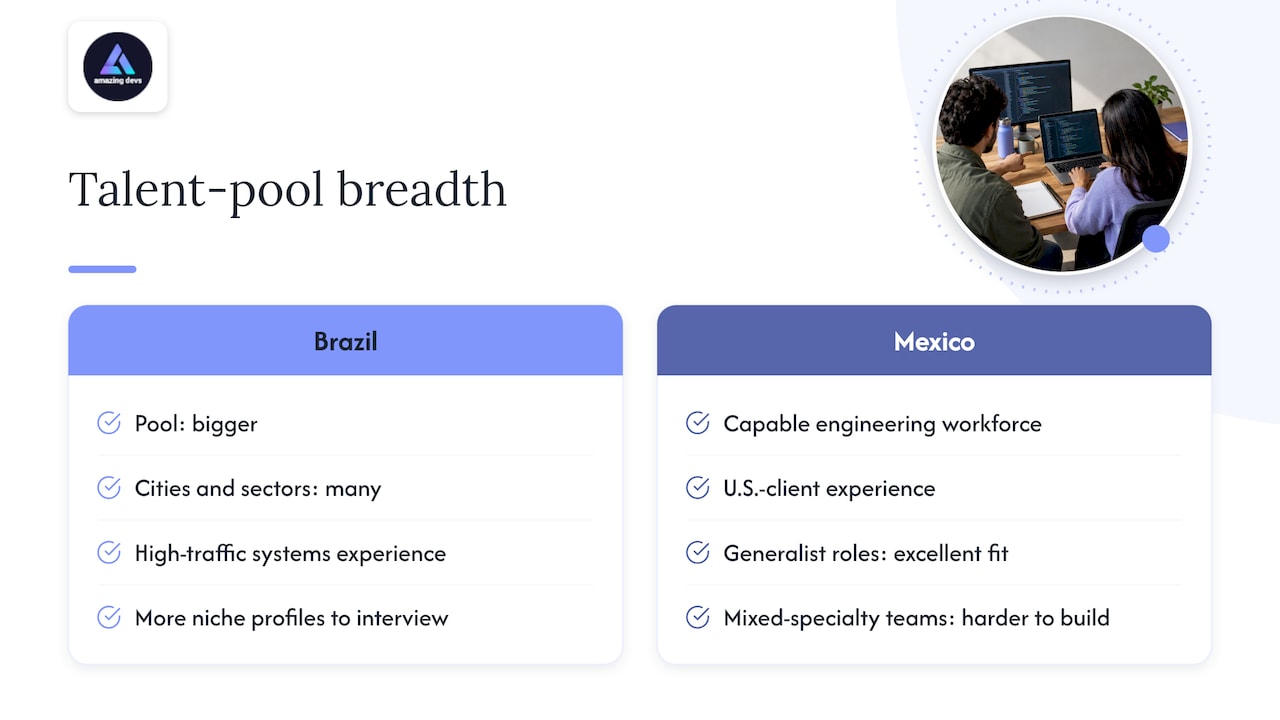
A bigger pool does not only mean more resumes. It means that when you need a senior backend engineer with payments experience, or a data engineer who has worked with streaming pipelines, the number of qualified people you can actually interview is higher. That shortens searches and lets you be pickier on technical and cultural fit.
Brazil’s pool is also spread across many cities and sectors. Fintech, e-commerce, logistics and marketplace companies have trained a generation of engineers on high-traffic systems. If your roadmap includes data work, our guide on hiring data engineers in Brazil goes deeper on why the market tends to move quickly.
Mexico has a capable engineering workforce too, with a lot of experience serving U.S. clients. For a handful of generalist roles it can be an excellent fit. The constraint appears when you want to build a team of eight or ten with a mix of seniority and specialties: a smaller base means longer searches for the rarer profiles.
Cost: what a U.S. company should expect
We will not hand you a single “Brazil is X% cheaper” number, because rates depend on seniority, stack, and whether you pay for a contractor, an employee through a partner, or a full agency team. What matters is the full cost, not the headline salary: benefits, taxes, equipment, management time and recruiting fees all change the picture.
For Brazil, our own budgeting guide, Plan $30,000–$78,000 for Brazil Developers, walks through how U.S. employers build an all-in annual budget, and Brazil Developer Rates breaks down what U.S. teams pay by level. Use those as the baseline, then ask any Mexico-based provider for the same all-in structure so you compare like for like.
A few rules for a fair comparison:
- Compare the same seniority and the same stack. A mid-level React developer is not a staff-level platform engineer.
- Compare the same engagement type: direct contractor, employer of record, or staffing partner placement.
- Include recruiting cost. Domestic recruiting can be heavy; our breakdown in $150,000–$220,000 to Recruit Developers shows how hiring overhead adds up before anyone writes code.
- Include management cost of overlap gaps, covered in the next section.
Time zones and communication
This is where Mexico has its clearest advantage. Mexico’s working day sits close to U.S. Central time, so stand-ups, pairing sessions and incident response happen without anyone shifting their schedule. A Mexico City developer and a Chicago manager are effectively in the same day.
Brazil is a little further east and does not follow the same daylight-saving pattern as the U.S., so the gap with a U.S. team changes through the year. For East Coast companies the difference is small, usually one to two hours. For Central and Mountain teams, you still get a solid block of shared hours in the middle of the day. West Coast teams have the shortest overlap and need a clearer plan for async work.
What works in practice:
- Fix a core overlap window, such as four hours, for meetings and pairing.
- Keep everything else asynchronous: written specs, recorded demos, pull request descriptions that explain the why.
- Run sprint ceremonies at the overlap and keep them short. Our notes on remote sprint planning for distributed teams cover a format that saves live time.
- Use a short list of rules for handoffs. Three time-zone management moves is a practical starting point.
On language, both countries have developers who work comfortably in English with U.S. clients, and in both cases you should test it rather than assume it. A 20-minute technical conversation in English as part of screening tells you more than any national ranking. The same goes for culture: Brazilian teams tend to be relationship-driven and collaborative, and what foreign managers need to know about Brazil work culture helps you set expectations early.
Hiring setup and compliance
The practical question for most U.S. companies is not salary but structure: who employs the developer, who pays them locally, and who carries the legal exposure?
On the Mexican side, the U.S. Commercial Service notes that digital services providers not based in Mexico must register with the tax authorities, designate a legal representative, collect and remit 16% VAT, and follow e-invoicing and withholding rules. That framing is about digital services, and your exact obligations depend on how the engagement is structured, so have counsel or your provider confirm the setup. The point for planning is that cross-border arrangements come with paperwork somebody must own.
The same is true in Brazil, where labor and tax rules are detailed. The sensible route for a team that does not want to open a local entity is to work through a partner that manages contracts and local bureaucracy. We explain how that works in how to hire Brazilian developers with no local entity, including a realistic timeline.
Whichever country you choose, ask any provider these questions:
- Who is the legal employer of the developer?
- Who handles payroll, benefits and local taxes?
- What happens to IP assignment and confidentiality?
- How do you replace a developer, and how fast?
- What is the minimum engagement length?
This is also a good moment to think about the relationship itself. Ideas like the ones in hire a partner, not a vendor apply to engineering teams as much as to design work: the best results come when the provider cares about your outcome, not just filling seats.
Speed: how fast can you scale?
Scaling speed comes down to pool size and process. A larger pool gives a staffing partner more pre-vetted candidates to present in the first week. In Brazil, we aim to move from kickoff to shortlisted candidates quickly because we work from a vetted bench of engineers and handle the contract work. Our guide on hiring Brazilian developers lays out a two-to-four-week path without a local entity.
In Mexico the same approach can work for a few roles, but expect searches for niche profiles to take longer when fewer candidates match. If you are hiring one or two developers for a U.S.-hours project, that difference may be small. If you are building a team of ten across front end, back end, data and QA, it adds up.
If your plan includes quality assurance, see our nearshore QA contractors, which let you add testing capacity without a full-time hiring cycle.
AI-enabled and AI-native engineers
AI-assisted development is now part of normal engineering work in Latin America. A Platzi survey reported by Latinometrics found that 53% of developers with five or more years of experience named Claude as their preferred AI coding tool, ahead of ChatGPT and Gemini. That tells you senior developers in the region are choosing tools deliberately, not just trying them.
A larger developer base means more people experimenting with these tools, and more candidates who have shipped production features with AI assistance. When you screen in either country, look for evidence rather than buzzwords:
- Ask how they review AI-generated code before merging.
- Ask for an example where an AI tool produced a wrong answer and how they caught it.
- Give a small task and let them use their normal tools; judge the result, the tests, and the explanation.
Our playbook for hiring AI engineers covers screening for this in more detail, and skills-based sourcing with responsible AI explains how we source without relying on keyword matching.
Perspective: why we start in Brazil
We built Amazing Devs around Brazil because most of our clients are not asking for the closest country. They are asking for the right engineer, quickly, without the hiring headaches.
When a U.S. company comes to us, the first thing we look at is the shape of the team they need. If they need a few specialists and depth in senior profiles, Brazil’s talent pool gives us room to be selective on both technical skill and cultural fit. That is the part of recruiting that decides whether a placement lasts.
Time zone is real, and we plan for it. Our clients agree on a core overlap window, move the rest of the work to async habits, and see far fewer surprises than they expected. The bigger risk in distributed hiring is not a one-hour gap. It is a poorly vetted hire and a contract nobody owns.
That is why we handle the contracts and local bureaucracy ourselves, and why our engineering team stays involved after placement. If Mexico is the better fit for your constraints, you will know after the criteria above. If your priority is depth, specialization and scaling, we think Brazil is where to look first.
Gabriel
How to decide: a simple checklist
Score each line from one to five for your project, then see which country wins.
- Real-time need. Do developers need to be available at the same minute as your team all day? Favors Mexico.
- Team size. Are you hiring more than four people, or specialized roles? Favors Brazil.
- Specialization. Data, AI, mobile or platform engineering with senior depth? Favors Brazil.
- On-site visits. Do you need frequent in-person workshops? Favors Mexico for travel convenience.
- Compliance appetite. Do you want a partner to manage contracts and local setup? Either, if the provider does it.
- Time to first hire. Need candidates this month? Choose the provider with a vetted bench in the country, not the country alone.
If you are weighing more than these two, our overview of nearshore countries for U.S. companies lists ten options, and we compare Brazil head to head with Argentina, India and Eastern Europe too.
Build your Brazilian team with Amazing Devs
Amazing Devs places pre-vetted Brazilian developers with U.S. companies. We assess technical skill and cultural fit, manage the contract and local paperwork, and support the engagement after the developer starts. You can add one engineer to an existing team or build a dedicated group through our nearshore staff augmentation service.
If you want to grow an in-house team with developers who work as part of it, the Team Extension Model is built for that. Tell us the roles, stack and overlap you need, and we will come back with a shortlist.
FAQ
Is Brazil or Mexico better for hiring software developers?
It depends on your priorities. Brazil has a developer community almost three times the size of Mexico’s by GitHub count, which helps with depth and specialization. Mexico has the advantage of working hours that closely match U.S. teams.
Is Brazil too far for U.S. time zones?
No, for most teams. Brazil overlaps a large part of the U.S. workday, especially for East Coast and Central companies. Set a core window for meetings and keep the rest asynchronous, and the gap rarely becomes a blocker.
Do I need a local entity to hire in Brazil or Mexico?
Not necessarily. Working through a staffing partner that manages contracts and local compliance lets you hire without opening an entity. We explain the process for Brazil in our guide on hiring Brazilian developers.
Do Brazilian and Mexican developers speak good English?
Many do, particularly those who have worked with international clients, but fluency varies by person. Test it with a short technical interview in English during screening rather than relying on country-level assumptions.
Sources
- 16 million LatAm developers now build on GitHub (Latinometrics)
- Mexico – Digital Economy (U.S. International Trade Administration)