If you need reliable CI/CD ownership fast, hire a CI/CD specialist, or a vetted nearshore CI/CD engineer, and screen them with a broken-pipeline task before you talk salary. Resumes packed with “CI/CD tools” like Jenkins or GitHub Actions tell you almost nothing about whether someone can actually diagnose a stuck deployment at 11 p.m. The screening gate matters more than the tool list.
Here’s the fast path:
- Define the role tightly (CI/CD engineer, platform engineer, SRE, or DevSecOps) before you post the job.
- Run every finalist through a hands-on broken-pipeline assessment, not a whiteboard algorithm test.
- Build a one-month impact project into onboarding so the hire proves value before day 30, not day 90.
Pro Tip: Skip the take-home quiz. A 60-minute live session where the candidate fixes a pipeline you broke on purpose tells you more than three rounds of behavioral interviews.
Key Takeaways
Hiring for CI/CD ownership works best when the role is defined precisely, screened with a hands-on broken-pipeline task, and paired with a measurable one-month project from day one.
| Point | Details |
|---|---|
| Pick the right role first | Match CI/CD engineer, platform engineer, SRE, or DevSecOps to whether the need is scoped or ongoing. |
| Test doing, not describing | Use a live broken-pipeline task and a real repo review instead of algorithmic interview questions. |
| Watch for passive incident stories | Candidates who can’t explain detection, mitigation, and post-mortem learnings in first person are a red flag. |
| Assign a project before day one | A defined one-month impact project with clear metrics reduces early attrition and speeds up measurable results. |
| Consider nearshore for speed | Amazing Devs vets CI/CD engineers for technical skill and cultural fit, cutting search time versus a full-time hire. |
Table of Contents
- What CI/CD Tools Expertise Actually Requires From a Hire
- How Do You Test CI/CD Skills Before You Hire?
- Contractor, Full-Time Hire, or Nearshore Augmentation?
- The First 90 Days: Turning a New CI/CD Hire Into Measurable Impact
- How Should You Structure CI/CD Interview Questions?
- Evaluating Cultural Fit and Collaboration for CI/CD Teams
- Keeping CI/CD Skills Current After the Hire
- Should CI/CD Hires Be Remote, Onsite, or Nearshore?
- What Conventional Hiring Advice Gets Wrong About CI/CD Roles
- Getting Vetted CI/CD Talent Without the Months-Long Search
- Sources
- FAQ
What CI/CD Tools Expertise Actually Requires From a Hire
“CI/CD tools” is shorthand people use loosely, but what you’re really hiring for is pipeline ownership: someone who can build, break, fix, and secure the automated path from commit to production. That distinction changes who you should be interviewing. A developer who lists Jenkins and CircleCI on a resume isn’t automatically qualified to own your deployment pipeline. Four distinct role profiles cover this work, and picking the wrong one is the single most common hiring mistake engineering leaders make.
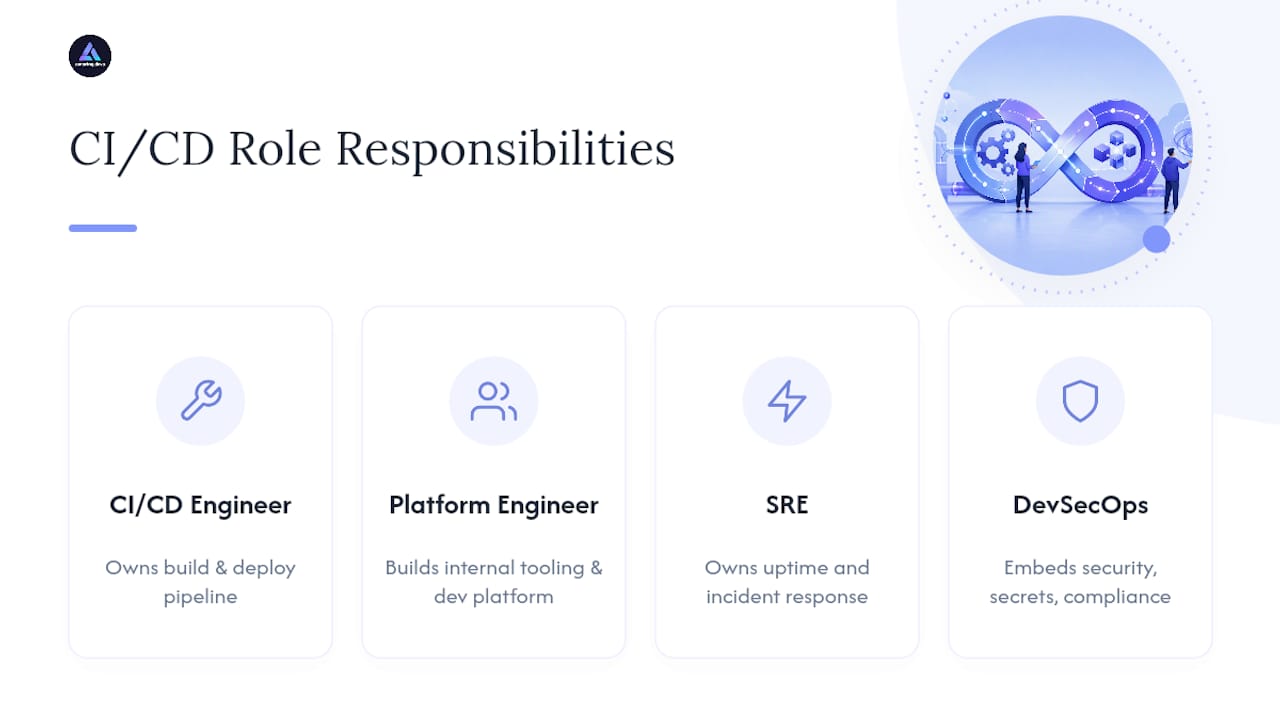
A CI/CD engineer owns the build and deployment pipeline itself: writing pipeline configs, managing artifact promotion, and keeping build times fast. A platform engineer goes broader, building the internal tooling and self-service infrastructure that multiple teams rely on, CI/CD included. A site reliability engineer (SRE) owns uptime and incident response, and treats the pipeline as one lever among many for hitting reliability targets. A DevSecOps engineer folds security scanning, secrets management, and compliance gates directly into the pipeline instead of bolting them on afterward.
Hire a focused CI/CD engineer when the problem is scoped: slow builds, flaky deployments, a migration between platforms. Hire for platform or SRE breadth when the need is ongoing and cross-team. A telltale signal in the job req itself: if you’re writing “fix our deploys,” you need a CI/CD engineer. If you’re writing “own our developer platform,” you need something bigger, and hiring benchmarks show platform and SRE roles take meaningfully longer to fill.
How Do You Test CI/CD Skills Before You Hire?
The best predictor of CI/CD job performance isn’t a certification or a tool checklist. It’s watching someone diagnose a broken pipeline in real time. Assessment research on DevOps hiring consistently points to hands-on, live environment tasks as the highest-signal format available, well above algorithmic coding tests that measure something else entirely.
Here’s a repeatable blueprint:
- Build a broken-pipeline scenario. Take a real pipeline config, introduce two or three realistic failures (a bad environment variable, a misconfigured test stage, a broken artifact path), and give the candidate 45 to 60 minutes to find and fix them while narrating their thinking.
- Add a live repo task for mid-to-senior candidates. Ask them to review an actual pull request touching your pipeline config and flag risks, or hand them a small Terraform module and ask what they’d change before merging.
- Score against a fixed rubric, not gut feel: pipeline design judgment, failure diagnosis speed, artifact promotion logic, rollback strategy, and whether they build security checks into the pipeline or treat it as an afterthought.
- Ask about a real incident and listen for structure: detection, mitigation, timeline, and what changed afterward. Candidates who describe outages in passive voice (“the service went down, it was fixed”) are a real warning sign; strong candidates walk you through what they personally did and learned.
Watch for three red flags specifically: resumes that list ten CI/CD tools with no depth on any of them, incident stories with no first-person action, and zero on-call experience. Tool familiarity is a weaker signal than demonstrated diagnosis ability, so verify the transferable skill first and confirm specific tool fluency second.
Pro Tip: Give the candidate the pipeline config a day in advance. You’re not testing memorization, you’re testing how they think under realistic conditions, and a little prep time makes the exercise closer to real work.
Contractor, Full-Time Hire, or Nearshore Augmentation?
The right hiring model depends on how urgent the problem is and how long you need the ownership to last. Contractors move fast but leave with the knowledge when the contract ends. Full-time hires build institutional memory but take months to source, especially for platform and SRE roles where hiring difficulty and salary bands run higher than for a scoped CI/CD engineer. Nearshore staff augmentation splits the difference: faster ramp than a full-time search, more continuity than a short-term contractor.
Rough expectations by model:
- Contractor: Fast start, often within two to three weeks. Good for a bounded migration or an urgent pipeline fire. Weak on long-term continuity; expect to rehire the knowledge later.
- Full-time hire: Strong retention potential, but a 60 to 90-day search is common for senior platform or SRE talent, and salary competition is steep.
- Nearshore augmentation: Typically faster to onboard than a full-time search, with lower overhead than a domestic contractor and better continuity since the engineer is embedded on your team, not rotating between clients.
Nearshore augmentation tends to make the most sense when you need CI/CD ownership now, your budget doesn’t support a six-figure platform hire, or you want to test the working relationship before committing to a permanent seat. It’s also the practical choice when your existing team already knows the roadmap and just needs another set of experienced hands executing it, rather than someone spending their first quarter learning your business from scratch.
The First 90 Days: Turning a New CI/CD Hire Into Measurable Impact
A new CI/CD hire who spends the first month reading documentation instead of shipping something visible is a retention risk. The fix is a bounded, measurable project assigned in week one, not week six.
- Days 1 to 30: Assign a specific, visible impact project early, paired with access to relevant pipeline logs and regular stakeholder feedback.
- Days 30 to 60: Expect a working runbook for the most common pipeline failures, at least one monitoring dashboard improvement, and a documented rollback procedure the rest of the team can use without them.
- Days 60 to 90: Look for the hire proposing pipeline changes proactively rather than just responding to tickets, and for measurable movement on deployment frequency or mean time to recovery (MTTR).
Track progress with numbers your team already watches: MTTR, build latency, and deployment frequency. Report movement on these three at each 30-day checkpoint instead of relying on subjective “how’s it going” check-ins.
Pro Tip: Assign the one-month project before the hire’s start date is even confirmed. Walking in on day one with a defined target beats a week of shadowing and Slack introductions.

How Should You Structure CI/CD Interview Questions?
Skip questions that reward memorized definitions. “What’s the difference between continuous delivery and continuous deployment?” tells you someone read a blog post. Better questions put the candidate inside a decision.
Ask them to walk through a specific, plausible scenario: “Our deploy pipeline just failed halfway through a rollout to production. Half the fleet is on the new version, half isn’t. What do you check first?” There’s no single right answer, but strong candidates immediately think about traffic routing, rollback mechanics, and blast radius, not just “check the logs.”
Follow up with a design question rather than a definition question: “How would you structure a pipeline for a team shipping five times a day versus a team shipping weekly?” This surfaces whether the candidate understands that progressive delivery techniques like canary releases and feature flags exist to decouple deployment from release risk, which matters far more at high shipping velocity.
Round out the interview with a security question that isn’t a trick: “Where would you put a vulnerability scan in a pipeline, and what would make you block a deploy versus just warn on it?” The answer reveals whether they treat security as integrated or bolted on. And always ask one question you already know the answer to, from their resume or portfolio, so you can gauge how honestly they describe their own limitations.
Evaluating Cultural Fit and Collaboration for CI/CD Teams
CI/CD work touches nearly every other engineering team, which makes collaboration skills as important as technical depth. A brilliant pipeline architect who won’t document decisions or explain tradeoffs to non-DevOps engineers creates a bottleneck, not a solution.
Test this directly in the interview process rather than assuming it. Ask the candidate to explain a pipeline decision to you as if you were a backend engineer with no DevOps background. Watch whether they simplify without condescending, or whether they retreat into jargon. Ask how they’ve handled disagreement with a developer who wanted to skip a pipeline gate under deadline pressure, since that scenario happens constantly and reveals whether they can hold a line diplomatically or just say no.
Best-in-class CI/CD hires treat developer experience as a product they’re building for internal customers, not a set of rules to enforce. That mindset shows up in how they talk about past work: do they describe pipelines they made faster and more predictable for other engineers, or just systems they configured and walked away from? The strongest hires want their pipelines boring and repeatable, because boring means nobody’s paged at 2 a.m.
Keeping CI/CD Skills Current After the Hire
CI/CD tooling and best practices shift quickly enough that a hire’s skills six months in should look different from their skills on day one. Build that expectation into the role from the start instead of treating training as an afterthought.
Set aside dedicated time, even a few hours every two weeks, for the engineer to experiment with new pipeline patterns or evaluate a tool the team is considering. Pipelines that rely on configuration-as-code and strong test feedback loops benefit from someone who stays current on flaky-test detection and observability practices, since those areas evolve fastest.
Pair newer hires with your most experienced pipeline owner for structured knowledge transfer, not just ad hoc questions in Slack. Rotate ownership of specific pipeline components periodically so no single engineer becomes an unreplaceable bottleneck. And treat post-incident reviews as a learning tool for the whole team, not a blame exercise for whoever was on call. Teams that document what broke and why build institutional knowledge that outlasts any one hire’s tenure.
Should CI/CD Hires Be Remote, Onsite, or Nearshore?
CI/CD work is unusually well suited to remote and distributed setups, because the job is fundamentally about code, configuration, and logs, not physical presence near a data center or office. Most of the tooling, monitoring, and communication happens through the same dashboards and chat tools regardless of where the engineer sits.
The real variable isn’t remote versus onsite, it’s overlap hours and communication discipline. A fully onsite team gets easy hallway conversations but pays for it in real estate and a smaller talent pool. A fully remote, asynchronous setup scales talent access but demands rigorous documentation, since a pipeline decision made in a five-minute call and never written down becomes a mystery to the next engineer who touches it.
Nearshore hiring, particularly from a similar time zone, tends to land in the strongest spot on this spectrum: enough overlap for real-time incident response and pairing sessions, without the cost structure of a fully onsite domestic team. If your CI/CD hire needs to jump on a call during a production incident and actually be useful in that moment, time zone overlap matters more than physical location.
What Conventional Hiring Advice Gets Wrong About CI/CD Roles
Most hiring guides for CI/CD roles are really tool-comparison articles wearing a hiring hat. They tell you to look for Jenkins experience or GitHub Actions familiarity, as if fluency with a specific interface is the hard part. It isn’t. The hard part is judgment under ambiguity: knowing which pipeline failure to fix first, when to roll back instead of pushing forward, and how to explain a deployment risk to a product manager who just wants the feature shipped.
The evidence backs a different priority order than most job posts imply. Diagnostic reasoning predicts performance better than tool-name recognition, and passive-voice incident stories predict failure better than any resume gap. If your screening process still leans on take-home algorithm puzzles or a checklist of tool names, you’re filtering for the wrong thing and probably losing strong candidates who don’t test well on abstract problems but are excellent at the concrete, messy work of pipeline ownership.
The other undersold point: onboarding is part of hiring, not something that happens after it. A hire who spends their first month without a defined project is a hire you’re quietly setting up to leave. Fix the assessment, fix the first 30 days, and the role naming and tool stack become secondary decisions.
Getting Vetted CI/CD Talent Without the Months-Long Search
Amazing Devs is the faster route to CI/CD ownership when a full-time search would take too long and a short-term contractor won’t build the continuity your pipelines need. Every engineer goes through technical assessment and a cultural fit review before ever reaching your team, so you’re not running the broken-pipeline test yourself on candidate after candidate.
What sets a nearshore partner apart isn’t just the talent pool, it’s what happens around the placement: how contracts are structured, how handovers work if a project scope shifts, and whether there’s actual engineering support behind the placement instead of a recruiter who disappears after the signature. Amazing Devs manages the contract and bureaucratic overhead directly, and its engineering team stays involved proactively rather than waiting for a support ticket. That matters most in the early weeks, when a CI/CD hire is still learning your pipeline quirks and a fast answer from someone who understands the stack can save days.
When you’re weighing a partner against building the search yourself, the real question is speed-to-impact versus long-term headcount control. If you need someone running your one-month impact project within weeks, not months, start with Amazing Devs and see what a vetted CI/CD engineer looks like on your team before committing to a full-time search.
Sources
These sources back the specific recommendations in this guide, from assessment design to role definitions and pipeline practices worth screening for.
- DevOps Engineer Assessment Guide: Real-World Skills Testing – TrueAbility
- CI/CD best practices and progressive delivery – LaunchDarkly
- Best Practices for Successful CI/CD | TeamCity CI/CD Guide
FAQ
What Role Should I Hire First for CI/CD Ownership?
Start with a focused CI/CD engineer if the problem is scoped, like slow builds or unreliable deployments. Hire for platform engineering or SRE breadth only if the need spans multiple teams on an ongoing basis.
What’s the Best Way to Test CI/CD Skills in an Interview?
Use a hands-on broken-pipeline task where the candidate diagnoses and fixes real failures under time pressure, since this predicts job performance far better than algorithmic coding tests.
How Long Does It Take to Onboard a CI/CD Hire?
Expect a defined impact project in the first 30 days, working runbooks and monitoring improvements by day 60, and proactive pipeline improvements by day 90.
Is Nearshore Staffing a Good Fit for CI/CD Roles?
Yes, because the work is code and configuration based rather than location dependent. Amazing Devs specifically vets nearshore engineers for both technical skill and cultural fit before placement, which shortens the path to a productive hire.
What Are the Biggest Red Flags When Screening CI/CD Candidates?
Watch for resumes that list many tools with no depth, incident stories told in passive voice with no personal action described, and no on-call experience at all.