Turn Code Review Tools Into Reviewer Capacity for US Engineering Managers
When engineering leaders search for “code review tools” today, most of what they need isn’t software. The real bottleneck is finding qualified humans who can review pull requests fast, in your time zone, without a six-month hiring cycle. The most reliable answer is hiring vetted nearshore Brazilian developers through a managed partner like Amazing Devs, who can start reviewing PRs within days and overlap most of your working hours.
TL;DR:
- Nearshore Brazilian developers can review pull requests within the same day due to their minimal time zone gap with the US, enabling faster feedback loops.
- Hiring senior reviewers from Brazil costs less than onshore hires and offers access to experienced engineers familiar with distributed team workflows.
- Implementing a structured onboarding process, including clear style guides and daily overlap hours, is crucial for a successful first 90 days and maintaining review quality.
- Automated tools handle mechanical checks, but complex design, architecture, and maintainability issues require experienced human reviewers with strong communication skills.
- Conducting a 30-day pilot review with real PRs helps validate candidate fit, assess review speed, and avoid long-term hiring pitfalls.
Table of Contents
- What Do “Code Review Tools” Actually Mean for Hiring Managers?
- Why Hire Nearshore Brazilian Developers for Human Code Reviews?
- How Do You Evaluate a Nearshore Code Reviewer Before Hiring?
- What Do Engagement Models and Pricing Look Like?
- How Do You Onboard a Nearshore Reviewer So They’re Productive Fast?
- How Do Automated Code Scanning Tools Fit Alongside Human Reviewers?
- How Do Reviewers Fit into Your Existing Development Environment?
- What Security and Compliance Standards Matter for Code Review?
- What Does It Cost to Staff Reviewer Capacity Long Term?
- What Does Effective Nearshore Code Review Actually Look Like in Practice?
- The Real Reason Most Teams Get Nearshore Code Review Wrong
- How Amazing Devs Delivers Vetted Reviewer Capacity Fast
- Sources
- FAQ
What Do “Code Review Tools” Actually Mean for Hiring Managers?
For a hiring manager trying to close a review bottleneck, “code review tools” really means reviewer capacity: engineers who read diffs, catch design flaws, and give feedback fast enough that a pull request doesn’t sit for three days. Linters and static analyzers catch syntax problems and obvious bugs, but they can’t tell you whether a service boundary makes sense or whether a caching strategy will fall over at scale. That judgment call requires an experienced human reviewer looking at the actual business logic.
Nearshore Brazilian developers fill that gap without the six-to-nine-month timeline of a traditional US or European senior hire. The pitch isn’t “better tooling.” It’s “reviewer capacity you can actually staff this quarter,” sourced from a labor market with real depth in mid-level and senior backend, frontend, and DevOps talent.
Why Hire Nearshore Brazilian Developers for Human Code Reviews?
The case for nearshore reviewers comes down to three things: overlap, depth, and cost efficiency.
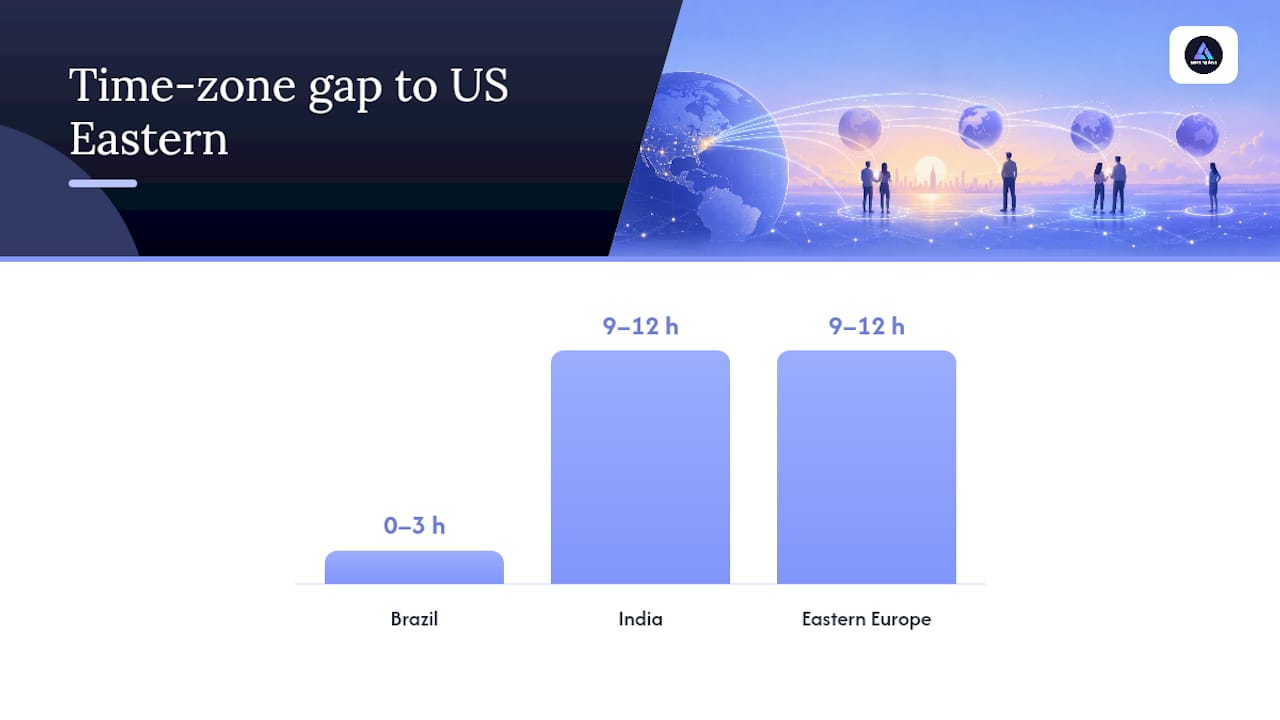
Brazil sits between UTC−2 and UTC−5, putting most of the country zero to three hours off US Eastern Time, according to time zone data from Aventura do Brasil. That’s a real advantage over reviewers in India or Eastern Europe, where a nine-to-twelve-hour gap turns every review cycle into an overnight wait. A Brazilian reviewer can look at a PR you opened at 2 p.m. and respond before your own team logs off.
Brazil also ranks in the top five countries globally on the Kearney Global Services Location Index, reflecting a talent pool deep enough to find reviewers with real seniority in your specific stack, not just generalists. And because most of the country doesn’t observe daylight saving time changes the way the US does, your standup schedule stays stable year round.
What you get in practice:
- Same-day PR turnaround instead of next-morning delays
- Access to senior engineers who’ve worked distributed teams before
- Lower fully-loaded cost than an equivalent onshore senior hire
- Direct, candid feedback on architecture and design, not just style nits
- Reviewers who catch maintainability problems automated scanners routinely miss
Pro Tip: Don’t just ask a candidate to describe their review philosophy. Send them a real PR from your codebase (redacted if needed) and ask for written comments. The quality of that feedback tells you more than any interview answer.
Brazilian engineering culture tends to reward proactive ownership and directness, according to research from HKTDC. Reviewers frequently push back on unclear requirements or flag tradeoffs before you ask. Hiring managers unused to that directness sometimes mistake it for friction. It’s usually the opposite: an engineer who cares enough to say something.
How Do You Evaluate a Nearshore Code Reviewer Before Hiring?
Skip the generic technical interview. A reviewer’s job isn’t writing algorithms from scratch, it’s reading someone else’s code critically and communicating what’s wrong in a way that doesn’t kill morale or slow the team down. Screen for that specific skill set directly.
- Ask for real PR examples. Have candidates walk you through three pull requests they’ve reviewed, including ones where they pushed back on the author.
- Check commit and PR hygiene. Small, atomic commits and PRs under a few hundred lines signal discipline; sprawling, unreviewable diffs signal the opposite.
- Run a micro-review exercise. Give the candidate a real PR (with a couple of planted issues) and 30 minutes to comment. Look for both technical catches and tone.
- Evaluate written communication samples. Slack threads, PR comments, and async status updates predict long-term collaboration success better than a live coding round, according to Sunbytes.
- Ask about testing discipline. A reviewer who can’t articulate what “adequate test coverage” means for your stack will let regressions through.
- Probe security habits. Do they flag hardcoded secrets, missing input validation, and overly broad permissions without being prompted?
Watch for red flags: candidates who describe reviewing 2,000-line PRs as normal, who can’t point to a specific time they blocked a merge, or whose feedback in the micro-review exercise stays vague (“looks good, maybe check the logic”) instead of specific.
Pro Tip: Treat the micro-review exercise as a two-way interview. A good reviewer will ask you clarifying questions about your codebase’s conventions before commenting, the same way they would on the job.
What Do Engagement Models and Pricing Look Like?
Three engagement shapes cover most hiring scenarios. A fractional reviewer works a set number of hours weekly across your PR queue, ideal for teams that need coverage but not a full seat. A dedicated full-time reviewer embeds in one team, joins standups, and owns review SLAs. A managed review pod gives you two or three reviewers plus a lead, useful when you’re scaling multiple teams at once.
Pricing depends on seniority, dedication level, and whether you go through a vendor-managed partner or hire direct contractors. Vendor-managed engagements typically run higher per hour than a raw contractor rate, but they absorb recruiting, payroll, and compliance overhead you’d otherwise carry yourself. GemmWork’s Brazil hiring guide lays out representative all-in cost bands and Employer of Record (EOR) fee structures that shape realistic budgeting.
Before signing anything, insist on:
- IP assignment language confirming code and review artifacts belong to your company
- A signed NDA covering codebase and business logic access
- An EOR arrangement rather than a loose contractor setup, since GemmWork notes this meaningfully reduces permanent-establishment and employment-liability risk
- A written SLA on review turnaround time, not just a verbal commitment
Skipping the EOR question is the most common mistake here. A contractor relationship that looks cheaper on paper can create real legal exposure if Brazilian labor authorities determine the working relationship functions like employment.
How Do You Onboard a Nearshore Reviewer So They’re Productive Fast?
Backlog happens when a new reviewer sits idle waiting for access or context. Structure the first 90 days deliberately.
- Days 1 to 7: Grant repo access, share your style guide, and walk through your CI/CD gates and test expectations together.
- Days 7 to 30: Set a fixed daily overlap window, ideally three to five hours, and hold a short daily PR triage where open reviews get assigned and prioritized, a rhythm Sunbytes recommends for nearshore teams.
- Days 30 to 60: Introduce pairing sessions for complex or architecture-heavy PRs, and start tracking review cycle time as a real metric.
- Days 60 to 90: Enforce hard PR hygiene rules, capped PR size, a commit message standard, and a required test checklist tied to CI gates, then review whether defects are being caught in review or slipping to production.
Track three numbers: PR cycle time (open to merge), SLA adherence (percentage of PRs reviewed within your target window), and defect leakage (bugs found in review versus after release). Teams that skip measurement almost always discover the backlog problem only after it’s already hurt a release. One useful early move: start with a single pilot reviewer for 30 days before committing to a full pod, so you validate fit with real data before scaling spend.
How Do Automated Code Scanning Tools Fit Alongside Human Reviewers?
Automated scanners still have a job. Tools in categories like static analysis (catching syntax errors and code smells), linting (enforcing style consistency), and dependency scanning (flagging vulnerable packages) run on every commit and catch the mechanical stuff before a human ever opens the PR. That’s valuable, but it’s also where their usefulness stops.
What automated platforms consistently miss: whether a new service actually fits your existing architecture, whether an abstraction will hold up under six more months of feature requests, and whether a “clever” solution is actually just hard to maintain. Those questions require a reviewer who understands your product and your team’s history with the codebase, not a rules engine matching patterns against a ruleset.
The practical approach most engineering teams land on: let automated scanning handle the mechanical gate (does it compile, does it pass linting, are there known vulnerable dependencies), and route everything else to a human reviewer who can reason about design intent. Treating automated scanning as a replacement for a second set of experienced eyes is how architectural debt piles up quietly for a year before someone notices the product can’t scale.
How Do Reviewers Fit into Your Existing Development Environment?
A nearshore reviewer needs to work inside the tools your team already uses, not a separate workflow bolted on the side. That means direct access to your version control platform, whether that’s GitHub, GitLab, or Bitbucket, with permissions scoped to review and comment rather than broad admin rights.
Reviewers also need visibility into your CI/CD pipeline output. If a PR fails a build or a test suite, the reviewer should see that status inline before spending time on a manual read-through of code that isn’t even passing automated checks yet. Most modern pipelines surface this automatically inside the pull request view, so onboarding mainly means granting access and confirming the reviewer understands what each pipeline stage checks.
The integration point that gets overlooked most often is your ticketing system. A reviewer who can see the original ticket or spec alongside the diff catches scope creep and missed requirements far more often than one working from the code alone. If your team uses Jira, Linear, or a similar tracker, link tickets in PR descriptions as a standing rule, not an occasional nice-to-have.
For teams working across multiple repos or services, standardize how reviewers get environment access, staging credentials, and documentation links so a new reviewer isn’t blocked on day one waiting for someone to remember where things live. This is exactly where a structured nearshore staff augmentation engagement pays off. Access provisioning becomes a checklist item handled during onboarding, not an afterthought discovered mid-sprint.
What Security and Compliance Standards Matter for Code Review?
Reviewers touch sensitive code, which means access control and confidentiality terms matter as much as technical skill. Any nearshore engagement should specify exactly what repositories, environments, and credentials a reviewer can access, scoped to the minimum needed for their actual review responsibilities.
For teams in regulated industries, the compliance bar is higher. Software tied to medical devices or health data, for instance, often needs to meet design control standards like 21 CFR 820.30 and IEC 62304, which require documented traceability between requirements, code changes, and testing. A reviewer working on that kind of codebase needs to understand why a change log entry or a specific test case exists, not just whether the code compiles.
Data handling terms belong in the contract, not left to assumption. That includes where code and review artifacts are stored, whether reviewers can access production data during debugging, and how access gets revoked when an engagement ends. An NDA covering codebase and business logic access is table stakes, but it should be paired with a clear offboarding process that immediately pulls repo and system access the day a contract ends.
Security hygiene should also show up in the review process itself. A strong reviewer flags hardcoded credentials, overly permissive access scopes, and missing input validation as a matter of habit, not because a scanning tool told them to. That’s one more reason the screening checklist earlier in this article matters: security awareness is a skill you assess during hiring, not something you bolt on afterward.
What Does It Cost to Staff Reviewer Capacity Long Term?
Total cost of ownership for reviewer capacity has more moving parts than a simple hourly rate. Beyond the reviewer’s pay, factor in onboarding time, any EOR or payroll administration fees, and the cost of a slower ramp if you skip a structured evaluation process and end up replacing a poor-fit hire.
Fractional engagements scale cost with actual usage, useful when PR volume fluctuates seasonally or across sprints. Dedicated full-time reviewers cost more per month but eliminate the coordination overhead of scheduling fractional hours across multiple contributors. Managed review pods sit at the higher end of the spectrum, but they include a built-in lead who handles quality control and continuity if one reviewer is out sick or on leave, something a single fractional hire can’t offer.
The hidden cost most hiring managers underweight is churn. Replacing a reviewer who leaves after two months, re-onboarding a new one, and absorbing the review backlog that piles up in between often costs more than the difference between engagement models. This is where working through a managed partner instead of direct contractor hiring tends to pay for itself: GemmWork’s cost guide shows all-in Brazil hiring bands running meaningfully below equivalent onshore senior hires, even after EOR fees, and a managed relationship typically includes replacement support if a reviewer doesn’t work out.
What Does Effective Nearshore Code Review Actually Look Like in Practice?
Consider a mid-sized SaaS company running a small platform team that couldn’t keep up with a growing PR queue. Every merge sat for two to three days waiting on a senior engineer who was also shipping features. That’s a common pattern, and it’s exactly the gap nearshore reviewers are built to close.
A team in that position typically adds one dedicated Brazilian reviewer with backend seniority matching their stack, sets a four-hour daily overlap window, and runs a 30-day pilot before committing further. Within the first month, PR cycle time drops because reviews happen same-day instead of queuing overnight. The reviewer’s written feedback, delivered directly in PR comments, starts catching architectural concerns the automated linter never flagged, like a service boundary that would have caused problems at higher scale.
The pattern that separates a successful pilot from a stalled one usually comes down to onboarding discipline: clear repo access from day one, a documented style guide, and a fixed daily sync slot rather than ad hoc scheduling. Teams that skip that structure often blame “the nearshore model” when the real issue was a rushed, undocumented handoff. Teams that follow the 30/60/90 rhythm described earlier tend to see the reviewer functioning as a full team member well before the three-month mark.
The Real Reason Most Teams Get Nearshore Code Review Wrong
Most engineering leaders treat hiring a nearshore reviewer like hiring a cheaper version of a local engineer. That framing sets the wrong expectations from day one. A nearshore reviewer isn’t a discount hire, they’re a different kind of hire, one whose value depends entirely on how well you set up overlap, communication norms, and PR hygiene before they ever open your codebase.
The teams that get burned almost always skipped the same step: they never tested written communication before hiring. A candidate can ace a live coding round and still write PR comments that are vague, overly polite to the point of uselessness, or so blunt they read as dismissive in a text-only channel. Written feedback is the actual product of a code review engagement, and yet most interview processes barely test for it.
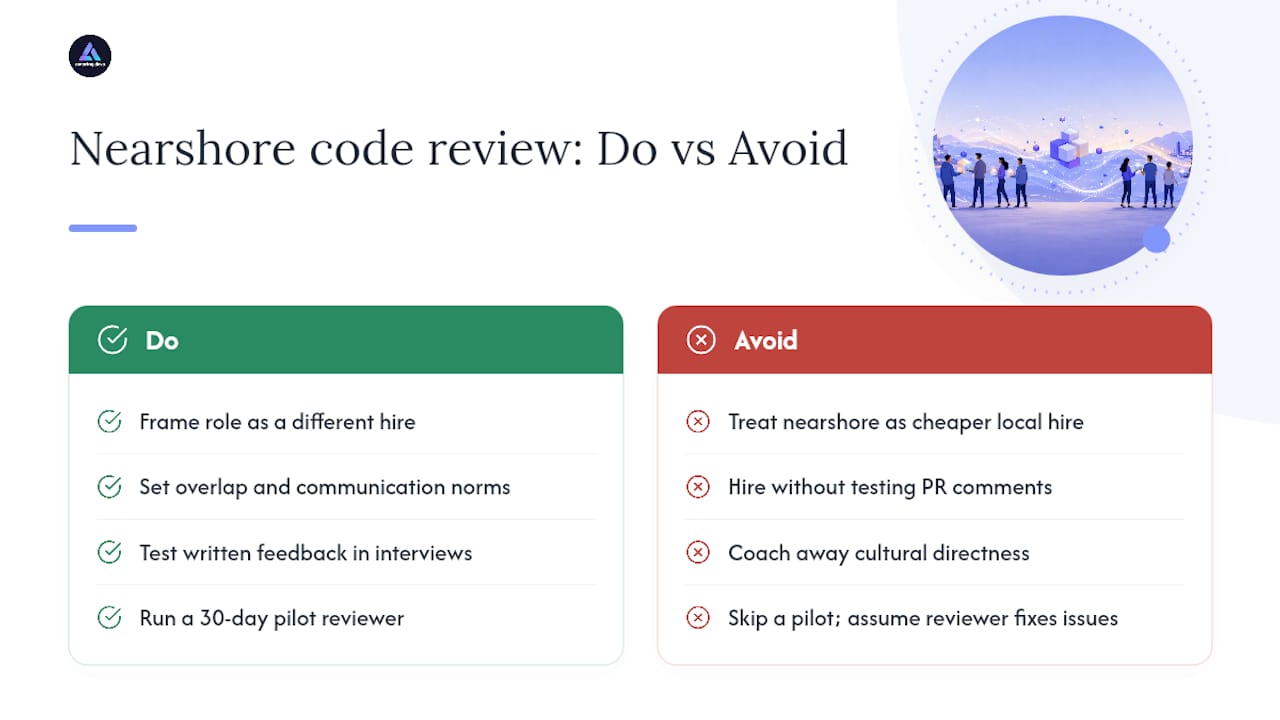
The other mistake is treating cultural directness as a problem to manage rather than an asset to use. Brazilian engineers who push back on unclear requirements or flag a risky architectural decision aren’t being difficult, they’re doing the job you hired them for. Hiring managers who read that as friction and coach it out of their reviewers end up with polite, unhelpful feedback instead of the candid catches that actually improve code quality.
If there’s one contrarian take worth sitting with: the “start small” advice about running a 30-day pilot reviewer isn’t just a risk-reduction tactic, it’s the fastest way to discover whether your own team’s PR habits are the actual bottleneck. Plenty of engineering teams find out their real problem was oversized PRs and missing tests long before the reviewer ever gets involved.
— Gabriel
How Amazing Devs Delivers Vetted Reviewer Capacity Fast
A managed partner runs a rigorous recruitment and assessment process built specifically to surface Brazilian developers who can review code well, not just write it. That means technical screening on your actual stack, evaluation of written communication quality, and a cultural fit check so reviewers integrate into your existing workflow instead of working around it. The managed partner also handles contract terms, payroll, and EOR logistics, so you’re not left untangling Brazilian labor law on your own.
If you’re weighing a fractional reviewer, a dedicated hire, or a full review pod, the fastest way to find out what fits is to request candidate profiles and see the caliber of engineer available at each level. Start with a 30-day pilot reviewer to validate overlap and output before committing to anything larger. You can review the full nearshore staff augmentation model breakdown or head straight to Amazing Devs to schedule a scoping call and get matched candidate profiles this week.
Sources
The time zone and overlap claims in this article come from Aventura do Brasil’s time zone data, which confirms Brazil’s zero-to-three-hour gap with US Eastern Time. Market and talent-depth context draws on Sunbytes’ Brazilian developer hiring guide, which cites Brazil’s ranking on the Kearney Global Services Location Index. Pricing bands and legal risk guidance come from GemmWork’s Brazil hiring and EOR guide, and cultural context comes from HKTDC’s research on Brazilian developer culture.
- Time zone difference Brazil — Aventura do Brasil
- Hiring Engineers from Brazil: Cost, PE Risk & EOR Guide (2026) | GemmWork
- HKTDC research on Brazilian developer culture
FAQ
How Fast Can a Nearshore Brazilian Reviewer Start?
Most vetted candidates can begin reviewing PRs within one to two weeks of a signed engagement, assuming repo access and onboarding materials are ready on your end.
How Many Overlap Hours Should I Plan for With Brazilian Developers?
Plan for a daily overlap window that allows consistent real-time collaboration, since most of Brazil sits zero to three hours off US Eastern Time and doesn’t observe the same daylight saving shifts.
Can Automated Code Scanners Replace Human Code Review?
No. Automated scanners catch syntax errors, style violations, and known vulnerabilities, but they can’t evaluate architecture, design tradeoffs, or long-term maintainability the way an experienced human reviewer can.
How Do I Measure Whether a Nearshore Reviewer Is Working Out?
Track PR cycle time, SLA adherence on review turnaround, and whether defects are caught during review versus discovered after release; a 30-day pilot reviewer is the fastest way to gather that data before scaling.