CoderPad vs HackerRank: Which Fits Your Hiring in 2026?
Pick CoderPad if your bottleneck is the live interview: pair programming, realistic multi-file work and a conversation with the candidate. Pick HackerRank if your bottleneck is volume: hundreds of applicants who need a consistent, automated first screen. Many teams end up needing both jobs done, and the real question is which one you do first.
This guide compares the two on approach, features, AI support, listed US pricing and the checks to run before you sign. We hire and place developers for US companies every day, so we see how these tools shape the candidate experience from the other side of the table.
TL;DR
- CoderPad fits high-touch live interviews. It offers a collaborative IDE with multi-file projects, and its plans are priced by monthly interview volume.
- HackerRank fits high-volume screening. It has a large assessment library, proctoring and an AI interviewer for first rounds.
- Listed prices (October 2026): CoderPad starts at $80/month billed annually. HackerRank starts at $199/month, or $1,990/year.
- Your real cost depends on candidate volume, overage rates and whether SSO or ATS integrations push you into a custom Enterprise quote.
- Neither tool replaces a good pipeline. Better candidates in means fewer tests to run.
Table of Contents
- CoderPad vs HackerRank at a glance
- Two different ideas of a technical interview
- Interview and assessment features
- Evaluating engineers who use AI
- Pricing compared (US, October 2026)
- Which one fits your situation
- What to check before you buy
- Perspective
- Hire pre-vetted Brazilian developers without running the funnel yourself
- FAQ
- Sources
CoderPad vs HackerRank at a glance
| Criteria | CoderPad | HackerRank |
|---|---|---|
| Core strength | Live, collaborative interviews | High-volume screening and assessments |
| Environment | IDE, REPL and file tree, multi-file projects | Assessment library plus live interview with a whiteboard |
| AI features | AI Assist on all plans; Claude Code and Codex inside the pad on higher tiers | AI Interviewer, Chakra agentic interviewer, Proctor Mode |
| Entry price | $80/month billed annually, $120 monthly | $199/month or $1,990/year |
| Mid tier | Team: $400/month annually, $500 monthly | Pro: $449/month or $4,490/year |
| Top tier | Frontier Lite $1,000/month annual-only, then custom Enterprise | Custom Enterprise |
| Best for | Small to mid teams that interview often and want depth | Larger pipelines that need consistent first-round filters |
The sections below explain each row and what it means in practice.
Two different ideas of a technical interview
The tools grew from different assumptions about what a coding test is for.
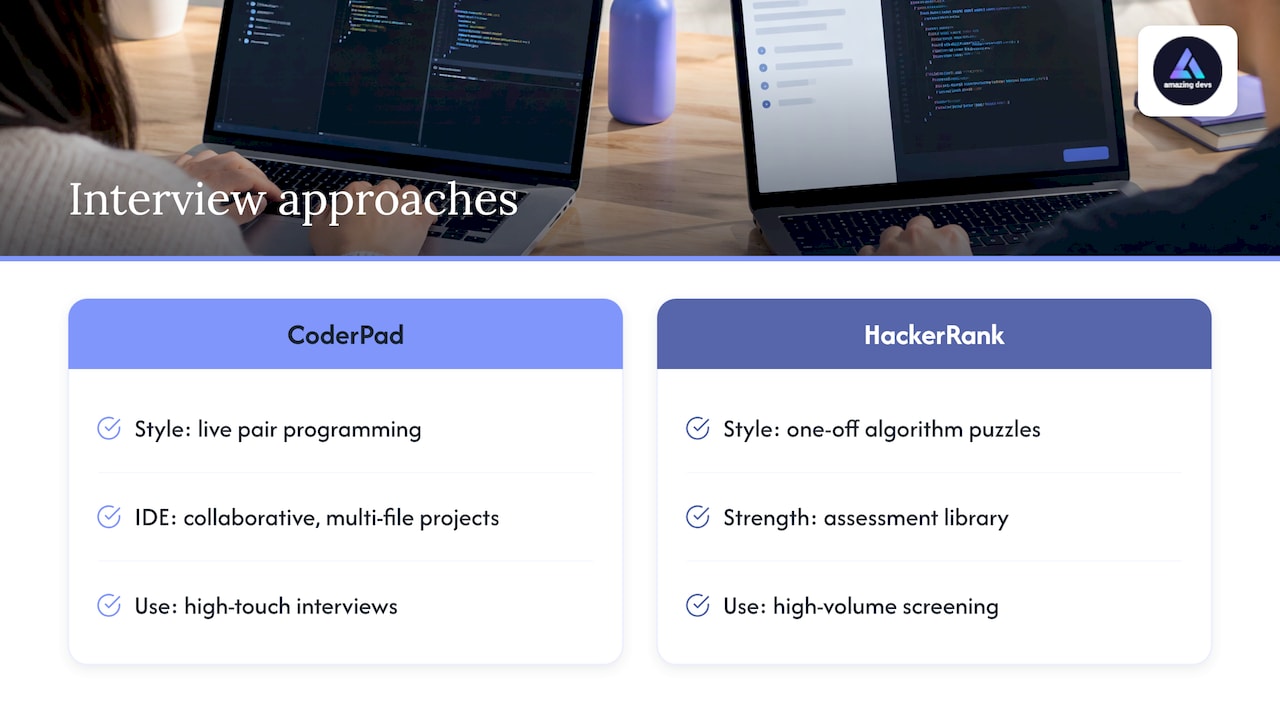
CoderPad was founded in 2013 and is headquartered in San Francisco. Its About Us page says it serves more than 3,800 customers and has hosted more than 4 million technical interviews. Its own comparison page frames the difference this way: CoderPad promotes production-style, multi-file projects and live collaboration, and it characterizes HackerRank as built around one-off algorithm puzzles. That is CoderPad’s view of a rival, so read it as positioning.
HackerRank’s pitch is consistency and scale. Its own comparison describes an AI Interviewer that simulates interviews, adapts to candidate skill, gives hints and asks follow-up questions. It also describes Proctor Mode, which guides assessments and flags integrity violations. Again, this is the vendor describing itself.
Independent review summaries land in a similar place. RFP.wiki’s 2026 analysis describes mixed feedback: HackerRank is praised for its assessment library and screening, while CoderPad is praised for a realistic, collaborative live IDE. Its summary is that CoderPad suits high-touch live pair programming and HackerRank suits high-volume screening.
That split should drive your decision more than any feature checklist.
Interview and assessment features
CoderPad
According to CoderPad’s homepage, the platform is organized into three products:
- Qualify: asynchronous video responses that an AI reviewer evaluates to rank candidates.
- Screen: real-world coding assessments.
- Interview: real-time collaborative coding in a multi-file environment, with structured scoring, private notes and code playback.
A professional review on recatools.com adds that CoderPad acquired CodinGame in October 2021, and that CodinGame’s assessment product became CoderPad Screen. The same review reports support for 99+ languages and frameworks in the live interview environment.
On language coverage per plan, CoderPad’s pricing page lists 40+ languages and frameworks on Starter.
HackerRank
HackerRank’s homepage describes an Interview product where interviewer and candidate work together on the same canvas. It also describes a community of more than 30 million developers. HackerRank’s pricing material lists support for 55+ programming languages (see CoderPad’s pricing page for that side-by-side figure). According to SelectHub’s comparison, HackerRank’s live interview feature includes a whiteboard, while CoderPad emphasizes an IDE, REPL and file-tree environment.
In plain terms: if you want a candidate to open a small repo, run tests and talk through trade-offs with you, CoderPad’s environment is closer to that. If you want to send the same assessment to 300 applicants and rank the results, HackerRank’s library and proctoring are closer to that.
Evaluating engineers who use AI
This is where both vendors have moved fastest, and it matters if you hire AI-enabled engineers.
CoderPad includes AI Assist on all plans, and per its pricing page, Claude Code and Codex run inside the pad on Frontier Lite and Enterprise. Per the PulseSignal summary of the tiers, Frontier Lite adds agentic interviews and an AI Project Designer, and Enterprise adds the full Frontier AI package. Treat that third-party summary as a guide and confirm details with CoderPad.
HackerRank’s homepage describes Chakra, an agentic interviewer that uses a canvas with a real-world problem to evaluate judgment, critical thinking and AI fluency. Its enterprise comparison lists the AI Interviewer for first-round interviews alongside Proctor Mode, while describing CoderPad’s offer as a collaborative IDE with multi-file projects and ChatGPT integration.
Whichever you choose, decide what you are measuring before you turn AI on. A candidate who prompts well, reads generated code critically and catches a subtle bug shows a different skill from one who writes a sorting routine from memory. Our guide to the AI engineer skills to screen first lists what we look for, and our candidate scoring matrix shows how to turn it into comparable scores across interviewers.
Pricing compared (US, October 2026)
Prices change, so use these as a snapshot and confirm on each vendor’s page.
| Plan | Price | Included volume |
|---|---|---|
| CoderPad Starter | $80/month billed annually, or $120 monthly | 60 interviews/year |
| CoderPad Team | $400/month billed annually, or $500 monthly | 360/year |
| CoderPad Frontier Lite | $1,000/month, annual only | 360/year |
| CoderPad Enterprise | Custom | Custom |
| HackerRank Starter | $199/month or $1,990/year | See HackerRank |
| HackerRank Pro | $449/month or $4,490/year | See HackerRank |
| HackerRank Enterprise | Custom | Custom |
CoderPad figures come from its pricing page, updated October 13, 2026. HackerRank figures come from HackerRank’s own pricing comparison.
Overage and extras
CoderPad charges $30 per test or interview above the monthly plan quota, per its pricing page. HackerRank lists $20 per additional attempt, and $15 per pre-purchased attempt on Pro annual plans, per the same HackerRank source.
A worked example
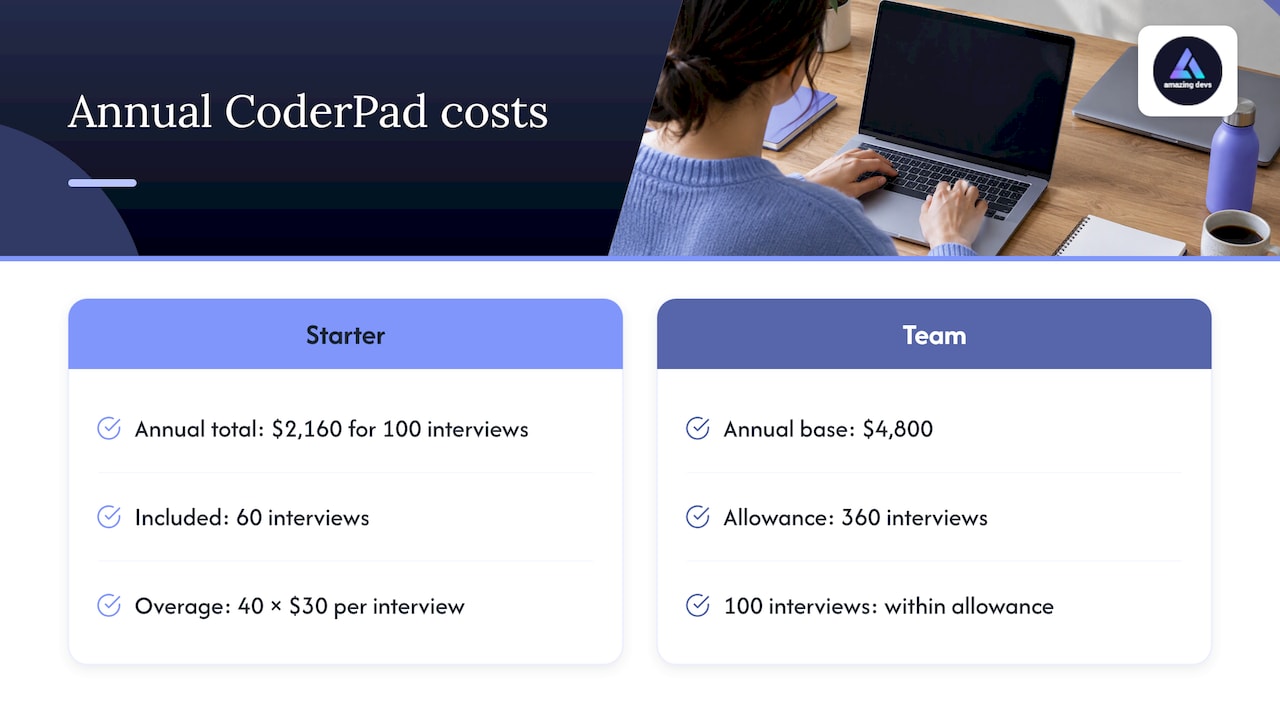
Say you interview 100 engineers a year on live calls. On CoderPad Starter billed annually, the base is $80 x 12 = $960. Starter includes 60 interviews, so 40 more at $30 adds $1,200, for $2,160 in total. On Team billed annually, the base is $400 x 12 = $4,800 and the 100 interviews fit inside the 360 included. At this volume Starter is cheaper on paper, but the gap narrows quickly as volume grows. This example uses the listed prices only and ignores taxes, trials or negotiated discounts.
CoderPad bills by interview volume with unlimited users rather than per recruiter seat, per InterviewCost, which also notes a 14-day free trial with no credit card. So the practical exercise is simple: estimate monthly technical-screen volume and pick the tier whose allowance covers it.
RFP.wiki’s 2026 analysis makes the broader point: total cost is driven by candidate volume, overage rates and security needs such as SSO, which often push teams into custom-quoted plans.
Which one fits your situation
Choose CoderPad when:
- You run a small or mid-sized engineering team that interviews a few candidates at a time.
- You want pair-programming-style conversations in a realistic environment. Our pair programming interview scripts give you a 60 to 90 minute structure that works well in a collaborative IDE.
- You prefer predictable pricing by interview count.
Choose HackerRank when:
- You get a large, noisy applicant flow and need a consistent first filter.
- Proctoring and integrity flags matter to you.
- You want a deep question library and an AI interviewer for early rounds.
RFP.wiki notes the trade-offs from the other direction: CoderPad’s live sessions are less suited to very high-volume async screening, and HackerRank can feel heavy for small teams.
Pick the format before the platform
The tool follows the format, not the reverse. If you have not settled whether a live session or a take-home fits the role, start with our comparison of live coding vs take-home tests. If you screen at volume, our guide to technical screening for developers explains why we cap tests at 90 minutes.
What to check before you buy
RFP.wiki recommends verifying a short list of items before adopting either platform. In practice:
- Project your volume. Count screens and live interviews per month, then price the overage exposure.
- Check what is gated. Confirm whether the ATS integration or SSO/SAML you need sits behind Enterprise. Per the same analysis, enterprise contracts for SSO, advanced ATS integrations such as Workday or Oracle, and professional services remain sales-quoted for both platforms.
- Match the library to your roles. A strong library for algorithm-heavy backend roles may be thin for front-end, data or QA work. Plan limits matter here: CoderPad lists a 400+ question library and 10 custom questions on Starter, with larger libraries on higher tiers, per PulseSignal.
- Run a pilot with real interviewers. Have two of your engineers use the tool for a week and score the same candidate with your rubric.
- Decide your AI policy. State whether candidates may use AI assistants, and pick the platform setting that matches.
Perspective
Every month we talk with hiring managers who ask us which assessment platform to buy. It is a fair question, but we think it comes second.
What we see is that the platform decides how you measure a candidate, while the sourcing decides who you get to measure. A team that screens 200 applicants to find three good ones needs heavy automation. A team that starts with a shortlist of pre-vetted engineers needs a sharp live conversation and a clear rubric.
That is how we built Amazing Devs. We run a rigorous recruitment and assessment process that looks at technical skills and at cultural and business fit, then we present Brazilian developers who match what you asked for. We handle contracts and the bureaucracy around them, so your engineers spend their interview hours on the finalists. Whichever tool you pick, CoderPad or HackerRank, it works best when the people entering it are already a good match.
Brazil also helps with the part tools cannot fix: overlap. Working in similar US time zones means the live pairing session you run on CoderPad can happen at a normal hour for you and for the candidate.
Gabriel
Hire pre-vetted Brazilian developers without running the funnel yourself
If your goal is a productive developer on the team and not a tooling project, we can shorten the path. Through nearshore staff augmentation, we source and assess developers, including AI-enabled engineers, check technical and cultural fit, and manage the contracts. You still meet your candidates and can run your own live session on the tool you prefer.
Want to see how the model compares to other options? Our guide to choosing a nearshore partnership model walks through the choices, and our breakdown of what it costs to recruit developers puts the tooling spend in context. You can start from our home page to tell us what roles you need.
FAQ
Is CoderPad or HackerRank better for live coding interviews?
CoderPad is the stronger fit for live interviews according to most comparisons. Its IDE, REPL and file-tree environment supports multi-file projects and real-time collaboration. HackerRank also offers live interviews, with a shared canvas and a whiteboard, but its reputation rests on assessments at scale.
Which is cheaper, CoderPad or HackerRank?
On listed prices as of October 2026, CoderPad starts lower at $80/month billed annually, against $199/month for HackerRank Starter. The cheaper option for you depends on volume, since CoderPad charges $30 per extra interview and HackerRank lists $20 per additional attempt. Estimate your yearly interview count first.
Can either platform assess candidates who use AI tools?
Yes. CoderPad includes AI Assist on all plans and runs Claude Code and Codex inside the pad on Frontier Lite and Enterprise. HackerRank offers an AI Interviewer and the Chakra agentic interviewer, which evaluates judgment and AI fluency. Decide your AI policy for candidates before configuring either.
Do I need Enterprise for SSO and ATS integrations?
Often, yes. Per the research cited above, SSO/SAML, advanced ATS integrations and professional services are typically sales-quoted on both platforms. Ask each vendor which integrations your plan includes before you commit.
Do small teams need a platform at all?
If you hire a handful of engineers a year, a lightweight setup with a clear rubric often covers the need. Our remote pair programming tools guide shows how to test options in 30 to 60 minutes.
Sources
- CoderPad pricing
- CoderPad About Us
- CoderPad vs HackerRank comparison page
- CoderPad homepage
- HackerRank homepage
- HackerRank vs CoderPad interview comparison
- Why enterprises choose HackerRank
- HackerRank pricing comparison
- RFP.wiki CoderPad vs HackerRank analysis
- SelectHub HackerRank vs CoderPad
- PulseSignal CoderPad pricing
- InterviewCost CoderPad cost