Choose a PEO when you already have a registered U.S. entity and want long-term HR outsourcing across payroll, benefits, and compliance. Choose an EOR when you need to hire fast in a state or country where you have no legal entity and want someone else to carry the employment risk. That’s the whole decision in one sentence, but the details determine whether you get it right or end up unwinding a contract six months in.
An Employer of Record (EOR) is a third-party company that becomes the legal employer of your workers on paper, handling payroll, tax withholding, and compliance while you direct the day-to-day work. A Professional Employer Organization (PEO) is different: it enters a co-employment arrangement with you, splitting employer responsibilities rather than replacing you as the legal employer. That distinction, co-employment versus sole employment, drives nearly every other difference between the two models.
The IRS’s guidance on employment tax responsibilities and the Department of Labor’s worker classification standards both hinge on who legally controls and pays the worker. The National Association of Professional Employer Organizations (NAPEO) represents the PEO industry and can be a useful resource for vetting whether a provider is a Certified PEO, which matters for federal tax liability shifting.
| Model | Legal employer | Entity required? | Who carries compliance risk |
|---|---|---|---|
| EOR | The EOR itself | No | The EOR assumes it |
| PEO | Shared (co-employment) | Yes, in most cases | Split between you and the PEO |
- If you have no entity in the hiring jurisdiction, a PEO generally isn’t an option. A PEO typically requires the client to already hold a registered business entity in that jurisdiction.
- An EOR sidesteps that requirement entirely by acting as a surrogate employer, which is why it’s the default choice for companies hiring in new states or countries without a local presence.
- Cost and control trade off against each other: EORs cost more per head but transfer risk; PEOs cost less at scale but keep you legally on the hook.
Key Takeaways
The choice between EOR and PEO comes down to one variable above all others: whether your business already holds a registered legal entity in the hiring jurisdiction.
| Point | Details |
|---|---|
| Entity rule of thumb | No entity means an EOR is generally your only option; an existing entity opens up PEO as a choice. |
| Liability split differs sharply | EORs assume full legal employer risk, while PEO co-employment splits liability unless the provider is IRS-Certified. |
| Cost trade-off is scale-dependent | EORs cost more per hire but move faster; PEOs cost less at scale but require existing HR infrastructure. |
| Watch contract red flags | Vague “direction and control” language and “global PEO” marketing claims are the two most common warning signs. |
| For fast technical hiring | Amazing Devs’ nearshore staffing model offers vetted developers with direct oversight, without entity formation or co-employment paperwork. |
Run this checklist with your legal and payroll teams before signing anything, the entity question alone will eliminate one of the two models for most businesses.
Where to verify these details further
- PEO vs. EOR: Key Differences Explained for Employers (US Chamber of Commerce): the clearest breakdown of legal employer status and entity requirements.
- PEO vs. EOR: Which Is Right for Your Business? (Rippling): useful for understanding cost structure and pricing models.
- What Is the Difference Between a PEO and an EOR? (Gusto): strong on use-case scenarios and hybrid staffing patterns.
- Professional employer organization vs. staffing agency (Indeed): helpful for distinguishing PEOs from staffing agencies.
- PEO vs Staffing Agency (PEO Consulting Partners): good detail on operational and tax treatment differences.
For jurisdiction-specific legal or tax questions, consult the IRS’s employment tax resources, the Department of Labor, or a licensed employment attorney. This article provides general information and isn’t a substitute for professional legal or tax advice.
This article is general information, not a substitute for advice from a qualified lawyer. Consult a qualified legal professional about your own circumstances before acting on anything here.
Table of Contents
- EOR vs PEO Comparison: Where the Two Models Actually Diverge
- When Should You Use an EOR Instead of a PEO?
- How Do You Decide Between EOR and PEO?
- What Does the Onboarding Process Actually Look Like?
- How Do Staffing Agencies and Nearshore Options Fit In?
- Need Developers Fast Without the Entity Headache?
- Sources
- FAQ
EOR vs PEO Comparison: Where the Two Models Actually Diverge
The surface-level pitch for both models sounds similar: outsource HR, reduce administrative burden, stay compliant. The mechanics underneath are not similar at all, and the gap matters most when something goes wrong, an audit, a termination dispute, a benefits lapse.

| Dimension | EOR | PEO |
|---|---|---|
| Legal employer status | The EOR is the sole legal employer | Co-employment; you and the PEO share the role |
| Requires client-registered entity? | No | Yes, in nearly all cases |
| Best for | New-state or international hires, fast entry, no entity | Established U.S. businesses with an existing entity |
| Payroll & benefits administration | Fully handled by the EOR | Jointly managed, PEO administers, you retain oversight |
| Compliance & tax liability | Assumed by the EOR | Shared, unless the PEO is IRS-Certified (CPEO) |
| Cost structure | Per-employee-per-month fee or % of payroll | PEPM or % of payroll, often lower at scale |
| Onboarding speed | Typically faster since the EOR supplies the entity | Slower, requires HR system integration |
| Control over employees | You direct work; EOR handles employment paperwork | You direct work; PEO shares some HR authority |
| Flexibility & termination | Simpler exit since the EOR owns the employment relationship | More complex; co-employment terms govern exit |
Three differences matter more than the rest. First, entity risk: you cannot use a PEO as a workaround for not having a legal presence somewhere. Only an EOR can act as a surrogate employing entity when you lack one yourself. Second, liability split: co-employment means PEO clients often retain shared exposure in state-level disputes unless the provider is a Certified PEO, which shifts certain federal tax liabilities. Third, benefits administration differs in practice, PEOs typically give you access to large-group insurance pools that a standalone small business couldn’t get on its own, while EORs usually offer their own benefits packages tied to the jurisdiction where they employ your worker.
- Read the “direction and control” language in any PEO contract closely. Vague wording here is often where legal responsibility quietly stays with you.
- Confirm who files payroll taxes and who the workers’ comp insurer is before signing anything.
- Ask about data portability. If the relationship ends, can you export employee records and transition payroll without a gap?
When Should You Use an EOR Instead of a PEO?
Some situations point toward one model so clearly there’s barely a decision to make. Others sit in a gray zone worth mapping out before you talk to a provider.
EOR scenarios:
- Hiring your first employee in a state where you have no entity and don’t want to form one for a single hire.
- Testing a contractor-to-employee conversion before committing to permanent headcount in that location.
- Running a short-term project in another jurisdiction where forming an entity would take longer than the project itself.
- Filling an urgent, compliance-sensitive role, say, a role requiring specific state licensing, where getting it wrong creates immediate legal exposure.
PEO scenarios:
- An established U.S. business with an entity in place, expanding headcount across states it already operates in.
- Wanting access to pooled, large-group benefits rates to compete for talent against bigger companies.
- Planning sustained, long-term headcount growth in jurisdictions where the entity already exists.
- Needing deeper HR integration, performance systems, HRIS, employee handbooks, than a pure staffing arrangement provides.
Edge cases show up constantly in practice. A common one: using a PEO for your core domestic team while using an EOR for the first hires in a new international market. Gusto’s research on hybrid staffing structures notes this exact pattern among U.S. tech companies expanding into markets where forming an entity upfront would be slow or costly.
The real test isn’t which model sounds more sophisticated. It’s whether headcount growth in a given location will eventually justify forming an entity, and if not, an EOR remains the right call indefinitely, not just as a stopgap.
How Do You Decide Between EOR and PEO?
Start with one question before anything else: do you already have a registered legal entity in the jurisdiction where you’re hiring?
- No entity? An EOR is likely your only workable option. Skip straight to vetting EOR providers.
- Entity exists? A PEO becomes viable. Move to the next questions.
- Estimate expected headcount and tenure. A handful of long-term hires favors PEO; a short-term or uncertain project favors EOR.
- Assess your appetite for shared liability. If your legal team wants a clean line of employer responsibility, EOR removes the ambiguity a PEO’s co-employment model creates.
- Weigh payroll complexity. Multistate payroll with varying tax registrations often benefits from a PEO’s established infrastructure, assuming you already have entities in each state.
- Check your timeline. Need someone working next week? EORs typically onboard faster since the provider supplies the employing entity and local payroll infrastructure rather than integrating with yours.
- Confirm data and reporting needs. Decide upfront who owns HRIS access and what happens to workforce data if you switch providers.
Pro Tip: When you read a PEO contract, look specifically for who retains “direction and control” over hiring, firing, and discipline decisions. If that language is vague or entirely retained by you, the co-employment structure hasn’t actually reduced your legal exposure, it’s just added a vendor.
Watch for these red flags before signing with any provider:
- A vendor marketing itself as a “global PEO” when it’s actually providing EOR services under a different label. Confirm which model you’re actually buying.
- A PEO that can’t clearly state whether it’s IRS-Certified, since certification affects who’s on the hook for federal tax liability.
- Opaque fee structures that mix percentage-of-payroll and flat fees without clear disclosure.
- Any provider requiring entity registration you weren’t told about upfront.
What Does the Onboarding Process Actually Look Like?
Before contacting any provider, gather entity documents (if you’re pursuing a PEO), recent payroll history, worker classification records, and internal authorization to share employee data with a third party. Decide internally who owns this decision, HR, finance, or legal, before you start vendor conversations.
- Vendor selection and diligence (1 to 3 weeks): Compare providers on certification status, geographic coverage, and fee transparency.
- Statement of work and service agreement (1 to 2 weeks): Confirm payroll tax filing responsibility, workers’ comp coverage, and termination transition terms in writing.
- Benefits setup (2 to 4 weeks for PEOs; often faster for EORs since benefits are pre-established): This step tends to be the slowest part of a PEO engagement.
- Payroll trial run (1 pay cycle): Test the integration before going live.
- Live payroll and onboarding: EORs often get a first hire working within days; PEOs, given HR system integration work, more commonly take several weeks.
- Confirm who manages day-to-day performance reviews versus who handles compliance paperwork.
- Clarify HRIS access: does your team get direct login, or do you route requests through the provider?
- Nail down the termination transition plan before you need it, including how quickly employee data exports if you switch providers later.
How Do Staffing Agencies and Nearshore Options Fit In?
EOR and PEO aren’t the only paths to building a team, and conflating them with staffing agencies is a common mistake.
- Staffing agencies supply labor, typically for temporary or project-based roles, and operate under a different tax and liability treatment than either EOR or PEO. Indeed’s comparison of PEOs and staffing agencies notes that a PEO handles ongoing HR administration while a staffing agency focuses narrowly on sourcing and placement.
- PEOs provide integrated HR back-office functions, payroll, benefits, workers’ comp, under co-employment. PEO Consulting Partners’ breakdown frames this as the key operational difference from a staffing model.
- EORs own the entire legal employment relationship, which makes them fundamentally different from a staffing agency’s supplied-labor arrangement.
- Nearshore staff augmentation is a fourth path entirely, one built for companies hiring technical talent specifically. It doesn’t replace EOR or PEO legally, but it solves a related problem: getting vetted developers working fast without navigating entity formation or co-employment paperwork at all.
A U.S. tech startup needing three backend engineers within a month faces a real choice. Standing up an EOR relationship works, but it adds a layer of employment administration for roles that may only need to exist for the length of a project. Businesses in that exact spot increasingly use nearshore staff augmentation instead, working with firms specializing in PEO and payroll for small businesses when domestic co-employment is the right fit, or nearshore providers when the priority is direct technical control and speed.
Reporting and data access differ sharply across these four models. With an EOR or PEO, you’re often working through the provider’s HRIS. With nearshore staff augmentation, you typically retain direct oversight of the developers’ day-to-day work while the staffing partner handles contracts and administrative overhead, closer to direct hiring than either co-employment model allows.
What experienced hiring teams get wrong most often
The trade-off between control and speed is where most U.S. tech companies underestimate the decision. Founders often assume a PEO is automatically cheaper at any scale, but that’s only true once headcount is high enough to offset the integration overhead. Below a certain size, an EOR or a direct nearshore hiring arrangement is frequently both cheaper and faster to stand up.
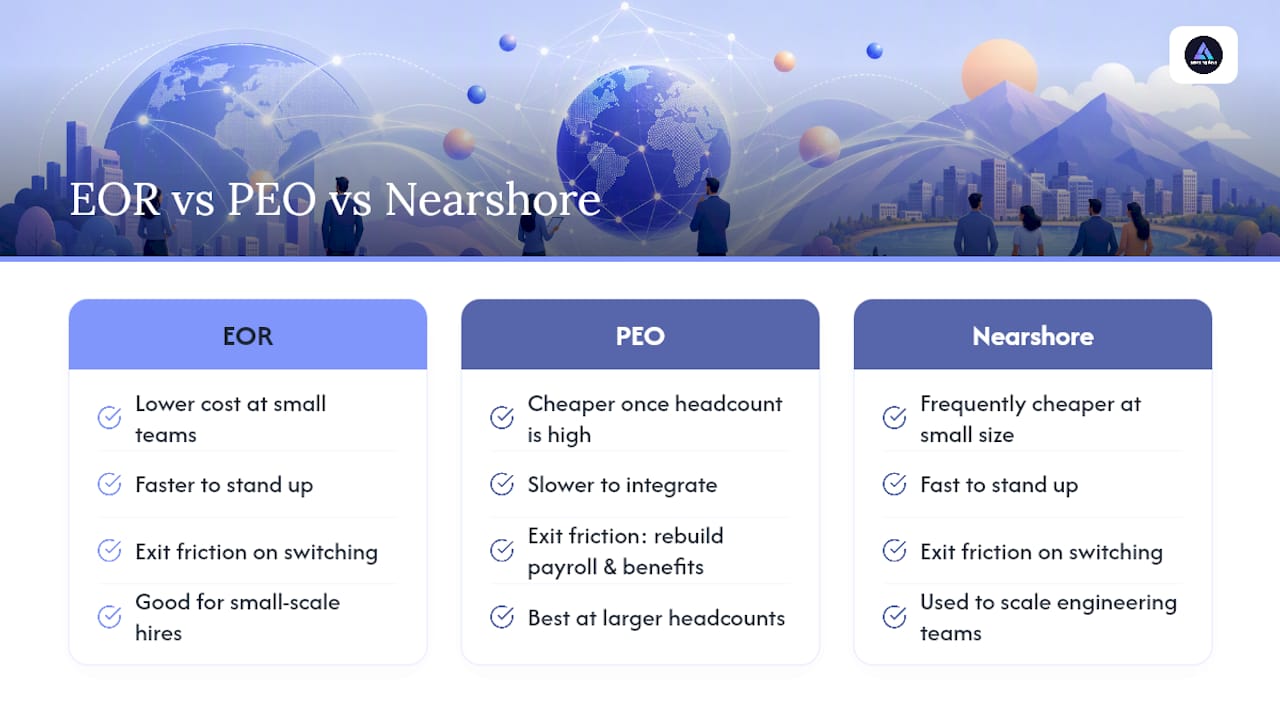
The pitfall I see most often isn’t picking the wrong model, it’s underestimating transition costs. Companies sign with a provider based on sales promises about speed and support, then discover mid-contract that switching providers means rebuilding payroll history and re-enrolling benefits from scratch. Amazing Devs has worked with U.S. companies navigating exactly this kind of transition when scaling engineering teams through nearshore placements, and the pattern is consistent: the businesses that do their diligence on exit terms upfront are the ones that don’t get stuck later.
Need Developers Fast Without the Entity Headache?
If you’ve read this far, you already know the trade-off: EOR gets you compliant fast but costs more per head, PEO is cheaper at scale but only works if you have an entity, and both add administrative layers that slow down technical hiring specifically. Amazing Devs offers a different route for companies that need software engineers now, not after weeks of payroll integration or entity formation. Its nearshore staffing model connects U.S. companies with vetted Brazilian developers, handling recruitment, technical and cultural fit assessment, and contract management directly, without requiring you to set up a co-employment relationship or wait on entity paperwork.
The developers work as an extension of your team, not through a shared HR system you have to learn. For engineering roles specifically, this often ends up faster than an EOR and simpler than a PEO. If you want to compare the cost and timeline against what an EOR or PEO quoted you, request matched developer profiles through Amazing Devs’ outsourcing page and see how the numbers stack up for your specific hiring need.
Sources
- PEO vs. EOR: Key Differences Explained for Employers | CO- by US Chamber of Commerce
- What Is the Difference Between a PEO and an EOR? | Gusto
- PEO vs Staffing Agency | PEO Consulting Partners
FAQ
What is the main difference between EOR and PEO?
An EOR is the sole legal employer of your workers, while a PEO enters a co-employment relationship, sharing employer responsibilities with you and typically requiring you to already have a registered entity.
Do I need a U.S. entity to use a PEO?
Yes, in nearly all cases a PEO requires the client to hold a registered legal entity in the jurisdiction, unlike an EOR, which can employ workers on your behalf without one.
Is EOR or PEO better for startups?
Startups hiring in a new state or country without an entity generally do better with an EOR, while startups with an established entity looking for long-term HR support and pooled benefits may prefer a PEO.
How does Amazing Devs relate to EOR and PEO?
Amazing Devs isn’t an EOR or PEO. It’s a nearshore staffing option that places vetted Brazilian developers with U.S. companies through direct contracts, offering another route for teams that need technical talent fast without entity formation or co-employment paperwork.
What’s a common contract red flag to watch for?
Vague “direction and control” language that leaves ambiguity over who legally directs the worker, and vendors marketing “global PEO” services that are actually EOR arrangements under a different name.