If you’re weighing whether to hire in-house, contract, or bring on nearshore ML engineers, staff augmentation with Brazilian ML engineers through Amazing Devs is the fastest path to production for iterative, product-facing machine learning work. It gives you meaningful daily overlap hours with US teams, production-grade engineering experience, and a faster time-to-fill than a direct hire search.
Here’s why this answers the actual job-to-be-done. Most companies hiring ML engineers aren’t trying to fill a headcount line. They’re trying to ship a model into production, keep iterating on it as real users touch it, and do that without six months of recruiting overhead. Nearshore staff augmentation solves for exactly that combination: speed, overlap hours that support same-day feedback loops, and engineers who’ve already operated models in live systems rather than notebooks.
Here’s what a nearshore ML hire needs to prove before you commit long-term:
- Can deploy and monitor an inference API without hand-holding
- Can debug model drift using real production signals, not synthetic data
- Can communicate technical tradeoffs clearly across a six-hour overlap window
- Can own a piece of the architecture, not just execute tickets
The concrete next step: schedule a two-week validation sprint with Amazing Devs before signing anything longer.
That sprint should prove several things at once:
- The engineer can ship a scoped, real piece of ML work end-to-end
- Communication cadence holds up without constant clarification loops
- Code and documentation quality match what your team already maintains
- The engineer asks the right architecture questions unprompted
- You retain full IP on anything built during the trial
- Escalation paths work if something breaks mid-sprint
- The engineer’s seniority claims match observed output
- Integration with your existing stack doesn’t require excessive rework
- Daily async updates are clear enough that you don’t need extra check-ins
- The vendor’s onboarding process gets the engineer productive inside days, not weeks
- You get a documented decision log for anything ambiguous
- The pilot cost stays proportional to the risk you’re removing
Pro Tip: Treat the two-week sprint as a hiring interview with real stakes on both sides, not a proof-of-concept demo. A candidate who performs well on a scoped, production-adjacent task tells you more than five rounds of whiteboard questions ever will.
A few more things the sprint should surface before you scale the engagement:
- Whether the engineer’s prior production experience was demo-only or genuinely operational
- Whether they can explain a model’s failure mode in plain language to non-ML stakeholders
- Whether their code review habits match your team’s standards
- Whether they proactively flag security or data-handling concerns
- Whether the vendor’s support team responds quickly if a problem comes up
- Whether the contract terms protect your IP from day one
- Whether reference checks from prior clients confirm the same strengths you observed
- Whether the engineer’s stated seniority level holds up under a system-design conversation
- Whether onboarding documentation was clear enough to start without excessive back-and-forth
- Whether daily standups or async updates gave you real visibility into progress
- Whether the engagement felt low-friction enough that you’d extend it without hesitation
- Whether pricing was transparent with no surprise fees mid-sprint
- Whether the vendor offered a clear off-ramp if the fit wasn’t right
- Whether cultural fit showed up in how the engineer handled ambiguity
- Whether the engineer pushed back constructively on a flawed requirement
- Whether the sprint’s deliverable is something you’d actually ship
- Whether you’d trust this person with production access unsupervised
- Whether the vendor’s process felt repeatable for a second or third hire
- Whether documentation habits would survive the engineer leaving the project
Key Takeaways
Nearshore staff augmentation with Brazilian ML engineers delivers faster iteration and clearer ownership than direct hire or offshore models for most production ML work.
| Point | Details |
|---|---|
| Recommended model | Nearshore staff augmentation fits iterative ML work best, especially with sensitive data or shifting specs. |
| Vet on production evidence | Ask for live pipelines and real-task assessments, not demo screenshots or algorithm puzzles. |
| Onboarding must-haves | Confirm repo access, a 30/60/90 plan, and defined overlap hours before day one. |
| Contract must-haves | Lock down IP assignment, SLAs, and a clear escalation path before signing anything. |
| Next step with Amazing Devs | Run a two-week validation sprint with Amazing Devs before committing to a longer engagement. |
Table of Contents
- When Should You Choose Nearshore Over In-House or Offshore?
- What Skills and Seniority Levels Should You Request?
- How Do Vendors Screen and Test ML Candidates?
- How Should You Structure Onboarding and Communication?
- What Engagement Models and Costs Should You Expect?
- What Red Flags and Questions Should You Watch For?
- How Does Amazing Devs Solve These Hiring Problems?
- What’s the Real Lesson Here for Hiring Managers?
- Ready to Validate a Nearshore ML Hire Without the Risk?
- Where to Learn More Before You Decide
- FAQ
When Should You Choose Nearshore Over In-House or Offshore?
Four variables decide this: how fast your requirements change, how sensitive your data is, how big your team needs to get, and how stable your specs actually are. Get the mapping wrong and you’ll either overpay for control you don’t need or underinvest in oversight you can’t skip.
Nearshore staff augmentation wins when requirements shift frequently, when engineers need access to regulated or customer data, and when you want an engineer embedded closely enough to own architecture decisions rather than just execute a spec. It’s also the better fit for smaller teams, where a mis-hire has outsized impact on velocity. Same-day overlap between US and Latin American teams means a blocked engineer gets unblocked in hours, not a full day later.

Offshore or fixed-scope contractors make more sense when the work is high-volume, the specs are locked, and cost pressure outweighs the need for tight iteration. Think large-scale data labeling pipelines or a well-documented migration with almost zero ambiguity. Nearshore is generally the safer default the moment your product touches customer data or changes direction based on user feedback.
Pro Tip: If your product roadmap changes more than once a month, nearshore almost always beats offshore on total cost once you factor in the rework offshore misalignment tends to generate.
Run this checklist before deciding:
- Does your requirement set change weekly or faster?
- Does the engineer need direct access to production or customer data?
- Do you need architecture ownership, not just code execution?
- Is your team under 20 engineers, where one bad hire hurts disproportionately?
- Is same-day feedback critical to your release cadence?
- Would a four-week async delay meaningfully hurt your timeline?
If you answered yes to three or more, nearshore is your model.
What Skills and Seniority Levels Should You Request?
Hiring managers frequently ask for “an ML engineer” when what they actually need is one of five distinct roles, and conflating them is the single most common cause of a mis-hire. Get specific in your brief or you’ll get a resume that looks right and performs wrong.
- ML engineer: builds and trains models, owns the modeling layer
- MLOps engineer: owns deployment, CI/CD for models, and infrastructure reliability
- ML data engineer: owns pipelines, feature stores, and data quality upstream of training
- Research-to-prod engineer: translates prototype work into shippable, monitored systems
- Lead/architect: owns system design across the ML stack and mentors the team
| Level | Realistic responsibilities |
|---|---|
| Junior | Implements defined tasks, needs review on architecture decisions |
| Mid | Owns a feature end-to-end, contributes to design discussions |
| Senior | Owns production reliability, mentors, makes architecture calls |
| Lead | Sets technical direction, owns cross-team tradeoffs |
Beyond title, request a skill checklist covering the full model lifecycle: training and evaluation, deployment, monitoring, feature store design, data pipeline ownership, and observability. A candidate who can talk fluently about model accuracy but goes quiet on monitoring or drift detection is a research hire, not a production one.
Pro Tip: Ask every candidate to walk through one production incident they personally debugged. The answer separates people who’ve operated real systems from people who’ve only trained models in isolation.
When briefing a vendor, request specifics rather than a generic resume list:
- Production metrics the candidate personally owned (latency, drift rate, uptime)
- A sample architecture diagram from a past project, sanitized as needed
- Their expectation for SLA response time on a production incident
Fields worth adding to your SOW:
- Required seniority level with explicit responsibility examples
- Expected overlap hours and communication cadence
- Ownership boundaries between the nearshore engineer and your in-house team
How Do Vendors Screen and Test ML Candidates?
A rigorous pipeline runs through six stages: intake and role definition, sourcing, a real-task technical assessment, a system-design interview, a leadership or culture interview, and reference checks before an offer goes out. An efficient pipeline for senior roles typically closes in two to three weeks, which is worth knowing when a vendor promises a placement in days.
- Intake defines the exact role, seniority, and production ownership expected
- Sourcing pulls from a vetted talent pool, not a generic job board
- A real-task technical assessment replaces algorithm trivia with production-relevant work
- A system-design interview tests architecture judgment under ambiguity
- A leadership or culture interview checks communication and fit
- Reference checks confirm the candidate’s claimed production experience
The real-task assessment is where weak vendors get exposed. Strong screens ask candidates to deploy an inference API, debug a simulated model-drift scenario, or build a basic monitoring hook rather than solve an abstract coding puzzle. Those tasks predict production performance far better than a leetcode-style interview ever will.
A vendor that shows you a living, observable pipeline, not screenshots from a demo, is showing you what the engineer will actually maintain on your team.
Pro Tip: Ask the vendor to show you the exact assessment rubric before you sign. If they can’t produce one, they’re not actually assessing candidates against a consistent bar.
Deliverables to expect at each stage:
- A written role definition before sourcing begins
- A scored technical assessment with a documented rubric
- A system-design writeup showing tradeoff reasoning
Trust signals worth demanding from any vendor:
- Decision logs showing why a candidate passed or failed each stage
- Evidence of hands-on coding tasks tied to production scenarios
- Case studies or references from clients with comparable ML workloads
How Should You Structure Onboarding and Communication?
The most common failure mode in nearshore ML hiring isn’t a skills gap. It’s poor communication design that lets context evaporate between async updates, leaving both sides guessing about priorities and ownership.
A solid onboarding checklist covers access, repos, datasets, runbooks, and a documented 30/60/90 plan before day one ends:
- Repository and environment access provisioned before the start date
- A documented data-access policy covering what the engineer can see and touch
- Existing runbooks and architecture docs shared upfront, not discovered later
- A written 30/60/90 plan with concrete milestones at each checkpoint
Governance matters just as much as access. Set these before the engineer’s first day:
- Define overlap hours explicitly, not as a vague “some overlap” promise
- Set a daily async update format everyone actually follows
- Assign sprint ceremony roles so standups don’t drift into status theater
- Document an escalation path with named owners on both sides
- Schedule recurring knowledge-transfer sessions, not one-off handoffs
Pro Tip: Require an Architecture Decision Record for every non-trivial technical choice. It’s the single governance habit that prevents context loss when a team member rotates off a project six months later.
Demand these integration artifacts from any nearshore engineer joining your stack:
- ADRs documenting the reasoning behind architecture choices
- A living SPEC.md that stays current as requirements shift
- A decision log that survives personnel changes
And keep these cadence basics non-negotiable:
- Overlap hours confirmed in writing before the engagement starts
- A named escalation contact on both the vendor and client side
What Engagement Models and Costs Should You Expect?
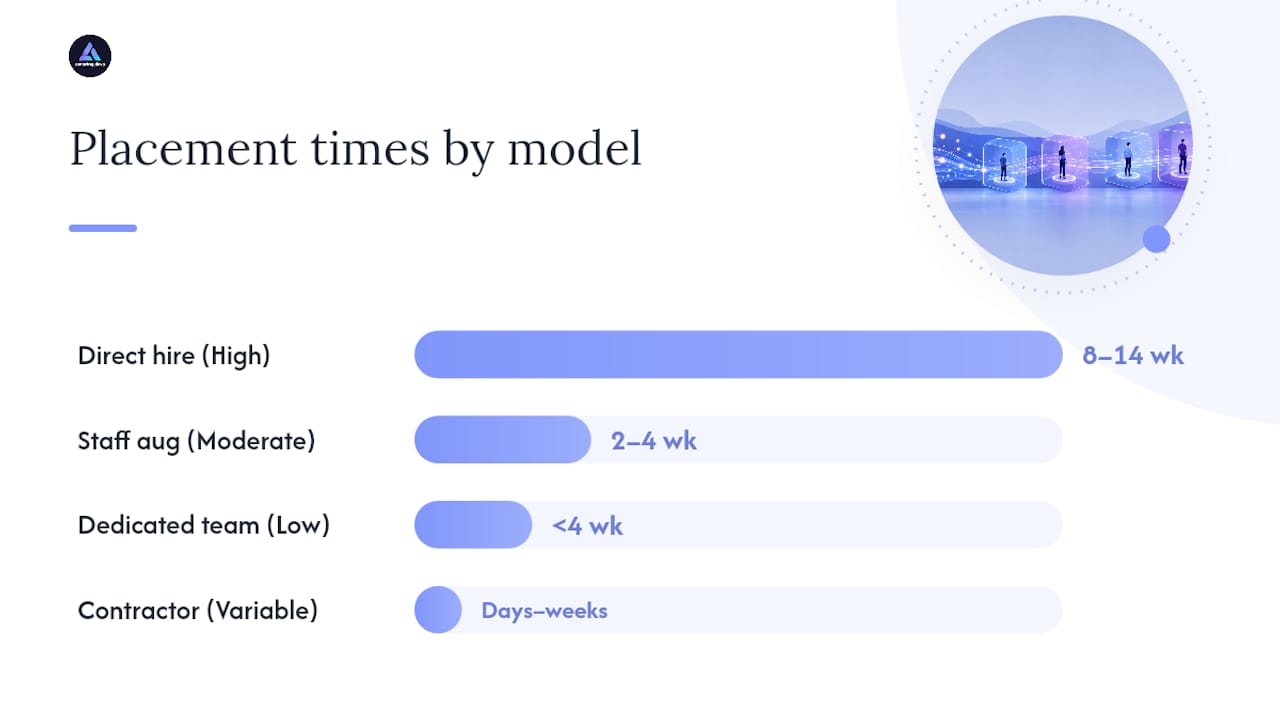
Four models cover almost every hiring scenario: direct hire, staff augmentation, dedicated team, and independent contractor. Each carries a different management burden and a different timeline.
- Direct hire: full control, highest management burden, longest timeline
- Staff augmentation: embedded engineer under your management, moderate burden, fast placement
- Dedicated team: vendor-managed team working your roadmap, lower burden
- Independent contractor: narrow scope, minimal integration, variable reliability
On timing, direct hire commonly takes 8 to 14 weeks, while staff augmentation places an engineer in roughly two to four weeks, and embedded or managed-team arrangements can close in under four weeks. That gap alone often decides the model for teams under real delivery pressure.
Primary cost drivers to watch:
- Seniority level, since senior and lead roles command a wider compensation band
- Security or compliance requirements that narrow the eligible candidate pool
- Evaluation complexity, since a rigorous technical screen takes longer to run
- Employer-of-record fees layered on top of base compensation
- Urgency, since compressed timelines often mean a smaller shortlist
Regional compensation for senior ML engineers in Latin America varies widely by country, and EOR setup typically runs one to two weeks with a modest monthly service charge layered on top of the engineer’s pay.
| Model | Typical placement time | Management burden |
|---|---|---|
| Direct hire | 8 to 14 weeks | High |
| Staff augmentation | 2 to 4 weeks | Moderate |
| Dedicated team | Under 4 weeks | Low |
| Contractor | Days to weeks | Variable |
A low-risk pilot means starting with one scoped deliverable, a fixed short timeline, and a budget proportional to what you’d spend validating a direct hire’s first month. Starting small before scaling consistently produces better hiring decisions than committing to a full engagement on resume strength alone.
What Red Flags and Questions Should You Watch For?
Vague answers on IP ownership are the single biggest warning sign in any nearshore contract, and they’re more common than most hiring managers expect.
Watch for these red flags before signing anything:
- No production evidence, only polished slide decks or demo videos
- Ambiguous IP assignment language that doesn’t clearly transfer model and data ownership to you
- No documented escalation path if the engagement hits friction
- Undefined or unrealistic overlap hours
- No decision log or rubric behind how candidates were screened
Ask the vendor these questions directly before you sign:
- Who owns the IP for models and data built during the engagement?
- What SLA governs engineer availability and knowledge-transfer obligations?
- What’s the notice period and replacement process if fit isn’t right?
- Is this an EOR arrangement or something else, and what does that mean for compliance?
- Can you show a decision log from a recent candidate screen?
Pro Tip: Ask a candidate to describe a time a model degraded silently in production and how they caught it. Anyone who’s actually maintained live ML systems has a specific, detailed answer ready. A vague one is your clearest signal of demo-only experience.
A few more questions worth asking directly in the technical interview:
- What monitoring did you set up to catch that issue before users noticed?
- How did you decide whether to roll back or patch forward?
- What would you change about that system’s architecture with hindsight?
How Does Amazing Devs Solve These Hiring Problems?
Amazing Devs was built around the exact failure points hiring managers hit when bringing on nearshore ML talent: weak screening, murky contracts, and communication gaps that stall delivery. The recruitment and assessment process evaluates both technical depth and cultural fit before a candidate ever reaches your team.
Concrete ways this reduces your risk:
- Production-oriented technical assessments instead of resume-based matching
- Managed contracting and payroll that removes the need to open a local entity
- Structured knowledge-transfer milestones built into onboarding, not left informal
Outcomes hiring managers actually care about:
- Faster time-to-product through overlap hours that support same-day iteration
- Clear ownership boundaries defined before the engagement starts
- Reduced administrative burden across contracts, payroll, and compliance
Vetting a nearshore ML hire on production ownership, not demo polish, is what separates an engineer who ships from one who just interviews well.
What’s the Real Lesson Here for Hiring Managers?
Most advice on hiring ML engineers still treats this like a resume-matching problem: list the frameworks, check the degree, run a coding test, sign the contract. That framing misses where nearshore ML engagements actually succeed or fail, which is almost never in the skills column.
The failure mode that sinks these engagements is communication design, not competence. An engineer who can debug drift at 2 a.m. is worthless to you if nobody on your team knows to ask them to. Overlap hours, escalation paths, and decision logs aren’t administrative overhead. They’re the mechanism that turns a technically strong hire into a productive one, and skipping that setup is the single most avoidable mistake I see hiring managers make.
The other overrated variable is speed-to-signature. Companies rush to lock in a long-term contract because a candidate interviewed well, then discover three weeks in that the working relationship doesn’t hold up under real deadline pressure. A short, paid validation sprint costs you almost nothing compared to what a bad six-month engagement costs, and it tells you things no interview ever will: how someone handles an ambiguous requirement, how they communicate a blocker, whether their claimed seniority survives contact with your actual codebase.
If you take one thing from this: prioritize the pilot over the pitch. Vendor promises are cheap. A two-week sprint with a real, scoped deliverable is not, and it’s the only test that actually predicts what happens after you sign.
Ready to Validate a Nearshore ML Hire Without the Risk?
A two-week validation sprint with Amazing Devs gives you a real, scoped ML deliverable, not a sales pitch or a resume promise, before you commit to anything longer.
The sprint includes a defined technical task tied to your actual stack, whether that’s an inference API, a monitoring hook, or a scoped feature-store integration, with acceptance criteria you set upfront. You retain full IP on everything built during the sprint, and every decision made along the way gets documented so nothing gets lost if you decide to scale the engagement. That combination, a real deliverable on a short timeline with documented decisions, consistently surfaces communication gaps and skill mismatches that a standard interview process misses entirely.
Start a two-week validation sprint with Amazing Devs and see how a Brazilian ML engineer performs on your actual production work before you sign anything longer.
Where to Learn More Before You Decide
A few pages are worth reading before you finalize a vendor decision or engagement model.
- Amazing Devs outlines the core nearshore staffing service and how recruitment and assessment work end to end.
- Nearshore vs Offshore: Definitive Guide to Success breaks down the tradeoffs behind this article’s nearshore recommendation in more depth.
- Outsourcing covers engagement models and contract logistics if you’re still comparing structures.
Two outside resources round out the picture:
- Open-Source AI Scalability Challenges explains how infrastructure decisions shape the skills your ML hire actually needs.
- Hiring software developers internationally offers useful background on EOR and compliance tradeoffs if you’re comparing global hiring structures.
FAQ
What’s the difference between an ML engineer and a data scientist?
A data scientist focuses on analysis and model experimentation, while an ML engineer owns deployment, monitoring, and production reliability of the models a data scientist develops.
How is an ML engineer different from an MLOps engineer?
An ML engineer builds and trains models, while an MLOps engineer owns the infrastructure, CI/CD pipelines, and reliability systems that keep those models running in production.
How long does it take to place a nearshore ML engineer?
Staff augmentation typically places a nearshore ML engineer in two to four weeks, compared to eight to fourteen weeks for a direct hire.
What should I ask a vendor before signing a contract?
Ask who owns the IP for models and data, what SLA governs availability and knowledge transfer, and what the notice period looks like if the engagement needs to end early.
Does Amazing Devs handle contracts and payroll for nearshore engineers?
Yes, Amazing Devs manages contracting and payroll so clients can bring on nearshore ML engineers without opening a local entity.
What’s the best way to test a nearshore ML engineer before committing long-term?
A short, paid validation sprint with a scoped, real deliverable gives the clearest signal on technical fit and communication before you sign a longer contract.