MLOps Hiring Guide: How to Hire the Right Engineer
You probably need one of three MLOps hires, and the fastest way to figure out which is to look at your pain point. If deployments are manual and nobody owns retraining, you need a pipeline owner. If models are live but nobody sleeps through an incident, you need someone focused on serving and reliability. If you’re scaling past one team and need shared infrastructure, you need a platform builder.
Mid-level engineers in this space typically land in the low-to-mid six figures; senior operators with LLM serving or GPU infrastructure experience can push toward $250K or more in total compensation depending on company and scope. A clean, well-scoped search closes in four to seven weeks; a vague one drags past ninety days and burns your best candidates on slower competitors.
Your one immediate action: pick the lane before you write the job description. Everything else in this guide, from sourcing to comp to the interview loop, depends on that decision.
- Pipeline owner: fixes broken CI/CD and retraining, usually a mid-to-senior hire
- Serving & reliability: owns uptime, latency, and on-call for live models
- Platform builder: builds shared infrastructure across multiple ML teams, usually senior/staff level
Quick stat: Clean MLOps searches close in four to seven weeks when the role is scoped correctly. Mis-scoped searches routinely blow past ninety days.
Key Takeaways
Successful MLOps hiring requires picking a lane before writing the job description, testing for production incidents instead of whiteboard theory, and closing offers within days, not weeks.
| Point | Details |
|---|---|
| Pick a lane first | Choose pipeline owner, serving & reliability, or platform builder before writing the job description. |
| Expect $130K to $250K+ | Comp varies by level, lane, and premiums like LLM serving or GPU infrastructure ownership. |
| Target a 4 to 7 week close | A well-scoped search closes fast; a vague one drags past ninety days. |
| Test incidents, not algorithms | Use production-incident deep dives and paid take-homes instead of whiteboard ML questions. |
| Consider Amazing Devs for speed | Amazing Devs offers pre-vetted nearshore MLOps talent through contract, contract-to-hire, or direct placement models. |
Table of Contents
- What Does an MLOps Engineer Actually Do?
- Which of the Three MLOps Lanes Should You Hire For?
- What Should You Pay an MLOps Engineer in 2026?
- Should You Hire Now, Wait, or Use a Contractor?
- Where Do You Actually Find Strong MLOps Candidates?
- What Interview Questions Actually Predict MLOps Success?
- What Resume Signals Predict a Strong MLOps Hire?
- How Do You Win the Offer Once You’ve Found the Right Candidate?
- What Mistakes Most Often Sink MLOps Hiring Efforts?
- How Should You Think About Filling These Roles Fast?
- Ready to Fill Your MLOps Role Faster?
- Sources
- FAQ
What Does an MLOps Engineer Actually Do?
An MLOps engineer runs the operational layer that keeps machine learning models alive in production. That means CI/CD pipelines for model releases, drift monitoring, automated retraining, and on-call rotations for inference endpoints, not building models from scratch. Think of the role as DevOps for machine learning, but with extra complexity because models degrade silently. Code doesn’t decay when nobody touches it; a model absolutely does, as the data underneath it drifts.
Core responsibilities break down into a handful of concrete duties:
- CI/CD and model lifecycle management. Automating the path from a trained model to a deployed endpoint, including versioning and rollback capability.
- Monitoring and drift detection. Watching for data drift, concept drift, and performance decay before customers notice.
- Retraining pipelines. Building the automated or semi-automated systems that refresh models on schedule or trigger.
- On-call and incident response. Owning the pager when an inference service degrades or fails.
- Reproducibility and governance. Making sure any model can be rebuilt, audited, and traced back to its training data and code version, a point Coursera’s role breakdown emphasizes as a core MLOps skill.
Success in this role gets measured in specific numbers: SLO adherence, p99 latency on inference calls, the count of drift events caught before they hit production, and mean time to recovery (MTTR) when something breaks. If your candidate can’t speak fluently about at least two of these metrics, that’s a real gap.
Where this role blurs into adjacent titles matters just as much as where it’s distinct. A data engineer builds and maintains the pipelines that feed data into training, but rarely owns what happens after a model ships. A ML engineer focuses on model architecture, feature engineering, and experimentation, the “build it” side of the house. An SRE or DevOps engineer owns infrastructure reliability broadly but usually lacks the ML-specific context to reason about drift or retraining triggers. Some overlap is healthy, especially at smaller companies where one person wears two hats. The trouble starts when a job description mashes together all four roles and expects one hire to cover them at senior-level depth in each.
Which of the Three MLOps Lanes Should You Hire For?
Picking a lane before you post the job is the single highest-leverage decision in this entire process. Each lane has a different skill profile, a different sourcing pool, and different success criteria for the first ninety days.
Pipeline owner. This hire fixes the mess between “data scientist trained a model” and “model is running in production.” First-90-day milestone: automate at least one manual deployment process and stand up a basic retraining trigger. Signal you need this lane: your data scientists are manually copying model files to servers, or deployments require a Slack thread and a prayer.

Serving & reliability. This hire owns uptime, latency, and incident response for models already in production. First-90-day milestone: establish SLOs, build alerting on the top failure modes, and cut MTTR on model-related incidents. Signal you need this lane: models are live, but nobody owns what happens when they break, and your ML engineers get paged at 2 a.m.
Platform builder. This hire builds shared infrastructure (feature stores, model registries, standardized deployment templates) that multiple ML teams use. First-90-day milestone: ship one reusable component that at least two teams adopt. Signal you need this lane: you have more than one ML team duplicating the same infrastructure work independently.
- Pipeline owner: mid-to-senior level, strong software engineering plus ML lifecycle familiarity
- Serving & reliability: senior level, strong SRE instincts plus ML-specific monitoring knowledge
- Platform builder: senior-to-staff level, systems design experience across multiple ML use cases
Pro Tip: Write the first ten alerts or incidents you expect this hire to own before you write the job description. If you can’t list ten, you haven’t picked a lane yet, and the job posting will attract the wrong candidates.
What Should You Pay an MLOps Engineer in 2026?
Base salary for a mid-level MLOps engineer generally lands in the $130K to $170K range at U.S. companies, with senior operators pushing $170K to $220K in base, and total comp for staff-level or specialized hires reaching $250K or higher once equity and bonus are factored in. Contract rates run separately and typically reflect a premium for short engagement length, often landing in the $90 to $150 hourly range depending on lane and location.
A handful of specific skills and responsibilities pull pay upward regardless of level:
- LLM serving experience. Candidates who’ve deployed and scaled large language model inference (vLLM, TGI, quantization tradeoffs) command a premium because the skill set is newer and thinner in the market.
- GPU infrastructure ownership. Managing GPU clusters, scheduling, and cost optimization is a distinct skill from general cloud infra and pays accordingly.
- Feature store experience. Candidates who’ve built or operated feature stores (Feast, Tecton, or homegrown systems) tend to skew platform-builder level and price higher.
- Multi-cloud or hybrid deployment. Fewer engineers have deployed ML workloads across AWS, GCP, and on-prem simultaneously, and that scarcity shows up in comp.
To build your own comp band, start with a market midpoint for the lane and level, then apply roughly a 25% spread above and below it to account for interview performance and negotiation room. Add a separate line item, not a blended average, for any of the four premium skills above if the role genuinely requires them.
Quick stat: Senior MLOps compensation in the U.S. can reach $250K or more in total comp, with the spread driven heavily by LLM and GPU infrastructure responsibilities.
Should You Hire Now, Wait, or Use a Contractor?
Three operational signals tell you it’s time to hire rather than patch the gap another way. First, deployments are manual and every model release requires someone to babysit the process by hand. Second, triage takes days instead of hours when a model’s performance degrades, because nobody owns monitoring end-to-end. Third, your ML engineers are spending more than 30% of their time on operational firefighting instead of building models, a direct signal that the ops burden has outgrown ad hoc coverage.
Team size shapes the decision as much as the signals do:
- Under 5 ML engineers: A dedicated MLOps hire is often premature. Consider a fractional contractor or a managed platform to cover the gap while your ML headcount grows.
- 5 to 15 ML engineers: This is the sweet spot for a first dedicated MLOps hire, usually in the pipeline owner or serving & reliability lane.
- 15+ ML engineers across multiple teams: You likely need a small MLOps function, not just one hire, and the platform builder lane becomes relevant.
Each engagement model carries tradeoffs. Direct hire gives you long-term ownership and institutional knowledge but takes longest to close. Contract-to-hire lets you validate fit on live work before committing, useful when the lane itself is still uncertain. Short-term contracts solve an acute problem without adding headcount, but you’ll relearn the system with every new contractor. Managed platforms remove the operational burden entirely but limit customization and can create vendor lock-in on critical infrastructure.
Where Do You Actually Find Strong MLOps Candidates?
Four sourcing pools consistently produce stronger candidates than a generic “MLOps Engineer” job board post. SREs who picked up ML in production often make excellent hires because they already carry on-call discipline and run book habits that most pure ML engineers never develop. Data engineers who moved into ML platform work bring pipeline rigor and a comfort with data quality issues that show up constantly in drift monitoring. Senior ML engineers with real production experience, not just research or Kaggle backgrounds, understand the tradeoffs between model accuracy and operational cost. Contractor marketplaces specializing in infrastructure or ML talent can surface candidates faster than a standard recruiting funnel, especially for short-term or contract-to-hire engagements.
A few tactical sourcing notes:
- Search job titles beyond “MLOps Engineer”: “ML Platform Engineer,” “ML Infrastructure Engineer,” and “Applied ML SRE” all describe overlapping work.
- Boolean strings combining “on-call” or “SLA” with “model deployment” or “inference” surface candidates with real production exposure, not just modeling experience.
- Flops-specific Slack communities and conferences (MLOps Community, local ML infrastructure meetups) tend to attract candidates already thinking in production terms, not research terms.
Write the job description around the lane you picked, not a wish list. Separate must-haves (the specific tools and responsibilities tied to your chosen lane) from nice-to-haves, and include the concrete 90-day deliverable from earlier in the JD itself. Candidates self-select more accurately when they can see exactly what success looks like, and you’ll get fewer mismatched applicants clogging the pipeline.
What Interview Questions Actually Predict MLOps Success?
Whiteboard ML questions, the kind that ask candidates to derive gradient descent from memory, tell you almost nothing about whether someone can keep a production model alive at 3 a.m. The candidates who thrive in this role have handled real incidents, made real rollback decisions, and lived with the consequences of a bad deployment. Your interview loop needs to test for that directly, not for textbook recall.
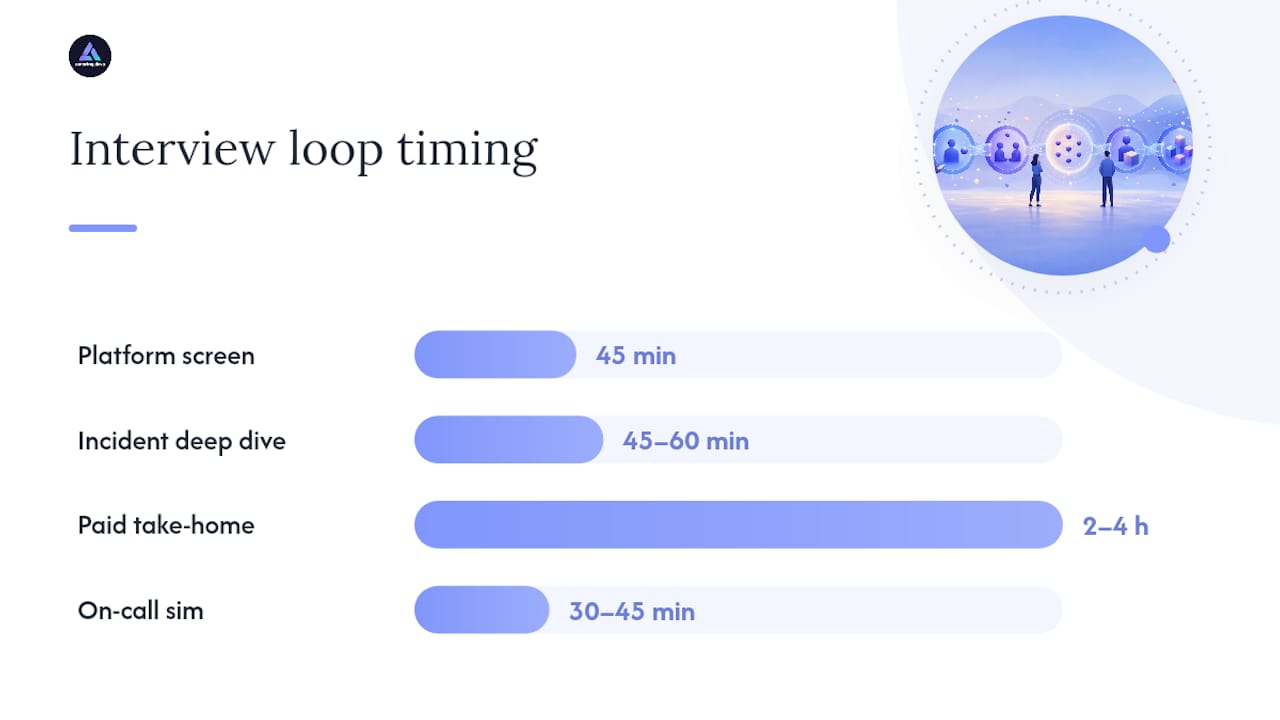
Recommended four-stage loop:
- Platform architecture screen (45 minutes). Have the candidate walk through a system they’ve built or maintained: the deployment pipeline, monitoring stack, and retraining triggers. Listen for specifics, not buzzwords. A strong candidate names actual tools, actual failure modes they hit, and actual tradeoffs they made.
- Production-incident deep dive (45 to 60 minutes). Ask the candidate to walk through a real incident from a previous role, start to finish. What triggered the alert? What was the triage sequence? Did they roll back or mitigate forward, and why? This single conversation reveals more about operational maturity than any algorithm question ever will.
- Paid take-home or paired deploy exercise (2 to 4 hours, compensated). This is where theory meets practice.
- On-call simulation and team fit (30 to 45 minutes). Present a live-fire scenario, a model’s accuracy just dropped 15% overnight, and ask the candidate to talk through their response in real time alongside a conversation about working style and communication under pressure.
The take-home deserves its own detail because it’s the highest-signal part of the loop. Design it to be completed in two to four hours: deploy a small model behind an inference endpoint, add a basic drift monitor, and document a rollback plan. That’s it. You’re not testing whether they can build a sophisticated model; you’re testing whether they can ship something small, safely, with the right guardrails.
Compensate candidates for this work. A few hundred dollars for a few hours of focused effort is a small cost against a bad senior hire, and it signals respect for the candidate’s time, which matters more than most hiring teams realize in a competitive market.
Score the take-home against a clear rubric rather than a gut feeling:
- Did the endpoint actually deploy and respond correctly to test inputs?
- Is the drift monitor meaningful, or a token metric bolted on to check a box?
- Does the rollback plan address a realistic failure scenario, or is it generic boilerplate?
- Is the code reproducible, meaning could someone else on the team run it without asking the candidate for help?
Pro Tip: During the incident deep dive, ask what the candidate checked before touching production, not just what they did once something broke. The sequence of questions they ask before acting tells you more about their judgment than the fix itself.
For structured question banks covering deployment strategies like shadow, canary, and blue-green releases, GeeksforGeeks’ MLOps interview resource offers concrete comparisons worth adapting into your own screen. The best answers in that deep dive tend to hit the same proxies every time: a clear triage sequence, deliberate observability choices (what they’d monitor and why), a defensible rollback-versus-mitigate decision, and evidence they communicate before they act rather than after something goes sideways.
What Resume Signals Predict a Strong MLOps Hire?
A resume that shows real production ownership looks different from one built entirely around coursework or research. Look for these green flags first: explicit mention of on-call rotations, shipped inference endpoints with measurable outcomes (latency improved, uptime maintained), hands-on experience with a feature store or MLflow-style experiment tracking, and reproducibility artifacts like documented pipelines or infrastructure-as-code repos.
Red flags cluster just as predictably. A resume built entirely around notebook-based projects, with no mention of deployment or production systems, usually signals someone stronger in modeling than in operations. Vague ownership language (“worked on ML infrastructure”) without specifics on scale or impact is a caution sign. No mention of SLAs, on-call, or production incidents anywhere on the resume often means the candidate hasn’t actually operated a model at scale, whatever the job titles suggest.
- Green flag: “Reduced inference p99 latency by rearchitecting the serving layer” (specific, measurable)
- Red flag: “Worked on machine learning models and pipelines” (vague, unmeasurable)
- Quick validation: ask the candidate to describe one production incident in detail during the phone screen before investing in a full loop
How Do You Win the Offer Once You’ve Found the Right Candidate?
Speed matters more in MLOps hiring than almost any other engineering discipline right now, because the talent pool is thin and competing offers move fast. The strongest closing playbook follows a tight cadence: deliver a same-day verbal offer immediately after the final interview if the loop went well, follow with written terms within 24 hours, and give the candidate a three-to-five business day decision window rather than an open-ended one that invites shopping the offer around.
- Pre-approve sign-on bonus ranges and offer parameters with finance and leadership before you’re in active negotiation. Scrambling for approval mid-negotiation costs you days you don’t have.
- Run reference checks in parallel with final interviews, not after an offer decision, so you’re ready to move the moment the loop concludes.
- Use a direct closing script that reiterates the specific problem the candidate will own and the impact they’ll have in the first 90 days, tied back to the lane and milestones you defined earlier.
For roles where the lane or the cultural fit still carries some uncertainty, structure a contract-to-hire arrangement instead of a full-time offer. Set clear benchmarks tied to the 90-day milestones from earlier in this guide, and put a defined conversion date in writing so both sides know when the evaluation period ends.
Pro Tip: Every day you delay between the final interview and the offer is a day a competing company can close the same candidate. If your internal approval process takes longer than 48 hours, that process is your biggest hiring risk, not the candidate market.
What Mistakes Most Often Sink MLOps Hiring Efforts?
Three mistakes account for most failed MLOps hires, and all three are fixable before you post a single job description.
Not deciding the lane. Teams write a job description that asks for pipeline automation, on-call reliability, and platform architecture all in one posting. The fix: write out the top ten alerts or incidents the hire will own before drafting the JD. If you can’t do that, you haven’t scoped the role yet.
Slow internal approvals. Strong candidates disappear during a two-week internal sign-off process for comp or sign-on bonuses. The fix: pre-clear salary bands and bonus authority with finance before you start interviewing, so an offer can go out within a day of the final round.
Testing theory instead of practice. Whiteboard algorithm questions filter for the wrong skill set entirely in this role. The fix: replace them with incident-based screens and paid take-home exercises that mirror the actual job, as outlined earlier in this guide.
- Mis-scoped lane → write the first ten alerts the hire will own
- Slow approvals → pre-clear comp and sign-on authority before interviewing
- Whiteboard testing → replace with incident deep dives and paid take-homes
How Should You Think About Filling These Roles Fast?
Amazing Devs approaches MLOps hiring from the staffing side of this exact problem, and it’s worth being direct about where that fits. The strongest MLOps hires, as this guide has argued, come from a narrow pool: SREs with ML exposure, data engineers who’ve moved into platform work, and senior ML engineers with real production scars. That pool is thin in any single company’s local network, but it’s exactly the kind of talent a dedicated nearshore staffing process can source at scale from Brazil’s much deeper technical labor market.
Where this makes the most sense: you’ve picked your lane, you know the comp band, but your internal sourcing funnel isn’t producing candidates with real production ownership fast enough. Amazing Devs runs its own technical and cultural fit assessment before a candidate ever reaches your interview loop, which shortens your funnel rather than replacing your judgment on the final hire.
Contract, contract-to-hire, and direct placement models all apply here, mirroring the same engagement tradeoffs discussed earlier in this guide. Amazing Devs also handles the contract and compliance management that otherwise slows down nearshore hiring.
— Gabriel
Ready to Fill Your MLOps Role Faster?
If you’ve read this far, you already know the hard part of MLOps hiring isn’t writing the job description, it’s finding someone who’s actually operated production ML systems under pressure. Amazing Devs exists specifically to shorten that search: nearshore Brazilian engineers who’ve already been assessed for technical depth and cultural fit before you ever see a resume.
Whether you need a contract engineer to cover an urgent gap, a contract-to-hire arrangement to validate fit before committing, or a direct placement for a long-term platform build, Amazing Devs structures the engagement around what you actually need instead of a one-size-fits-all staffing model. The vetting process focuses on the same production signals this guide walks through: real incident experience, real deployment ownership, not notebook projects dressed up as production work.
Check candidate availability and engagement options on the Amazing Devs nearshore staffing page, and get a sense of timeline for your specific lane and level before your next internal hiring cycle starts.
Sources
A few sources are worth bookmarking as you build out your own hiring process. KORE1’s 2026 MLOps hiring guide covers hiring timelines and take-home design in more depth. Coursera’s MLOps engineer overview breaks down the skill set and career path if you need to explain the role to non-technical stakeholders. Recruiter offers additional market salary context. GeeksforGeeks’ interview question bank is useful for building out your technical screen. Domino’s breakdown of enterprise MLOps roles is worth reading if you’re scaling past a single hire into a full team structure.
- How to Hire an MLOps Engineer: 2026 Guide – KORE1
- MLOps Engineer: Roles, Skills, and Career Path — Coursera
- Recruiter
- Comprehensive MLOps interview questions — GeeksforGeeks
FAQ
What Is the Difference Between MLOps and DevOps?
DevOps focuses on software deployment and infrastructure reliability generally, while MLOps adds model-specific concerns like drift detection, retraining pipelines, and reproducibility of training data and model versions.
How Long Does It Take to Hire an MLOps Engineer?
A well-scoped search typically closes in four to seven weeks; searches without a clear lane definition often extend past ninety days.
Should I Test MLOps Candidates With Whiteboard Coding?
No. Incident-based interviews and paid take-home exercises that mirror real deployment work predict production success far better than whiteboard algorithm questions.
What Should a Paid Take-Home Assessment Include?
A strong take-home asks candidates to deploy a small model behind an inference endpoint, add a drift monitor, and document a rollback plan, completable in two to four hours and compensated for their time.
Can Amazing Devs Help Me Hire MLOps Engineers Faster?
Yes. Amazing Devs sources and assesses nearshore Brazilian MLOps talent through contract, contract-to-hire, or direct placement models, shortening the sourcing funnel for a hard-to-fill role.
What Salary Should I Offer a Senior MLOps Engineer?
Senior MLOps engineers in the U.S. typically earn a base in the $170K to $220K range, with total compensation reaching $250K or more for specialized skills like LLM serving or GPU infrastructure ownership.