Outsourcing vs Staff Augmentation: Which Wins in 2026?
Choose staff augmentation when you need extra engineers that your own team leads day to day. Choose outsourcing when you want a vendor to own delivery of a defined outcome. That one distinction, who runs the work, decides almost everything else about cost, risk, and speed.
Here’s how to sort yourself quickly:
- Pick staff augmentation if you have engineering leads who can direct new hires and you need headcount fast.
- Pick outsourcing if the project has fixed, well-documented requirements and you’d rather a vendor absorb delivery risk.
- Combine both if you have a stable core product team (augmented) plus a separable side project with clear specs (outsourced).
Pro Tip: If you’re not sure whether you have the internal leadership bandwidth to direct augmented staff, that uncertainty is itself the answer: start with a smaller outsourced pilot first.
For companies that want nearshore talent without losing day-to-day control, Amazing Devs sources vetted Brazilian developers who slot into your existing team and reporting structure.
TL;DR:
- Staff augmentation is suitable when your engineering leads can actively manage new team members and you need flexible, quick scaling of headcount.
- Outsourcing is ideal for well-defined projects with fixed requirements, where you prefer a vendor to own the delivery and absorb project risk.
- Nearshore augmentation rates from companies like Amazing Devs are significantly lower than U.S. wages, offering cost savings while maintaining control.
- Successful augmentation requires direct management; without a capable lead, engineers may drift, and onboarding takes approximately 30 to 60 days for full productivity.
- Hybrid approaches, combining outsourcing for fixed projects and augmentation for core team growth, work well for companies balancing stability and flexibility.
Table of Contents
- Outsourcing vs Staff Augmentation: What Each Model Actually Means
- How Does Staff Augmentation Work in Practice?
- What Does Outsourcing Actually Involve?
- Outsourcing vs Managed Services vs Staff Augmentation: Key Differences
- Which Model Fits Your Project? A 6-Question Framework
- How to Run a Pilot for Either Model
- Why Amazing Devs Fits the Staff Augmentation Model
- Real-World Patterns: Where Each Model Actually Succeeds
- Should You Outsource or Augment Your Team in 2026?
- Scale Your Engineering Team Without Losing Control
- Sources
- FAQ
Outsourcing vs Staff Augmentation: What Each Model Actually Means
Staff augmentation means adding vetted engineers to your existing team, under your management, for as long as you need them. Outsourcing means handing a scoped outcome to a vendor who owns delivery from start to finish. Resourcifi frames the deciding question as simple: who is actually running the work day to day?
That single question cascades into everything else, including how you’re billed, how fast you start, and who answers for a missed deadline.
There’s a third model worth naming here too: managed services, where a provider owns an ongoing function under a service-level agreement rather than a fixed project or a headcount add. It’s a distinct category from both staff augmentation and outsourcing, useful mainly for recurring operational work like help desk support or infrastructure monitoring, and it’s worth ruling in or out before you assume your choice is binary.
How Does Staff Augmentation Work in Practice?

Staff augmentation puts engineers on your payroll structure (through the vendor) while your leads assign tickets, run standups, and review pull requests exactly as they would with a direct hire. Billing is almost always time-and-materials, meaning you pay for hours worked rather than a fixed scope.
Nearshore augmentation rates typically undercut U.S. onshore hiring by a wide margin. The Bureau of Labor Statistics tracks median software developer pay in the U.S. in the six-figure range once you include benefits and overhead, a baseline that makes nearshore rates attractive for companies stretching engineering budgets.
The upside:
- You keep full control over priorities, architecture decisions, and code quality.
- IP stays fully yours since the engineers work inside your systems and processes.
- You can scale headcount up or down faster than a traditional hire, often within days to a couple of weeks according to industry ramp benchmarks.
The catch: augmentation only works if someone on your side can actually direct the new engineers. Without a functioning lead, augmented staff drift without clear priorities, and onboarding still takes real time. Budget 30 to 60 days before augmented engineers hit full productivity, even with strong screening.
Pro Tip: Treat the first two weeks like a real onboarding, not a formality. Give augmented engineers repo access, ticket context, and a named point of contact on day one, or you’ll pay for that gap later in slower output.
What Does Outsourcing Actually Involve?
Outsourcing shifts ownership of delivery to the vendor. You define the outcome; they figure out the how, staff the team, and answer for the result. Pricing usually takes one of three shapes: fixed-price for tightly scoped work, milestone-based for larger builds, or outcome-based when a vendor is confident enough to tie payment to results.
The trade-off is scope creep. Any change to requirements after signing typically triggers a change order, and change orders are where outsourced projects quietly balloon past their original quote.
Where outsourcing wins:
- You get vendor accountability for the final result, not just hours logged.
- Day-to-day management overhead drops since you’re not directing individual contributors.
- Well-scoped, self-contained projects can land at a lower total cost than staffing a team internally.
Where it creates risk:
- Requirements changes mid-project mean renegotiation, delay, or both.
- Knowledge transfer at handover is often weak, leaving your team to reverse-engineer decisions later.
- You have less visibility into how the vendor’s internal team handles your code and data day to day.
Idealogic’s comparison puts outsourcing’s biggest failure mode plainly: scope creep and handover gaps, not vendor incompetence, sink most outsourced projects. Expect two to six weeks of scoping and contracting before any code gets written, longer than augmentation’s ramp time, but that upfront investment is what prevents the change-order spiral later.
Outsourcing vs Managed Services vs Staff Augmentation: Key Differences
The comparison hiring managers actually need maps to six practical questions: who manages, who bears risk, what it costs in practice, how fast you get output, how IP is protected, and how easily the model scales.
Control and risk ownership. With augmentation, you manage the work and you own the outcome risk. With outsourcing, the vendor manages the work and contractually owns delivery risk, at least on paper. That “on paper” caveat matters. Vendor accountability is only as strong as the contract’s remedies.
Cost behavior. Augmentation’s headline hourly rate looks straightforward, but total cost depends on how well you direct the team. Outsourcing’s fixed quote looks safer until scope shifts, and Resourcifi notes that change orders are the single biggest driver of outsourced projects exceeding budget.
Speed and ramp. Augmentation gets you a working engineer faster. Outsourcing takes longer to start but front-loads the planning that augmentation often skips.
IP and security. Augmented engineers work inside your infrastructure, so IP visibility is direct. Outsourced work often happens on vendor infrastructure, which makes IP assignment clauses and data security terms non-negotiable contract items.
Scalability. Augmentation scales headcount incrementally. Outsourcing scales by scoping a new project. Neither flexes mid-engagement without a formal change.
Hybrid patterns. Plenty of teams outsource a separable, well-defined module while augmenting their core product team, a pattern Arc’s guide treats as the default answer once a company runs both a stable product and occasional standalone projects.
Which Model Fits Your Project? A 6-Question Framework
Score your project against these six questions before you talk to a single vendor.
- Do you have engineering leadership with bandwidth to direct new engineers? If yes, augmentation is viable. If no, outsourcing or managed services fits better until that capacity exists.
- How stable is your scope? Frozen, well-documented requirements favor outsourcing. Evolving requirements favor augmentation.
- How urgent is your timeline? Need output in days? Augmentation. Can you absorb weeks of scoping? Outsourcing works.
- What are your IP and compliance requirements? Sensitive IP or strict compliance usually pushes toward augmentation, where work happens inside your own environment.
- Do you need budget predictability or flexibility? Fixed budgets favor outsourcing’s quoted price. Flexible, evolving budgets favor augmentation’s time-and-materials structure.
- Do you want to retain institutional knowledge afterward? Augmentation keeps knowledge inside your team by default. Outsourcing requires a deliberate transition plan or that knowledge walks out the door with the vendor.
Score mostly toward leadership capacity, flexibility, and IP sensitivity, and augmentation wins. Score toward fixed scope and urgency for cost certainty, and outsourcing wins. A split score usually means hybrid.
Pro Tip: If your answer to question one is “I’m not sure,” that’s your real answer. Fix leadership capacity before you sign anything.
How to Run a Pilot for Either Model
Before committing to a full engagement, run a scoped test.
For staff augmentation:
- Shortlist two or three candidates and run a paid test task tied to real backlog work.
- Prepare an onboarding checklist covering SSO, repo access, and ticketing before day one.
- Negotiate a replacement SLA upfront in case a placed engineer isn’t a fit.
For outsourcing:
- Write a scoping document with explicit acceptance criteria, not just feature descriptions.
- Set a milestone schedule with payment tied to accepted deliverables.
- Define the change-order process in writing before the first milestone starts.
Require IP assignment clauses, data security terms, and, for larger outsourced engagements, code escrow. Red flags: vague scoping documents, no named point of contact, or reluctance to put a replacement SLA in writing. Track ramp-to-productivity at 30 days and delivery-against-milestone accuracy at 90.
Why Amazing Devs Fits the Staff Augmentation Model
Amazing Devs sources nearshore developers from Brazil through a screening process that evaluates technical skill and cultural fit before a candidate ever reaches your interview stage, the exact onboarding risk that sinks most augmentation attempts.
Amazing Devs handles contracts, payroll, and the bureaucratic overhead of hiring across borders, while your engineering leads retain direct, daily control over the work itself. That split matters: you get managed sourcing without losing the “who runs the work” control that makes augmentation valuable in the first place.
Amazing Devs fits best when you:
- Need to scale a product team quickly without opening a new legal entity abroad.
- Care about cultural fit and communication, not just a resume match.
- Want IP and code to stay inside your own systems and processes.
If your need is closer to a single, tightly scoped deliverable with no internal team to direct it, outsourcing or a managed-services arrangement, possibly through Amazing Devs’ outsourcing services, remains the better fit.
Real-World Patterns: Where Each Model Actually Succeeds
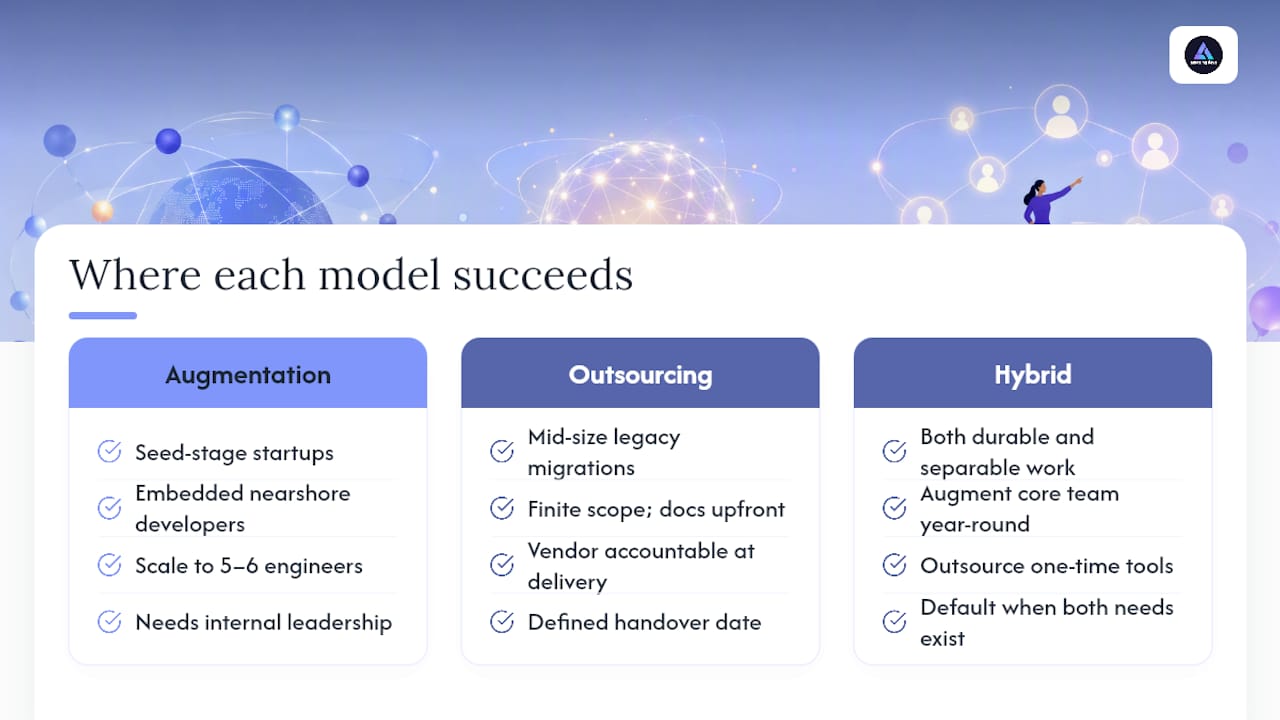
A seed-stage startup building its first product usually has founders who can direct engineers closely but can’t justify full-time salaries yet. Augmentation fits here: a couple of nearshore developers embedded in daily standups, working inside the founders’ own repo and stack, scaling to five or six engineers as funding allows.
A mid-size company migrating a legacy billing system to a new platform is a different case entirely. The scope is finite, the requirements can be documented upfront, and the internal team has no spare capacity to manage a parallel project. That’s a textbook outsourcing scenario: fixed milestones, a defined handover date, and a vendor accountable for a working system on delivery.
The hybrid pattern shows up most often in companies with one foot in both situations. A company might augment its core product engineering team year-round while outsourcing a one-time compliance audit tool that doesn’t touch the main codebase. Resourcifi’s guidance treats this split, augment the durable work, outsource the separable work, as close to a default recommendation once a company has both kinds of need running simultaneously.
The pattern that fails most often: a company with no engineering leadership tries augmentation anyway, assuming vendors will self-direct. They won’t, and shouldn’t. Augmented engineers work inside your management structure by design. Without direction, that structure has a hole in it.
A Rule of Thumb for Choosing Between Models
The most common procurement mistake is mismatching the model to leadership capacity, choosing augmentation without a lead who can direct it, or choosing outsourcing for work that needed tight, iterative control. My rule of thumb after advising on this decision repeatedly: if you can name the person who will run standups next Monday, augment. If you can’t, outsource until you can.
— Gabriel
Should You Outsource or Augment Your Team in 2026?
Matching your staffing model to your actual engineering leadership capacity, not just your budget or timeline, is the single factor that predicts whether the engagement succeeds.
| Point | Details |
|---|---|
| Leadership capacity decides fit | Augmentation needs a functioning lead to direct new engineers; without one, outsourcing is safer. |
| Cost shape differs by risk | Time-and-materials augmentation flexes with scope; fixed-price outsourcing risks change-order overruns. |
| Ramp times vary | Augmentation can start in days to weeks; outsourcing needs two to six weeks for scoping and contracts. |
| Hybrid is often the real answer | Augment your core product team while outsourcing separable, well-defined side projects. |
| Amazing Devs fits managed augmentation | Amazing Devs handles nearshore sourcing, screening, and contracts while your team keeps daily control. |
Authoritative comparisons from Resourcifi, Arc, and Idealogic back the definitions and decision criteria in this piece, alongside BLS occupational data for U.S. developer wage context. For deeper reading on Amazing Devs’ own model, see the pros and cons of staff augmentation and nearshore vs offshore sourcing.
Scale Your Engineering Team Without Losing Control
If you’ve read this far, you already know augmentation only works when you can direct the engineers yourself, and that’s exactly the gap Amazing Devs closes for U.S. companies hiring nearshore. Amazing Devs screens Brazilian developers for technical skill and cultural fit before you ever see a resume, then handles the contracts and payroll logistics so your team leads keep full daily control over the work.
That combination, vetted talent plus managed paperwork plus direct control, is what separates augmentation done well from the leadership gap this article just walked through. If a separable project fits outsourcing better, Amazing Devs’ outsourcing services cover that too. Either way, the next step is the same: talk to Amazing Devs about your team’s current roadmap and get a shortlist of matched developers before your next sprint planning cycle.
Sources
- Bls
- Staff Augmentation vs Outsourcing: Choose Right | Resourcifi
- Staff Augmentation vs Outsourcing vs Managed Services (2026 Guide) – Arc Employer Blog
- Staff Augmentation vs Outsourcing: How to Choose | Idealogic
FAQ
Is Staff Augmentation Considered Outsourcing?
Not in the strict sense. Staff augmentation adds people to your own managed team, while outsourcing hands a defined outcome to a vendor who manages the work itself, a distinction Resourcifi treats as the core difference between the two.
Is Outsourcing a Dying Concept?
No. Outsourcing remains a standard model for well-scoped, self-contained projects where a company would rather pay a vendor to own delivery than manage the work internally; it’s simply not the right fit for every engagement.
What Are the Three Types of Outsourcing?
Outsourcing is commonly split by location: onshore (same country), nearshore (a nearby country, often similar time zones), and offshore (a distant country, usually for lower rates). Each carries different trade-offs in cost, communication, and overlap hours.
What Are the Three Main Types of Staffing Models?
The three main models are staff augmentation, outsourcing, and managed services. Staff augmentation adds managed headcount, outsourcing transfers ownership of a scoped project, and managed services puts a provider in charge of an ongoing function under a service-level agreement, as Arc’s comparison lays out.
How Do I Know If My Company Is Ready for Staff Augmentation?
If you have engineering leads with bandwidth to onboard and direct new team members, and you need flexible headcount rather than a fixed deliverable, you’re likely ready. Amazing Devs’ screening process is built specifically to reduce the onboarding risk that trips up companies trying augmentation for the first time.