60–90 Minute Pair Programming Interview Scripts for Candidates and Teams
A pair programming interview tests how you collaborate, communicate, and judge trade-offs in real time, not whether you memorized an algorithm. The single most important move is to treat the session like a real day of pairing: narrate your thinking, ask questions, and switch roles when it makes sense. Sessions typically run 60 to 90 minutes, and the strongest interviewers score against a written rubric rather than a gut feeling, because pairing consistently reduces defects when it’s done well on the job, too.
TL;DR:
- Effective pair programming interviews last 60 to 90 minutes, with the emphasis on collaboration, communication, and trade-off reasoning rather than perfect solutions.
- Interviewers should utilize structured rubrics and role switches to accurately score candidates on key dimensions like narration, role cooperation, and technical fluency.
- Candidates should rehearse by setting up their environment early and practicing with real partners to simulate real-work conversations and avoid spending too much time orienting.
- Remote pairing tools such as hosted editors or IDE-sharing plugins are preferred, but candidates and interviewers must test them thoroughly beforehand to prevent delays or lag.
- Avoid stale problems, silent coding, or passive observation; fostering open dialogue, clear role swaps, and honest communication greatly improves the signal from the session.
Table of Contents
- What Does a Pair Programming Interview Look Like?
- How Are Pair Programming Interviews Scored?
- How Should Candidates Prepare for a Pair Programming Session?
- How Should Interviewers Run and Score These Sessions?
- What Tools Work Best for Remote Pair Programming?
- What Mistakes Wreck a Pair Programming Interview?
- A Sample 60 to 90 Minute Session Timeline
- How Amazing Devs Evaluates Collaboration in Hiring
- The Real Skill Being Tested Isn’t Coding
- Sources
- FAQ
What Does a Pair Programming Interview Look Like?
Most sessions hand you a working (if imperfect) codebase and ask you to do one of four things: fix a failing test, add a small feature, refactor a messy function, or just explore an unfamiliar repo and explain what you find. None of these require you to invent a clever algorithm from scratch. They require you to work the way you’d actually work on a real team, which is exactly the point.
The role structure shapes how the hour feels:
- Driver/navigator — one person types while the other reviews, questions, and suggests direction, then you swap.
- Ping-pong TDD — one person writes a failing test, the other makes it pass and writes the next failing test, back and forth.
- Strong-style pairing — the navigator has to state the idea before the driver types anything, which forces verbal precision.
- Single-block session — no formal role swap; the interviewer and candidate move fluidly, common in shorter or more casual formats.
Recruiters gravitate toward these formats because they surface real signal, and problems that resemble actual work beat abstract puzzles for that purpose. Expect session length in the 60 to 90 minute range. Forty five minutes rarely leaves room to get past the orientation phase, and two hours tends to produce fatigue rather than better signal. If you’re prepping, rehearse in that window, not in the 20 minute leetcode sprint you might be used to. The pace is slower and the conversation matters more than the keystrokes.
How Are Pair Programming Interviews Scored?
Good interviewers don’t wing it. They score against a small set of dimensions, each with anchored descriptions of what a 1 looks like versus a 5, because anchored 1 to 5 scales with example behaviors cut down on the fuzzy “I just liked them” bias that ruins most interview feedback.
A workable rubric looks like this:
- Communication (weight: high) — 1: works in silence, ignores questions. 5: narrates intent before typing, checks assumptions out loud, adjusts based on feedback.
- Collaboration (weight: high) — 1: dismisses the interviewer’s input or refuses to swap roles. 5: builds on suggestions, hands off cleanly, treats the interviewer as a real partner.
- Technical fluency (weight: medium) — 1: struggles with basic syntax or tooling. 5: navigates the language and editor smoothly enough that tooling never becomes the bottleneck.
- Trade-off articulation (weight: medium) — 1: picks an approach with no stated reasoning. 5: names at least one alternative and explains why this one wins right now.
- Reflective depth (weight: medium) — 1: can’t explain a decision after the fact. 5: identifies what they’d do differently with more time.
Communication and collaboration should carry the most weight, since candidates who narrate their thought process, ask clarifying questions, and write small tests consistently outperform quiet, heads-down coders, even when the quiet coder’s final solution is technically cleaner.
Statistic Callout: Pairing sessions run best at 60 to 90 minutes, and interviewers should score within 10 minutes of wrapping up to avoid memory drift skewing the rubric.
How Should Candidates Prepare for a Pair Programming Session?
Preparation for a pairing interview looks different from grinding practice problems alone. You’re rehearsing a conversation as much as a skill.
- Set up your environment the week before. Know your IDE’s shortcuts cold, confirm your screen share works, and test the specific collaborative tool the company mentioned in scheduling.
- Practice with a real partner. Mock pairing sessions with a friend or a peer teach you something solo practice can’t: how it feels to think out loud under mild pressure, since pairing is a distinct, practicable skill that improves with repetition, not raw talent.
- Timebox your practice runs to 45 or 60 minutes so the real thing doesn’t feel unfamiliar in length.
When the session starts, resist the urge to type immediately. Spend the first several minutes orienting: skim the README, find the entry point, and ask what the interviewer actually wants prioritized. Interviewers often hand you a messy or unfamiliar codebase on purpose, and rushing straight into code without exploring the structure is one of the fastest ways to burn 20 minutes going the wrong direction.
Once you’re coding, keep commits small, write a test before you fix the thing it’s testing when that fits the task, and say your intent out loud before your hands move. Alternate driving if the format calls for it, and when you hit something you genuinely don’t know, say so plainly instead of stalling. “I haven’t used this library before, can you point me at the docs or should I search?” reads far better than five minutes of silent Googling. For deeper habits that carry over into the actual job, Amazing Devs’ guide to application development practices covers coding hygiene worth building before interview day, not during it.
Pro Tip: If you get stuck, narrate the stuck-ness instead of hiding it. “I think the bug is in how we’re handling the empty array case, let me add a quick test to confirm” shows more judgment than a silent guess that happens to work.
How Should Interviewers Run and Score These Sessions?
The quality of a pair programming interview depends almost entirely on how much thought went into it before the candidate ever joins the call.
Start with problem design. A good pairing exercise needs to resemble real work, allow for more than one reasonable solution path, and hold up under a time limit. Pilot every new problem on three internal engineers first; if experienced people on your own team can’t produce useful signal from it, candidates won’t either. Problems built for trade-off discussion rather than a single correct answer consistently generate richer conversation than closed-ended puzzles.
During the session itself:
- Give a short, honest orientation to the codebase before the clock starts, the same way you’d onboard a new hire.
- Let the candidate drive most of the time, but jump in occasionally. A pairing interview where the interviewer never touches the keyboard isn’t really testing collaboration.
- Schedule at least one role switch partway through, and announce it clearly rather than letting it happen awkwardly.
- Save five minutes at the end for a debrief conversation, not just a code review.
Bias creeps in fastest when interviewers default to silent observation without a structured rubric. Fix it with a written scorecard, a second rater whenever possible, and scoring done before anyone reopens the resume. Quarterly calibration sessions using recorded interviews keep raters aligned over time, an approach checklist-driven evaluation frameworks back up across hiring functions generally, not just engineering.
What Tools Work Best for Remote Pair Programming?
Remote pairing lives or dies on the tooling, and the wrong choice turns a collaboration test into a connectivity test.
Your main options: hosted collaborative editors built specifically for interviews, live IDE-sharing plugins, or a plain screen share paired with a shared repo. Browser-based platforms like CoderPad and LeetCode Interview work well when you want zero setup friction and built-in language support. VS Code Live Share and JetBrains Code With Me give both people their own cursor inside a real IDE, which matters if the task involves navigating a large, unfamiliar codebase where IDE features like “go to definition” actually help. A basic screen share plus a shared Git repo works fine for shorter, simpler tasks but adds latency to every handoff.
Whatever you pick, run through this before the candidate joins:
- Test audio and video quality on the actual platform, not a generic call.
- Confirm editor and repo permissions are live, not “pending.”
- Install dependencies and do a dry run of the starter project.
- Check for lag. A half-second delay on every keystroke wrecks the ping-pong rhythm.
- Decide in advance whether the session is recorded, and tell the candidate.
Distributed teams working across time zones sometimes use “bookend pairing,” where one person starts a task, hands off written notes, and a teammate in another zone picks it up. It’s a reasonable pattern for real work, but a poor fit for interviews since it strips out the live collaborative signal you’re actually trying to measure. For broader guidance on making remote setups work day to day, Amazing Devs’ remote working resource covers the infrastructure side in more depth.
What Mistakes Wreck a Pair Programming Interview?
Most failed sessions fail the same handful of ways, on both sides of the table.
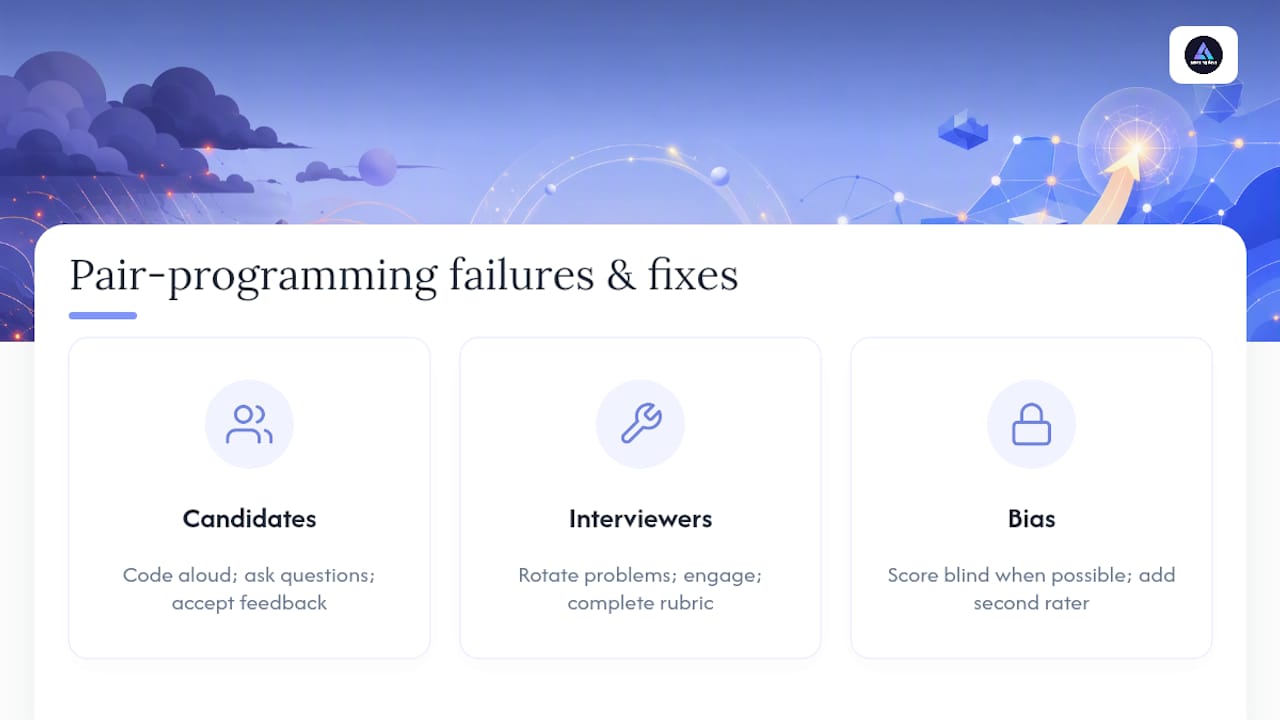
Candidates most often sink themselves by coding in silence, refusing to ask for clarification, or clinging to their first approach even after the interviewer flags a problem with it. The fix is almost embarrassingly simple: talk more, and treat interviewer feedback as new information rather than a threat to your ego.
Interviewers cause just as much damage. Common failures include reusing a stale problem that’s leaked online, sitting back and observing without engaging, and skipping the rubric in favor of a vague “good vibe” impression afterward. Each of these has a direct fix: rotate problems regularly, drive occasionally yourself, and fill out the scorecard before discussing the candidate with anyone else.

Bias amplifies when a single interviewer scores alone after seeing the resume first. Two structured mitigations help most: score blind to background whenever the workflow allows it, and bring in a second rater for close calls. Neither takes more than a few extra minutes of process design, and both meaningfully improve consistency across candidates.
A Sample 60 to 90 Minute Session Timeline
Here’s a script both sides can rehearse before the real thing:
- 0 to 5 minutes: Introductions, quick orientation to the task and codebase, tooling check.
- 5 to 15 minutes: Candidate reads through the repo, README, and relevant files out loud, asking clarifying questions.
- 15 to 20 minutes: Candidate proposes an approach; interviewer confirms scope or nudges direction if needed.
- 20 to 55 minutes: Active coding with at least one role switch around the midpoint. Interviewer occasionally drives or injects a small twist.
- 55 to 65 minutes: Wrap up the current thread, even if incomplete, rather than starting something new.
- 65 to 75 minutes: Debrief conversation: “What would you do differently with more time?” “Walk me through the trade-off you made at the start.”
- 75 to 90 minutes: Interviewer scores independently against the rubric while the session is still fresh.
A tighter 45 minute variant compresses steps two and three into five minutes and drops the mid-session role switch, but expect a noticeably thinner signal on collaboration. At handoff points, a clean script sounds like: “I’m going to hand you the keyboard here. I was about to check whether this function handles null input.” Simple, specific, and it keeps momentum instead of losing five minutes to an awkward pause.
How Amazing Devs Evaluates Collaboration in Hiring
Assessing whether a developer can actually pair well, not just code well, sits at the center of how Amazing Devs vets nearshore talent before ever presenting a candidate to a client.
- Every developer goes through structured technical and collaborative assessment, not just a resume screen and a solo coding test.
- Cultural fit and communication style get evaluated alongside raw technical skill, since a brilliant coder who can’t pair effectively creates friction on a distributed team.
- Contract management and onboarding logistics are handled directly, so clients inherit a developer who’s already comfortable working closely with a remote counterpart.
- Candidates preparing for their own interview loop can find more structured guidance in Amazing Devs’ recruitment best practices resource.
If your team wants developers who arrive already fluent in collaborative workflows, Amazing Devs connects businesses with nearshore Brazilian engineers vetted specifically for that fit, cutting the ramp-up time most new hires need before they pair well.
The Real Skill Being Tested Isn’t Coding
Most advice about pair programming interviews treats them as a slightly friendlier coding test, and that framing undersells what’s actually happening. The format exists because it’s hard to fake collaborative judgment under time pressure. You can memorize a sorting algorithm the night before. You cannot memorize how to gracefully receive pushback on an approach you just proposed, or how to hand off a half-finished thought to someone else without losing the thread.
That’s also why I think most candidates over-invest in algorithm review and under-invest in mock pairing sessions with an actual human. The conventional prep advice, more Leetcode, more solo grinding, optimizes for the wrong variable entirely. And most interviewers, if I’m honest, under-invest in problem design. A stale take-home problem repurposed for a live session almost always produces worse signal than something built and piloted specifically for pairing.
If you take one thing from this piece and act on it this week: candidates should find a real partner and rehearse the conversation, not just the code. Interviewers should write down their rubric before the next session, not after.
— Gabriel
Sources
- On Pair Programming — Martin Fowler
- The Pair Programming Interview: AI-Resistant Hiring’s Gold Standard | CTAIO
- Pair Programming Interview: What to Expect and How to Succeed (Kindatechnical)
- What to expect from a pair programming interview | Thoughtworks
FAQ
How Long Does a Pair Programming Interview Usually Last?
Most sessions run 60 to 90 minutes. Anything under 45 minutes rarely allows enough time to orient and code meaningfully, and sessions beyond two hours tend to produce fatigue rather than better signal.
What’s the Difference Between Driver/Navigator and Ping-Pong Pairing?
In driver/navigator, one person types while the other reviews and directs, then you swap. In ping-pong pairing, one person writes a failing test and the other makes it pass, then writes the next test, alternating roles constantly.
Do I Need to Solve the Problem Completely to Pass?
No. Interviewers weigh communication, collaboration, and trade-off reasoning as heavily as a finished solution, and wrapping up the current thread cleanly matters more than rushing to a complete answer.
What Should I Do If I Don’t Know Something Mid-Session?
Say so plainly and ask how to proceed, whether that’s checking documentation or asking the interviewer directly. Narrating your thought process instead of staying silent consistently scores better than a quiet guess.
What Tools Should I Expect for a Remote Pairing Interview?
Expect either a hosted collaborative editor like CoderPad, a live IDE-sharing plugin like VS Code Live Share or JetBrains Code With Me, or a basic screen share paired with a shared repository, depending on the company’s setup.