You can pay foreign contractors legally and efficiently, but the first move is not choosing a payment app. It’s confirming two things: whether the contractor is genuinely independent (not an employee), and where the work is physically performed. Those two answers determine your entire tax and withholding posture before a single dollar moves.
Before the first payment, run through this checklist:
-
Collect the right W-8 form. Individual contractors provide Form W-8BEN; foreign business entities provide Form W-8BEN-E. No valid form on file means you may be required to withhold at the 30% statutory rate.
-
Verify where the work is performed. Services performed entirely outside the U.S. by a nonresident alien are generally foreign-source income and fall outside U.S. withholding requirements.
-
Run an OFAC/SDN sanctions screen on the contractor and their bank before the first payment and periodically thereafter.
-
Record the payment method, amount, currency, and delivery confirmation for every transaction.
-
Archive the invoice, the W-8, and proof of work delivery in a per-contractor file.
Per a pre-payment compliance checklist used by finance teams, completing these steps before payment prevents default withholding and audit exposure.
Pro Tip: *Missing a W-8 form doesn’t just create a withholding headache.
Key Takeaways
Paying foreign contractors compliantly requires confirming work location, collecting the correct W-8 form before the first payment, choosing the right payment rail for your volume and frequency, and maintaining an audit-ready per-contractor file throughout the year.
| Point | Details |
|---|---|
| Work location determines withholding | Services performed outside the U.S. by a nonresident alien are generally not subject to U.S. withholding or 1042-S reporting. |
| W-8 forms are non-negotiable | Missing a W-8BEN or W-8BEN-E triggers 30% statutory withholding on every payment until corrected. |
| FX spread dominates total cost | Specialist FX platforms typically charge 0.4%–2% fee depending on the corridor. |
| Match the rail to the use case | Use specialist FX platforms for recurring retainers, bank wires for large one-off payments, and Payoneer for multi-contractor batching. |
| Amazing Devs manages the process | Amazing Devs handles contract setup, tax-form coordination, and developer vetting for U.S. companies hiring nearshore Brazilian talent. |
Table of Contents
-
What are the U.S. tax and withholding rules for paying foreign contractors?
-
How much does it cost to pay overseas workers, and how do you reduce fees?
-
In-house payments, platforms, or an EOR: which model fits your operation?
-
Amazing Devs cuts the compliance burden for U.S. companies hiring Brazilian developers
How do you pay foreign contractors? Payment rails compared
Choosing how to pay overseas workers comes down to four variables: payment size, frequency, the destination country, and whether you want the platform to handle any compliance tasks. No single rail wins on all four.

Bank wire (SWIFT)
The traditional route for large, one-off payments. SWIFT wires reach virtually every country with a bank account, but they carry real costs: your sending bank typically charges a flat fee of $25 to $50, intermediary banks can deduct additional fees mid-transfer, and the receiving bank may charge its own fee on arrival. FX spreads on bank wires are often marked up a few percent above the mid-market rate. Delivery typically takes a few business days.
Best for: Single large payments where the contractor has a local bank account and you need a paper trail.
Cons: Expensive for recurring small payments; intermediary deductions are unpredictable; slow.
ACH (not for foreign payouts)
ACH is a U.S.-domestic rail. It does not reach foreign bank accounts directly. Some platforms use ACH to pull funds from your U.S. account and then convert and forward via a different rail, but ACH itself stops at the U.S. border.
Specialist FX platforms (Wise/TransferWise)
Wise uses the mid-market exchange rate and charges a transparent percentage fee, typically 0.4%–2% depending on the currency corridor. Transfers often settle in 1–2 business days, and the platform supports dozens of currencies. For recurring monthly retainers paid to the same contractor, Wise’s fee structure usually beats a bank wire by a meaningful margin.
Best for: Recurring retainers, mid-size payments ($1,000–$20,000), and corridors where the contractor’s local currency is supported.
Cons: Transfer limits vary by corridor; not ideal for very large enterprise-volume batching without a business API integration.
Digital wallets: PayPal, Xoom, and Payoneer
It works well for contractors who already have PayPal accounts and for smaller payments where speed matters more than cost.
Xoom (a PayPal service) focuses on remittance corridors, particularly Latin America and Asia. It’s faster than a wire for those corridors, but FX markups apply and transfer limits are lower.
Payoneer is built for freelancer and contractor payouts at scale. It lets contractors receive funds in a local Payoneer account and withdraw in local currency, and it supports batch payments via API. Fees vary by corridor and payment method but are generally competitive for recurring, multi-contractor scenarios.
Best for: PayPal suits occasional small payments to contractors who prefer it. Payoneer suits recurring payments across many contractors in multiple countries.
Cons: PayPal and Xoom FX markups add up fast on large amounts. Payoneer requires the contractor to have or create a Payoneer account.
Card-based payout solutions and crypto
Virtual card payouts work for contractors who can receive a Visa or Mastercard credit to a local card. They’re fast but carry interchange and FX costs. Crypto payouts (Bitcoin, USDC, USDT) are an edge option: they settle quickly and bypass traditional banking rails, but they introduce volatility risk (unless using stablecoins), tax-reporting complexity on both sides, and limited contractor adoption outside tech-forward markets.
Payment rail comparison
Fee ranges are typical estimates based on publicly available platform pricing; verify current rates before committing to a rail.
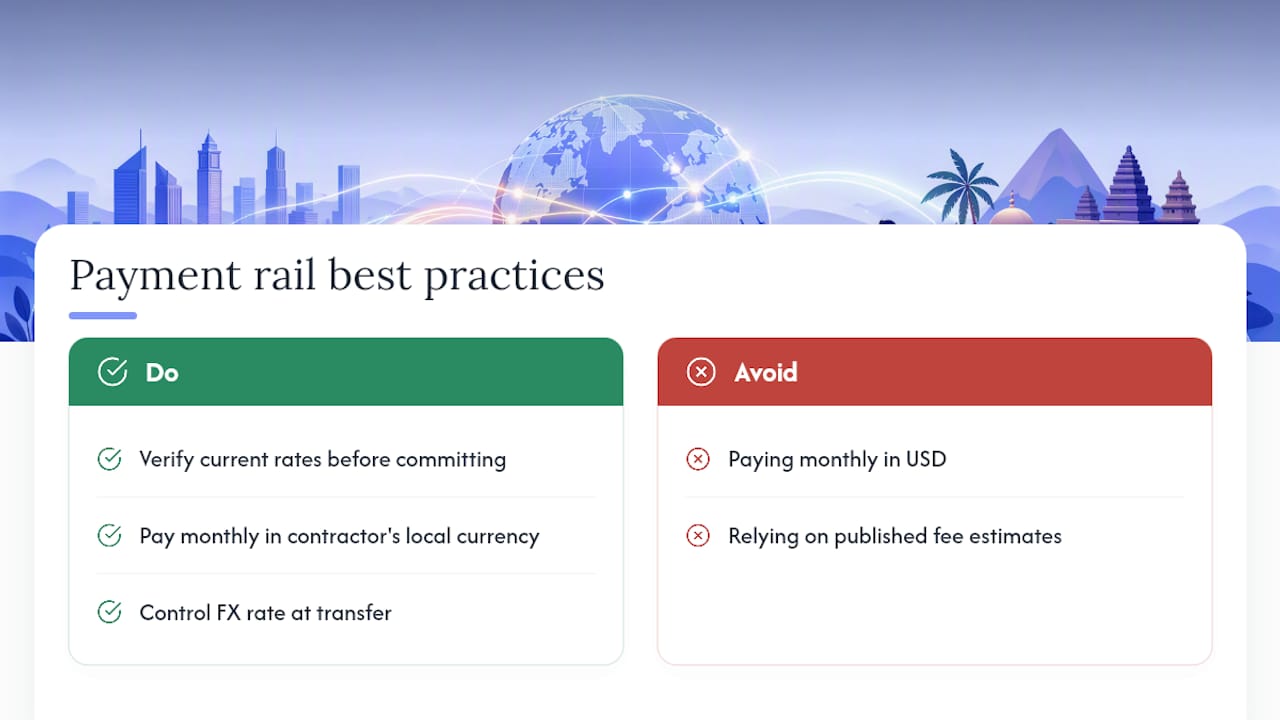
Pro Tip: When paying the same contractor monthly, send in their local currency rather than USD. The contractor avoids conversion costs on their end, and you control the FX rate at the moment of transfer rather than letting their bank decide it.
What are the U.S. tax and withholding rules for paying foreign contractors?
The single rule that governs everything: where the services are physically performed determines whether U.S. tax withholding applies.
Services performed entirely outside the United States by a nonresident alien are generally foreign-source income. Foreign-source income is not subject to U.S. Chapter 3 withholding, and you do not need to file Form 1042-S for it. That covers the vast majority of nearshore and offshore contractor arrangements where the developer or specialist never sets foot in the U.S.
If the contractor performs any portion of their services inside the United States, that portion becomes U.S.-source income. The statutory withholding rate under IRC sections 1441–1443 is 30%, although this rate may be reduced or exempted if an applicable tax treaty applies or proper documentation is provided.
Which forms to collect
-
Form W-8BEN (individuals): certifies the contractor’s non-U.S. status and, if applicable, claims a reduced withholding rate under a tax treaty. Without a valid W-8BEN on file, you may be required to withhold at 30%.
-
Form W-8BEN-E (foreign entities): required when the contractor operates through a foreign company or LLC. It covers Chapter 3 withholding and FATCA-related reporting and requires the entity to identify its FATCA status. Entities with certain structures may also need a Global Intermediary Identification Number.
-
Form 8233: used when a tax treaty exempts personal services income for an individual. Less common but relevant for contractors from treaty countries performing some U.S.-source work.
-
Form W-9 and 1099-NEC: apply only to U.S. persons. If a contractor provides a W-9, they are claiming U.S. tax status, and you report payments on a 1099-NEC. Do not issue a 1099-NEC to a foreign contractor who has provided a W-8.
Reporting: Form 1042-S and Form 1042
When U.S.-source income is paid to a foreign person and withholding applies (or a treaty exemption is claimed), you must file Form 1042-S with the IRS and furnish a copy to the contractor by March 15 of the following year. The aggregate return, Form 1042, is also due March 15. Late filing triggers IRS penalties that scale with the delay and the amount of the unreported payment.
The 2026 1099 reporting threshold context
Starting January 1, 2026, the IRS lowered the Form 1099-K reporting threshold for third-party payment networks to $600 (down from the prior higher threshold). This change primarily affects U.S.-person payees and platforms reporting U.S. transactions. For foreign contractors who have provided valid W-8 forms, the 1099-NEC reporting obligation does not apply, but the change is a signal that IRS information-reporting scrutiny is increasing across the board. Finance teams should treat this as a prompt to audit their contractor classification files.
Sanctions screening and recordkeeping
IRS guidance on worker classification makes clear that misclassification can trigger back taxes and penalties. Keep documentation of the contractor’s independence: control over how work is done, use of their own tools, multiple clients, and no guaranteed hours.
Run OFAC/SDN checks before the first payment. Sanctions lists update frequently, and a missed hit can trigger severe civil or criminal penalties. Retain W-8 forms, invoices, and payment receipts for at least three years after the filing date of the return to which they relate, longer if your internal policy requires it.
Pro Tip: Build a living file for each contractor: W-8 form, signed contract, every invoice, payment receipt, and a note on where services are performed. When annual reporting season arrives, you pull one folder instead of hunting across three systems.
Statutory withholding rate: 30% applies to U.S.-source income paid to foreign contractors without a valid W-8 form or applicable treaty exemption. Collecting the form before the first payment is the single highest-leverage compliance action a U.S. payer can take.
What should your contracts and invoices include?
Documentation is what converts a payment into a defensible business record. A wire confirmation alone proves money moved; it does not prove the contractor was independent, where they worked, or who owns the deliverable.
Required documents per contractor
-
Signed contract or Statement of Work (SOW) with clear scope, deliverables, and payment terms
-
Contractor-issued invoice referencing the SOW and specifying the currency
-
Completed W-8BEN or W-8BEN-E (collected before first payment)
-
Bank or platform payment receipt with timestamp and amount
-
Evidence of where services were performed (see below)
-
IP assignment clause or a separate IP assignment agreement
Key contract clauses to include
Scope and deliverables: Define what is being delivered, the acceptance criteria, and the timeline. Vague scope creates misclassification risk because it looks like an employment relationship.
Payment currency and timing: State the currency explicitly (USD, BRL, EUR) and the payment schedule. Ambiguity here leads to disputes and FX disagreements.
IP assignment: All work product created under the contract should assign ownership to your company upon payment. Without this clause, the contractor may retain rights under their local law.
Tax self-responsibility: The contractor acknowledges they are responsible for their own local tax obligations. This does not eliminate your U.S. withholding duties, but it documents the independent relationship.
Confidentiality and data handling: Limit what data the contractor can access and how they must handle it. For contractors working with customer data, align this clause with your privacy policy and any applicable data-protection law in the contractor’s country.
Termination and dispute resolution: Specify notice periods, grounds for termination, and the governing law. U.S. law is common for U.S.-based companies, but some contractors will negotiate for their local jurisdiction.
Capturing proof of work location
You need evidence that services were performed outside the U.S., not a sworn statement. Practical options:
-
Time-stamped Git commits or project management tool logs (Jira, Linear, Asana) showing activity from a non-U.S. IP address
-
Video call records showing the contractor’s location
-
Contractor-signed location declaration in the contract or a periodic attestation
-
Deliverable metadata (document properties, file creation timestamps)
Avoid overreaching. You do not need to monitor a contractor’s physical location continuously. A reasonable, documented basis for the work-location claim is sufficient for IRS purposes.
Data privacy and W-8 form storage
W-8 forms contain sensitive personal information: name, address, tax identification number, and sometimes treaty-claim details. Store them in an access-controlled system, not a shared drive. Limit access to the finance and legal team members who need it. If you use a payment platform that collects W-8s on your behalf, confirm their data-handling and retention practices in writing.
Pro Tip: Renew W-8 forms when a contractor changes their entity structure (sole proprietor to LLC, for example) or when your internal policy requires periodic refresh. A W-8BEN-E for an entity that no longer exists is not valid documentation.
How much does it cost to pay overseas workers, and how do you reduce fees?
The visible transaction fee is rarely the biggest cost. FX spread is. Exchange-rate markup frequently accounts for more total cost than the explicit transfer fee, especially on recurring payments.
Fee components to budget for
-
Sender bank flat fee: $0–$50 per wire, depending on your bank and account type
-
Intermediary bank deductions: $10–$30 per SWIFT hop, deducted mid-transfer and often invisible until the contractor reports receiving less than expected
-
Receiving bank fee: $0–$25, charged by the contractor’s bank on arrival
-
Platform transaction fee: Flat or percentage, varies by rail (see comparison table above)
-
FX spread: The gap between the mid-market rate and the rate you actually get; ranges from near-zero on specialist FX platforms to 4%+ on bank wires and some digital wallets
Timing by rail
-
Same day: Card payouts, PayPal (to existing accounts), some Payoneer corridors
-
1–2 days: Wise, Payoneer (most corridors)
-
2–5 days: SWIFT bank wires
-
Variable: Crypto (minutes to hours, but confirmation times vary by network)
Cost-reduction tactics
-
Batch payments. Consolidate multiple contractor payments into a single transfer where the platform supports it. One flat fee instead of five.
-
Pay in local currency. Sending Brazilian reais (BRL) to a contractor in Brazil rather than USD means you control the conversion, and the contractor avoids a second conversion on their end.
-
Negotiate receiving-bank fee reimbursements. For large, recurring transfers, some banks will waive or reimburse receiving fees if you ask.
-
Use specialist FX rails for recurring payments. The difference between a 3% bank-wire spread and a 0.6% specialist-platform spread on $15,000/month is $432/month, or $5,184/year.
-
Combine rails strategically. Use a specialist FX platform for recurring retainers and a bank wire only for large one-off payments where the flat fee is a smaller percentage of the total.
Pro Tip: Before approving a payment rail, calculate the total landed cost: flat fee + (payment amount × FX spread %). The “free” wire your bank offers is rarely free.
In-house payments, platforms, or an EOR: which model fits your operation?
The right operational model depends on how many contractors you pay, how often, and how much classification risk you’re carrying. There are three realistic options.
Model 1: In-house payments
Your finance team handles everything: collecting W-8 forms, running OFAC checks, initiating wires, reconciling receipts, and filing 1042-S returns. This works when you have one or two foreign contractors and a finance team with international tax experience.
Pros: Full control, no platform fees, direct banking relationships.
Cons: Scales poorly. Each new contractor adds manual work. Classification errors and missed form renewals are easy to miss without a system. Annual 1042-S filing requires careful reconciliation.
Model 2: Managed payment platforms and global payroll
Specialist payment platforms and global payroll services often combine payment rails with tax-form collection and contractor onboarding, making them efficient for recurring payments across multiple countries. The platform collects W-8 forms, runs KYC checks, batches payments, and generates reports for annual filing.
Pros: Scales well, reduces manual errors, often includes OFAC screening, and provides audit-ready records.
Cons: Platform fees add up; you still own the classification decision; some platforms do not file 1042-S on your behalf.
Model 3: Employer of Record (EOR) or PEO
An EOR becomes the legal employer of record in the contractor’s country, handling local payroll, statutory benefits, and labor-law compliance. This is appropriate when:
-
The contractor relationship looks more like employment than independent contracting (regular hours, single client, managed workflow)
-
The contractor’s country has strict rules about who qualifies as an independent contractor
-
You want to hire someone as a local employee without setting up a foreign legal entity
Pros: Eliminates misclassification risk, handles local statutory obligations, and allows you to hire compliantly in countries where contractor status is legally fragile.
Cons: More expensive than a direct contractor relationship; the EOR charges a markup on top of the worker’s salary; less flexibility than a pure contractor arrangement.
A practical monthly payment workflow (platform model)
A five-step compliance process covers the typical U.S. payer’s needs for recurring contractor payments:
-
Confirm status and collect forms. Before onboarding, verify the contractor is not a U.S. person and collect the correct W-8 form. Log the form in your contractor record.
-
Run OFAC/SDN check. Screen the contractor name and bank against the current sanctions list. Document the result.
-
Receive and approve invoice. Match the invoice to the SOW, confirm the amount and currency, and get internal approval.
-
Schedule and execute payment. Initiate via your chosen rail. For recurring retainers, set up a scheduled batch.
-
Reconcile and archive. Confirm receipt with the contractor, save the payment confirmation, and update the living file.
Integration features worth prioritizing
-
API batch pay for multi-contractor payrolls
-
Single-source contractor records (W-8, bank details, invoices in one place)
-
Automatic W-8 expiration reminders
-
OFAC screening built into the onboarding flow
-
Export-ready reports for 1042-S filing
The compliance gap nobody talks about until it’s too late
Most finance teams get the big things right: they collect W-8 forms, they choose a reasonable payment rail, they file their returns. Where things quietly fall apart is in the middle of the year, when a contractor changes their entity structure, moves to a different country, or incorporates a local LLC, and nobody updates the file.
A W-8BEN on file for an individual contractor who has since incorporated is no longer valid documentation. If that contractor’s payments continue under the old form and the IRS pulls the file, you’re looking at potential back-withholding liability on every payment made after the status change. The fix is not complicated: build a status-review trigger into your contractor onboarding agreement (contractor must notify you of entity or residency changes within 30 days) and run an annual file audit before year-end.
The other gap is FX cost opacity. Finance teams often approve a payment rail based on the visible fee and never calculate the spread. Over a year of paying a nearshore development team, that invisible markup can exceed the cost of a dedicated finance tool that would have caught it. Run the total landed cost calculation at least once per rail per quarter.
My practical recommendation: treat the per-contractor living file as a compliance asset, not an administrative chore. It’s the single document that lets you answer any IRS question in under five minutes. Before year-end reporting, audit every file for form validity, payment totals, and work-location evidence. An hour of review in November beats three weeks of reconstruction in March.
Amazing Devs cuts the compliance burden for U.S. companies hiring Brazilian developers
Paying nearshore developers in Brazil involves every layer discussed in this guide: W-8 form collection, OFAC screening, FX cost management, contract structuring, and ongoing file maintenance. Amazing Devs handles the operational weight of that process so your team focuses on shipping product instead of chasing paperwork.

Amazing Devs sources and vets senior Brazilian developers through a rigorous technical and cultural-fit assessment, then manages the contract and onboarding documentation, including tax-form coordination, so the first payment goes out clean. For U.S. companies that want the cost advantages of nearshore IT staffing without building an international HR function from scratch, that’s a concrete difference. Clients typically see faster time-to-fill and fewer payment errors compared to managing the process in-house across multiple platforms and spreadsheets.
If you’re ready to add a vetted Brazilian developer to your team without the compliance overhead, contact Amazing Devs to discuss your requirements and get a matched candidate profile.
Sources
The primary references used for tax and withholding guidance in this guide:
This article is general information, not a substitute for advice from a qualified financial advisor. Consult a qualified financial professional about your own circumstances before acting on anything here.