What Is Nearshore Outsourcing for IT Teams?

Nearshore means hiring software developers in a nearby country, usually within a 0 to 3 hour time difference, so your team can run standups, code reviews, and troubleshooting sessions in real time. The practical payoff is fewer scheduling standoffs and faster feedback loops than you get with distant offshore partners. For most agile product teams, nearshore is the better call when collaboration speed matters more than shaving every possible dollar off the rate.
TL;DR:
- Nearshore developers typically come from countries within a 0 to 3 hour time difference, enabling real-time collaboration for active agile teams.
- Rates for specialized nearshore talent can approach onshore prices, especially for senior or niche skills, reducing cost savings compared to offshore options.
- Risks include talent shortages in specific fields, ramp-up delays, and legal or contractual issues if not carefully managed beforehand.
- Nearshore works best when daily overlap is at least two hours, retention data is available, and legal contracts clearly cover IP and compliance.
- Providers like Amazing Devs screen candidates thoroughly and handle legal setup, making nearshore onboarding smoother and faster for clients.
Table of Contents
- What Is Nearshore Outsourcing, Exactly?
- Nearshore vs. Onshore vs. Offshore: How They Actually Differ
- The Real Benefits of Nearshoring for Software Delivery
- Where Nearshore Falls Short: Risks and Hidden Costs
- How to Decide If Nearshore Fits Your Project
- How Amazing Devs Delivers Nearshore Talent That Actually Works
- When Nearshore Is Worth It (And When It Isn’t)
- Ready to Build Your Nearshore Team?
- Sources
- FAQ
What Is Nearshore Outsourcing, Exactly?
Nearshore outsourcing definition, in plain terms: it’s the practice of delegating IT and software development work to providers in a country close enough that your workdays substantially overlap. TechTarget defines it as an engagement model built specifically around that time-zone proximity, typically within 0 to 3 hours of the client’s own clock.
That’s the technical meaning. Worth a quick side note: “nearshore” also shows up in marine science to describe waters close to a coastline, a completely unrelated concept. In business, nearshoring rests on more than the clock. Wikipedia’s overview and the ANSR explainer both point to five dimensions of proximity that make nearshore work:
- Geographic — short flights, easy visits, minimal jet lag for in-person kickoffs
- Temporal — overlapping work hours that support live collaboration
- Cultural — shared business norms, holidays, and communication styles
- Linguistic — strong English (or your operating language) proficiency
- Legal and economic — trade agreements and cost structures that simplify contracts
Engagements usually take one of three shapes: staff augmentation (you slot nearshore developers into your existing team), dedicated teams (a standalone squad working solely on your product), or project-based delivery (a fixed scope handed to an external team).
Nearshore vs. Onshore vs. Offshore: How They Actually Differ
The three models split along four practical lines: time zone, cost, oversight, and legal complexity.
Time zone and daily rhythm. Onshore means zero time gap; nearshore usually means 0 to 3 hours; offshore can mean 8 to 12 hours. That gap decides whether your daily standup happens live or gets replaced by asynchronous Slack threads and next-morning surprises.
Cost. Onshore developers command the highest rates. Offshore delivers the deepest discount but with real friction. Nearshore sits in the middle, though TechTarget notes that rates for specialized nearshore talent can climb close to onshore pricing, especially for senior engineers or niche skills.
Oversight and travel. Nearshore lets you fly out for a quarterly planning session without burning two days on the flight alone. Offshore rarely offers that option practically.
Legal and workforce factors. Nearshore countries often share trade frameworks or at least more familiar contract norms than distant offshore markets, which matters when you’re negotiating IP assignment or data handling clauses.
- Choose onshore when regulatory sensitivity or client-facing roles demand zero ambiguity.
- Choose nearshore when you need daily collaboration without onshore pricing.
- Choose offshore when budget dominates and the work is well-specified, lower-touch, or easily documented.
Many mature engineering orgs blend all three: onshore leadership, nearshore delivery for active development, and offshore capacity for overflow. Read our full nearshore vs. offshore comparison for a deeper breakdown of contract structures.
The Real Benefits of Nearshoring for Software Delivery
The core benefit isn’t just cost. It’s reduced management friction. When your nearshore team shares most of your working day, daily standups happen live instead of over recorded video, and a blocked pull request gets unblocked in an hour instead of overnight.

Statistic to know: Statista’s market outlook shows continued growth in Latin America’s software market, a region that has become a common nearshore talent pool for North American companies, meaning the supply of available engineers keeps expanding rather than tightening.
Beyond scheduling, nearshore tends to deliver:
- Tighter agile ceremonies (sprint planning, retros, and demos held live rather than staggered across days)
- Better requirement clarity, since cultural and linguistic proximity cuts down on misread specs
- Cost savings versus onshore hiring, while preserving collaboration quality that offshore often sacrifices
- Faster incremental releases, because bugs and blockers surface and get resolved within the same working day
The tradeoff is real, though: nearshore won’t match offshore’s rock-bottom rates. Teams that chase cost savings above all else sometimes give up the collaboration advantage that made nearshore worth choosing in the first place.
Where Nearshore Falls Short: Risks and Hidden Costs
Nearshore isn’t automatically cheaper. Senior specialists, niche frameworks, and in-demand skills like DevOps or security engineering can push nearshore rates close to onshore levels, particularly in competitive hubs.
Other risks worth planning around:
- Talent supply gaps in narrow specialties, even when general availability looks strong
- Retention risk if a provider doesn’t actively manage career growth for its developers
- Ramp time of several weeks before a new nearshore hire reaches full productivity on your codebase
- Weak IP or contract terms if the provider doesn’t handle legal structuring rigorously
Mitigate these with backup resourcing plans, clearly scheduled overlap windows, and contracts that spell out IP assignment before work begins, not after a dispute.
Pro Tip: Ask any nearshore provider for average developer tenure and time-to-productive numbers before signing. A provider that can’t produce those figures probably isn’t tracking them, and that’s a signal about how they manage their own talent.
How to Decide If Nearshore Fits Your Project
Nearshore tends to make the most sense for cross-functional agile teams running frequent releases on a budget that can’t absorb full onshore rates. If your project needs constant back-and-forth between product, design, and engineering, the overlap matters more than the discount.
Run through this checklist before you commit:
- Confirm overlap hours. Require at least two hours of daily overlapping core working time, plus a clear escalation window for anything outside it.
- Ask for real retention data. Average tenure and time-to-productive metrics predict continuity far better than a sales pitch.
- Request sample team CVs, not generic profiles, tied to the actual skill set your project needs.
- Check IP and legal clauses before any code gets written, not after.
- Score the fit honestly. If your work is loosely specified, low-touch, and cost is the only variable that matters, offshore may serve you better. If it demands zero ambiguity or client-facing presence, onshore might be worth the premium.
How Amazing Devs Delivers Nearshore Talent That Actually Works
Amazing Devs sources developers from Brazil, a market inside the nearshore window for North American time zones, and runs every candidate through a screening process that weighs technical skill alongside cultural fit and business alignment, not just a resume check.
That process directly targets the risks covered above, including rigorous recruitment rigor and vendor screening:
- Rigorous technical and cultural-fit assessment before any candidate reaches a client interview
- Contract and IP handling managed on the client’s behalf, removing the bureaucratic friction that trips up first-time nearshore buyers
- Proactive engineering support after placement, aimed at the retention and ramp-time gaps that undercut weaker providers
The goal is a team that fits your workflow from week one, not month three.
When Nearshore Is Worth It (And When It Isn’t)
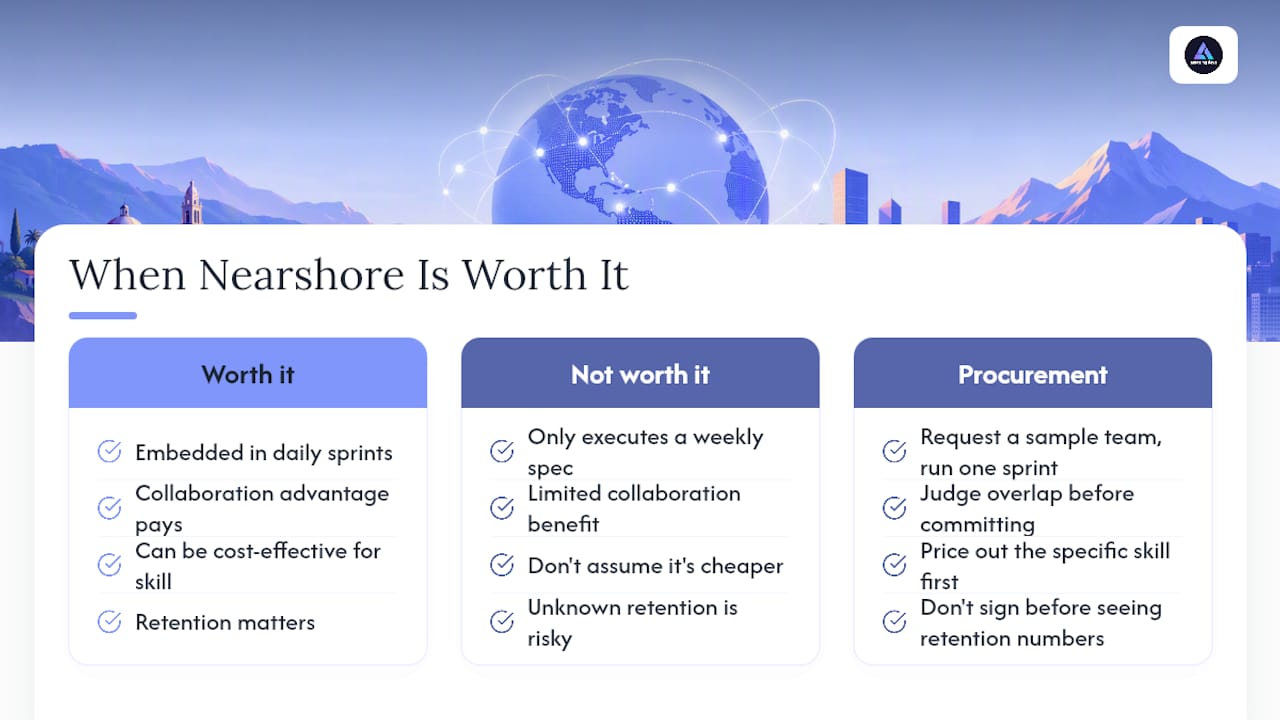
Nearshore earns its place when you need engineers embedded in your daily sprint cycle, not just executing a spec handed off once a week. That’s where the collaboration advantage actually pays for itself.
Two rules for procurement teams: don’t sign before you’ve seen real retention numbers, and don’t assume nearshore is cheaper without pricing out the specific skill you need first. If you’re still unsure, start with a pilot: request a sample team, run one sprint cycle, and judge the overlap for yourself before committing to a longer contract.
— Gabriel
Ready to Build Your Nearshore Team?
Amazing Devs gives you what the checklist above demands: Brazilian developers screened for both skill and cultural fit, with contracts and compliance handled so your team doesn’t get stuck in paperwork instead of shipping code.
If overlap hours and retention data are the two things that matter most to you, that’s exactly what Amazing Devs leads with. Every placement goes through the same assessment process outlined earlier, and Amazing Devs manages the legal and administrative work directly so your engineering leads can focus on the actual sprint. Explore outsourcing options or head to the Amazing Devs homepage to request a sample team and see how a real nearshore squad fits into your existing workflow before you commit to anything longer.
Sources
- What is nearshore outsourcing and how does it work? | TechTarget
- What Is Nearshoring? Definition, Benefits & How It Works | ANSR
FAQ
What is offshore vs. nearshore?
Offshore means outsourcing to a provider on a distant continent, often with an 8 to 12 hour time gap, while nearshore keeps you within roughly 0 to 3 hours of your own working day, which is why nearshore supports live collaboration and offshore usually relies on asynchronous handoffs.
What is another word for “nearshore”?
There isn’t a widely used synonym, but “near-site outsourcing” or “regional outsourcing” describe the same concept: delegating work to a provider in a geographically and temporally close country.
What does “nearshore” mean in a business context?
In business, nearshore refers to outsourcing IT or other business processes to a company in a nearby country that shares meaningful time-zone overlap, and often cultural and linguistic proximity, with the client.
What is nearshore outsourcing?
Nearshore outsourcing is the practice of hiring an external provider, typically within 0 to 3 hours of your time zone, to handle software development or other IT work through staff augmentation, a dedicated team, or a project-based contract, with providers like Amazing Devs handling recruitment and legal logistics on the client’s behalf.