Every Contractor Needs an NDA, With DTSA Notice and Offboarding
Yes, use an NDA with every contractor before you share anything sensitive. The right agreement is short and job-specific: it defines confidential information in concrete terms, requires return or destruction of materials when the engagement ends, and includes the federal whistleblower notice required by trade-secret law. Skip any of those three, and you’ve built a document that looks protective but folds under pressure. The clauses, a sample template, and the deployment steps follow below.
TL;DR:
- An NDA for contractors must specify concrete confidential information, include return or destruction clauses within 30 days, and contain the federal whistleblower notice to be enforceable.
- Disclosing sensitive information before signing weakens the NDA’s protections; signing should occur before any sharing.
- The scope of the NDA should be tailored with explicit categories of technical data, avoiding overly broad definitions that could trigger disputes.
- It is essential to log and store all signed NDAs, access credentials, and offboarding actions to ensure enforceability and effective trade-secret protection.
- Limiting confidentiality to two to five years for general info and matching trade secret protections to secrecy requirements is recommended for balanced enforcement.
Table of Contents
- What Is an NDA for Contractors and When Do You Need One?
- Clause-by-Clause Checklist: What to Include and Why
- Sample Contractor NDA Template With Fill-In Notes
- How to Roll Out the NDA: Signing, Records, and Offboarding
- How Long Should the NDA Last, and Why the DTSA Notice Matters
- Red Flags, Contractor Pushback, and Fair Negotiation Language
- Pre-Disclosure and Offboarding Checklist
- How Amazing Devs Handles Contractor Confidentiality
- Let Amazing Devs Handle the Onboarding Paperwork
- Sources
- FAQ
What Is an NDA for Contractors and When Do You Need One?
A contractor NDA is a signed promise that anyone you bring in outside your payroll won’t use or share what they learn while working with you, whether that’s your codebase, your customer list, or your unreleased product roadmap. It’s distinct from an employee NDA mainly in scope and leverage: contractors often work across multiple clients at once, so the agreement has to protect your information without pretending to own their entire skill set or client roster.
You have two structural choices. A standalone NDA works well when you’re still in the scoping or interview phase and haven’t committed to a contract yet. Once you sign a master service agreement or statement of work, it usually makes more sense to embed confidentiality terms directly into that document, so you’re not managing two separate instruments with two separate expiration clocks.
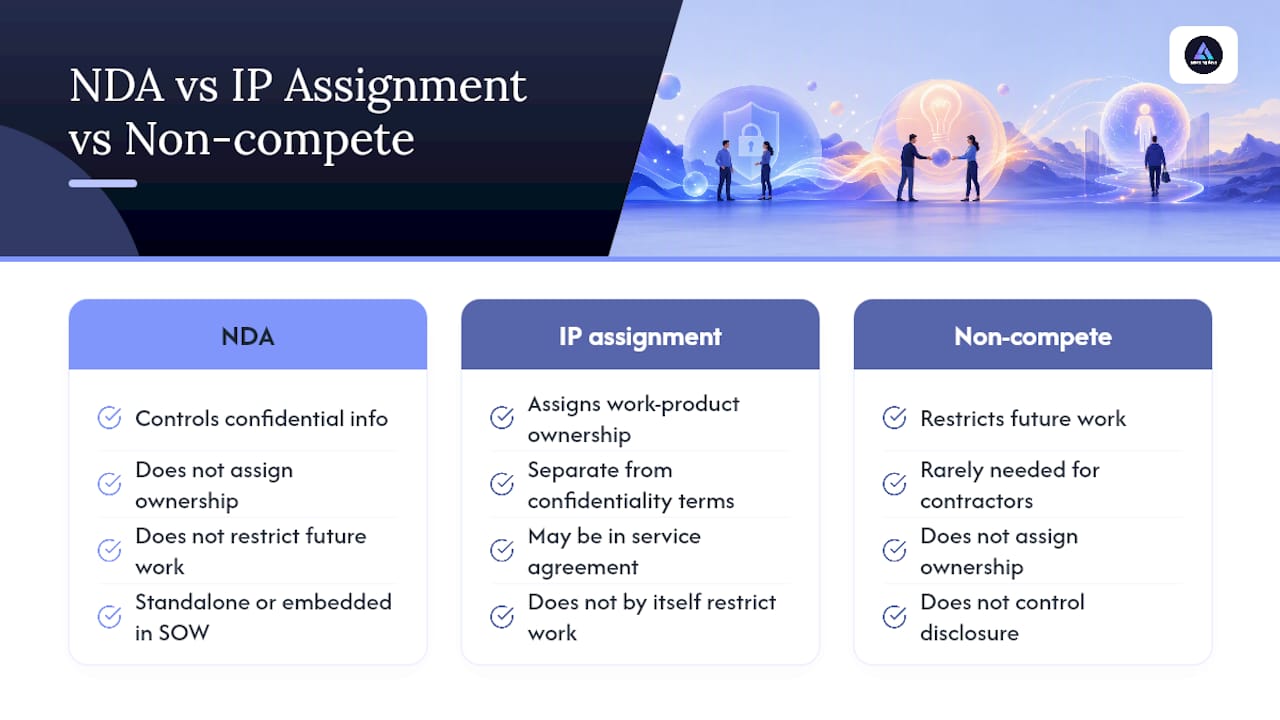
Don’t confuse this with an IP assignment or a non-compete. An NDA controls what a contractor can say or do with your confidential information. IP assignment controls who owns the work product they create. A non-compete restricts where they can work next, and most contractor relationships don’t need one. Sign the NDA before you disclose anything. Signing after the fact weakens it considerably, since a contractor could argue the information was shared freely.
Clause-by-Clause Checklist: What to Include and Why
Every enforceable contractor NDA rests on a handful of clauses. Skip one, and you’ve got a document that sounds serious but does nothing under scrutiny.
- Purpose and permitted use. State exactly why confidential information is being shared and what the contractor may do with it, usually limited to performing the contracted work.
- Definition of Confidential Information. Vague language like “business information” won’t hold up. For technical roles, list specifics: source code, API keys, database schemas, algorithms, architecture diagrams, and system documentation.
- Standard exclusions. Information that’s already public, already known to the contractor, independently developed, or required to be disclosed by law shouldn’t be covered. Courts expect these carve-outs, and omitting them can make the whole agreement look overbroad.
- Protection obligations. Require reasonable security measures and limit internal sharing to people who genuinely need access.
- Return or destruction. Materials, including anything copied to personal devices or cloud storage, should be returned or destroyed within a set window, typically 30 days, with written certification.
- Remedies and DTSA notice. Spell out that breach may justify injunctive relief, not just damages, and include the federal whistleblower notice (more on this below).
- No rights granted / IP note. Clarify the NDA doesn’t transfer ownership of anything, and point to a separate IP assignment if deliverables need to change hands.
Pro Tip: Don’t copy a generic NDA template off the internet and call it done. Tailor the Confidential Information definition to the actual project. A developer NDA that lists “source code and API credentials” holds up far better in a dispute than one that just says “proprietary information.”
Sample Contractor NDA Template With Fill-In Notes
Here’s a lean, copy-ready structure you can adapt. This isn’t a substitute for review by counsel on high-value engagements, but it covers the essentials most contractor relationships need.
- Parties and effective date. Name your company and the contractor; date it the day before work or disclosure begins.
- Purpose clause. Example: “Disclosing Party will share technical specifications, source code, and product roadmaps for the purpose of enabling Contractor to perform software development services under the associated agreement.”
- Confidential Information definition. List categories explicitly: code repositories, API documentation, customer data, financial projections.
- Exclusions. Public knowledge, prior knowledge, independent development, legally compelled disclosure.
- Term. Two to five years for general information; trade secrets survive as long as they remain secret.
- Return/destruction clause with certification language.
- DTSA notice paragraph (verbatim statutory language, covered in the next section).
- Signatures.
For unilateral versus mutual: use unilateral wording when only your company is disclosing information. Use mutual wording when the contractor might also share proprietary methods, tools, or IP during the engagement, which happens more often than most business owners expect. Most contractor templates default to mutual language for exactly this reason. Fill the Purpose and Confidential Information sections with the actual technical items at stake, not boilerplate. A vague purpose clause is one of the fastest ways to make an NDA unenforceable.
How to Roll Out the NDA: Signing, Records, and Offboarding
Ask for a signed NDA before the first substantive conversation, not after the contractor has already seen your code or client list. If disclosure already happened, you can use a retroactive NDA, but it’s weaker unless it expressly names the prior disclosures it’s meant to cover.
- Use e-signature tools that log timestamp, IP address, and signer identity as audit-trail metadata.
- Store signed copies alongside the contract and any access credentials you issue.
- At offboarding, revoke repository and system access the same day, confirm deletion from personal devices, and collect written certification as outlined in our Employee Offboarding IT Checklist.
- Keep every record. If you ever need injunctive relief, your paper trail is what proves the contractor had access and agreed to the terms.
Pro Tip: Build offboarding into your calendar the moment a contract starts, not when it ends. A revocation checklist that only gets triggered by memory is how access lingers for months after a project wraps.
How Long Should the NDA Last, and Why the DTSA Notice Matters
Set the confidentiality term at two to five years for general business information. A perpetual NDA looks tough but often gets challenged as unreasonable. Trade secrets are different: they stay protected for as long as they remain genuinely secret, so draft survival language that separates “general confidential information” (time-limited) from “trade secrets” (protected indefinitely while secrecy holds).
Include the Defend Trade Secrets Act whistleblower notice under 18 U.S.C. §1833(b). Leaving it out doesn’t void your NDA, but it forfeits your right to exemplary damages and attorney’s fees in federal trade-secret litigation if things go wrong. It costs nothing to include and only pays off if you ever need it, which makes skipping it a strange risk to take. Note that state law varies on non-compete and non-solicit enforceability tied to NDAs, so loop in counsel before you attach either.
Red Flags, Contractor Pushback, and Fair Negotiation Language
Watch for NDAs that define Confidential Information so broadly it covers a contractor’s general skills and prior knowledge, or ones with no time limit and no carve-outs. Both invite disputes and both make contractors nervous about signing.
Common negotiation swaps that keep protection intact without scaring off good contractors:
- Narrow the definition to specific, named categories instead of “all information disclosed.”
- Add a portfolio carve-out so contractors can still reference general project types in their own marketing.
- Replace vague penalty language with reasonable, specific remedies.
Offer a mutual NDA when the contractor will also expose you to their own proprietary tools or methods. Some contractors read any NDA as a disguised non-compete; clarify explicitly that it restricts use of specific confidential information, not their ability to work elsewhere. Bring in counsel for high-value IP, regulated data, or multi-jurisdiction contractors.
Pre-Disclosure and Offboarding Checklist
- Signed NDA in hand, including the DTSA notice, before any disclosure happens.
- Scope check: confirm the Confidential Information definition actually matches what this contractor will touch.
- E-signature audit trail saved, along with a record of what access was granted and when.
- Return/destruction window set (30 days is standard) with certification collected at offboarding.
- Separate IP assignment signed if the contractor’s deliverables need to transfer ownership to you.
How Amazing Devs Handles Contractor Confidentiality
Managing NDAs across a growing bench of contractors is where most in-house teams lose track, not at the drafting stage but at the follow-through. Amazing Devs builds contract administration and credential control into every placement: NDAs get signed before a developer touches a repository, access is logged, and revocation happens the day an engagement ends, not weeks later when someone remembers to ask IT. That operational discipline is what actually preserves trade-secret protection, since a signed document means little if the access behind it never gets cleaned up.
— Gabriel
Let Amazing Devs Handle the Onboarding Paperwork
Drafting airtight NDAs is only half the job. The harder part is enforcing them consistently across every contractor you bring on, especially when you’re scaling a development team fast.

Amazing Devs handles the operational side that most contracts miss: onboarding paperwork, credential issuance, access revocation, and contract administration for every nearshore developer we place. We’re not your legal counsel and we don’t draft or review your NDAs, but we make sure the controls around them actually hold, so confidentiality doesn’t depend on someone remembering to revoke a login three months after a project ends. If you’re hiring Brazilian developers and want the administrative burden handled for you, see how Amazing Devs manages contractor onboarding and get a placement started this week.
Sources
- Why buyers should limit the timeframe of confidentiality in NDAs
- The notice provision of the Defend Trade Secrets Act
- Free NDA Template for Contractors (2026) | Omnivoo
- NDA for Independent Contractor: Free Template & Guide
FAQ
Can I Draft My Own NDA?
You can, and many businesses do for standard contractor engagements. For high-value IP, regulated data, or complex multi-jurisdiction arrangements, have an attorney review it before you send it out.
What Is a Non-Disclosure Agreement for Contractors?
It’s a signed agreement requiring an independent contractor to keep specified business information confidential and use it only for the contracted work, distinct from IP assignment or non-compete terms.
How Long Can NDAs Legally Last?
General confidential information is typically protected for two to five years, while trade secrets can remain protected indefinitely as long as they stay genuinely secret.
What Are Red Flags in an NDA?
Overly broad definitions of confidential information, no time limit, missing standard exclusions, and vague or excessive penalty clauses are the most common warning signs for contractors and businesses alike.
Does an NDA Need the DTSA Notice?
Yes, if it governs trade secrets. Omitting the DTSA whistleblower notice doesn’t invalidate the NDA but forfeits eligibility for exemplary damages and attorney’s fees in federal litigation.