Hire Brazilian Developers in 2–4 Weeks, No Local Entity Required for U.S. Teams
For most U.S. teams that need to hire fast without tripping over payroll law, nearshore staff augmentation through an Employer of Record is the fastest, lowest-risk way to hire Brazilian developers. Brazil sits high on the Global Innovation Index, and its developer supply shows up consistently in GitHub’s Octoverse activity data. Direct hire gives you the most control, freelancers give you the least commitment, and outsourcing firms sit in between. Amazing Devs specializes in the nearshore route, which trades a small management fee for speed and legal cover.
TL;DR:
- Nearshore staff augmentation with an EOR typically takes two to four weeks, providing faster hiring compared to direct hire which can take up to four months.
- Budgeting should include total landed costs, which for Brazilian developers range from around $5,200 to $5,600 per month for a $4,000 base salary, due to statutory benefits and management fees.
- EOR or CoR arrangements are recommended for long-term roles exceeding 12 months or when day-to-day management control is necessary, especially if no local legal entity exists.
- Most first-time hires of Brazilian developers are best suited to nearshore models that eliminate entity setup while providing a full-time, dedicated team member.
- Verifying compliance, such as IP assignment, termination clauses, and remittance processes, is crucial to avoid legal liabilities when hiring through an EOR or CoR.
Table of Contents
- How to Hire Brazilian Developers: Comparing the Hiring Models
- What Does It Cost to Hire a Developer in Brazil?
- Contracts, Payroll, and Compliance: What You Actually Need to Verify
- How to Find and Vet Brazilian Developers
- Onboarding, Collaboration, and Time-Zone Best Practices
- Common Challenges When Hiring Brazilian Developers (and Fixes)
- Amazing Devs’ Approach to Hiring Brazilian Developers
- When to Choose Managed Nearshore vs. Direct Hire
- Hire Brazilian Developers Faster With a Partner Who Handles the Paperwork
- Sources
- FAQ
How to Hire Brazilian Developers: Comparing the Hiring Models
Every hiring model solves a different problem. The mistake most U.S. companies make is picking a model based on what’s cheapest on paper, not what actually matches their timeline, risk tolerance, and how much day-to-day control they want over the engineer.
Freelancer marketplaces solve the “I need one thing done fast” problem. You post a project on a platform, hire an independent contractor directly, and pay per milestone or hour. There’s no local entity requirement and almost no onboarding overhead, but you also get zero guarantee of continuity. Freelancers often juggle multiple clients, and vetting quality varies wildly from listing to listing. Time-to-hire: often under a week. This works for short scripts, one-off integrations, or a proof-of-concept nobody expects to live past a demo.
Outsourcing firms solve the “I need a team, not a person” problem. You hand over a project scope and the firm assigns its own staff, manages its own management layer, and delivers a result. You get less visibility into who’s actually writing the code, and pivoting scope mid-project can be slow because the firm’s own processes sit between you and the engineers. Time-to-hire for a dedicated team: two to six weeks.
Direct hire through a Brazilian legal entity solves the “I want full ownership and long-term headcount” problem. This is the model most large enterprises eventually land on, but it requires registering a local entity (a Brazilian filial or subsidiary), running local payroll, and complying with Brazil’s labor code (the CLT) directly. Time-to-hire: two to four months once you count entity setup, and that’s before recruiting even starts. Very few startups or mid-market companies choose this path for a first hire.
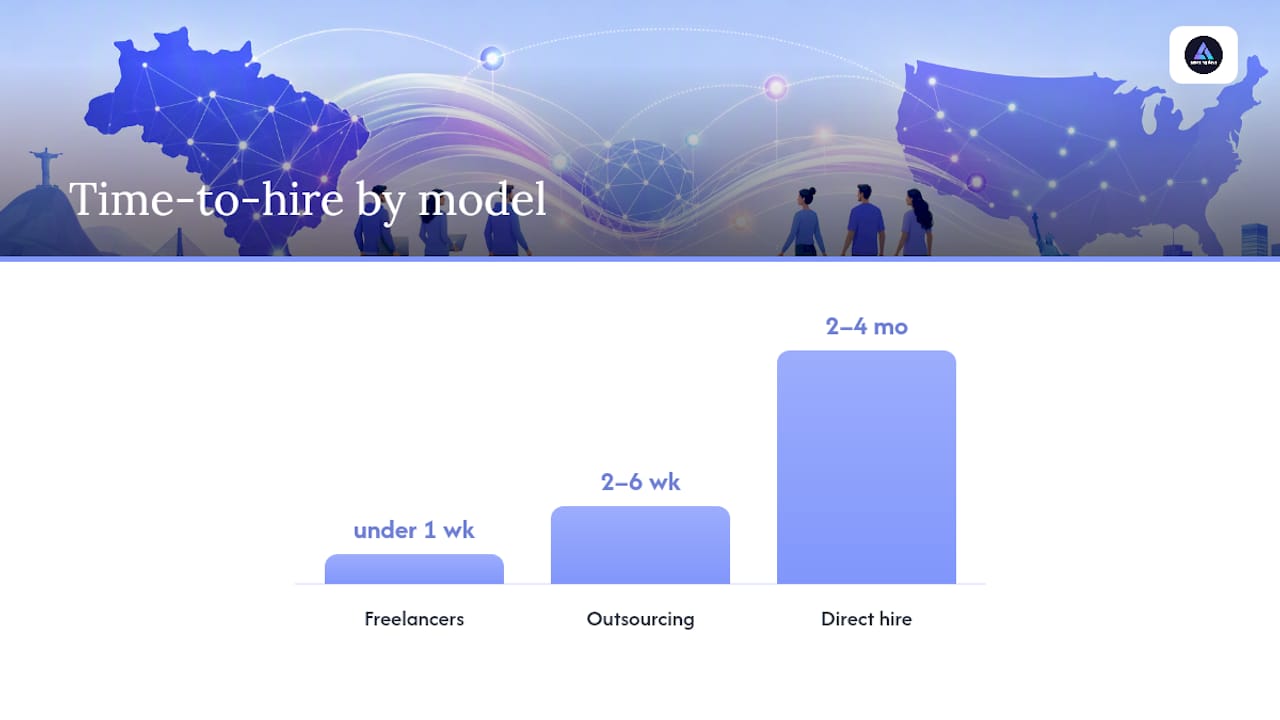
Nearshore staff augmentation with an EOR or Contractor of Record solves the problem most U.S. buyers actually have: “I want a real employee experience, direct day-to-day management, and I need to not become a payroll tax expert.” A partner like Amazing Devs sources and vets the developer, then either employs them locally (EOR) or manages a compliant contractor agreement (CoR) while you direct the work. Time-to-hire: typically two to four weeks from kickoff to first day, according to the operational patterns Amazing Devs uses across its placements.
Use this checklist to pick fast:
- How long can you wait for a hire? Under two weeks, look at freelancers. Two to four weeks, nearshore staff augmentation. Two months or more, direct hire becomes viable.
- Do you need day-to-day management control? If yes, rule out outsourcing firms, which insert their own management layer.
- Will this be a long-term role (12+ months)? If yes, EOR or CoR arrangements scale better than freelance contracts, which tend to get messy at scale.
- Do you already have a Brazilian legal entity? If not, direct hire adds months of setup you probably don’t need for one or two engineers.
Most companies hiring their first one to five Brazilian engineers land on nearshore staff augmentation because it removes the entity question entirely while still giving you a dedicated, full-time-feeling team member.
What Does It Cost to Hire a Developer in Brazil?
Salary is the smaller half of the cost equation. Base compensation for Brazilian developers is genuinely competitive against U.S. rates, but the real budgeting exercise is understanding what sits on top of that number.
Brazilian developers’ gross pay varies by seniority and specialization, with juniors earning below mid-level engineers, and senior or specialized engineers earning the highest salaries. These figures align qualitatively with broader nearshore market analyses indicating generally competitive rates compared to U.S. benchmarks. These figures track with broader nearshore market analysis on why startups are turning to Brazil for cost-efficient senior talent, and they sit meaningfully below comparable U.S. web developer salary benchmarks, where a similar mid-level role frequently starts north of $7,000 a month before benefits.
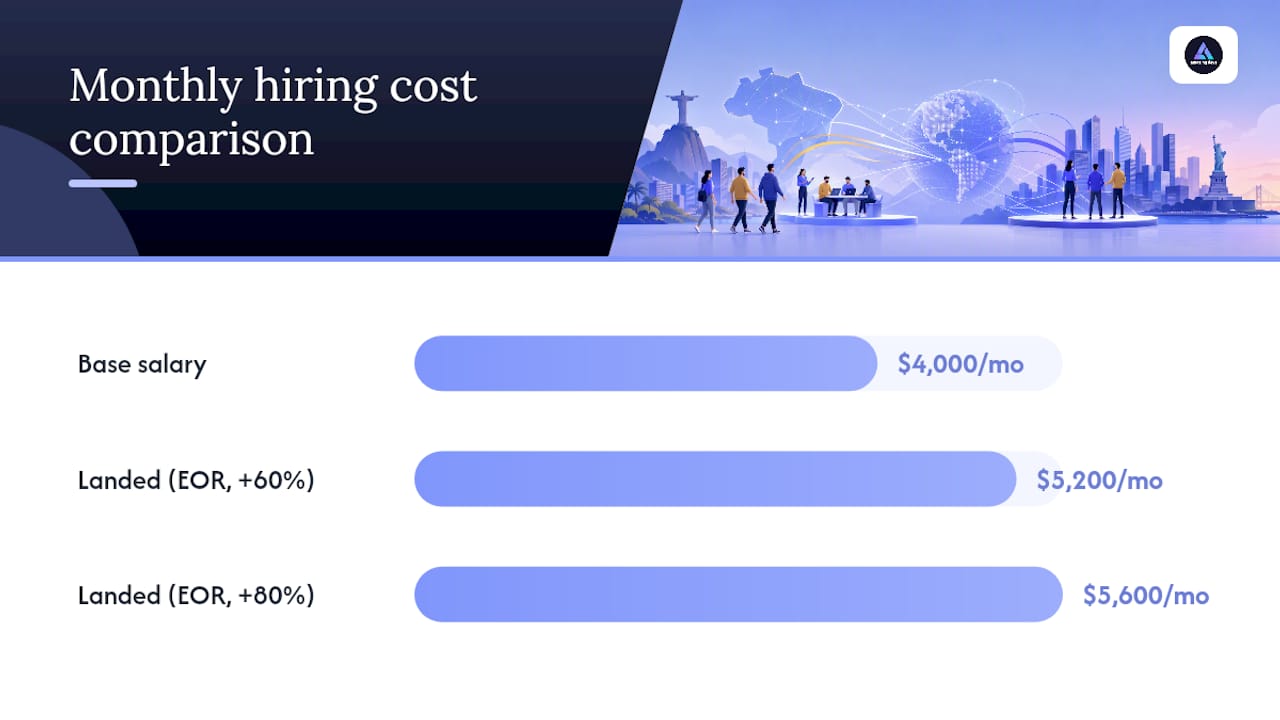
Pro Tip: Don’t budget off base salary alone. A $4,000/month engineer under an EOR arrangement often lands closer to $5,200-$5,600 in total monthly cost once you add mandatory benefits and management fees, so build your budget around landed cost, not the headline number.
Employer-side costs stack on top of gross salary. Brazilian labor law requires a 13th-month salary (an extra month’s pay split across the year), mandatory vacation pay with a one-third bonus, FGTS contributions (roughly 8% of salary into a severance fund), and INSS social security contributions. An EOR partner typically folds all of this into a single monthly invoice, usually adding 60% to 80% on top of gross salary when you account for statutory benefits and the EOR’s service fee. Direct-hire entities pay similar statutory costs but also absorb legal, HR, and payroll administration overhead that an EOR partner otherwise handles for you.
Here’s how the budget scenarios typically shake out:
For context on why Brazilian salaries stretch further locally than the raw dollar figure suggests, cost-of-living data from Numbeo shows that a comfortable monthly budget in most Brazilian cities outside São Paulo and Rio sits well under $2,000, which is part of why the same salary that feels modest by U.S. standards is highly competitive for retaining talent in Brazil.
Contracts, Payroll, and Compliance: What You Actually Need to Verify
This is where most first-time buyers get burned, not on salary, but on the paperwork nobody warned them about. Brazil’s labor code (the CLT) is protective of employees and treats misclassified contractors as a legal liability for the hiring company, not just a tax problem.
You have three real legal paths. A local entity means you register a Brazilian subsidiary and become the direct employer, taking on full CLT compliance yourself, including payroll tax filings, mandatory benefits, and termination procedures. This is the highest-control, highest-overhead option. An EOR (Employer of Record) means a third party is the legal employer on paper. You direct the work, but the EOR runs payroll, withholds taxes, and handles termination compliance. A Contractor of Record (CoR), or a properly structured independent contractor agreement, works for project-based engagements but carries misclassification risk if the relationship starts looking like full-time employment (fixed hours, exclusive availability, company equipment).
Before you sign anything, verify these items:
- IP assignment clause explicitly assigns all work product to your company under terms enforceable in Brazil, not just a generic U.S. boilerplate clause.
- Termination terms spell out notice periods and severance obligations. Brazilian law requires notice and severance calculations that most U.S. contract templates don’t address.
- Payroll tax responsibility is clearly assigned to either you, your entity, or the EOR. Never assume “the contractor handles their own taxes” holds up if the relationship functions like employment.
- Payment currency and method are agreed upfront. Most EOR partners pay developers in Brazilian reais locally while invoicing you in U.S. dollars, which shields you from currency risk but is worth confirming line by line.
- Benefits obligations (13th-month pay, vacation bonus, FGTS) are baked into the quoted rate, not billed separately after the fact.
Use an EOR or CoR the moment you’re hiring anyone for more than a short-term project and don’t already have Brazilian legal counsel on retainer. Setting up a local entity only makes financial sense once you’re hiring a large enough team that the EOR’s per-head fee outweighs entity maintenance costs, which for most companies is somewhere past ten to fifteen local employees. For a deeper walkthrough of contractor payment mechanics specifically, see this guide on how to pay foreign contractors compliantly from the U.S. side.
Pro Tip: Ask any EOR candidate for their FGTS and INSS remittance process in writing before signing. A legitimate provider will show you proof of compliance filings on request; a provider that can’t produce this on demand is a bigger risk than any salary savings they’re offering.
How to Find and Vet Brazilian Developers
Sourcing in Brazil isn’t fundamentally different from sourcing anywhere else, but the channels that work best are specific. Local job boards popular with Brazilian tech talent, GitHub activity, university partnerships with programs in São Paulo, Florianópolis, Campinas, Recife, Belo Horizonte, and Curitiba, and referral networks inside those hubs consistently outperform generic global freelance platforms for finding candidates who plan to stay. Those six cities are widely recognized as Brazil’s core tech hubs, each with its own university and startup density feeding the local talent pool.
GitHub deserves special mention as a sourcing signal. Contribution history, the languages a candidate actually ships in production, and involvement in active repositories tell you more about real-world skill than a resume ever will, a pattern GitHub’s own Octoverse data on developer activity backs up. Recruitment partners and headhunting firms that specialize in the Brazilian developer market can also shortcut months of cold sourcing by tapping networks you don’t have access to.
Once candidates are in the pipeline, run them through a consistent funnel:
- Resume and portfolio screen. Filter for relevant stack experience and, critically, real production ownership rather than tutorial-following. GitHub profiles help here more than a formatted resume does.
- Technical take-home assignment. Give a scoped, realistic problem (not a puzzle) that mirrors actual work, with a clear rubric scoring correctness, code organization, and test coverage before the interview.
- Paired live coding session. Watch how a candidate thinks out loud, handles ambiguity, and responds to feedback in real time. This catches candidates who had help on the take-home.
- Culture and English interview. Assess communication style directly, since regional English proficiency in Brazil varies significantly, and a strong coder with weak spoken English on a fast-moving team is a real risk worth screening for explicitly.
- Reference checks. Call two prior managers, not just peers, and ask specifically about reliability under deadline pressure and how the candidate handled disagreement with a manager.
Watch for a few red flags: vague answers about who owned what on a “team project,” reluctance to share a GitHub profile at all, and inconsistent overlap availability during the interview process itself, which usually predicts inconsistent overlap once hired. Confirm time-zone overlap explicitly. Brazil sits mostly in UTC-3, roughly one to two hours ahead of U.S. Eastern time, which gives you four to six hours of comfortable overlap depending on the specific U.S. time zone. Test that overlap during the interview scheduling itself. A candidate who can’t make an 9 a.m. Eastern call rarely improves once hired.
Onboarding, Collaboration, and Time-Zone Best Practices
The first 90 days determine whether a new hire becomes productive fast or quietly disengages. Structure it deliberately rather than improvising.
- Days 1 to 30: Provision system access before day one, assign a dedicated onboarding buddy, walk through architecture documentation, and assign small, well-scoped first tickets that build early confidence rather than testing limits.
- Days 31 to 60: Shift to normal sprint participation, introduce the developer in cross-team meetings, and schedule a formal check-in specifically about communication clarity and workload pacing.
- Days 61 to 90: Assign ownership of a small feature or module end-to-end, gather peer feedback, and set 6-month goals collaboratively rather than handing down a scorecard.
Meeting cadence matters more than most managers expect. Because Brazil’s UTC-3 overlaps four to six hours with most U.S. time zones, protect a fixed daily or near-daily overlap window for standups and pairing, and push documentation-heavy work to the non-overlapping hours. A scheduling tool like TimeTamer removes the manual math of tracking overlap windows across a distributed team, which matters more once you’re managing more than one nearshore hire across different U.S. offices.
Favor asynchronous-first tools for anything that doesn’t require real-time discussion: recorded video walkthroughs for complex handoffs, written design docs before big decisions, and a shared team wiki that doesn’t rely on someone being online to answer a question. Reserve live meetings for the overlap window specifically. Weekly one-on-ones and a lightweight performance check-in at 30 and 60 days catch misalignment early, before it becomes a resignation. Organizational research on distributed teams consistently finds that structured integration practices predict remote-team effectiveness better than raw talent alone, which is a strong argument for treating onboarding as a real process rather than an afterthought.
Common Challenges When Hiring Brazilian Developers (and Fixes)
Most friction points are predictable, and most have a straightforward fix once you know to look for them.
- Communication style mismatch. Brazilian workplace culture tends to be warmer and more relationship-first than the terse Slack culture common at U.S. startups. Mitigate by front-loading context and rapport in early interactions, not just task assignments. A resource on Brazilian work culture is worth sharing with any manager new to distributed teams.
- Retention risk from local market competition. Brazil’s tech market is competitive, and developers do get poached. Counter this with clear career maps, periodic local market rate reviews, and specific recognition for shipped work, not just annual reviews.
- IP and confidentiality gaps. Weak contractual language is the single most avoidable risk in nearshore hiring. Confirm IP assignment and NDA terms are enforceable specifically under Brazilian law, not just copied from a domestic template.
- Quality drift without oversight. Distributed teams can drift from code standards quietly. Enforce CI/CD pipelines with mandatory code review and automated test gates so quality control doesn’t depend on a manager’s daily attention.
Pro Tip: Run a 30-day “trial sprint” before locking in a 12-month contract, even with a strong candidate on paper. It surfaces communication and workflow friction faster than any interview can, and it costs a fraction of what a bad six-month placement costs.
Amazing Devs’ Approach to Hiring Brazilian Developers
Amazing Devs runs the nearshore model described throughout this guide as an operational service rather than a one-off recommendation. The process starts with sourcing candidates against your specific stack and role requirements, then runs them through technical assessment, English-language screening, and cultural-fit evaluation before a single resume reaches your inbox.
- Sourcing and assessment. Candidates are pulled from Amazing Devs’ vetted network and evaluated against the same skills-test, live-coding, and reference-check funnel outlined earlier in this guide, tailored by role, including specialized paths for data engineering and AI engineering hires.
- Contract and payroll management. Amazing Devs manages the EOR/CoR arrangement directly, handling Brazilian statutory benefits, tax withholding, and compliant termination terms so clients never have to interpret CLT requirements themselves.
- Scaling support. Once a first placement proves out, the same intake and vetting process scales to additional hires without requiring the client to stand up a local entity or repeat the compliance research from scratch.
The practical outcome is a shorter path to a first hire and materially less internal HR and legal overhead than either direct-hire entity setup or ad hoc freelance sourcing typically requires.
When to Choose Managed Nearshore vs. Direct Hire
Three questions cut through most of the decision paralysis. First: do you already have in-house legal or HR capacity to manage foreign payroll compliance? If not, an EOR partner isn’t a convenience, it’s a requirement. Second: are you hiring one developer or building a ten-person team over eighteen months? Scale changes the math on when a local entity starts paying for itself. Third: how much day-to-day management control do you actually need versus how much you’re willing to delegate to an outsourcing firm’s own layer of oversight?
Managed nearshore staff augmentation is clearly the better call whenever speed matters, your legal bandwidth is limited, and you want the developer reporting into your team directly rather than through a third-party project manager. Direct hire earns its overhead only once headcount and long-term commitment justify the entity cost.
The gap between what nearshore hiring promises and what it delivers usually comes down to one thing: whether the partner treats compliance as a real discipline or a line item. Cheap EOR providers that can’t produce their own tax filing process on request are a bigger liability than the salary savings they advertise.
— Gabriel
Hire Brazilian Developers Faster With a Partner Who Handles the Paperwork
Amazing Devs exists for exactly the gap this guide has been walking through: the space between “I want to hire in Brazil” and “I don’t want to become a CLT compliance expert to do it.” Instead of choosing between the slow overhead of a local entity and the risk of an unvetted freelancer, Amazing Devs sources, tests, and manages the entire relationship, so your team gets a developer, not a compliance project.
Every candidate goes through the same technical, English, and cultural screening described earlier in this guide before you ever see a profile, and every contract runs through a compliant EOR or CoR structure that Amazing Devs manages directly. That means no entity setup, no payroll tax research, and no guessing whether your termination clause holds up under Brazilian labor law.
If you’re ready to see what a shortlist actually looks like, start with a discovery call through the Amazing Devs landing page. Most clients move from that first conversation to a pilot placement within a few weeks, with the sourcing and contract work already handled on Amazing Devs’ side.
Sources
FAQ
Can You Live on $2,000 a Month in Brazil?
Yes, in most Brazilian cities outside São Paulo and Rio de Janeiro, $2,000 a month covers a comfortable standard of living according to Numbeo cost-of-living data, which is part of why competitive-but-modest-by-U.S.-standards salaries still attract and retain strong local talent.
How Much Does It Cost to Hire Dedicated Developers Through an Agency?
Dedicated developers hired through a nearshore staff augmentation partner like Amazing Devs typically cost more than a freelance contractor but less than maintaining a local entity, with the difference covering vetting, compliance management, and ongoing HR support bundled into one monthly rate.
Can a U.S. Citizen Work Remotely From Brazil?
U.S. citizens can work remotely from Brazil under a digital nomad visa for stays beyond the standard tourist period, but this question is separate from hiring Brazilian developers as employees or contractors, which is governed by Brazilian labor law rather than U.S. citizenship status.
How Long Does It Take to Hire a Brazilian Developer?
Nearshore staff augmentation through an EOR partner typically takes two to four weeks from kickoff to start date, while freelance hires can close in under a week and direct-hire entity setup often takes two to four months before recruiting even begins.