If you need production-grade data engineers fast and can’t stomach a six-month US hiring cycle, hire through a specialist nearshore partner in Brazil. Amazing Devs and firms like it place engineers who already work on Apache Spark, Apache Kafka, and dbt pipelines, typically at a fraction of US onshore cost, in weeks rather than months.
Here’s the math behind that claim. Senior Brazilian data engineers run roughly $70 to $130 per hour in blended nearshore rates, and an all-in monthly cost for a senior hire through an Employer of Record often lands around $3,432 to $5,016 a month, close to 67% below an equivalent US onshore package. Same time zone as most of the US business day, no six-month visa wait, and a talent pool that already knows Snowflake and AWS Redshift cold.
This path works best when you:
- Need to scale a data team by three to six engineers within a quarter, not a year
- Want a partner who owns payroll, contracts, and compliance so you don’t build that infrastructure yourself
- Are integrating data engineers into an existing squad rather than building an entirely new function from zero
- Care more about proven pipeline experience (ETL, streaming, orchestration) than about hiring the cheapest resume in the stack
Pro Tip: Before committing to a five or six-person pod, run a four-week pilot with one senior and one mid-level engineer on a real backlog item. You’ll learn more about a vendor’s vetting quality from one sprint than from any sales call.
Key Takeaways
Hiring nearshore data engineers from Brazil through a vetted specialist partner offers production-grade Spark, Kafka, and Airflow skills at significantly lower cost than US onshore alternatives, often with hiring timelines measured in weeks rather than months.
| Point | Details |
|---|---|
| Cost advantage is real | All-in senior hires via EOR run about $3,432–$5,016/month, near 67% below US onshore. |
| Pilot before you scale | Run a four-week pilot with one senior and one mid-level engineer before committing to a full pod. |
| Match model to need | Use augmentation for embedding, dedicated pods for standalone squads, build-transfer for long-term ownership. |
| Vet on real debugging stories | Interview questions about production failures reveal more than architecture whiteboarding. |
| Amazing Devs handles the overhead | Vetting, contracts, and payroll are managed end-to-end, letting you focus on shipping. |
Table of Contents
- Why Nearshore Brazil Works for Data Engineering
- How Do You Evaluate a Nearshore Data Engineering Partner?
- Onboarding, Contracts, and Retention for Nearshore Data Engineers
- When to Choose Nearshore vs. Hiring Locally
- Get Started With a Nearshore Data Engineering Pilot
- Where These Figures and Practices Come From
- Sources
- FAQ
Why Nearshore Brazil Works for Data Engineering
Brazil’s advantage for data engineering hiring isn’t just cheaper labor. It’s overlap on the clock and depth in the pipeline. Engineers in São Paulo or Florianópolis work business hours that line up with US Eastern and Central time for most of the day, which means your data engineer can join a 10 a.m. stand-up without anyone waking up at midnight. That overlap alone eliminates the asynchronous back-and-forth that kills momentum on offshore teams working 10 to 12 time zones out.

The talent pipeline is real, not marketing copy. Brazil produces engineering graduates out of hubs in Rio de Janeiro, Belo Horizonte, Florianópolis, Curitiba, and Porto Alegre at a volume that supports specialized data roles, not just generalist web developers. That matters because data engineering recruitment is narrower than general software hiring: you’re not just looking for someone who can write Python, you need someone who has actually built a streaming pipeline that didn’t fall over in production.
Amazing Devs structures its delivery around three models, mirroring what FWC Tecnologia documents as the standard nearshore engagement shapes. Staff augmentation embeds one or two engineers directly into your existing team, reporting to your engineering manager. Dedicated pods give you a self-contained squad, typically four to eight engineers plus a lead and QA, running semi-independently against your roadmap. Build-transfer stands up a team under the vendor first, then transfers ownership and often the engineers themselves to your entity once the function matures. Startups usually start with augmentation. Companies scaling a data platform from scratch often prefer a dedicated pod so the team ships as a unit from day one.
Trust signals matter more here than in general software hiring, because a mediocre data engineer causes damage that’s hard to see until a pipeline silently drops rows for three weeks. Amazing Devs runs technical assessments before any candidate reaches a client interview, checks references from prior engagements, and tracks retention so clients aren’t rebuilding a team every six months. Ask any nearshore vendor for their average engineer tenure on client accounts. If they can’t answer, that’s a red flag worth noting.
Statistic Callout: Vendor-managed data engineering pods in Brazil commonly run $35,000 to $90,000 per month depending on seniority mix and squad size, a wide enough range that pricing conversations should always specify the exact skill blend before you compare quotes.
Expect a competent Brazilian data engineering candidate pool to cover:
- ETL design and data pipeline architecture
- Apache Spark for distributed processing
- Apache Kafka for event streaming
- Apache Airflow for workflow orchestration
- dbt for transformation and data modeling
- Snowflake and AWS Redshift for warehousing
- Working cloud experience across AWS, GCP, or Azure
Pro Tip: Ask candidates to walk through a pipeline failure they debugged in production, not a pipeline they designed on a whiteboard. The debugging story tells you far more about real-world competence than a clean architecture diagram ever will.
| Point | Details |
|---|---|
| Time-zone overlap | Brazilian business hours align closely with US Eastern and Central, cutting async delays. |
| Talent hubs | Rio de Janeiro, Belo Horizonte, Florianópolis, Curitiba, and Porto Alegre feed a strong engineering pipeline. |
| Engagement models | Augmentation, dedicated pods, and build-transfer each fit different scaling stages. |
| Pod pricing | Vendor-managed pods typically run $35,000 to $90,000 per month depending on seniority mix. |
How Do You Evaluate a Nearshore Data Engineering Partner?
Run every provider or candidate through the same seven dimensions, in this order, so you’re comparing apples to apples instead of getting swayed by whoever pitches best.
- Hiring model fit. Does the provider actually offer augmentation, dedicated pods, and direct hire, or just one flavor dressed up three ways?
- Seniority match. Ask for the exact mix of senior, mid, and junior engineers proposed, not a vague “experienced team.”
- Tech-stack expertise. Require proof of hands-on work with your specific stack (if you run Kafka and Snowflake, ask for examples of both, not adjacent tools).
- Pricing and billing transparency. Get a rate card broken out by seniority, not a single blended number that hides who’s actually doing the work.
- Time-to-hire. A specialist nearshore partner should present a shortlist within one to two weeks; anything longer suggests a thin bench.
- Communication and cultural fit. Request a live call with the actual candidate, not just a recruiter, before any offer discussion.
- Contract flexibility. Confirm you can scale up, scale down, or swap an engineer without penalty clauses buried in the fine print.
Interview questions that actually separate strong candidates
Skip generic “tell me about yourself” openers. Data engineering interviews should test judgment under real constraints:
- Walk me through a data pipeline you built that broke in production. What caused it, and how did you fix it?
- How do you decide between batch processing and streaming for a given use case?
- Describe a time you had to optimize a slow Spark job. What was the bottleneck?
- How do you handle schema evolution in a pipeline feeding multiple downstream consumers?
- What’s your approach to testing data transformations before they hit production?
- How do you monitor data quality once a pipeline is live?
- Walk me through how you’d design an ingestion pipeline for a source that changes its API without warning.
- How do you document a pipeline so someone else can maintain it after you’re gone?
A solid take-home task: give candidates a small, messy dataset and ask them to build a transformation pipeline with basic validation and a written note on tradeoffs. Score on correctness, but weight the written reasoning higher. Anyone can copy a working script; explaining the tradeoffs shows you they actually understood the problem. For a broader framework on structuring these evaluations, The Recruitment Alternative’s hiring checklist offers a useful role-definition template worth adapting to data roles specifically.
Timeline runs roughly like this: discovery and role scoping take about a week, shortlist delivery one to two weeks after that, technical assessment and client interviews another week, and offer-to-start typically two to four weeks depending on notice periods. A dedicated pod takes longer to assemble than a single augmentation hire, usually four to six weeks total versus two to three.
Watch for these red flags during evaluation: a candidate who can’t produce a code sample or walk through prior work in detail, a vendor who won’t share reference contacts, evasive answers when you ask who owns IP and data residency, and English fluency that’s noticeably weaker in live conversation than on a resume. Any one of these should slow you down before signing.
Onboarding, Contracts, and Retention for Nearshore Data Engineers
Getting a nearshore data engineer productive fast depends less on their skill and more on how well you’ve prepared the handoff. Follow this sequence:
- Confirm the legal and payroll owner before day one. Under an EOR model, the EOR employs the engineer locally and handles Brazilian payroll, tax withholding, and benefits, which meaningfully reduces permanent establishment risk compared to informal contractor arrangements. Under a vendor employment model, the nearshore partner carries that same responsibility. Direct hire through your own local entity means you own it all.
- Grant repo, infrastructure, and data access on day one, scoped to least-privilege principles from the start rather than granted broadly and trimmed later.
- Document security and compliance expectations in writing, especially around data residency if you handle regulated data.
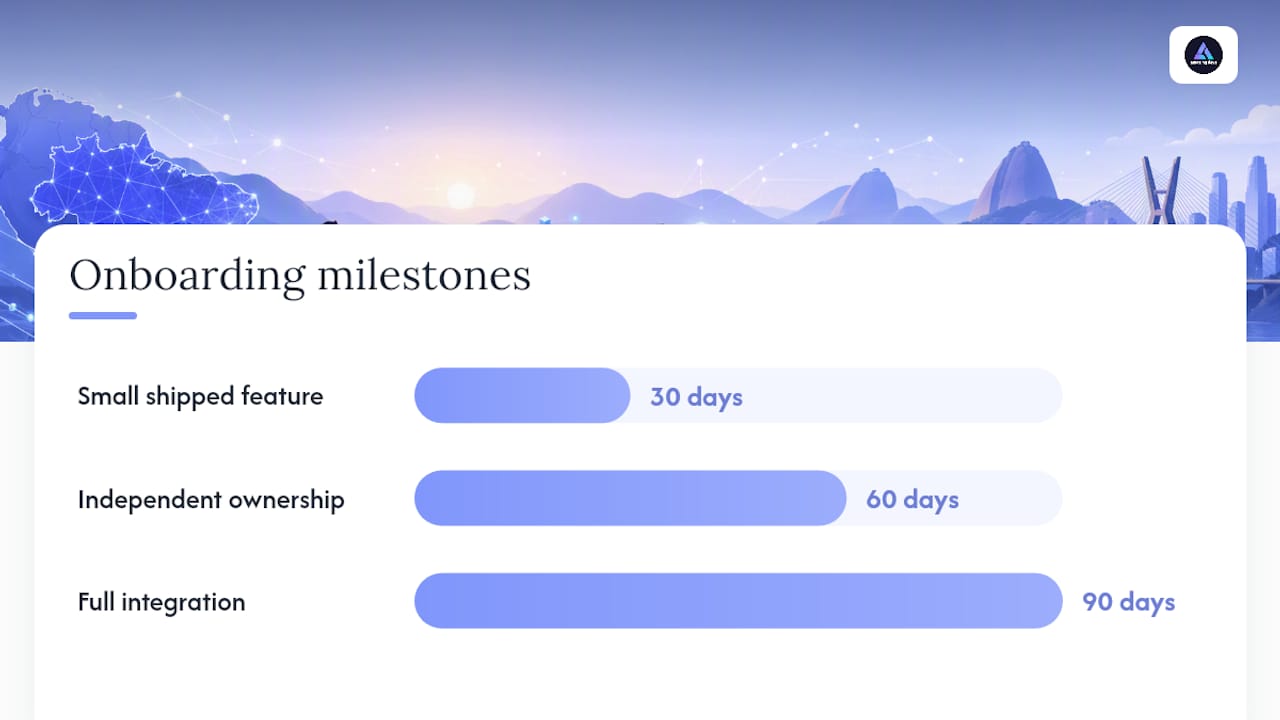
- Set 30/60/90-day milestones. By day 30, expect a small shipped feature. By day 60, independent ownership of a pipeline component. By day 90, full integration into on-call rotation if applicable.
| Hiring model | Payroll & tax | Benefits | IP ownership |
|---|---|---|---|
| Staff augmentation (vendor-managed) | Vendor handles it | Vendor manages local benefits | Assigned to client via contract |
| Dedicated pod | Vendor handles it | Vendor manages local benefits | Assigned to client via contract |
| Direct hire (own entity) | Client owns it | Client owns it | Native to employer, no assignment needed |
Contract fundamentals matter as much as the code. Confirm IP assignment language explicitly transfers work product to you, not just a license to use it. Confidentiality clauses should cover both the individual engineer and the vendor entity. Amazing Devs’ outsourcing page outlines how it structures these handoffs so clients aren’t negotiating boilerplate from scratch.
Retention isn’t automatic just because the paycheck is smaller than a US hire. Brazilian engineers, like engineers everywhere, leave for stagnant career paths and poor management, not just better offers. Build in real career pathing, run regular one-on-ones instead of only status updates, and rotate engineers across projects periodically so the work stays interesting. Soft skills and cultural fit matter more in cross-border teams than domestic ones, since a communication gap that’s a minor friction in person becomes a recurring source of misunderstanding over video calls.
Pro Tip: Pair every new nearshore hire with a local “integration owner”, someone on your existing team responsible for context, not just tickets, and give them a documented minimal-viable-production task due within two to four weeks. That single pairing does more for ramp speed than any onboarding document.
When to Choose Nearshore vs. Hiring Locally
Nearshore makes sense when you need to scale fast, control cost without sacrificing pipeline quality, or access specialized skills like streaming architecture that your local market is thin on. It makes less sense for workloads under strict on-site regulatory requirements, roles that genuinely require daily physical presence, or short, ad hoc engagements measured in days rather than months, where the setup overhead outweighs the benefit.
Communication cadence is the variable most hiring managers underweight. Brazil’s time-zone overlap with the US is a real advantage, but it only pays off if you actually structure daily stand-ups and async documentation to use it. Teams that treat a nearshore hire like a remote domestic hire, clear expectations, written decisions, regular check-ins, get far better results than teams that assume geography alone solves collaboration.
The biggest risks are compliance exposure if contracting is handled loosely, IP ambiguity if assignment language is vague, and timeline mismatches when a company expects a dedicated pod to assemble in the same two weeks a single augmentation hire takes. A four-week pilot with one or two engineers resolves most of this uncertainty before you commit budget to a five-person pod. It’s a small bet that tells you exactly how a vendor performs under real conditions, not sales conditions.
Get Started With a Nearshore Data Engineering Pilot
Amazing Devs is the alternative to a slow, expensive US hiring cycle for companies that need working data pipelines built now, not next quarter. Where a traditional recruiter hands you resumes and walks away, Amazing Devs vets each engineer technically and culturally, then manages the contract, payroll, and compliance side so you’re not building HR infrastructure just to hire one data engineer.
Engagement is straightforward: a discovery call to scope the role, a shortlist within one to two weeks, a technical and cultural interview with your team, then a pilot engagement before scaling to a full pod. That pilot period is deliberate. It lets you validate fit on real work before committing to a longer-term squad.
What you get built in: a replacement policy if a placement doesn’t work out, transparent rate cards by seniority instead of one blended number, and a team that already knows Spark, Kafka, Airflow, and Snowflake rather than learning them on your dime. Amazing Devs is the right partner when you need production-grade data engineering talent fast and want someone else owning the contracts and compliance headaches. It’s not the right fit if you need a single contractor for a two-week project, in that case, direct hire is simpler.
Ready to see what a shortlist looks like? Start a hiring conversation with Amazing Devs and get a pilot scoped this week.
Where These Figures and Practices Come From
- FWC Tecnologia’s nearshore Brazil guide supplied the blended rate ranges, pod pricing, engagement model definitions, and talent hub data used throughout this article.
- GemmWork’s Brazil hiring guide provided the EOR cost comparisons and permanent establishment risk guidance for contract structuring.
- Amazing Devs’ service pages informed the description of vetting practices, engagement models, and onboarding workflows referenced in the provider profile and onboarding sections.
These sources shaped the pricing ranges, hiring model breakdown, and evaluation checklist so the recommendations reflect realistic timelines and costs rather than rounded estimates.
Sources
- Nearshore IT Outsourcing to Brazil: 2026 US Buyer’s…
- Hiring Engineers from Brazil: Cost, PE Risk & EOR Guide (2026) | GemmWork
FAQ
How much does it cost to hire a data engineer from Brazil?
Senior Brazilian data engineers typically bill at $70 to $130 per hour in blended nearshore rates, with all-in EOR costs for a senior hire running $3,432 to $5,016 per month.
How long does it take to hire a nearshore data engineer?
A single augmentation hire typically takes two to four weeks from discovery to start date, while assembling a dedicated pod of four to eight engineers usually takes four to six weeks.
What’s the difference between staff augmentation and a dedicated pod?
Staff augmentation embeds one or two engineers directly into your existing team under your management, while a dedicated pod delivers a self-contained squad of four to eight engineers plus a lead, operating semi-independently against your roadmap.
Should I use an EOR or hire directly through a vendor?
An Employer of Record reduces permanent establishment risk by employing the engineer locally on your behalf, which is typically the safer default unless you already have a Brazilian legal entity.
Does Amazing Devs handle contracts and payroll for nearshore hires?
Yes, Amazing Devs manages sourcing, technical vetting, contracts, and payroll end-to-end so clients don’t need to build separate compliance infrastructure for a single hire or a full pod.