Best Coding Interview Platforms for Hiring Developers in 2026
The best coding interview platform is the one that matches your hiring stage: an automated assessment tool when applicant volume is high, a live collaborative editor when you need to see how a person thinks. Every one of them only tests the candidates you already have. If your real bottleneck is finding, vetting and contracting developers, we handle that earlier step: Amazing Devs places pre-vetted Brazilian developers who have already passed a technical and cultural fit assessment, so your team’s interview time goes to a short list instead of a pile of résumés.
This guide compares the platforms US teams use most, what they publish about pricing, and how AI changes what you should test.
TL;DR
- Assessment platforms (HackerRank, Codility, CodeSignal) screen at scale with auto-grading. Live tools (CoderPad, CodeInterview, HackerEarth FaceCode) show how a candidate reasons with you in the room.
- Most mature funnels use both: an async test first, a live session second.
- Published entry prices run from free to roughly $1,000 a year for small plans, and into the thousands for team plans. Enterprise tiers are quoted individually.
- In 2026 the main decision is whether you test how candidates use AI or block it.
- A platform does not source anyone. Amazing Devs delivers vetted nearshore developers so you run fewer, better interviews.
Table of Contents
- Assessment platforms and live interview tools are different products
- Amazing Devs: skip the funnel, interview vetted developers
- The platforms US teams use most
- Published pricing side by side
- How to choose for your stage
- Testing AI-enabled engineers
- A simple hiring sequence that uses fewer platform seats
- Hire vetted Brazilian developers without the funnel
- FAQ
- Sources
Assessment platforms and live interview tools are different products
People search for “coding interview platforms” and “coding assessment platforms” as if they were one thing. They are two formats, and buying the wrong one is the most common mistake.
Princeton’s career center describes both from the candidate side: a self-directed timed test of 30 to 60 minutes, reviewed days or weeks later, and a live 45 to 60 minute session where the candidate talks through their thinking in a shared editor.
From the hiring side, HackerEarth’s 2026 guide separates them like this:
- Asynchronous assessment platforms auto-grade timed tests. No interviewer is needed per candidate, so they suit high volume and early filtering.
- Live coding tools put an interviewer in the session. The signal is how the candidate thinks and handles hints, which a graded test cannot show.
HireHunch’s July 2026 comparison adds the cost: live interviews let you watch problem-solving, communication and debugging directly, but they consume engineering hours. Assessments scale, with structured scoring built in.
The practical sequence is an automated screen early, then a live round where human judgment matters. We cover the trade-offs in more depth in our guide to live coding versus take-home tests and in our advice on capping technical screens at 90 minutes.
Amazing Devs: skip the funnel, interview vetted developers
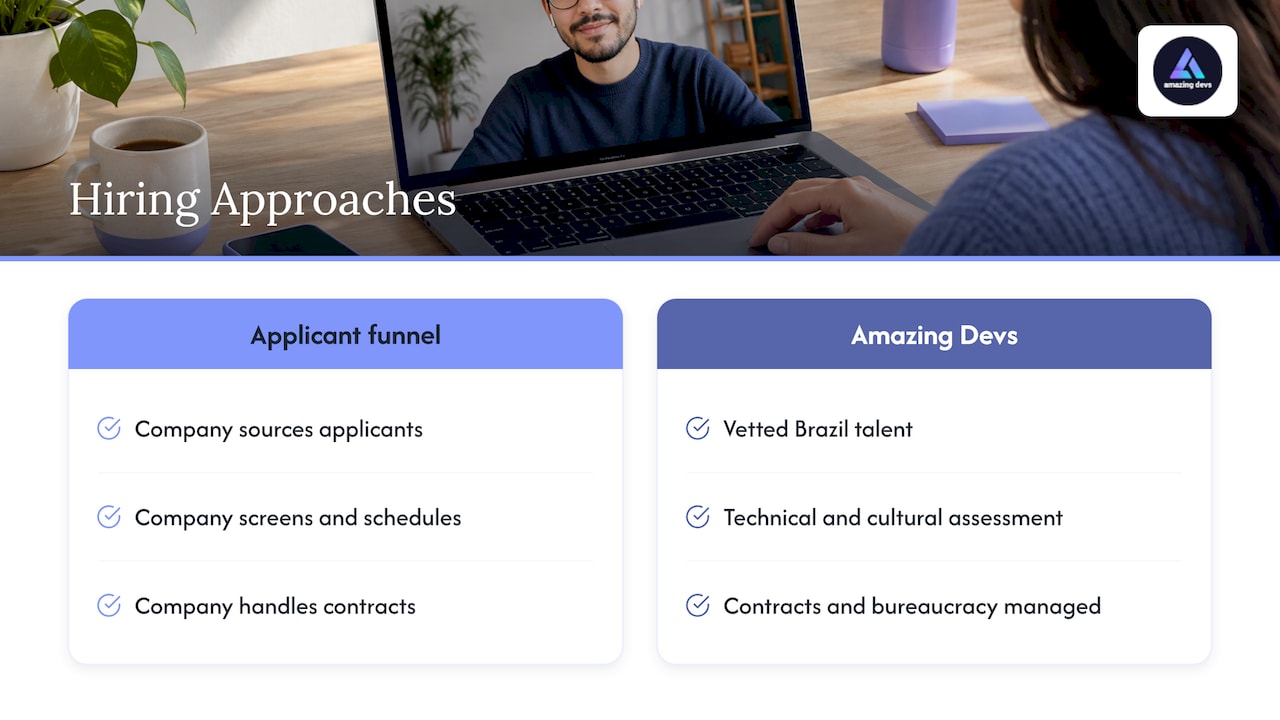
Every platform below assumes you already have a stream of applicants. For a startup or a scaling company, that is the expensive part. Sourcing, screening, scheduling and contracting developers eats engineering time before a single coding question is asked. Our breakdown of what it costs to recruit developers shows how quickly that overhead adds up.
We approach it differently. Amazing Devs provides nearshore IT talent from Brazil through a rigorous recruitment and assessment process that checks technical skill and cultural fit. We also manage the contracts and the bureaucratic work, so you can add developers without the usual hiring headaches. We support AI-enabled and traditional software engineering roles, from our nearshore staff augmentation model to dedicated talent and QA contractors.
For a hiring manager, that changes what an interview platform is for. Instead of filtering hundreds of unknown applicants, you use a live session, or a short pair-programming exercise, to confirm fit with the matched candidates in front of you. Pricing for our services is not published, so you get a scoped proposal rather than a rate card.
The platforms US teams use most
Dice’s guide to coding tests lists the names US employers meet most often: HackerRank, Codility, CoderPad, CodeSignal, TestDome, HackerEarth and CodeInterview, with LeetCode as the candidate-preparation standard. An InterviewChamp overview from September 2026 says HackerRank and CodeSignal dominate first-round coding screens, CoderPad leads live human-led rounds, and Karat is used for outsourced technical interviews.
HackerRank
The volume option. HackerRank offers online tests and a pair-programming Interview product, and describes Chakra as an agentic interviewer that evaluates judgment, critical thinking and AI fluency. It suits teams screening many candidates for software roles. Its own May 2026 comparison cites 7,000+ questions across 40+ languages and anti-cheating tools such as browser lockdown, copy-paste detection and tab-switch monitoring.
CoderPad
The live-coding specialist. CoderPad sells three products: Qualify for async video screening with an AI reviewer, Screen for real-world coding assessments, and Interview for real-time collaborative coding with code playback. Candidates can use AI in the editor while interviewers review the prompt history. If you are choosing between it and HackerRank, our CoderPad vs HackerRank comparison goes deeper.
CodeSignal
Built around a realistic IDE and standardized scores. daily.dev’s April 2026 comparison reports completion rates of 75 to 85% for CodeSignal, against 72% for HackerRank and 68% for Codility. Completion matters because every candidate who abandons a test is a candidate you paid to source.
Codility
An enterprise-leaning platform with a published price. Codility’s pricing page lists online plans from $800 per month for 25 monthly invites and annual plans from $4,800, with custom quotes for Enterprise. Plans include an AI assistant, plagiarism detection and snapshot proctoring.
CodeInterview
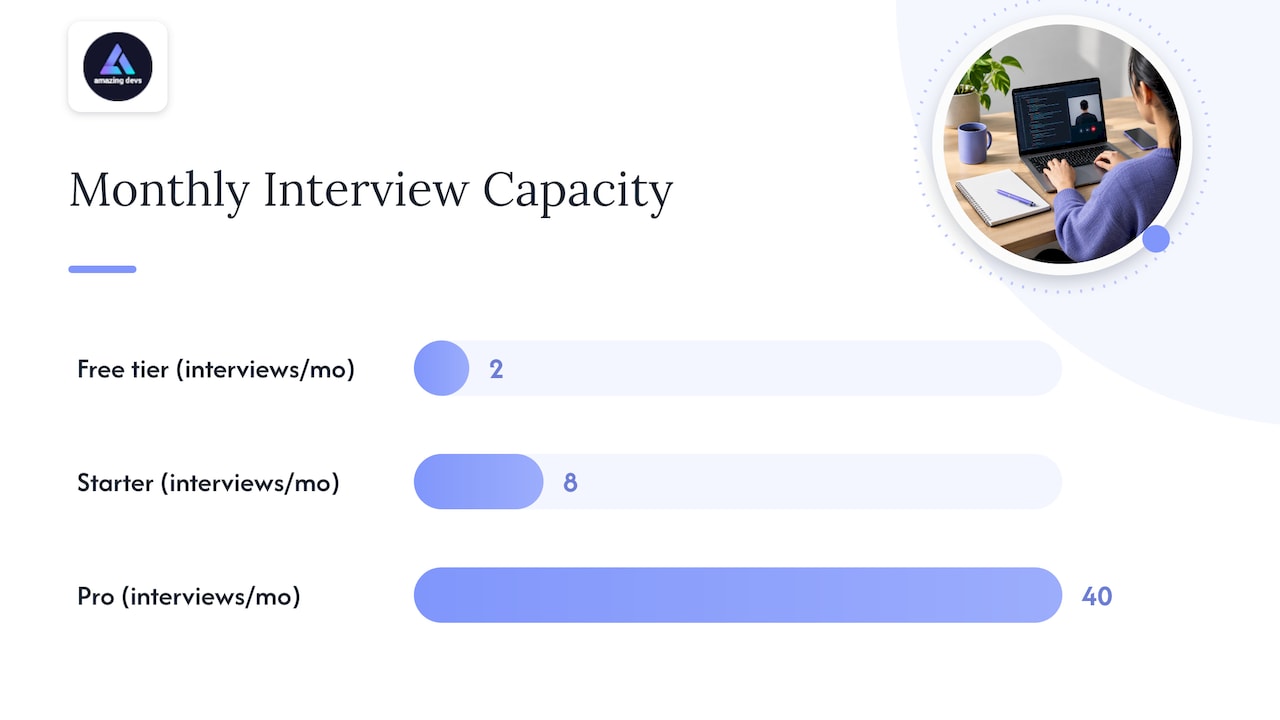
The low-cost live option. CodeInterview’s pricing lists a Free tier at 2 interviews a month, Starter at 8 and Pro at 40, with extra interviews at $15 each. Every tier includes unlimited users, 50+ languages, a collaborative editor, video calling and a whiteboard.
HackerEarth FaceCode and Qualified
HackerEarth FaceCode runs live interviews in 40+ languages and is designed with regulated hiring in mind. Qualified offers assessments in a developer-friendly IDE with automated scoring, similarity checks and code playback, and can turn an assessment into a pair-programming session.
Published pricing side by side
Prices move, so treat these as a snapshot of what each source published and confirm on the vendor page before budgeting. The figures below, except Codility’s and CodeInterview’s, come from InterviewCost’s comparison, which checked vendor pages in October 2026.
| Option | Best for | Published entry plan | Larger plan |
|---|---|---|---|
| Amazing Devs | Hiring vetted nearshore developers, not just testing them | No published price | Scoped to your team |
| CodeInterview | Small teams running live interviews | Free, 2 interviews/month | Pro, 40 interviews/month |
| CoderPad | Live pair coding | Starter, $960/year | Team, $4,800/year |
| HackerRank | High-volume screening | Starter, $948/year (60 attempts) | Pro, $5,028/year (360 attempts) |
| CodeSignal | Realistic IDE, high completion | Build, $948/year (60 credits) | Grow, $5,748/year (420 credits) |
| Codility | Enterprise screening | From $800/month (25 invites) | Annual from $4,800 |
Attempt-based metering is where budgets drift. PulseSignal’s 2026 comparison models 100 assessments a month and shows HackerRank Pro at $1,819 a month (a $419 base plus 70 overage attempts at $20) against CoderPad Team at $2,500 a month (a $400 base plus 70 extra interviews at $30). The lesson: price your real monthly volume, not the headline plan.
Now add the cost the table leaves out. A platform fee is small next to the engineering hours spent writing questions, running interviews and reviewing results for candidates who never convert. That is the spend a vetted-candidate model removes.
How to choose for your stage
Startups. You have few hires and little interviewer time. A live tool with a generous low tier fits, and the real saving comes from interviewing fewer, better-matched people.
Scaling companies. If you are hiring many engineers across regions, auto-graded assessments with ATS integration keep results in your workflow. Testlify’s May 2026 analysis says integration depth decides whether scores flow into hiring or sit in a silo, and reports that HackerRank lists 30+ major ATS integrations against 25+ for CodeSignal. If your team tracks hiring operations in other tools too, this overview of matching features to team size shows a similar selection logic.
Senior roles. Automated tests are a weak primary signal for senior engineers. InCruiter’s June 2026 guide argues that system design judgment and collaboration need human evaluation on top of the automated layer. A structured live round does this well; see our pair programming interview scripts for a 60 to 90 minute format.
Candidate experience. Long, abstract tests lose people. Testlify, citing SHRM research, warns that ghosting rises when assessments run long or feel disconnected from real work. Keep tests short and tied to the job.
Testing AI-enabled engineers
If you want AI-enabled or AI-native engineers, a pure algorithm quiz is the wrong instrument. Goodfit’s 2026 guide notes that many platforms now let candidates use AI during the test and score how well they use it. HackerRank includes Chakra on every plan, Codility offers an AI copilot with reviewable prompts, and CoderPad adds agentic interviews.
Your decision is simple:
- If the job allows AI tools every day, test with AI on and review the prompts: how the candidate frames the problem, checks the output and fixes mistakes.
- If you need to measure independent coding, block AI help and log every attempt.
- Either way, add a live conversation. The question “how did you decide this was correct?” separates engineers who direct AI from those who paste from it.
Our overview of AI code assistants for teams covers the tools your new hires will likely use on the job.
A simple hiring sequence that uses fewer platform seats
- Define the role and the AI policy before choosing any tool.
- Start with vetted candidates. Fewer candidates means a smaller plan on any platform, or none at all for the first screen.
- Run one short, job-relevant exercise of 60 to 90 minutes, live or take-home.
- Hold a structured conversation about decisions, trade-offs and collaboration. Our behavioral interview guide for developers has the questions.
- Decide quickly. Good developers do not wait through a six-week process.
Our view: the interview is the last step, not the first
Teams ask us which platform to buy as if the tool were the hard part. It rarely is. The hard part is getting engineers who are worth interviewing in front of your team without burning a quarter of sourcing time.
That is why we put our effort into the recruitment and assessment work before you ever open an editor. We check technical ability and cultural fit, and we manage the contracts and the bureaucracy, so a manager can spend an hour with a candidate who is already a realistic match. For companies that want AI-enabled engineers, that conversation is where you see how they work with AI, and a vetted shortlist makes it count.
Use a platform for what it does well. Use us to make sure the people you test are the right ones.
Gabriel
Hire vetted Brazilian developers without the funnel
If you would rather add engineers than build a screening operation, our nearshore staff augmentation service gives you pre-vetted Brazilian developers matched to your needs, with contracts and bureaucracy handled for you. It works for startups that need affordable skilled developers and for established companies scaling teams quickly. You can also look at our Team Extension Model if you want developers working as an extension of your own team.
Tell us the role, the stack and whether it is AI-enabled work, and we scope the engagement from there.
FAQ
What is the difference between a coding assessment platform and a coding interview platform?
An assessment platform delivers timed, auto-graded tests that candidates complete on their own, which suits early screening at volume. An interview platform is a live shared editor with video where an interviewer watches the candidate reason. Most teams use an assessment first and a live session second.
Which coding platform is best for a startup?
Startups usually do better with a live tool on a low-cost or free tier, because hiring volume is small and interviewer judgment matters most. CodeInterview, for example, publishes a free plan with 2 interviews a month. Pairing that with a pre-vetted shortlist keeps your engineers’ time focused.
How much do coding assessment platforms cost?
Published entry plans range from free to about $1,000 a year, with team plans around $4,800 to $6,000 a year in October 2026 snapshots, and custom pricing for enterprise. Overage fees per attempt or interview can raise the real total, so estimate your monthly candidate volume first.
Should I let candidates use AI during a coding test?
If the job involves AI tools, yes: test with AI enabled and review the prompts. If you need a clean read on independent coding, block AI and log attempts. Decide before the test, and state the rule to candidates.
Sources
- Princeton Center for Career Development: Coding Interview Preparation
- HackerEarth: Online Coding Interview Tools
- HireHunch: Live Coding Interviews vs Coding Assessments
- Dice Hiring: 10 Essential Coding Tests for Interviews
- InterviewChamp: Online Interview Assessment Platforms in 2026
- HackerRank
- HackerRank: Best Coding Assessment Tools in 2026
- CoderPad
- daily.dev: Technical Screening Tools Compared
- Codility Pricing
- CodeInterview Pricing
- HackerEarth FaceCode
- Qualified
- InterviewCost: Coding Assessment Platform Cost Comparison
- PulseSignal: CoderPad vs HackerRank Pricing
- Testlify: Best Coding Challenge Platforms
- InCruiter: Best Coding Assessment Platforms in 2026
- Goodfit: Best Coding Assessment Platforms in 2026