Behavioral Interview Questions for Developers: A Hiring Guide
A behavioral interview asks a developer to describe what they actually did in past situations, then scores the answers against the behaviors the job needs. Done well, it shows how a person communicates, handles disagreement, owns mistakes and works with a distributed team: the things a coding test cannot show. This guide is for hiring managers, founders and recruiters. It gives you the questions, the follow-ups, a scoring method and the red flags to watch for.
TL;DR
- Behavioral interviewing rests on one idea: past behavior in similar situations predicts future performance. Ask for real examples, not hypotheticals.
- Build 6 to 8 questions around collaboration, conflict, ownership, problem-solving, adaptability, remote communication and AI use. Ask every candidate the same ones.
- Score each answer on a written scale tied to the job, using the STAR structure (Situation, Task, Action, Result) to keep answers concrete.
- Pair the behavioral round with a short, job-realistic technical exercise. Neither one alone gives a full picture.
- For remote and nearshore hires, test async communication and timezone habits directly.
Table of Contents
- What a behavioral interview reveals that a coding test does not
- Start with the behaviors the job requires
- The STAR method, for you and for the candidate
- Questions on collaboration and conflict
- Questions on ownership, mistakes and feedback
- Questions on problem-solving and adaptability
- Questions for remote and distributed teams
- Questions on AI-enabled development
- How to score answers consistently and fairly
- Fitting the behavioral round into the whole process
- Our perspective
- Hiring nearshore developers with the vetting done for you
- A one-page checklist
- FAQ
- Sources
What a behavioral interview reveals that a coding test does not
A technical interview tells you whether someone can solve the problem in front of them. It says much less about what happens in week six, when a teammate rejects their pull request, the requirements change mid-sprint, or a production bug lands on a Friday.
Behavioral questions fill that gap. Behavioral assessments surface patterns of judgment, communication, ownership and adaptability that technical tests do not capture. That matters more because many technical interviews are weak predictors on their own: coding puzzles can have little or no bearing on actual work, according to SHRM.
A behavioral round is not a personality screen or a “culture fit” vibe check. Its job is to collect evidence about specific, job-related behaviors. If you keep that focus, the interview is both more useful and easier to defend.
Start with the behaviors the job requires
Before you write a single question, decide what good looks like in the role. SHRM’s advice is to begin by consulting the people currently doing the job to identify the exact behaviors that separate great performance from poor performance in your organization.
For a developer role, a short list usually looks like this:
- Collaborates in code review without ego.
- Communicates technical tradeoffs to non-technical people.
- Takes ownership of bugs and outages, including their own.
- Works through ambiguity and changing requirements.
- Stays productive and visible on a distributed team.
- Uses modern tools, including AI assistants, with judgment.
SHRM also notes that employers can translate company values into core competencies and anchor hiring decisions to job-related factors. That is the right way to handle “cultural fit”: define it as observable behaviors, not as “someone we’d enjoy a beer with.”
The STAR method, for you and for the candidate
The standard structure for answers is STAR: Situation, Task, Action and Result. Candidates use it to organize stories. Interviewers can use it as a checklist for follow-up questions.
- Situation: What was the context? Team size, system, deadline.
- Task: What was this person responsible for?
- Action: What did they personally do, step by step?
- Result: What happened, and what did they learn?
Most weak answers fail at the Action step. The candidate describes what the team did, or what should have been done. Your best follow-up is a plain one: “What did you do, specifically?”
Questions on collaboration and conflict
Developers rarely ship alone, so start here. Employers can ask about disagreements with teammates or managers, code-review disagreements and difficult stakeholders to assess respectful disagreement, empathy and collaboration.
Questions that work well for engineers include:
- “Tell me about a time you disagreed with another engineer on a technical decision. How did you resolve it?”
- “Describe a conflict on your team. What was your part in resolving it?”
- “Tell me about a code review where you and the author didn’t agree.”
These three come from a published set of software engineer behavioral questions. For broader teamwork, Utah State University’s hiring toolkit suggests testing for successful collaboration across roles or groups, willingness to support others, and respectful communication. One of its prompts translates directly to engineering: “What have you done in the past to contribute toward a teamwork environment? What were some of your specific contributions?”
The University of Maryland’s sample questions add a useful pattern: ask about a difficult coworker and a disagreement with a supervisor or colleague, then follow up on how the candidate handled it.
Follow-ups that separate real stories from rehearsed ones
- “What did the other person say when you raised it?”
- “What would they say about how you handled it?”
- “If you could replay it, what would you change?”
- “Who else was affected, and how did you keep them informed?”
Other collaboration prompts worth borrowing: giving constructive feedback, handling a teammate who misses deadlines, adapting to a colleague’s working style, and making sure all team members’ ideas are heard.
Questions on ownership, mistakes and feedback
Ownership is the trait most managers say they want and the hardest to verify. Ask about failure directly. Questions about mistakes and feedback should be followed up with what the candidate learned and what they would do differently.
Sample prompts:
- “Tell me about a bug you shipped that reached production. What happened next?”
- “Describe feedback you received that was hard to hear. What did you do with it?”
- “Tell me about a time you made a tough call with limited information.”
That last one echoes the University of Maryland’s list, which also covers adapting to a major workplace change and handling feedback.
Listen for who the story is about. A strong answer names the candidate’s own decisions, including the wrong ones. A weak answer spreads the blame across a vague “legacy system,” an “unclear spec” and “the other team.”
Questions on problem-solving and adaptability
This is where behavioral and technical interviews overlap. Instead of asking a candidate to solve a puzzle, ask how they solved real problems. Problem-solving can be assessed with examples of diagnosing difficult bugs, choosing between custom and library solutions, or handling unexpected technical challenges. Evaluators look for analytical troubleshooting, persistence and the ability to explain a problem clearly.
Try these:
- “Walk me through the hardest bug you’ve diagnosed. How did you narrow it down?”
- “Tell me about a time you chose to build something yourself instead of using a library, or the reverse. Why?”
- “Describe a time requirements changed in the middle of a sprint. What did you do?”
That last question also tests communication. Interviewers can ask how candidates explain technical tradeoffs to non-technical stakeholders and respond when requirements change mid-sprint.
Questions for remote and distributed teams
If your team is remote, or you hire across borders, treat distributed work as its own competency. Plenty of strong engineers struggle with it, and the problem shows up as silence, slow handoffs and surprise blockers.
Calendly’s guidance for hiring remote workers suggests asking whether the candidate has worked with a distributed team, how they adapted to different schedules, and how they get information or feedback when teammates are unavailable. It also recommends asking how candidates communicate with remote teammates, which channels they choose for different needs, and whether they follow up proactively when a reply is delayed.
Turn those into developer-specific questions:
- “Tell me about a project where your teammates were in different time zones. How did you hand work off?”
- “You’re blocked and the person who can unblock you is offline. What do you do?”
- “When do you pick a call over a written message, and why?”
- “How do you make sure a decision made in a meeting reaches people who weren’t there?”
Good answers mention written decision records, clear pull request descriptions, explicit handoff notes and early flagging of blockers. If you work with developers in Latin America, a time zone close to US business hours is a real advantage, but only if the habits are there. Our guide on timezone management strategies covers the working agreements that cut coordination delay.
Questions on AI-enabled development
AI assistants are now part of the daily toolkit. Google’s DORA research found that AI adoption had reached 90% among software development professionals, and that 39% of surveyed developers turned to AI when they hit a problem or task. “Do you use AI?” is therefore a useless question. Ask about judgment instead:
- “Tell me about a time an AI tool gave you a wrong or risky suggestion. How did you catch it?”
- “How do you decide which tasks to hand to an assistant and which to do yourself?”
- “Describe a feature you built that used a language model or other AI component. What went wrong in testing?”
- “How do you review code you didn’t write, including code a tool generated?”
Strong candidates describe verification: tests, reading the diff, checking edge cases and security implications. Weak candidates describe speed only. For the technical side of this role, see our guide to AI engineer skills to screen first.
How to score answers consistently and fairly
Good questions are wasted without a consistent way to evaluate the answers. SHRM’s guidance is that employers should ask every candidate the same questions and score the responses, and that structured interviews should be job-related and validated.
A simple setup:
- Pick 6 to 8 questions mapped to the competencies above.
- Write a 1 to 4 scale for each, with a sentence describing what a 1 and a 4 sound like.
- Have each interviewer take notes and score independently before any discussion.
- Compare scores, discuss gaps and decide against the written criteria.
The same discipline applies on the candidate side. Many applicants now prepare their stories with tools such as a career log for tracking achievements, so polished STAR answers are common. That makes your scoring rubric and follow-up questions more important, not less: they reward specifics a rehearsed story cannot supply. If you need a ready framework, our candidate scoring matrix walks through building one in an afternoon.
Example rubric for one question
| Score | What the answer sounds like |
|---|---|
| 1 | Vague or hypothetical. Blames others. No result or lesson. |
| 2 | A real example, but the candidate’s own role is unclear. |
| 3 | Specific actions, a clear result and a stated lesson. |
| 4 | All of the above, plus the candidate checked the outcome, involved others and changed how they work afterward. |
Signals to watch for
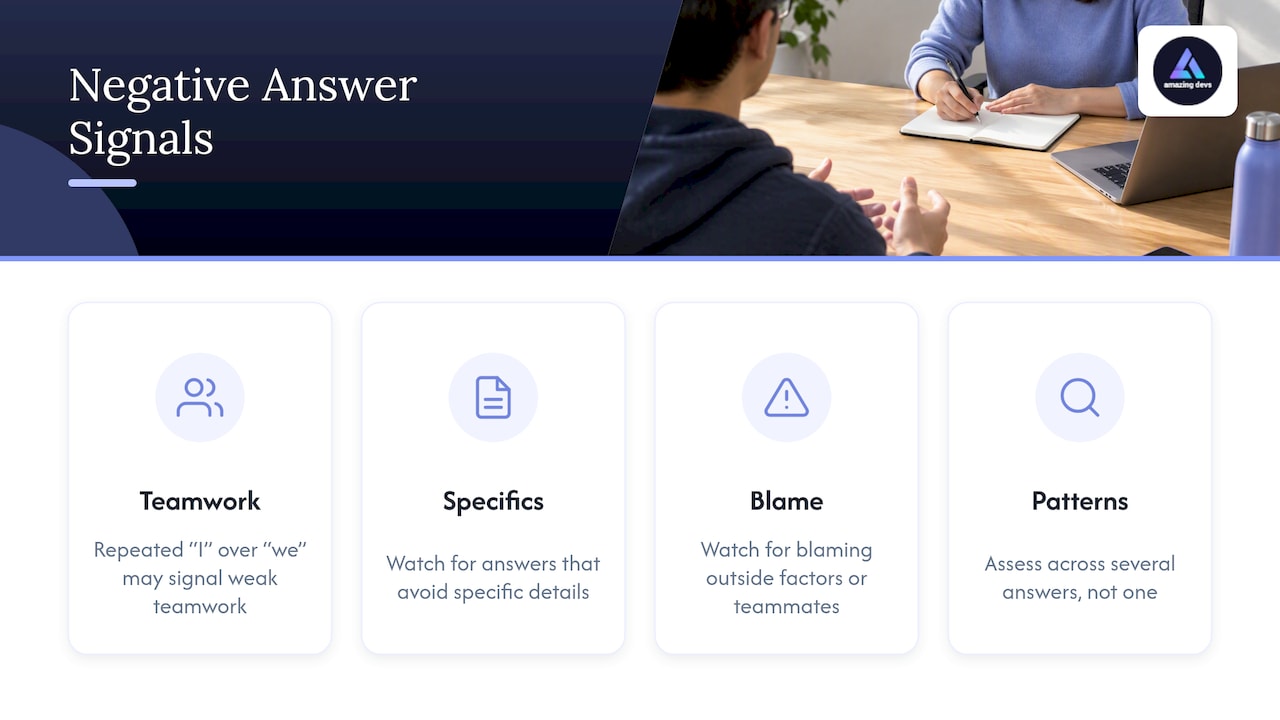
The Holloway Guide lists negative signals worth noting: a consistent use of “I” over “we” when it points to weak teamwork, avoiding specific details, and a pattern of blaming outside factors or teammates for failures. Treat these as patterns across several answers, not verdicts from one. A single “we” or a single vague answer proves nothing.
Also watch your own biases. If you find yourself writing “good energy” or “not a fit” without naming a behavior, go back to the rubric.
Fitting the behavioral round into the whole process
Behavioral interviews work best as one stage of a structured process. They give a holistic view of non-technical competencies that pure coding tests ignore: communication, judgment and growth mindset, alongside hard skills.
A lean sequence for a developer hire:
- Resume and short screen: confirm the basics and the logistics, including time zone and availability.
- Technical screen: a capped, realistic task. Our note on technical screening that caps tests at 90 minutes explains why.
- Behavioral interview: 45 to 60 minutes, same questions for every candidate.
- Working session: a pair programming interview or system design round that shows collaboration live.
- References: verify the stories. See our guide to reference checks for engineers.
If you want a more realistic technical step, DataStax’s Frank Moley suggests timed project reviews, which shift the conversation toward code quality, feedback and collaborative decision-making. That is a natural bridge to behavioral topics. Freelance CTO Benjamin Reitzammer adds that you should anchor behavioral questions in your stated core values, writing scenarios for both the behaviors you want and the ones you won’t tolerate.
Our perspective
We place Brazilian developers with US companies, so we see behavioral signals decide hires every week. Technical skill is the entry ticket. What decides whether a placement works is whether the developer asks questions early, writes things down, flags a problem before the standup and treats your codebase as theirs.
That is why our recruitment process assesses technical ability and working style together, and why we ask the same behavioral questions you would: tell me about a disagreement, tell me about a mistake, tell me about working across time zones. The answers help us match a developer to a team’s actual way of working, not just to a stack.
Our advice to hiring managers: write down the five behaviors your best current engineer shows, and build your interview around them. Do not copy a list of 50 questions from the internet. Eight good questions, asked identically and scored honestly, beat any long list.
— Gabriel
Hiring nearshore developers with the vetting done for you
Running this process well takes time that startups and growing teams often do not have. At Amazing Devs we source, assess and contract pre-vetted Brazilian developers, covering technical and cultural fit and the contract paperwork, so you can meet candidates who already passed a rigorous screen. If you want to add engineers to your team quickly, see our nearshore staff augmentation service, or the team extension model if you want developers working as a seamless part of your existing team. You still run your own final interviews, and this guide is built for exactly that step.
A one-page checklist
- Define 5 to 6 job-related behaviors before writing questions.
- Choose one or two questions per behavior, with prepared follow-ups.
- Use the same questions, in the same order, for every candidate.
- Ask for specific past examples and probe the candidate’s own actions.
- Include one remote-work question and one AI-judgment question.
- Score independently with a written rubric, then compare.
- Verify key stories in reference checks.
FAQ
How many behavioral questions should I ask in one interview?
Six to eight is plenty for a 45 to 60 minute session. Each question needs time for the story plus two or three follow-ups. Fewer, deeper questions give you more usable evidence than a rapid-fire list.
Should I ask the same questions to junior and senior developers?
Use the same core competencies, but expect different scope. A junior might describe a disagreement in a code review, while a senior should describe influencing an architecture decision or mentoring others. Keep the rubric tied to the level you are hiring for.
Can behavioral interviews replace the technical interview?
No. They answer a different question. The behavioral round shows how someone works with people and handles ambiguity, while a technical exercise shows whether they can do the work. Use both, and keep each one short and job-relevant.
What if a candidate has no professional example?
Accept open-source, university, freelance or side-project stories, and ask the same follow-ups. What you want is evidence of specific actions and reflection, not a particular employer on the resume.
Sources
- Behavioral Interview Guide, Caltech Human Resources
- Behavioral Assessment for Technical Hiring, Intervue
- How to Fix Technical Interviews, SHRM
- Viewpoint: There Are No Holy Grail Interview Questions, SHRM
- How to Screen for Cultural Fit, SHRM
- 10 Behavioral Interview Questions, Indeed
- 25 Behavioral Interview Questions for Software Engineers, Interview Titan
- Behavioral interview questions for software engineers, Roundhound
- Teamwork & Collaboration Questions, Utah State University
- Sample Interview Questions, University of Maryland
- Collaboration Questions, GreatFrontEnd
- Nontechnical Interviewing, The Holloway Guide
- 19 Behavioral Interview Questions for Software Engineers, TestGorilla
- Ask these 7 interview questions to hire great remote workers, Calendly
- Google DORA Research: Software Developers Use AI Heavily, TechRepublic
- Coding interviews suck. Can we make them better?, TechRepublic