Brazil vs Argentina Developers: Which to Hire in 2026

Brazil gives a US company a much larger talent pool and more room to scale. Argentina gives you stronger English proficiency on paper and a smaller, more specialized market. Both sit within about an hour of US Eastern Time, so neither forces a night-shift handoff. Which one fits depends on how many engineers you need, how much English fluency your workflow demands, and how you plan to contract them.
We place Brazilian developers, so we have a view. This guide still compares the two on the criteria that decide the outcome, including where Argentina wins.
TL;DR
- Pool size: one comparison lists about 500,000 software developers in Brazil against 115,000 in Argentina, so Brazil is easier to hire from at volume.
- English: Argentina ranks #26 and Brazil #75 in EF’s 123-country English index. Interview for spoken English in both countries, because national rankings say little about one candidate.
- Time zone: both are listed one hour ahead of US Eastern Time, so real-time overlap with a US team is strong in either.
- Pay: published figures conflict by source and year. Treat any single number as directional and build an all-in budget, not a salary guess.
- Contracting: the legal risk is in how you structure the relationship, not the country. Misclassified contractors are a problem in both.
Table of Contents
- Brazil vs Argentina at a glance
- Talent pool: where Brazil pulls ahead
- English and communication
- Time zones and working-hour overlap
- Compensation: read the numbers carefully
- Hiring models and legal exposure
- Speed to hire and retention
- Costs beyond pay
- Perspective: how we would choose
- Hire vetted Brazilian developers without the paperwork
- FAQ
- Sources
Brazil vs Argentina at a glance
The table below pulls together the figures most US hiring managers ask for first. The talent-pool, English and time zone numbers come from one 2026 Latin America comparison, which describes its own data as directional rather than precise. Read them as a sense of scale, not a spec sheet.
| Criterion | Brazil | Argentina |
|---|---|---|
| Software developers (approx.) | 500,000 | 115,000 |
| EF English proficiency rank (of 123) | #75 | #26 |
| Offset from US Eastern Time | One hour ahead | One hour ahead |
| Median gross developer salary (same comparison) | $50,000 | $47,000 |
| Main language | Portuguese | Spanish |
Two things stand out. Brazil is more than four times larger by developer headcount. And the salary gap in that table is small, which tells you cost is rarely what separates these two countries.
Talent pool: where Brazil pulls ahead
If you need one senior engineer, either country works. If you need eight engineers across backend, mobile, QA and data in a quarter, pool size starts to matter. A market with roughly 500,000 developers lets you filter hard on stack, seniority and domain experience and still have candidates left. A market with 115,000 gives you a thinner shortlist for niche profiles, and you compete with other foreign employers for the same people.
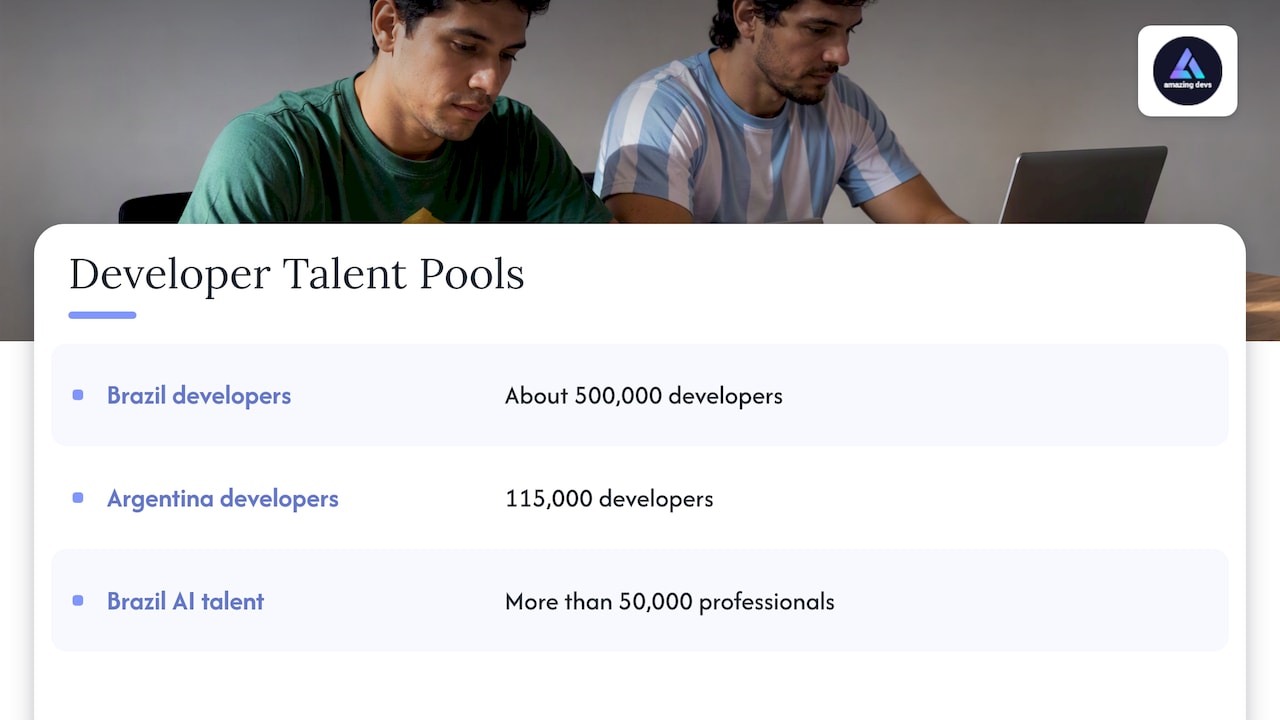
Brazil also shows up in AI. CBRE’s global tech talent guidebook, which draws on LinkedIn Talent Insights, places Brazil among the countries with more than 50,000 AI-development professionals. That matters if you are hiring engineers who build with AI tools or on top of models. For the full picture on that profile, see our nearshore playbook for hiring AI engineers and our explainer on what AI-native development means for engineering teams.
Argentina has real strengths too. A May 2025 report on generative AI in Latin America covers Argentina among its five study countries, which reflects an active professional community around the technology. Brazil is not part of that study, so it says nothing about Brazil either way. Do not read it as Argentina beating Brazil.
The same research carries a lesson for how you screen candidates in either country. It suggests AI shifts the mix of engineering work: routine programming is more exposed, while analysis, coordination and planning are less so. So test AI-tool fluency, but weigh it alongside fundamentals and system-design judgment. A developer who can only prompt is not the one you want owning your architecture.
English and communication
This is Argentina’s clearest advantage. In EF’s 123-country ranking, Argentina sits at #26 and Brazil at #75. If your developers will lead client calls, write product specs in English or work with non-technical stakeholders daily, that gap is worth weighing.
Three cautions keep this in proportion:
- The index is national and self-selected. EF’s own methodology uses test data from people who chose to take its online test, per its Wikipedia summary. It describes a country, not the engineer in front of you.
- Developers are not the average citizen. Engineers read English documentation daily. Technical English in both countries is usually better than national rankings suggest, but you should verify it, not assume it.
- Communication is more than grammar. Written clarity, willingness to flag blockers and comfort disagreeing with a manager decide how smooth a remote engagement feels. Our guide to Brazil work culture for foreign managers covers what to expect.
The practical fix is to run a live technical interview in English for every candidate, whichever country they come from. That is a standard step in our own screening.
Time zones and working-hour overlap
The comparison above lists both countries as one hour ahead of US Eastern Time, and notes the difference can shift with US daylight saving. For a team on the East Coast, that means nearly the whole working day overlaps. For a team on the West Coast, you still get a solid overlap in the morning and midday hours. The comparison is a wash between the two. Neither country gives you the 10 to 12 hour gaps common with offshore hiring in Asia.
If you work with a mixed US team, a few habits help with any nearshore engineer: a shared core-hours window, written standups for the edges, and a team calendar that shows each person’s local holidays. We cover the specifics in three timezone management moves for managers.
Compensation: read the numbers carefully
Pay data for both countries is messy, and the sources disagree. That is worth knowing before you set a budget.
- The Latin America comparison cited above lists median annual gross developer salaries of $50,000 in Brazil and $47,000 in Argentina.
- A separate roundup of Stack Overflow’s 2025 survey data gives medians of roughly $40,474 in Argentina and $30,582 in Brazil.
The two sources flip the order. The reason is mostly method: survey respondents, seniority mix, whether the figure is gross salary or contractor pay, and the exchange rate on the day all move the result. Neither is wrong, and neither is a quote for your role.
What this means in practice:
- Do not choose a country on the median. The spread within a country, between a mid-level engineer and a staff-level one, is bigger than the spread between the two countries’ medians.
- Price the role, not the country. A senior backend engineer with payments experience is priced by demand for that profile, not by passport.
- Budget the total. Salary is only part of what you pay. Benefits, taxes, equipment, fees and administration add to it. Our breakdown of what US employers budget for Brazil developers and what US teams actually pay in rates walks through the line items.
Argentina’s economy also adds a factor that Brazil’s does less often in headlines: currency and price swings can move local-currency pay quickly, so how and in what currency you pay matters. Agree the currency of the contract up front and review it on a set schedule rather than ad hoc.
Hiring models and legal exposure
This is the part many comparisons skip, and it is where US companies get hurt. Both countries let you engage developers as independent contractors, as local employees through a local entity, or through an employer of record or a staffing partner. The difference is how much risk each route carries.
Brazil
In Brazil, companies often use a contractor structure known as pejotização, where a worker invoices through their own company. Brazil’s tax authority has described it as a way to reduce tax and labor charges and a substitute for employment contracts. That is a regulator’s description of the practice, and it signals why scrutiny exists.
Baker McKenzie’s labor-law overview, hosted by Cornell, explains that an employment relationship in Brazil turns on facts such as continuous service, employer direction and compensation, not just on what the contract says. That overview dates from 2014, so confirm current rules with Brazilian labor counsel. The risk it points to is still the one to plan for: if a contractor works full time, takes your direction and sits in your standups, a label of “contractor” may not hold.
Argentina
Argentina changed its rules recently. Law 27.802, published March 6, 2026, amended the definition of employment contracts and excludes certain service contracts regulated by the Civil and Commercial Code. The reform also clarifies that independent service agreements are distinct from employment contracts, provided the work is not under direct dependency. That condition is the important one. The reform gives more room for genuine independent engagements, but it does not protect an arrangement where the person is working under your direction like an employee.
If you plan an Argentine contractor arrangement, ask a local employment lawyer how the new law applies to your specific setup before you sign.
What this means for you
The legal line is similar in both countries: real independence is fine, disguised employment is not. A US company with no local entity has three realistic choices:
- Contract directly. Cheapest on paper, highest classification risk if the person works like a full-time team member.
- Use an employer of record. The EOR becomes the in-country legal employer and handles contracts, payroll and statutory items. You pay a fee for that.
- Use a nearshore staffing partner. The partner recruits, vets and manages the contract and local compliance, and you direct the day-to-day work.
We built our model around the third option, so US clients do not need a local entity. Our guide on how to hire Brazilian developers without a local entity explains the steps.
Speed to hire and retention
We could not find a reliable, independent benchmark for time-to-hire in either country, so we will not invent one. What we can say is structural. A larger pool shortens the search for common profiles, because more qualified people are looking at any time. A smaller pool lengthens it for niche stacks. A partner that keeps a vetted bench shortens it again, whichever country you choose.
Retention is shaped less by geography than by how you treat the developer. Foreign employers that offer clear growth, steady work and respect for local holidays and norms keep people. Those that treat contractors as interchangeable lose them to the next offer. Budget for this in both countries, since skilled engineers in each are recruited by US and European companies alike.
Costs beyond pay
When you compare the two, include these items that a salary table hides:
- Fees and administration: EOR or staffing fees, payroll processing, and invoicing.
- Statutory costs: employer taxes, social security and mandatory benefits where an employment relationship applies.
- Equipment and security: laptops, device management and access controls for remote staff.
- Management time: onboarding, code review capacity and the manager hours you spend bridging cultural gaps.
- Currency exposure: more relevant for Argentina-based arrangements, as noted above.
- Replacement cost: a resignation in month four costs more than the fee difference between two countries.
Compare the full loaded cost of a candidate, not the headline pay.
Perspective: how we would choose
We place Brazilian developers every week, so we are not neutral, and we will not pretend Argentina is a poor option. It is a good one for specific needs. Here is how we would decide if we were in your seat.
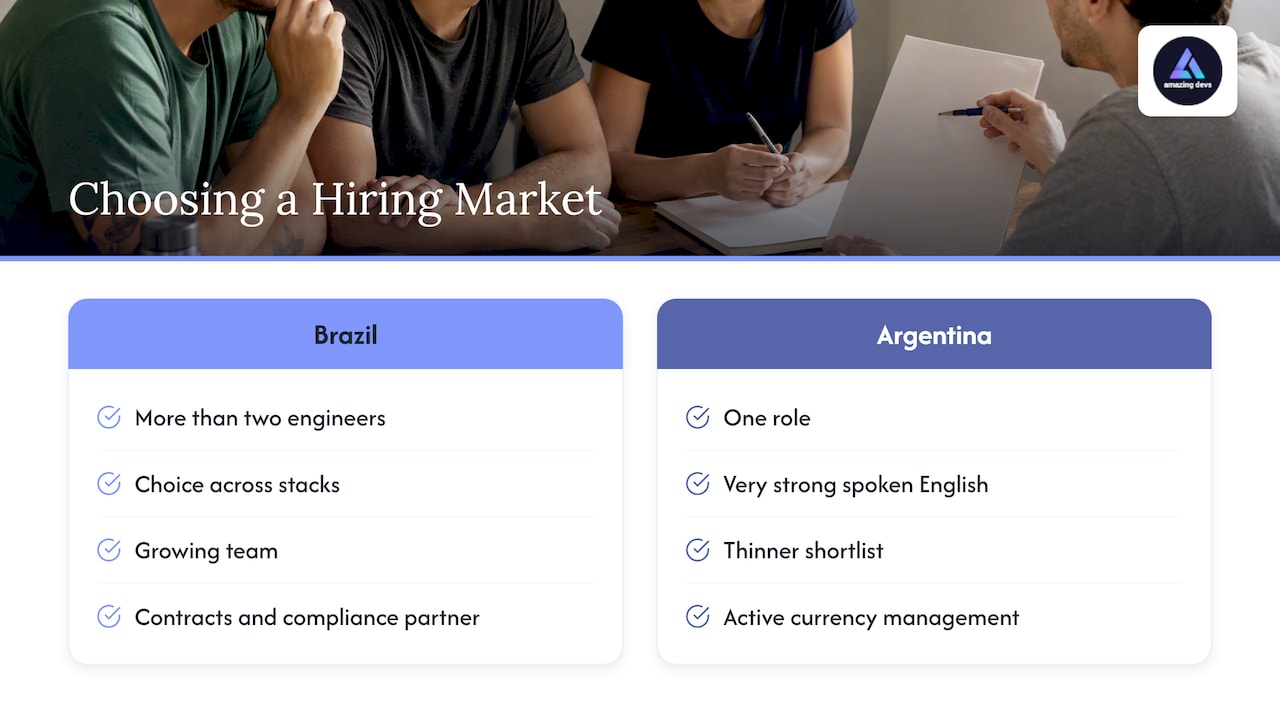
Choose Brazil when you need more than a couple of engineers, you want choice across stacks, you are building a team that will grow, or you want a partner to handle contracts and compliance so you never open a local entity. Scale is what Brazil does best, and the quality of the people we assess is why clients extend with us. Our process screens for technical skill and for cultural and business fit, because a strong coder who cannot work with your team is a bad hire.
Choose Argentina when a single role needs very strong spoken English from day one, and you are comfortable with a thinner shortlist and active currency management.
Our honest advice: pick the country after you write the role, not before. Define the stack, seniority, English requirement and team size, then see which pool serves it. Most of our clients arrive thinking they are choosing a country and end up choosing a hiring model.
For a wider view, our guide to nearshore countries for US companies looks at ten options, and our comparison of Brazil and India covers the offshore alternative.
— Gabriel
Hire vetted Brazilian developers without the paperwork
If Brazil fits your role, our nearshore staff augmentation service gives you pre-vetted developers who work in your time zone and on your processes. We source, assess for technical and cultural fit, and manage the contract and local bureaucracy, so you do not set up an entity or run payroll abroad.
If you want an engineer or two to join an existing team, the Team Extension Model is built for that. For testing capacity, we also provide nearshore QA contractors. Tell us the role and we will show you who we would put forward.
FAQ
Is Brazil or Argentina better for hiring developers?
Neither wins on every criterion. Brazil has the larger pool, with about 500,000 developers against 115,000 in Argentina, according to one comparison. Argentina ranks higher on national English proficiency. Choose by the role you need to fill and how many people you plan to hire.
Are Brazilian developers cheaper than Argentine developers?
Not reliably. One comparison lists median salaries of $50,000 in Brazil and $47,000 in Argentina, while Stack Overflow survey data summarized elsewhere shows Argentina higher than Brazil. Method and seniority mix drive these gaps. Price the specific role and get quotes instead of relying on country medians.
Do Brazilian and Argentine developers work in US time zones?
Yes, closely. Both are listed as one hour ahead of US Eastern Time, with some shift around US daylight saving. That gives East Coast teams almost a full working day of overlap and West Coast teams a solid morning and midday window.
Can I hire contractors directly in either country?
You can, but classification matters. In Brazil, employment can be found based on the facts of the relationship, regardless of the contract label. Argentina’s 2026 reform clarifies independent service agreements but requires that the work not be under direct dependency. Get local legal advice or use an employer of record or a staffing partner.
Is English a problem with Brazilian developers?
It is a factor to test, not a blocker. Brazil ranks lower than Argentina in EF’s national index, but that index measures a self-selected group of test takers, not engineers. Run a live technical interview in English for every candidate.
Sources
- Latin America Country Comparison (Nearshore), Alten Capital
- Nearshore Developer Rates: Pay by Country
- Labor Supply, CBRE Global Tech Talent Guidebook 2025
- Voices of Change: Generative AI and the Transformation of Work in Latin America
- EF English Proficiency Index
- Receita Federal, pejotização study
- Argentina Law 27.802, Presidencia de la Nación
- Overview of Labor & Employment Law in Latin America, Cornell eCommons