Nearshore Countries for US Companies: 10 Options, Start in Brazil

Start with Brazil, Mexico, Colombia, Argentina and Costa Rica. Each pairs a deep engineering pool with a workday that overlaps yours, and may cost less than hiring onshore. Brazil leads on sheer developer depth, and we place Brazilian developers directly through Amazing Devs. This list ranks the nearshore countries for US hiring teams.
TL;DR:
- Mexico offers near total Central and Eastern overlap and easy travel; Brazil has deeper staffing, but assess English because Portuguese is used locally.
- Colombia shares Eastern time during part of the year, while Costa Rica aligns with Central time; both suit teams prioritizing daily collaboration.
- Senior rate estimates are screening ranges, not quotes; specialization, seniority, and city affect costs, with AI and data work costing more than general web development.
- Peru has a smaller pool, so senior searches may take longer; Uruguay and Panama suit targeted hires better than large teams.
- Before committing, pilot one or two developers on real work, set pass criteria in advance, and get the partner’s average tenure and replacement window in writing.
Table of Contents
- 1. Which Latin American countries should you shortlist first?
- 2. How do you read the differences between countries?
- 3. How do you choose a country and validate a partner?
- 4. Why does nearshoring pay off for US companies now?
- 5. How do we help you hire Brazilian developers?
- 6. What do travel and trade agreements change?
- 7. Why I start with a pilot in Brazil
- 8. Start your Brazilian developer pilot with us
- FAQ
- Sources
1. Which Latin American countries should you shortlist first?
The rate bands below are market-range estimates for senior developers, not quotes. Real rates move with seniority, specialization and city, so treat them as a screening filter, not a budget.
- Mexico: Best for teams that need near-total overlap with Central and Eastern hours and easy travel. Overlap is substantial. Estimated senior rates vary by seniority, specialization and city. Hubs: Mexico City, Guadalajara, Monterrey. Strong in backend, QA and enterprise software.
- Brazil: Best for staffing depth and senior engineering. Overlap is workable with US Eastern time. Estimated senior rates vary by seniority, specialization and city. Hubs: São Paulo, Florianópolis, Belo Horizonte, Curitiba. Strong in backend, mobile, fintech and data. Portuguese is the working language locally, so ask about English screening.
- Colombia: Best for bilingual-friendly teams in US Eastern hours. Overlap is close to full, since Bogotá shares Eastern time during part of the year. Estimated senior rates vary by seniority, specialization and city. Hubs: Bogotá, Medellín. Strong in mobile, web and customer-facing product work.
- Argentina: Best for experienced generalists and strong computer science graduates. Overlap is moderate. Estimated senior rates vary by seniority, specialization and city. Hubs: Buenos Aires, Córdoba, Rosario. Statista city-level startup data shows where the startup talent clusters.
- Costa Rica: Best for small, high-quality teams and Central time alignment. Overlap is substantial. Estimated senior rates vary by seniority, specialization and city. Hub: San José. Strong in QA, support engineering and cloud work. The IMF has written on global competition for technology workers, with Costa Rica as a case study.
- Chile: Best for stable, structured engagements and strong English at the senior level. Overlap is moderate. Estimated senior rates vary by seniority, specialization and city. Hub: Santiago. Strong in data, cloud and fintech.
- Peru: Best for cost-conscious teams building web and mobile products. Overlap is substantial. Estimated senior rates vary by seniority, specialization and city. Hub: Lima. The pool is smaller, so plan for longer searches on senior roles.
- Uruguay: Best for a small, highly educated pool with strong English. Overlap is moderate. Estimated senior rates vary by seniority, specialization and city. Hub: Montevideo. Good for software product and consulting-style work.
- Panama: Best for regional hub operations and bilingual talent. Overlap is substantial. Estimated senior rates vary by seniority, specialization and city. Hub: Panama City. A narrower engineering pool, so it suits targeted hires more than large teams.
- Dominican Republic: Best for support-heavy and QA-heavy roles in Eastern time. Overlap is close to full. Estimated senior rates vary by seniority, specialization and city. Hubs: Santo Domingo, Santiago de los Caballeros. Growing, but thinner for senior specialists.
Pro Tip: Budget for retention before you budget for rate. A developer who stays longer may cost less than a cheaper one you replace sooner, so ask any partner about average tenure and replacement terms up front.
2. How do you read the differences between countries?
Country pages tend to blur together until you apply the same few lenses to each one.
- Time-zone overlap: Overlap decides whether engineers can pair in real time, join standups without anyone dialing in at midnight, and hand off work cleanly at the end of the day. Some overlap supports a daily rhythm, while more extensive overlap can support true embedded teamwork. Our own guide on timezone management strategies covers how to structure the shared window.
- Talent depth: A large pool means you can fill senior roles faster and replace people without starting over. Smaller markets like Uruguay or Panama may work well for a small number of hires but can strain under a large team. Statista figures on Brazil’s software and IT services sector help size that market.
- Cost: Treat every rate as a range. Seniority, specialization (AI and data cost more than general web work) and city all move the number. Hiring in a capital city usually costs more than a secondary hub.
- English and culture: English proficiency varies by city, and Statista’s English proficiency data for Latin American cities is a useful starting point. Interview for communication directly, since reading ability and live conversation differ. If your team also ships localized products, app localization costs are worth planning alongside language needs.
- Travel and trade: Flight times from most US hubs can make in-person kickoffs realistic. Trade frameworks matter more for Mexico, covered in the logistics section below. None of this is legal advice, so confirm contract and tax structure with counsel.
3. How do you choose a country and validate a partner?
Pick a country with a scorecard, then prove it with a short pilot rather than a long commitment.
- Score each country from one to five on skills fit, time-zone overlap, cost, retention, contract clarity, language and travel. Weight skills fit and overlap highest, since they decide daily output.
- Ask the partner how they source and screen. Request a description of the technical test, the cultural-fit interview and who runs each.
- Ask about contracts and compliance. Who employs the developer, who handles payroll and benefits, and what happens if you need to end the engagement?
- Ask about replacement and tenure. What is the average tenure, and what is the guaranteed replacement window if a hire does not work out?
- Run a short pilot with one or two developers on real work, not a toy project.
- Set pass criteria in advance: sprint commitments met, code review quality at your standard, availability during the shared window, and a manager who would hire them again.
Pro Tip: Require a stated replacement window and average tenure in writing. Those two numbers reveal more about a staffing partner than any sales deck.
If you want a deeper walkthrough, our guide to hiring Brazilian developers lays out a timeline for US companies.
4. Why does nearshoring pay off for US companies now?
Nearshoring shortens the distance between decision and delivery. You get faster hiring cycles than most onshore searches, less time lost to scheduling gaps, and a team that can join a live incident or a planning session in the same workday. Compared with far-offshore models, the shared hours remove the overnight handoff that slows iteration. Our primer on nearshore versus offshore breaks down that tradeoff.
There is also a resilience argument. Spreading engineering across more than one region reduces the risk of depending on a single geography, which is the logic behind the “China plus one” strategy many companies apply to operations and now to talent.
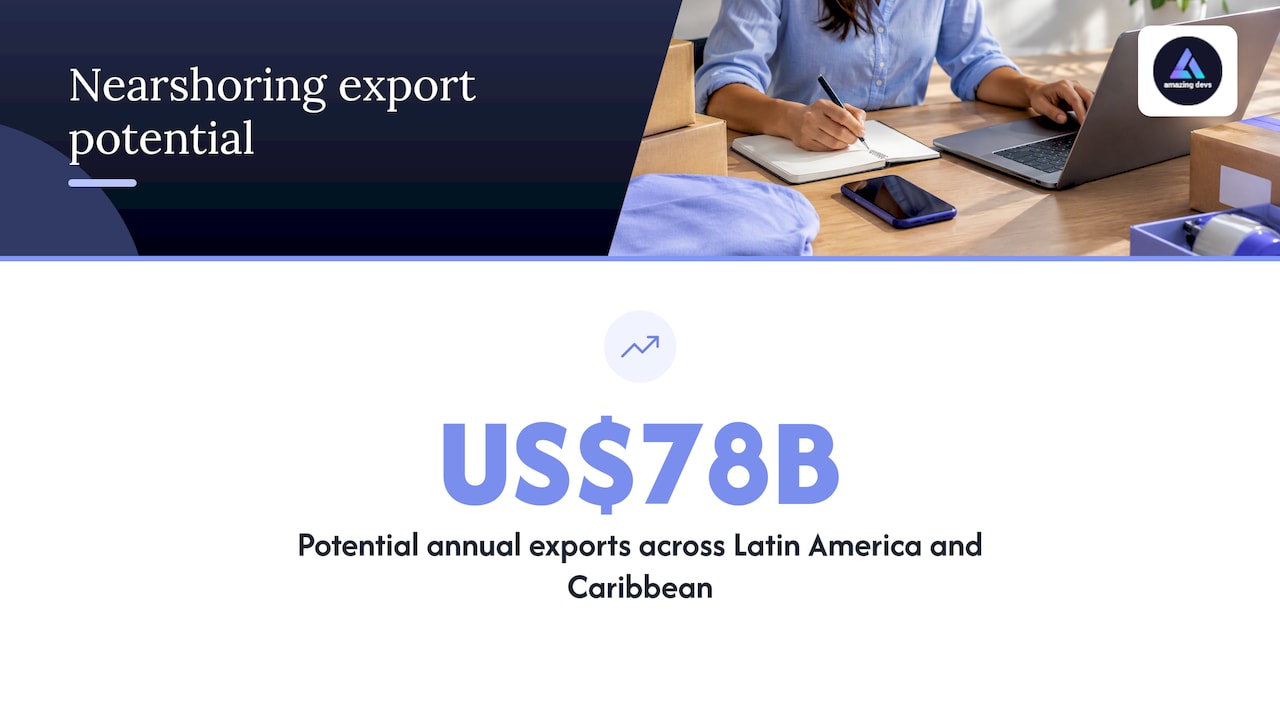
IDB researchers estimate nearshoring could add US$78 billion in annual exports of goods and services in Latin America and the Caribbean in the near and medium term, with Mexico and Brazil gaining the most. That growth signals sustained investment in the region’s workforce and infrastructure. The Atlantic Council’s nearshoring report adds that the opportunity is real but depends on trade policy, regional cooperation and private-sector engagement.
5. How do we help you hire Brazilian developers?
Our work maps directly to the hiring job described above. Here is what we offer:
- Nearshore staff augmentation: Pre-vetted Brazilian developers added to your existing team.
- Team extension model: A dedicated team that works as part of your organization over the long term.
- QA contractors: Nearshore quality assurance engineers for testing and release confidence.
- Dedicated talent: Engineers matched to your stack, working hours and culture.
We screen for technical skill and cultural fit, and we handle contracts and the local bureaucracy. For a closer look at when each model fits, see our staff augmentation use cases and the primer on what nearshore outsourcing means.
6. What do travel and trade agreements change?
Travel is one of the quiet advantages of nearshoring. Many engineering hubs in Mexico, Colombia, Costa Rica and Panama are a short direct flight from major US cities, so a kickoff week, a quarterly planning visit or an onsite incident review is practical. Compare that with a far-offshore team, where a single in-person meeting can eat several days.
Trade frameworks matter most for Mexico, where the USMCA agreement published by USTR governs a broad set of cross-border commercial rules. Other countries on the list have their own arrangements with the US, and the details differ by country and by the type of service you buy. Because most nearshore engineering is delivered as a service rather than shipped goods, the practical questions are usually contract structure, payment, data handling and tax treatment, not tariffs.
A WTO-related report on services reform in Latin America and the Caribbean finds wide variation in competitiveness across countries for knowledge-based services, and recommends harmonized standards and fewer information frictions. For you, that means doing country-specific diligence instead of assuming one set of rules applies across the region. Confirm visa, tax and contracting questions with qualified advisors before you commit.
7. Why I start with a pilot in Brazil
Brazil often leads for staffing depth in engineering, and that is where I start most conversations about launching a nearshore program. The pool is large enough to replace people without starting over, and the time-zone fit is workable for most US teams. Whatever country you pick, begin with a short pilot, and measure two things above all: how many hours your team actually overlaps with the developers, and whether they are still engaged at the end.
— Gabriel
8. Start your Brazilian developer pilot with us
If your shortlist points to Brazil, we can move quickly. Our nearshore staff augmentation service gives you Brazilian developers who have passed our recruitment and technical assessment, with contract management handled on our side. You keep control of the work, and we handle sourcing, screening and the paperwork that usually slows a first hire.
Tell us the roles, stack and hours you need, and we will propose a pilot. Start on our nearshore staff augmentation page or review the team extension model if you want a longer-term setup.
FAQ
What is considered nearshore versus offshore?
Nearshore means working with teams in nearby countries that share a similar time zone, such as Latin America for US companies. Offshore usually means far-away regions with large time differences. The practical gap is overlap: nearshore teams can collaborate in real time, while offshore teams often rely on handoffs.
Which countries are the best for offshoring?
It depends on what you need. For US buyers who want real-time collaboration, Brazil, Mexico, Colombia, Argentina and Costa Rica are strong starting points. Match the country to your required overlap, specialization and budget range.
What are 10 examples of outsourcing?
Common examples include software development, QA testing, IT support, data entry, customer support, accounting, payroll, recruiting, graphic design and cloud infrastructure management. Many firms mix staff augmentation for engineering gaps with outsourcing for standardized, high-volume tasks.
How do you get outsourced work from the USA?
Build a clear service offer, a portfolio of delivered work and a presence where US buyers look, such as referrals, partnerships and specialist staffing firms. Time-zone overlap and English communication help you win US clients. Partnering with an established nearshore firm can speed up that first contract.
Sources
- IDB | Nearshoring can add annual $78 bln in exports from Latin America and Caribbean
- From rhetoric to reality: Nearshoring in the Americas – Atlantic Council
- Policy reforms in services: where next for LAC?
- Ustr
- Imf