Staff Augmentation Use Cases for Leaders With a Nearshore Playbook
Staff augmentation works best for time-boxed capacity gaps: release crunches, scarce specialist skills (AI, security, cloud migration), product launches, legacy migrations, and QA sprints. The deciding question is simple: does your team already have engineering leadership and defined process to direct new hires from day one? If yes, augmentation is usually your fastest, cheapest path. If not, outsourcing a finished outcome may serve you better than adding hands you can’t manage.
TL;DR:
- Staff augmentation is most effective for narrowly defined, short-term projects like release surges, migrations, or QA sprints where clear end states and timelines exist.
- It is ideal when your internal engineering leadership can assign tickets, review code, and provide ongoing guidance from day one, otherwise outsourcing a finished outcome may be better.
- Proper onboarding, security measures, and regular progress tracking are crucial to prevent productivity loss and knowledge gaps when working with augmented engineers.
- Overreliance on augmentation without investing in internal skills leads to long-term dependence; pairing it with upskilling is essential for sustainable growth.
- Nearshore talent from countries like Brazil offers a practical balance of technical expertise and cultural fit, with shorter ramp-up times than offshore arrangements.
Table of Contents
- Common Staff Augmentation Use Cases for Growing Teams
- Staff Augmentation vs. Outsourcing vs. Dedicated Teams: How to Choose
- How to Onboard and Manage Augmented Engineers Without Losing Momentum
- Where Staff Augmentation Goes Wrong (and How to Prevent It)
- How Amazing Devs Puts This Playbook Into Practice
- The Strategic Trap Most Leaders Miss
- Get a Pre-Vetted Nearshore Shortlist Before Your Next Sprint
- Sources
- FAQ
Common Staff Augmentation Use Cases for Growing Teams
Not every skill gap needs the same fix. Some problems call for a warm body who can pick up tickets by Thursday. Others need someone who’s rebuilt a payments pipeline three times before and can spot the landmines. Here’s how the most common scenarios actually break down, roughly in order of how often they come up.
1. Short-term capacity for release crunches and sprint surges
This is the bread-and-butter case. A release date is fixed, your backlog isn’t shrinking, and your internal team is already at full velocity. You bring in frontend or backend engineers, sometimes a dedicated QA analyst, for a defined stretch, usually one to three months, to clear the backlog without burning out your core team or delaying the ship date.
The math here is straightforward: adding two mid-level engineers for ten weeks costs less than the schedule slip you’re avoiding. Companies rarely regret this one because the scope is narrow and the exit is clean.
2. Specialist skill gaps in AI, security, and cloud migration
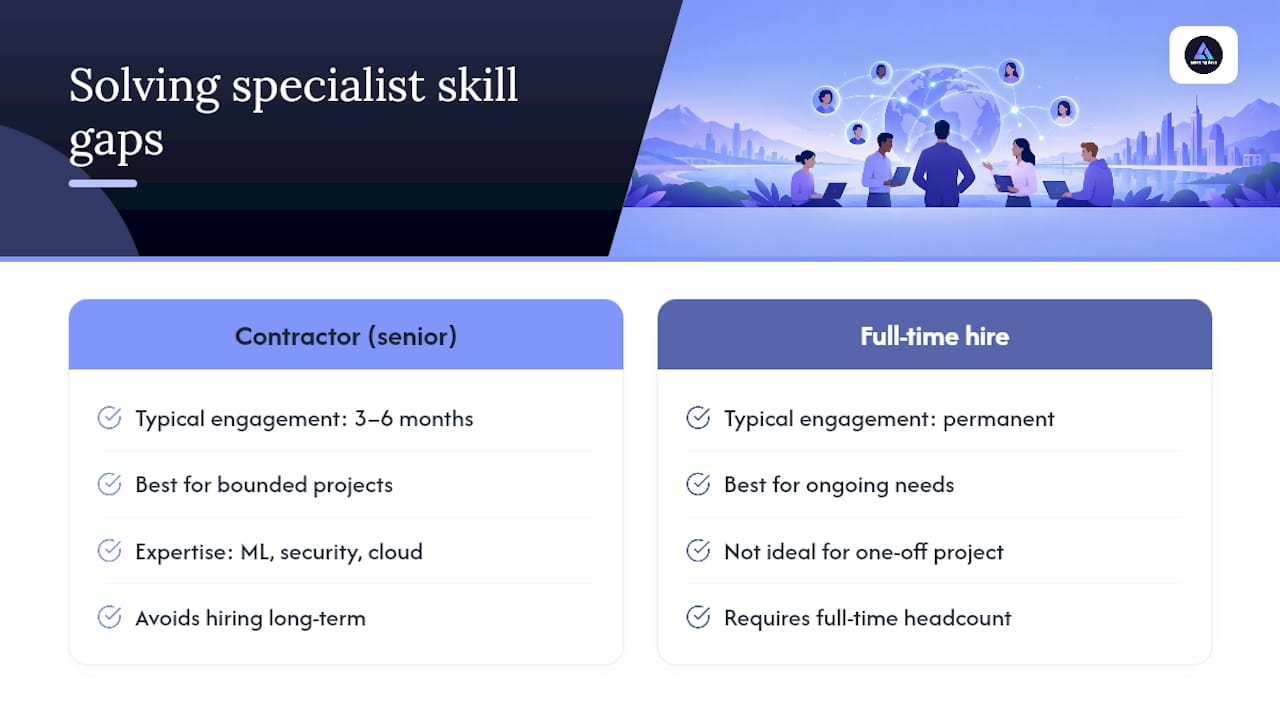
Sometimes the problem isn’t headcount, it’s expertise you don’t have and don’t need permanently. A team building a new recommendation engine might need someone who’s shipped production machine learning models before—not a generalist who’ll learn on the job. Security audits, penetration testing prep, and cloud migration architecture fall into the same bucket.
Bureau of Labor Statistics projections show continued strong demand for software developers and QA roles through the decade, driven partly by AI adoption and security requirements outpacing the supply of specialists inside most companies. That gap is exactly why senior contractors for a bounded engagement, three to six months is typical, beat trying to hire a full-time specialist you’ll only need for one project.
3. Product launches and feature ramps against a fixed date
Launch dates rarely move, but scope always grows. When marketing has already booked a launch event and the roadmap suddenly needs three more integrations, augmentation lets you throw extra engineering capacity at the problem without derailing your permanent team’s other commitments. This works especially well when the extra work is well-defined: a payment integration, a new onboarding flow, a mobile feature parity push.
4. Legacy migrations and refactors
Migrating off a legacy monolith or an outdated framework needs both hands and judgment. You want architects who’ve done this migration pattern before, paired with engineers who can grind through the repetitive parts of the conversion. Augmentation fits because the work has a clear end state (the migration is done) and a bounded timeline, typically four to nine months depending on codebase size.

5. QA and test automation sprints around major releases
Testing capacity is the most underfunded part of most engineering organizations, and it’s also the easiest gap to fill with augmented staff. Bringing in QA engineers and test automation specialists ahead of a major release gives you regression coverage you wouldn’t otherwise have time to build. This is one of the cleanest use cases for temporary staffing because the work is measurable: test coverage percentage, defect escape rate, automation suite size.
6. Interim coverage for leaves, vacancies, and sudden departures
When a senior architect goes on leave or a key engineer resigns mid-project, you need continuity, not a six-week hiring search. An augmented specialist can step into the gap, keep the project moving, and hand off cleanly once you’ve made a permanent hire or the original person returns.
7. Seasonal spikes, compliance audits, and M&A integration work
Retailers scaling for holiday traffic, fintechs preparing for a SOC 2 audit, or companies integrating two codebases after an acquisition all face short bursts of specialized work that don’t justify permanent headcount. These are inherently temporary by nature, which makes them some of the most natural fits for augmentation.
Pro Tip: Match the augmentation type to the problem’s shape, not its size. A migration project needs architects who plan for handoff from day one. A release crunch needs engineers who can start contributing to existing code quickly. Confusing the two is the single most common reason companies feel disappointed by the model.
Staff Augmentation vs. Outsourcing vs. Dedicated Teams: How to Choose
The core decision isn’t about cost. It’s about who directs the work. Staff augmentation keeps control and intellectual property in-house while outsourcing sells you a finished outcome, and the deciding question is whether your organization has the engineering leadership to direct external engineers day to day.
Run through this before picking a model:
- Do you have a technical lead who can assign tickets, review pull requests, and make architecture calls? If yes, augmentation gives you speed and control. If no, outsourcing a defined scope removes that management burden entirely.
- Do you need the code, data, and institutional knowledge to stay entirely inside your company? Augmentation keeps everything, including the people, under your direct oversight. Outsourcing hands a chunk of the work, and often the process decisions, to another company.
- Is your internal team already saturated with reviews, standups, and mentoring duties? If your leads can’t absorb one more person’s onboarding, a dedicated team or an outsourced deliverable will serve you better than augmentation that nobody has time to manage.
- Is the scope fixed and well-documented, or does it need to flex week to week? Outsourcing rewards fixed, well-scoped work with predictable pricing. Augmentation rewards fluid backlogs where priorities shift and you need to redirect people quickly.
- Do you need to scale down as fast as you scaled up? Augmented engineers can typically ramp down within the notice period in their contract. Dedicated teams and outsourced engagements usually carry longer commitments.
Practitioner guidance on this tradeoff is consistent: staff augmentation underperforms when internal processes are undefined, because augmented engineers need direction, not just tickets. If you don’t have that leadership bandwidth today, building it should come before adding headcount, augmented or otherwise. For a side-by-side breakdown of tradeoffs, see this outsourcing versus staff augmentation comparison.
How to Onboard and Manage Augmented Engineers Without Losing Momentum
Getting the model right operationally matters more than picking the right model in theory. A brilliant augmentation decision executed with sloppy onboarding will fail just as fast as the wrong decision made carefully.
- Day 0: Provision everything before they start. Accounts, repository access, documentation links, and a named buddy should be ready on the first morning, not requested on it. Include the new engineer in the current sprint immediately rather than parking them on a side project while IT catches up.
- Week 1 to 2: Pair, review, and assign real ownership. Put augmented engineers into pair-programming sessions and code review rotation from week one. Augmented developers integrated into a team’s communication network perform meaningfully better than those left to work in isolation, and skipping this step is the fastest way to end up with disconnected code nobody else understands.
- Set an overlap policy and stick to it. Guarantee a block of daily overlap hours between your core team and any nearshore or offshore talent, and put it in writing. Ambiguity here is where miscommunication starts.
- Lock down access before day one, not after an incident. Apply least-privilege access controls, signed NDAs, and, where relevant, contractual language around SOC 2 or ISO compliance. This belongs in the contract, not in a post-hoc security review.
- Track a handful of concrete metrics. Cycle time, pull request review turnaround, and sprint velocity contribution tell you more in the first month than any subjective check-in. Review them biweekly with the augmented engineer present, not behind closed doors.
- Negotiate replacement SLAs and knowledge-transfer windows up front. Contractual replacement guarantees and defined knowledge-transfer periods are among the most effective protections against losing weeks of productivity if someone leaves mid-project.
Pro Tip: Treat the first two weeks as a trial period even when the contract is signed. If an augmented engineer isn’t contributing production code by day ten, that’s a signal to raise it with the staffing partner immediately, not to wait and hope it improves on its own.
Where Staff Augmentation Goes Wrong (and How to Prevent It)
Most failed augmentation engagements trace back to the same handful of causes, and nearly all of them are preventable with a bit of planning up front.
- Knowledge walks out the door with the contractor. Without mandated documentation and pair-programming, an augmented engineer’s departure can leave gaps nobody else can fill. Build handover windows into every contract, not just the ones that feel risky.
- Augmented staff become an operational island. Skipping them on retros, demos, and cross-functional syncs breeds exactly the kind of silo that undermines the whole point of adding capacity.
- Management gets stretched past its limit. Set a hard cap on how many augmented engineers one internal lead can realistically direct, and name an owner for every workstream before the person starts, not after.
- Access controls get treated as an afterthought. Loose permissions and vague IP clauses turn a staffing decision into a security liability. Least-privilege access and explicit code-ownership terms belong in the contract from day one, the same way they would for any full-time hire, not scaled back because the engagement is temporary.
Watch for early warning signs rather than waiting for a postmortem: a growing pull request review backlog, cycle times creeping upward, or a drop in cross-team pull requests involving the augmented engineer. Any of those trending in the wrong direction for more than two sprints usually means the integration, not the individual, is the problem.
How Amazing Devs Puts This Playbook Into Practice
Nearshore engineering talent from Brazil can help solve the use cases above without the six-figure overhead of a full internal hiring cycle. The recruitment process weighs technical skill alongside cultural fit and business alignment, because an engineer who nails the technical interview but can’t integrate into your team’s workflow solves nothing.
A typical engagement moves through a few clear stages:
- Scoping: Amazing Devs clarifies whether you need a release crunch fix, a specialist for a migration, or ongoing QA capacity.
- Shortlist and vetting: Candidates go through technical assessment and a fit review before you ever see a resume.
- Overlap-guaranteed onboarding: Because talent is nearshore rather than offshore, engineers work hours that overlap substantially with U.S. teams, which shortens the ramp time compared to distant time zones.
- Contract and continuity management: The staffing partner typically handles the paperwork and bureaucratic complexity directly, including continuity planning if a replacement is ever needed.
The Team Extension Model is built around exactly this flow, treating each augmented engineer as an extension of your existing team rather than a detached contractor.
The Strategic Trap Most Leaders Miss
Augmentation is a bridge, not a substitute for building real capability. Lean on it too long without investing in your own hiring pipeline, and you end up permanently dependent on external talent for skills your team should own.
Pair every augmentation decision with a genuine upskilling plan. CompTIA’s workforce research shows employers increasingly combine third-party talent with structured internal training, and that combination, not augmentation alone, is what actually closes a skills gap for good. If you find yourself re-augmenting the same role every six months, that’s not a staffing problem. That’s a recruiting or process problem wearing a staffing disguise.
— Gabriel
Get a Pre-Vetted Nearshore Shortlist Before Your Next Sprint
This type of service is designed for scenarios like release crunches, specialist gaps, migrations, and QA sprints, with pre-vetted engineers who overlap with U.S. work hours to avoid asynchronous challenges.
Instead of running your own outreach, screening calls, and reference checks, you get a shortlist that’s already been assessed for both technical depth and cultural fit. The Team Extension Model handles contracts and onboarding logistics directly, so you’re reviewing candidates in days, not weeks. If your current need looks more like testing capacity than development capacity, the nearshore QA contractor service covers that specifically. Request a shortlist through Amazing Devs’ nearshore staff augmentation page and see who’s available for your timeline this week.
Sources
- ScienceDirect — team knowledge networks and external consultants
- U.S. Bureau of Labor Statistics — Software developers employment projections
- CompTIA — IT industry outlook and workforce trends
- Resourcifi — staff augmentation vs outsourcing comparison
FAQ
Can You Give an Example of Staff Augmentation?
A common example is a company facing a release deadline that hires two backend engineers and a QA specialist for ten weeks to clear a backlog without pulling its core team off other work. Another frequent example is bringing in a senior cloud architect for three to six months to lead a migration that the internal team lacks the specific experience to run alone.
What Are the Advantages of Staff Augmentation?
The main advantages are speed of hiring, direct control over the work since engineers integrate into your existing team and processes, and the ability to scale capacity up or down without a long-term commitment. It also keeps intellectual property and decision-making in-house rather than handed to an external vendor, which matters most for companies with sensitive codebases.
What Is Staff Augmentation in Simple Terms?
Staff augmentation means adding external engineers, QA specialists, or other technical talent directly into your existing team for a defined period, while your own managers continue directing the day-to-day work. It differs from outsourcing, where an outside company manages the entire deliverable instead of your internal leadership.
What Are the Different Types of Staff Augmentation?
The main types are short-term capacity augmentation for release crunches, specialist augmentation for scarce skills like AI or security, and long-term augmentation for ongoing needs like ongoing QA or maintenance support. Sourcing models also vary between onshore, nearshore, and offshore, with nearshore arrangements generally offering better real-time overlap than fully offshore setups. Some staffing providers focus specifically on nearshore talent from Brazil to maintain time zone overlap with U.S. teams.