For most startups and fast-moving engineering teams, embedded nearshore quality assurance contractors deliver reliable test coverage faster and cheaper than building an in-house QA team from scratch. A well-vetted nearshore QA contractor or small pod can be live in your sprints within 3 to 5 weeks, work inside your existing tools, and cost 40 to 60 percent less than hiring equivalent full-time U.S. engineers once salary, benefits, and recruiting overhead are factored in.
Here’s what that typically looks like in practice:
- Ramp time: 3 to 5 weeks from kickoff to sprint participation for a nearshore QA team
- Cost range: 40 to 60 percent savings versus a comparable in-house hire
- Role coverage: manual testing, test automation/SDET, performance testing, and mobile QA, often from a single contractor or small pod
Quick take: A contract QA engineer costs less than half of an equivalent in-house hire in most cases, and can be running tests inside your sprint within a month.
Amazing Devs handles the recruiting, contracts, and HR side of this so your engineering managers only have to manage the work, not the paperwork.
Key Takeaways
Embedded nearshore QA contractors give startups and scaling teams reliable test coverage in weeks, not months, at a fraction of in-house cost.
| Point | Details |
|---|---|
| Ramp time is short | Nearshore QA contractors typically join sprints within 3 to 5 weeks of kickoff. |
| Cost savings are substantial | Outsourced QA can run 40 to 60 percent cheaper than an equivalent in-house hire. |
| Match model to scenario | Use embedded contractors for speed, hybrid models for compliance-heavy products, and pods for mature roadmaps. |
| Contracts must protect test assets | Require IP ownership, exportable tests, and a replacement SLA before signing. |
| Amazing Devs handles the overhead | Amazing Devs recruits, screens, and manages contracts for Brazilian QA talent so engineering teams manage only the work. |
Table of Contents
- How Do You Choose Between Contractors, Managed QA, and In-House?
- What Are the Different QA Engagement Models?
- What Should Be on Your QA Contractor Hiring Checklist?
- What Should Onboarding and SLAs Look Like?
- How Amazing Devs Builds Your Nearshore QA Team
- What the Data Actually Says About Nearshore QA
- Get Started With Amazing Devs Nearshore QA Talent
- Sources
- FAQ
How Do You Choose Between Contractors, Managed QA, and In-House?
The right staffing model depends less on your budget and more on how fast you need coverage and how complex your compliance requirements are. Here’s how the decision usually breaks down by scenario.
- Early-stage startup racing to launch. Speed and cost matter more than deep domain expertise. An embedded nearshore contractor or two, working directly in your sprint, is almost always the right call. You don’t need a QA department; you need testers who can write automation against your API by week two.
- Regulated product (fintech, healthtech, insurance). Compliance complexity changes the math. You still want nearshore talent for cost reasons, but pair it with an in-house QA lead who owns audit trails, validation protocols, and sign-off authority. This hybrid model, an internal lead directing strategy while a remote team executes, is the pattern most managed-QA providers recommend for anything touching regulated data.
- Mature product with a stable roadmap. A dedicated nearshore QA pod, two to four engineers who become permanent extensions of your team, makes more sense than rotating single contractors. Continuity matters more once your test suite is large and your release cadence is predictable.
- Variable or seasonal demand. Flex staffing through a contractor agency or nearshore provider lets you scale QA headcount up before a big release and down afterward, without the severance costs of hiring and firing full-time employees.
The decision usually comes down to four axes: how fast you need people working, how much budget flexibility you have, how complex the domain knowledge is, and whether compliance requires an internal owner of record.
Signals that nearshore contractors are your right move right now:
- You need testers contributing within a month, not a quarter
- Your budget can’t support U.S. salaries for a role that doesn’t require someone in the building
- Your test needs span multiple skill sets (automation, mobile, performance) that don’t justify four separate full-time hires
- You already run distributed or remote engineering teams and have a communication rhythm that works across time zones
What Are the Different QA Engagement Models?
Not every “QA contractor” arrangement works the same way, and the differences matter for your contract terms and daily expectations.
- Single contractor. One tester, usually hired directly or through an agency, working a defined scope. Fast to start, but you own onboarding, tooling access, and performance management yourself.
- Embedded contractor. A contractor who joins your sprint ceremonies, uses your project management tools, and reports to your engineering manager like an internal hire, even though a third party manages their payroll and HR. This is the most common nearshore arrangement.
- Dedicated nearshore pod. A small team (two to four testers, sometimes including a QA lead) assigned exclusively to your product. You get more coverage across specialties, automation, manual, performance, without managing four separate contracts.
- Managed QA. The provider owns the QA strategy end to end, including test planning and reporting, and you review outcomes rather than manage day-to-day work. Faster to deploy but you give up some control over methodology.
- Hybrid. An in-house QA lead sets strategy and standards; a nearshore team or pod executes. This is often the strongest model for regulated or high-complexity products.
The tradeoff across all five is control versus speed. Single contractors and embedded contractors give you more day-to-day control but require your engineering manager or a QA lead to actively direct the work. Managed QA and pods move faster out of the gate but require more trust upfront. Test asset ownership should be spelled out in every contract regardless of model.
Pro Tip: Whoever manages the engagement daily, a QA lead or an engineering manager, should own the relationship in writing. Ambiguity about who reviews test results and approves releases is the single most common source of friction in nearshore QA arrangements.
What Should Be on Your QA Contractor Hiring Checklist?
Build your hiring plan around the specific problem you’re solving, not a generic QA job description.
Recommended starting mixes:
- Startup shipping an MVP: one manual/exploratory tester plus one automation engineer (SDET) who can also cover API testing.
- Scaling SaaS product: a small pod, automation engineer, manual tester, and a part-time performance tester as release volume grows.
- Compliance-heavy product: an in-house QA lead plus nearshore manual and automation testers, with the lead owning validation sign-off.
Screening tasks that actually predict performance:
- An automation “kata”: a small, timed coding exercise using tools they’d realistically use, Selenium, Cypress, or Playwright for web, Appium for mobile
- A live exploratory testing session against a real (or sandboxed) build, watching how they think, not just what bugs they find
- A code review exercise where they critique an existing test suite for gaps and flakiness
Contract clauses to require before signing:
- IP ownership of all test code and documentation, assigned to you, not the contractor or their agency
- Exportable tests: your suite must run outside their tooling if you ever switch providers
- A replacement SLA defining how fast a contractor gets swapped out if performance or fit issues arise
- Confidentiality and data-handling terms appropriate to your industry
- Defined onboarding deliverables: what they produce in week one, not just what they’re expected to know
What Should Onboarding and SLAs Look Like?
Fast ramp-up depends more on what you hand a contractor on day one than on their raw skill level.
Onboarding basics: environment access, CI/CD pipeline permissions, credentials for staging and test environments, a handful of sample tickets to work through, and inclusion in the very first sprint planning session they’re available for. Nearshore teams that follow this pattern are typically operational within 3 to 5 weeks of kickoff.

Knowledge transfer that actually sticks: a living test repository (not a static wiki page nobody updates), mandatory documentation for every new test class added, and a pair-testing period where a departing or existing team member walks a new contractor through the suite before handoff. Treating your test suite as a team-owned asset rather than one person’s personal project is what prevents a six-month setback every time a contractor rotates off.
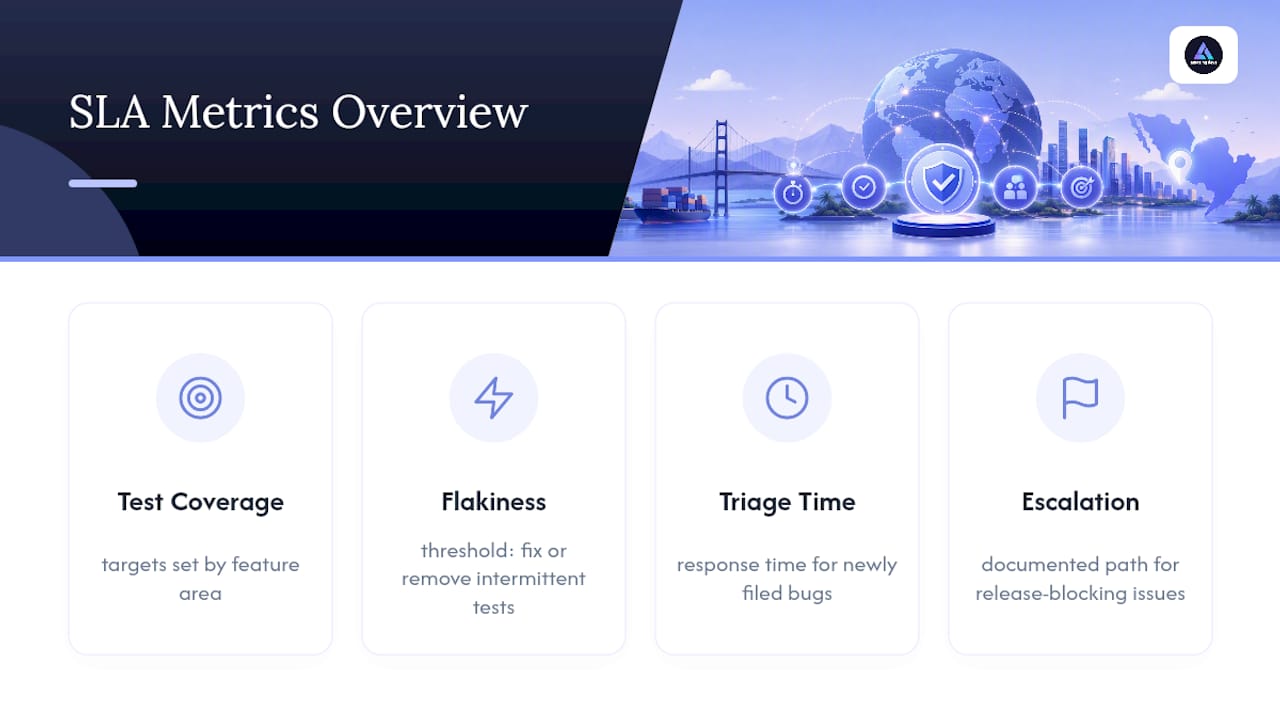
SLA metrics worth tracking: test coverage targets by feature area, a flakiness threshold (tests that fail intermittently should be fixed or removed, not ignored), triage response time for newly filed bugs, and a documented escalation path when a release-blocking issue is found late.
Pro Tip: Ask every new contractor to document one improvement to the test suite in their first two weeks. It’s a fast, low-stakes way to see whether they think critically about coverage or just execute scripts.
How Amazing Devs Builds Your Nearshore QA Team
We built Amazing Devs around a simple observation: most engineering leaders don’t struggle to find QA talent, they struggle to find QA talent they can trust with minimal oversight, hired fast, without the bureaucratic drag of international payroll and contracts.
Amazing Devs specializes in sourcing Brazilian QA engineers and testers who are technically screened and evaluated for cultural fit before a client ever sees a resume. Their rigorous recruitment process filters candidates on automation skill, communication, and domain familiarity, not just years of experience. Amazing Devs manages contracts and the bureaucratic overhead of international hiring so your engineering team never has to touch payroll or compliance paperwork. Their commitment to customer success means a dedicated point of contact stays engaged through onboarding and beyond, not just through the first invoice.
Most clients see a contractor contributing meaningful test coverage within the first two weeks of a sprint cycle, with full sprint integration by week four or five.
Check current availability for QA contractors who match your stack and timeline.
What the Data Actually Says About Nearshore QA
Most advice on hiring QA contractors treats the decision as binary: outsource everything or build an internal team. That framing doesn’t hold up. The strongest results come from hybrid setups, an internal QA lead who owns strategy paired with nearshore execution, particularly once a product touches compliance or handles sensitive data.
The bigger blind spot is turnover risk. Companies obsess over finding the “right” contractor and then treat test knowledge as if it lives permanently in that person’s head. It doesn’t, and it shouldn’t. A test suite is a team asset. If a contractor leaves and your coverage collapses with them, the failure was in your onboarding process, not their departure.
Prioritize documentation and exportable test code before you prioritize finding a “10x” tester. A solid mid-level contractor with clean handoff practices will outperform a brilliant one who never writes anything down. That’s the part conventional hiring advice skips, and it’s the part that actually protects you six months from now.
Get Started With Amazing Devs Nearshore QA Talent
If you’ve read this far, you already know the tradeoffs between hiring in-house, contracting freelancers, or going with a managed QA firm. Amazing Devs offers a different, more direct path: vetted Brazilian QA engineers embedded into your team, with the recruiting, contracts, and HR handled on your behalf.
That means you skip the months-long search for the right hire and the administrative weight of managing an international contractor yourself. Amazing Devs suits engineering managers who need someone contributing real test coverage inside a sprint cycle, not a resume pipeline that takes a quarter to produce a hire. Start a conversation about your QA needs and get a sense of timeline and cost before committing to anything.
Sources
FAQ
How Long Does It Take to Onboard a Nearshore QA Contractor?
Most nearshore QA contractors are operational within 3 to 5 weeks of kickoff, assuming environment access and credentials are ready on day one.
How Much Cheaper Is a QA Contractor Than an In-House Hire?
Outsourced QA typically costs 40 to 60 percent less than an equivalent full-time U.S. hire once salary, benefits, and recruiting costs are included.
Who Owns the Test Code When You Use a QA Contractor?
Your contract should assign IP ownership of all test code and documentation to your company, with exportable tests so you can switch providers without losing your suite.
Should I Hire a Single QA Contractor or a Nearshore Pod?
A single contractor works for narrow, well-defined scopes; a dedicated pod makes more sense once you need coverage across manual, automation, and performance testing simultaneously.
Does Amazing Devs Handle Contracts and Payroll for Nearshore QA Talent?
Yes. Amazing Devs manages recruiting, contracts, and payroll for its nearshore QA talent, letting your engineering team focus on the work instead of the paperwork.