Evaluation First LLM Developer Skills: 5 Starter Projects
An LLM developer needs eight core competencies: prompt engineering, context engineering, and RAG, fine-tuning with PEFT methods like LoRA, agent design and tool calling, evaluation and testing discipline, observability and LLMOps, serving and inference optimization, and security-aware development. Competence shows up in the output, not the résumé: can you ship a retrieval-backed Q&A system backed by a golden-test suite that blocks bad deploys? Start with the skills breakdown below, then move to the starter projects section to build proof of each one.
TL;DR:
- Building effective prompt engineering involves treating prompts as version-controlled code with validation schemas to prevent production errors.
- Developing robust retrieval-augmented generation systems requires mastering chunking strategies, hybrid search, and graceful degradation when retrieval confidence is low.
- Evaluation discipline, including golden test suites and CI gating, is essential to distinguish prototypes from production-ready models.
- Securing LLM applications demands strict scope, input/output sanitization, and adversarial testing to prevent prompt injection and misuse risks.
- Leveraging nearshore partners with vetted LLM expertise can accelerate team capacity, especially when in-house talent is scarce or recruiting is slow.
Table of Contents
- The Core LLM Developer Skills You Need to Master
- Tools and Frameworks Worth Learning First
- How Do You Build a Testing Harness for LLM Apps?
- Securing LLM Applications Against Prompt Injection and Misuse
- Deployment, Inference, and LLMOps in Production
- A Learning Path With Real Starter Projects
- What Hiring Managers Should Look for in LLM Engineers
- What Actually Separates a Junior From a Senior LLM Developer
- Another Option: Hiring LLM Engineers Through a Nearshore Partner
- Sources
- FAQ
The Core LLM Developer Skills You Need to Master
Most engineers coming from traditional software backgrounds underestimate how much of LLM work involves evaluation and infrastructure, not just model tweaking. Here’s what separates someone who can talk about LLMs from someone who can ship them.
1. Prompt engineering as structured, versioned code
Treat prompts like source code, not scratch notes. That means version control, JSON schemas for output validation, and constraint-based generation instead of loose natural-language requests. Papers on production agentic systems now recommend externalizing prompts and managing them with lifecycle discipline, the same way you’d manage a config file or a database migration. A common failure mode: hardcoding prompts inline, then losing track of which version produced which output when something breaks in production. Sample deliverable: a deterministic JSON API wrapper around an LLM call that rejects malformed outputs and retries with a corrective prompt.
2. Context engineering and retrieval-augmented generation
RAG sounds simple until you’ve built one. The real skill is chunking strategy, embedding model selection, and combining hybrid search (keyword plus vector) with a reranking step to surface the right passages. Deployments in the wild run into chunk-size trade-offs, noisy OCR output from scanned documents, and latency ceilings once your vector index grows past a few million vectors, according to engineering lessons from real RAG deployments. Sample deliverable: a document Q&A tool that cites its sources and degrades gracefully when retrieval confidence is low.
3. Fine-tuning and parameter-efficient methods
Full fine-tuning is expensive and usually unnecessary. LoRA and QLoRA let you adapt a base model on a fraction of the compute by training small adapter layers instead of the whole network. The skill isn’t just running a training script. It’s curating a dataset that actually represents your target task and gating the resulting model behind an evaluation suite before it ever touches production. Sample deliverable: a LoRA-tuned model with a paired evaluation suite showing measurable improvement over the base model on your specific task.
4. Agent design and tool calling
Good agent architecture favors single-responsibility agents over one sprawling agent trying to do everything. Each agent gets a narrow function signature, a defined tool, and explicit privilege boundaries. Best practices for production agentic workflows point toward this one-agent-one-tool pattern specifically because it makes testing and debugging tractable. Sample deliverable: an agent that calls a verified external API and pauses for human approval before executing any action with financial or irreversible consequences.
5. Evaluation and testing discipline
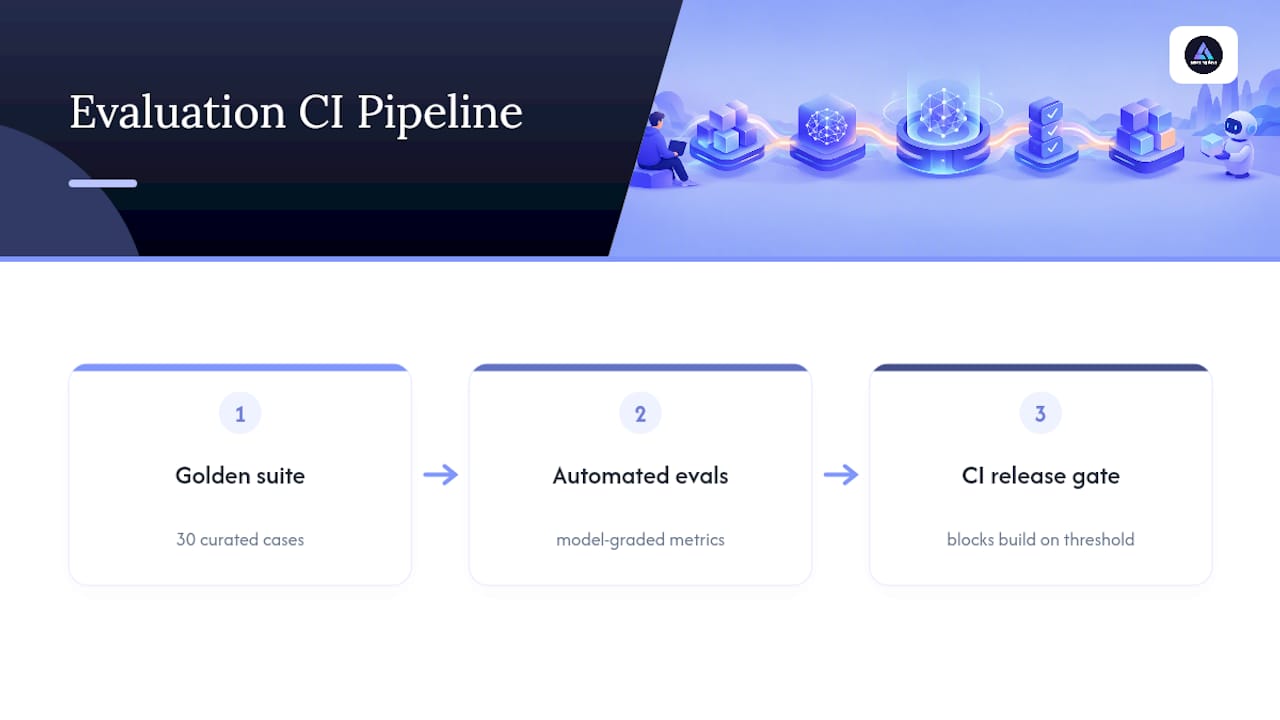
This is the skill most self-taught LLM developers skip, and it’s the one that separates prototypes from products. You need golden sets (curated test cases with known-good answers), automated model-graded evals, and CI gates that block a release when quality regresses. Sample deliverable: a 30-case golden suite wired into your CI pipeline that fails the build if faithfulness or accuracy drops below a threshold.
6. Observability and LLMOps
You can’t debug what you can’t see. Token-level tracing, cost-per-request metrics, latency percentiles, and telemetry that connects a bad output back to its retrieval step and generation call are non-negotiable once you’re past a demo. Without this, a production incident becomes a guessing game.
7. Serving and inference engineering
Knowing how to batch requests, when to quantize a model to 4-bit or 8-bit precision, and whether to self-host with something like vLLM versus call a managed API is a distinct skill from model development itself. Get this wrong and your latency or your cloud bill will tell you fast.
8. Security and adversarial testing
Prompt injection and excessive agency are now recognized as the top risks in LLM applications, according to the OWASP guidance for large language model applications. You need to sanitize inputs and outputs, scope agent privileges tightly, and run adversarial tests before shipping anything that touches real users or real data.
9. Optimization trade-off thinking
Cost and latency problems rarely have one fix. Sometimes a shorter prompt solves it. Sometimes you need a smaller model. Sometimes the fix is entirely in the infrastructure layer, like caching or batching. Knowing which lever to pull, and in what order, is a skill built from experience, not a checklist.
10. Cross-discipline communication and reproducibility
The best LLM engineers write code that a teammate can rerun a year later and get the same result. That means logging data provenance, documenting why a dataset was filtered the way it was, and reviewing prompt changes the same way you’d review a pull request touching production logic.
Tools and Frameworks Worth Learning First
Your stack choices should follow your constraints, not the other way around. Here’s where to focus your hands-on time:
- Vector stores: self-host with FAISS or Chroma when you need full control and predictable costs at small to mid scale; move to a managed option like Pinecone or Weaviate once query volume or team size makes operating your own index a distraction from the actual product.
- Orchestration frameworks: LangChain and LlamaIndex remain the default starting points for chaining retrieval, generation, and tool calls; newer agent SDKs and Model Context Protocol (MCP) patterns are worth learning if you’re building multi-agent systems.
- Inference stacks: vLLM for high-throughput self-hosted serving, Ollama for local development and quick prototyping, and bitsandbytes when you need quantization to fit a model into limited GPU memory.
- Evaluation and observability: tools like Promptfoo for automated prompt testing, OpenTelemetry for distributed tracing, and Phoenix-style observability platforms for tracking model behavior over time.
- Prompt-as-code tooling: schema validators (JSON Schema, Pydantic) that catch malformed model outputs before they reach a user or a downstream system.
Learn one option in each category deeply before sampling the rest. Breadth without depth here just means you can name tools, not use them under pressure.
How Do You Build a Testing Harness for LLM Apps?
Evaluation-first development means building your test harness before you build the fifth feature. A readiness harness combining automated benchmarks, CI gates, and observability is what tells you whether a change is safe to ship, not a gut feeling about whether the output “looks right.”
Start small. Golden sets of 20 to 50 curated cases are typically enough to catch regressions without becoming a maintenance burden themselves. Track four metrics consistently:
- Faithfulness, whether the model’s output is actually grounded in retrieved context rather than fabricated.
- Retrieval hit rate at k, whether the right document shows up in your top results.
- Policy pass rate, whether outputs comply with your content and safety rules.
- Cost per request and p95 latency, the two numbers that will get you paged at 2 a.m. if they drift.
Wire these checks into your CI pipeline using something like Promptfoo so every pull request runs against your golden set automatically. Log traces that connect retrieval results to the generation step and any tool calls, so when something goes wrong in production, you can replay the exact chain that produced a bad answer instead of guessing.
Pro Tip: Keep your golden set adversarial, not just representative. Include the tricky edge cases that broke a previous version, not just typical happy-path examples. A test suite full of easy wins won’t catch the next regression.
Securing LLM Applications Against Prompt Injection and Misuse
Prompt injection and excessive agency top the OWASP list of LLM application risks, and both require deliberate engineering, not an afterthought.
- Constrain model behavior with strict system prompts and enforce output schemas so malformed or off-policy responses get rejected automatically.
- Scope agent privileges down to the minimum required, and run any high-risk action (payments, data deletion, external API writes) server-side with its own authorization check, never trusting the model’s output alone.
- Apply semantic filters to catch manipulation attempts, and require human approval before an agent executes anything with real-world consequences.
- Run adversarial tests and periodic penetration simulations specifically targeting your agent’s tool-calling surface, not just your chat interface.
Security teams now treat excessive agency as a distinct risk category separate from prompt injection, because an agent with too much unchecked authority can cause damage even without a malicious prompt. A poorly scoped agent that can both read and write to a database is one bad instruction away from a real incident, whether that instruction came from an attacker or a confused user.
Deployment, Inference, and LLMOps in Production
Getting a model to respond correctly in a notebook and getting it to serve thousands of requests reliably are two different jobs. The gap between them is where most of the real LLMOps work lives.
- Batch requests together and budget your token usage carefully. GPU utilization drops fast when you’re processing one request at a time.
- Quantize to 4-bit or 8-bit precision using libraries like bitsandbytes when memory, not compute, is your bottleneck. You trade a small amount of accuracy for a large jump in throughput.
- Version your models and prompts together, and define rollback criteria before you need them. When a new prompt version causes a quality drop, you want a one-line revert, not a fire drill.
- Decide between self-hosting and managed APIs based on latency requirements, compliance constraints (data residency, for instance), and total cost at your expected volume, not on which option sounds more impressive.
The roadmap most LLM engineers follow treats vLLM and quantization as baseline skills, not advanced electives. If you can’t answer “what happens to our latency if traffic triples tomorrow,” you’re not done with this section yet.
A Learning Path With Real Starter Projects
Reading about LLM development and doing it are different skills. These five projects, done in order, build the full stack:
- Foundations mini-project. Run token-level experiments comparing how different tokenizers split the same text, then compare embedding models on a small retrieval task. This builds intuition you can’t get from documentation alone.
- RAG project. Build a document Q&A tool with a real vector store, tune your retrieval with hybrid search, and write a golden test suite before you call it done.
- Agent project. Build a single-responsibility agent that calls one verified external API and requires human approval for any action with real consequences.
- Fine-tuning mini-project. Run a LoRA experiment on a narrow task, and pair it with an evaluation suite wired into CI so you can measure the improvement objectively.
- Serving and ops wrap-up. Deploy one of the earlier projects with full tracing enabled, then run an adversarial test against it to see what breaks.
Pro Tip: Don’t skip the fine-tuning project just because RAG feels more useful day to day. Interviewers and hiring managers use it as a filter for whether you actually understand how these models learn, not just how to call an API.
If you’re experimenting with agents that pull external market or event data as a tool source, a prediction market API built for AI agent pipelines is a useful reference for how to structure a verified external data feed as a callable tool.
What Hiring Managers Should Look for in LLM Engineers
Résumés lie. A working evaluation suite doesn’t. When you interview for LLM roles, skip the whiteboard trivia and ask candidates to walk through a project where they built a golden set, wired it into CI, and made a gating decision based on the results. Ask them to review a chunk of retrieval code or a fine-tuning dataset out loud. You’ll learn more in fifteen minutes than from an hour of algorithm questions.
Nearshore teams can move faster on this kind of hiring because the talent pool is deep and the vetting process, when done right, filters for exactly these production habits before a candidate ever reaches a client interview. Technical and cultural fit assessments are important when placing Brazilian developers for LLM roles, given how much of this work depends on judgment calls under ambiguity. For a deeper look at structuring these interviews, see the MLOps hiring guide.
What Actually Separates a Junior From a Senior LLM Developer
Most advice on this topic focuses on model architecture and prompt tricks. However, engineers who ship reliable LLM systems spend considerable time on evaluation harnesses more than on refining prompts. A well-designed evaluation CI gate that blocks poor releases is often more valuable than a slightly improved prompt, as it catches failures prompts alone eventually miss.
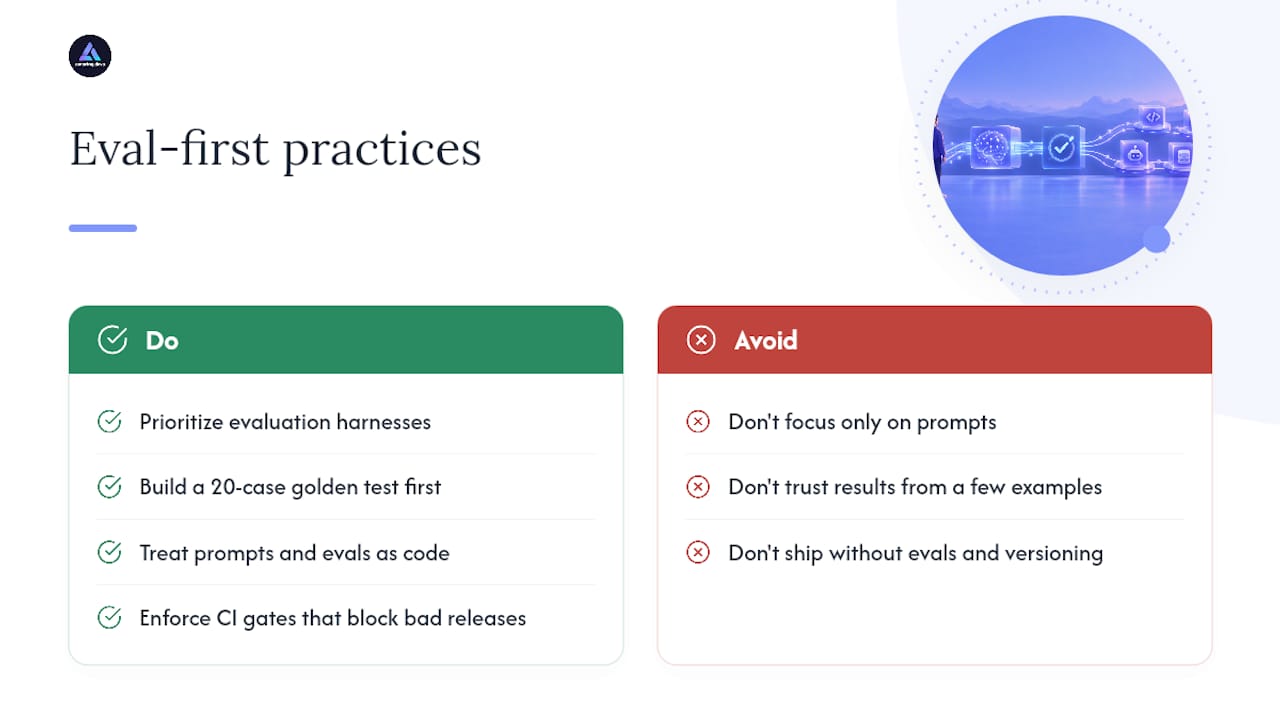
The conventional advice tells beginners to learn prompt engineering first. I’d flip that order. Learn to build a 20-case golden test before you learn to write a clever prompt, because without the test, you have no way to know if your prompt is actually good or just good on the three examples you happened to try. Evaluation is the skill that makes every other skill on this list verifiable instead of anecdotal.
If there’s one thing to prioritize this year, it’s treating your prompts and your evals as code from day one: versioned, reviewed, and tested. Everything downstream, from agent design to production serving, gets easier once that habit is in place.
— Gabriel
Another Option: Hiring LLM Engineers Through a Nearshore Partner
Building this skill set in-house takes time most teams don’t have, especially with LLM talent still scarce and expensive in most markets. Amazing Devs offers a different route: nearshore staff augmentation that puts vetted Brazilian developers with these exact skills, RAG, fine-tuning, agent design, evaluation harnesses, onto your team without the months-long search and salary premiums common in tighter talent markets.
Consider a nearshore partner when your roadmap needs LLM capability faster than your hiring pipeline can deliver it, or when you want engineers who’ve already been assessed for both technical depth and how well they’ll fit your team’s working style. The recruitment, cultural fit assessment, and contract logistics can be handled by the nearshore partner, allowing you to evaluate finished candidates instead of sifting through hundreds of applications. If you’re scaling a team for LLM work specifically, the team extension model is worth a look for how the engagement is structured. Reach out to talk through your project scope and see what a matched developer looks like for your stack.
Sources
- A Practical Guide for Designing, Developing, and Deploying Production-Grade Agentic AI Workflows
- OWASP Top 10 for Large Language Model Applications (2025/2026 updates)
FAQ
What Skills Are Required to Become an LLM Developer?
The core requirements are prompt engineering, RAG and context engineering, fine-tuning with PEFT methods like LoRA, agent design, evaluation and testing, observability, and serving and security practices. Strong Python skills and familiarity with frameworks like PyTorch underpin all of it. See the skills breakdown above for what each looks like in practice.
What Are Some Underrated LLM Developer Skills?
Evaluation harness design and data provenance tracking are the most underrated. Most learning resources focus on prompting and model architecture, but the ability to build a golden-test suite that gates releases is what separates a working prototype from a production system, as outlined in readiness harness research.
Why Do LLMs Perform Well at Coding Tasks?
Large language models are trained on massive amounts of publicly available code with clear syntax and structure, which gives them strong pattern recognition for common programming tasks. Their coding output still requires review and testing, especially for logic that isn’t well represented in training data or that touches security-sensitive paths.
How Do LLMs Use Tools and Skills in Agent Workflows?
An LLM calls external tools through function signatures you define, deciding which tool to invoke based on the user’s request and the tool descriptions provided. Well-designed agent systems scope each tool narrowly and require human approval before executing any high-risk action, a pattern described in guidance on production agentic workflows.
Does Amazing Devs Provide Developers With These LLM Skills?
Amazing Devs sources and vets Brazilian developers for nearshore placement, including engineers with LLM, RAG, and agent development experience, through nearshore staff augmentation and team extension engagements. Pricing details for specific engagements are available directly through the site.