Avoid 30% Withholding: W-8BEN for Contractors Working With U.S. Clients

Foreign independent contractors working with U.S. companies must give a completed Form W-8BEN to the paying company, not the IRS, to certify their non-U.S. status before receiving payment. Skipping this step, or sending an expired or unsigned form, can trigger default 30% withholding on payments that would otherwise flow untaxed at the source. The form itself is short, but getting the details right protects both your income and your paperwork trail.
TL;DR:
- Contractors who perform work entirely outside the U.S. and have no presence there typically only need a valid W-8BEN, while those traveling to the U.S. may need different forms like W-8ECI or W-8BEN-E.
- The form must be completed and signed before the first invoice’s due date to avoid default 30% withholding, with early ITIN application recommended if claiming treaty benefits requiring a U.S. taxpayer number.
- Using the wrong form, such as W-8BEN instead of W-8BEN-E or W-8ECI, often results in incorrect withholding or reporting, especially if U.S. personal services are involved.
- Payers rely on the form for withholding and reporting, and proper collection and renewal tracking prevent payment delays; outsourced contract management services can streamline this process.
- A foreign TIN from the home country generally suffices for treaty claims, but specific income types or treaty provisions may require a U.S. SSN or ITIN, which can delay payments if not applied for early.
Table of Contents
- Who must provide Form W-8BEN: contractors and edge cases
- When to use W-8BEN versus W-8BEN-E, W-8ECI, or Form 8233
- How to fill W8BEN: key lines, common mistakes, and signer rules
- Claiming tax-treaty benefits and TIN requirements
- Validity and change-in-circumstances: when you must refresh W8BEN
- What payers must do: withholding, reporting, and recordkeeping
- Practical onboarding checklist for contractors
- How a managed nearshore staffing partner can reduce W8BEN risk
- What I have learned about avoiding the top mistakes
- An adjacent option for companies managing contractor paperwork
- Sources
- FAQ
Who must provide Form W-8BEN: contractors and edge cases
Form W-8BEN is for nonresident alien individuals, meaning a foreign person working as a sole proprietor or freelancer who is the beneficial owner of the income being paid. Beneficial owner just means the person who actually earns and reports the income, rather than someone collecting it on another party’s behalf. If you are a foreign individual invoicing a U.S. client directly for your own work, you almost certainly fall into this category.
Contractors who operate through a registered company, rather than as individuals, typically do not use W-8BEN at all. A foreign entity, including a single-member company treated as its own taxpayer, generally files Form W-8BEN-E instead. A disregarded entity (a company with no separate tax identity from its owner) usually has the individual owner complete W-8BEN in their own name.
Where the work physically happens matters too:
- A contractor who performs all work outside the United States and has no U.S. presence typically has straightforward foreign-status documentation needs.
- A contractor who travels to the U.S. to perform services, even briefly, may trigger effectively connected income rules that change which form applies.
- Joint account holders or payees who share a contract need to separate forms per beneficial owner, since W-8BEN covers one individual’s status, not a group’s.
- A contractor paid through a payment settlement entity or marketplace platform may be asked for a W-8BEN by that platform instead of the end client, since the platform often acts as the withholding agent.
When to use W-8BEN versus W-8BEN-E, W-8ECI, or Form 8233
Picking the wrong form is one of the most common errors foreign contractors make, and it usually causes unnecessary withholding or reporting mismatches down the line. The IRS guidance on claiming treaty benefits draws a clear line based on where the work happens and what kind of income it produces.
- W-8BEN fits a foreign individual earning U.S.-source income (royalties, most freelance fees paid for work done abroad) who is not performing personal services physically inside the United States.
- Form 8233 applies when a foreign individual performs personal services inside the U.S. and wants to claim a tax treaty rate on that compensation. This form, not W-8BEN, is the correct one for treaty claims tied to services performed on U.S. soil.
- W-8BEN-E is for foreign entities rather than individuals: incorporated businesses, partnerships, or other organizations receiving U.S.-source payments.
- W-8ECI applies when the foreign person’s income is effectively connected with a U.S. trade or business, meaning it will be reported and taxed on a net basis rather than withheld at a flat rate.
A practical example: a graphic designer in Portugal who never sets foot in the U.S. and invoices a U.S. software company for remote design work files W-8BEN. A consultant from Canada who flies to New York for a two-week on-site engagement and wants to claim a treaty-reduced rate on that pay uses Form 8233 instead. Mixing these up, using W-8BEN for U.S.-based personal services, commonly causes the wrong withholding treatment and delays in resolving it.
How to fill W8BEN: key lines, common mistakes, and signer rules
The form asks for identifying information first, then moves into the treaty claim section. Getting each line right the first time avoids a rejected form and a payment delay.
- Line 1 is your full legal name exactly as it appears on your passport or government ID, not a business name.
- Line 2 is your country of citizenship, which may differ from where you live.
- Line 3 is your permanent residence address in your home country, formatted with city, region, postal code, and country spelled out since many non-U.S. address formats do not map cleanly onto U.S. fields.
- Line 4 is a mailing address only if it differs from your permanent residence, such as a P.O. box.
- Lines 5 and 6 cover your taxpayer identification numbers. Line 5 is for a U.S. Social Security Number or Individual Taxpayer Identification Number, which you generally only need if you are claiming certain treaty benefits or already hold one. Line 6 is your foreign tax identification number issued by your home country, which most contractors do have and should include.
- Line 10 is where you cite the specific tax treaty article and paragraph if you are claiming a reduced withholding rate, along with a brief explanation of why you qualify under that treaty provision.
- Signature and date must be the beneficial owner’s own signature, or that of a person with legal power of attorney, dated within a reasonable window before submission.
If you do not yet have an SSN or ITIN and need one for a treaty claim, the W-8BEN instructions point to Form W-7 as the application path, with processing commonly taking four to six weeks.
Pro Tip: Electronic signatures are generally acceptable as long as the withholding agent’s system captures the signer’s identity and date reliably, but check with your payer before assuming a typed name counts.
The most common mistakes are filing W-8BEN when Form 8233 applies, leaving the form unsigned, writing a U.S. address on Line 3 when you are not actually a U.S. resident, and forgetting to update the form after moving to a new country.
Claiming tax-treaty benefits and TIN requirements
Many countries have tax treaties with the United States that reduce or eliminate withholding on certain types of income, and Line 10 of W-8BEN is where you claim that benefit, as explained in detail in Btw op buitenlandse diensten: wat rekent u wel of niet?. Whether you need a U.S. taxpayer number to make that claim depends on the income type and the specific treaty article involved.
- A foreign TIN from your home country, entered on Line 6, satisfies most W-8BEN filings for non-personal-service income.
- Some treaty claims, particularly those tied to categories like scholarships or certain royalties, require a U.S. SSN or ITIN rather than just a foreign number.
- If you need an ITIN, you apply using Form W-7, and processing commonly takes four to six weeks, so start the application well before your first invoice is due if a treaty rate depends on it.
- Some treaties include limitation on benefits provisions, meaning the payer may ask for an additional statement confirming you qualify as a resident under the treaty’s specific tests, not just that you live in a treaty country.
Contractors who wait until a payment is already due to start an ITIN application often end up paying the default withholding rate on that first invoice, then seeking a refund later, which is a slower and more frustrating path than applying early.
Validity and change-in-circumstances: when you must refresh W8BEN
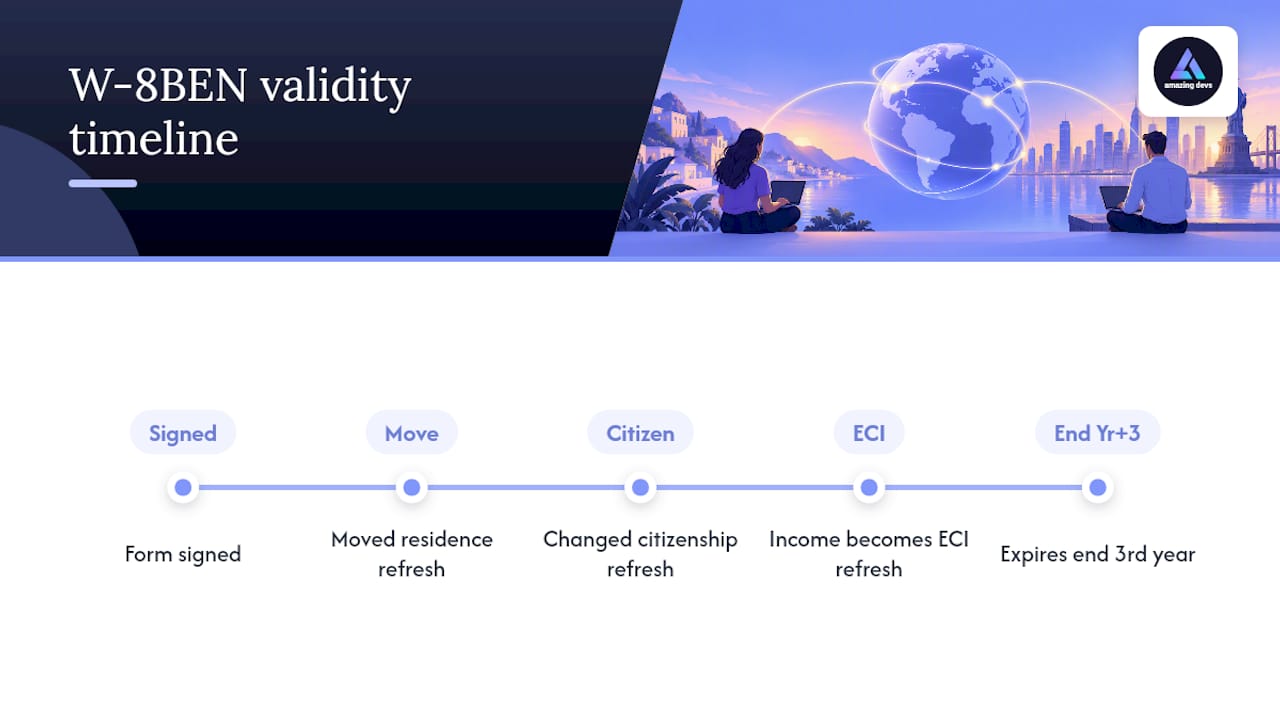
A Form W-8BEN does not last forever. Under the standard rule, it expires on the last day of the third succeeding calendar year after the date you signed it. A form signed on September 30, 2015, for example, remains valid through December 31, 2018.
Certain events invalidate the form immediately, regardless of that three-year window. Moving to a new country of residence, changing citizenship, or having your income shift from passive to effectively connected with a U.S. trade or business all require a fresh form right away, not at the next renewal date.
Because the expiry date is easy to lose track of across multiple client relationships, set a calendar reminder tied to each form’s signing date and keep signed copies in one central folder rather than scattered across email threads. A missed renewal is an administrative gap, not a tax problem, but it can still trigger withholding on your next payment until a new form is on file.
What payers must do: withholding, reporting, and recordkeeping
U.S. companies paying foreign contractors have their own set of obligations, and understanding them helps explain why a payer might ask for documentation you did not expect.
The reporting form used depends on your status, not your invoice amount. Form 1099-NEC is for U.S. persons, and payments to a foreign contractor with a valid W-8BEN on file are generally not reported that way. Instead, U.S.-source payments to foreign persons may be reported on Form 1042-S, with withholding governed by chapters 3 and 4 of the tax code.
- Without a valid W-8BEN on file, a payer may be required to withhold at the default 30% rate on U.S.-source payments to a foreign contractor.
- A properly completed W-8BEN with a valid treaty claim can reduce or eliminate that withholding, depending on the treaty article cited.
- Payers keep the W-8BEN in their own files; it is never sent to the IRS, though the payer must be ready to produce it if requested during an audit.
- If a contractor’s work is performed entirely outside the U.S. and a valid W-8BEN is on file, the payment often results in no 1099-NEC, no 1042-S, and no U.S. withholding at all, since the income is not U.S.-source in the first place.
Companies working through this process for the first time often find it easier to build a standard onboarding step around it. A payer-focused guide to compliance covers this from the hiring company’s side, including how to request and store the form correctly.
Practical onboarding checklist for contractors
A short, repeatable process at the start of every new U.S. client relationship prevents most of the problems described above.
- Complete and sign Form W-8BEN before your first invoice is due, not after a payment is already flagged for withholding.
- If you plan to claim a treaty benefit that requires a U.S. taxpayer number, start your ITIN application through Form W-7 as early as possible given the four to six week processing window.
- Keep a dated copy of every W-8BEN you submit, organized by client, and notify the payer immediately if your country of residence, citizenship, or work location changes.
- Confirm with each payer what signature format and supporting documents they accept, since some withholding agents request a copy of your passport or foreign tax residency certificate alongside the form.
Pro Tip: Store a template with your name, citizenship, and address pre-filled so each new client relationship only requires updating the payer-specific and treaty lines, cutting a five-minute task down to two.
How a managed nearshore staffing partner can reduce W8BEN risk
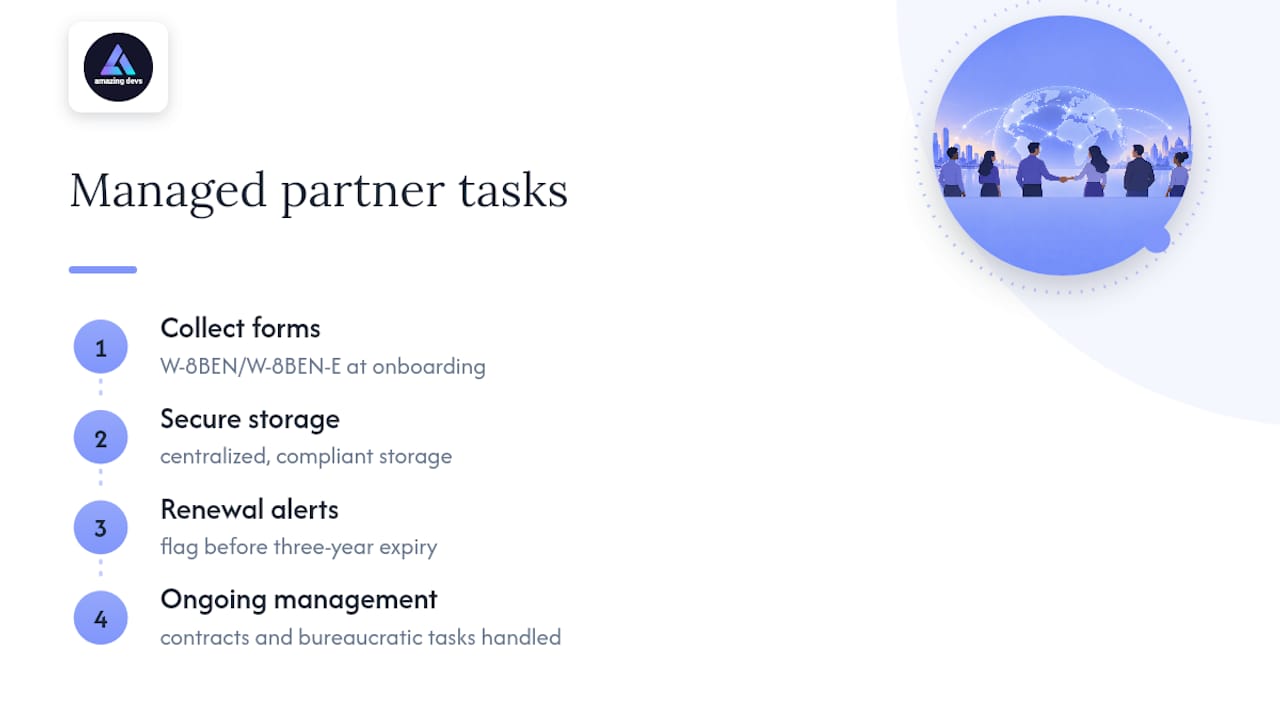
Companies that hire multiple foreign contractors often find the paperwork side, collecting forms, tracking expiration dates, following up on ITIN timing, becomes its own administrative job. A staffing partner that manages contracts on the client’s behalf can centralize that work: collecting W-8BEN or W-8BEN-E forms at onboarding, storing them securely, and flagging renewals before the three-year window closes.
Amazing Devs handles contract management and bureaucratic complexities as part of its nearshore staffing service, which is the kind of ongoing administrative task that trips up companies managing several contractor relationships in-house. For a business weighing whether to handle this internally or hand it to a partner, the deciding factor is usually volume: a handful of contractors is manageable alone, a growing team of foreign contractors often is not.
What I have learned about avoiding the top mistakes
The pattern I see most often is a contractor filing the wrong form, not because the rules are unclear, but because W-8BEN and Form 8233 look similar on the surface and only diverge once you check where the work physically happens. Late ITIN applications and unsigned forms are close behind. Get the form type right, apply for an ITIN early if a treaty claim depends on it, and sign before the first payment is due. For anything involving multiple countries or an unusual income type, a tax professional familiar with cross-border rules is worth the conversation.
— Gabriel
An adjacent option for companies managing contractor paperwork
If reading through form types and expiration rules made you think about how much easier hiring would be with someone else handling this, that is a fair reaction. Amazing Devs works with companies building out development and QA teams through nearshore staff augmentation, managing contracts and the bureaucratic steps that come with bringing on contractors from outside the U.S.

This is not a substitute for the tax guidance in this article: contractors and payers each still carry their own W-8BEN responsibilities regardless of who manages the relationship. What a partner like Amazing Devs adds is a team extension model where onboarding paperwork, including form collection and renewal tracking, is handled as part of the placement rather than left to a spreadsheet. If your company is scaling a nearshore team and wants that administrative layer covered, reach out through the Amazing Devs site to discuss your hiring plans.
FAQ
Is W-8BEN required for international contractors?
Yes, a foreign individual contractor earning U.S.-source income generally must provide a completed W-8BEN to the paying company to establish foreign status. Without it on file, the payer may be required to withhold at the default rate on that income.
Who is required to fill out a W8BEN?
A nonresident alien individual who is the beneficial owner of U.S.-source income and is not performing personal services physically inside the United States typically completes Form W-8BEN. Foreign entities use W-8BEN-E instead, and individuals performing personal services on U.S. soil who want a treaty rate use Form 8233.
What is a 1099 and/or W-8BEN independent contractor?
A 1099 contractor is a U.S. person whose payments are reported on Form 1099-NEC. A W-8BEN contractor is a foreign individual whose U.S.-source payments are documented with Form W-8BEN and, where applicable, reported on Form 1042-S instead.
What happens if I don’t fill out W-8BEN?
Without a valid W-8BEN on file, a U.S. payer may be required to apply default 30% withholding on U.S.-source payments to a foreign contractor. Submitting a valid form, including any applicable treaty claim, can reduce or eliminate that withholding going forward.