Five Phase Team Extension Model for Engineering Leaders

The team extension model embeds external developers directly into your existing engineering team, working in your stack, your sprints, and your codebase while your own tech lead keeps architectural control. The outcome is fast, flexible capacity without giving up ownership of how the product gets built. It fits best when you have a real skill gap or a demand spike but already have the internal leadership to direct the work.
TL;DR:
- Team extension involves embedding external developers into your team who work within your codebase, tools, and sprints, while your tech lead maintains control over architecture.
- Engagements typically last three months to over a year, with the staffing partner handling administration, payroll, and compliance, allowing you to focus on technical leadership.
- It is ideal when you need niche skills or face demand spikes, but not when no internal technical lead exists or for short-term, fixed-scope projects better suited for outsourcing.
- Success depends on proactive onboarding, daily pairing, shared tool access from day one, and clear offboarding processes to prevent siloing and security risks.
- Costs are driven by seniority, specialization, and overlap hours, with monthly retainers preferred; operational management and ramp-up time are additional considerations.
Table of Contents
- What Is the Team Extension Model, Exactly?
- When Should You Choose Team Extension?
- Benefits and Trade-offs You Should Weigh
- Team Extension vs. Outsourcing, Dedicated Teams, and Staff Augmentation
- The Five-Phase Implementation Framework for Extending Your Team
- How to Integrate Extended Developers Without Creating a Two-Tier Team
- What Does Team Extension Actually Cost?
- Where Team Extension Engagements Go Wrong
- How Amazing Devs Approaches Team Extension
- What I’ve Learned Running Team Extension Engagements
- Ready to Extend Your Team? Here’s How Amazing Devs Fits In
- Sources
- FAQ
What Is the Team Extension Model, Exactly?
Most confusion around this term comes from lumping it in with outsourcing, where you hand off a deliverable and a vendor manages the how. Team extension is different by design. The developers report into your existing structure. They join your standups, write code against your architecture decisions, and answer to your engineering manager, not a vendor project manager sitting between you and the work.
That distinction shapes everything else about the arrangement. Your internal tech lead still owns the technical roadmap. The extended developers execute against it, the same way a full-time hire would, except they’re employed and managed administratively by the staffing partner.
How the model typically works:
- Contracts are usually structured as monthly retainers per role (a senior backend engineer, a DevOps specialist) rather than a fixed project price.
- Engagements commonly run three months to over a year, long enough for someone to become genuinely productive in your codebase.
- Reporting lines stay internal. The extended developer takes daily direction from your team, not from the staffing company.
- Knowledge and intellectual property stay with you. Code lives in your repositories, decisions get documented in your systems, and nothing depends on the vendor’s internal tools to function.
- The staffing partner handles employment logistics: payroll, contracts, benefits, and compliance in the developer’s home country, freeing your HR team from that overhead.
This is why the model works well for staff augmentation situations where you need a specific skill set inside your team’s existing rhythm, rather than a separate group producing a separate deliverable.
When Should You Choose Team Extension?
Team extension earns its place when you already know what you’re building and who’s driving it. You just need more hands, or a specific skill set your current roster doesn’t have.
Scenarios where it makes sense:
- You need a niche skill, like a Kubernetes specialist or a machine learning engineer, that doesn’t justify a permanent hire but is critical for the next two quarters.
- Demand is seasonal or lumpy. A fintech company ramping up for tax season, or an e-commerce platform bracing for Q4, needs capacity that flexes without a permanent headcount commitment.
- You’re building a multi-quarter feature that requires sustained focus, not a quick contractor sprint. Extension developers stick around long enough to carry context forward.
- Your internal team is strong on product vision but thin on a specific technical layer, like mobile performance tuning or data pipeline architecture.
When it’s the wrong call: if you don’t have an internal technical lead who can direct the work, team extension will not fix that gap. Neither will it help much for a tightly scoped, short project with a fixed deliverable and no need for ongoing integration. Those cases usually fit outsourcing or a fixed-bid contractor better.
Before you commit to a vendor, run through a short checklist on the discovery call:
- Can they explain their recruitment and vetting process beyond “we have a talent pool”?
- Do they assess cultural fit and communication style, not just technical skill?
- What’s their average time from signed contract to a developer’s first commit?
- How do they handle a mismatch: is there a replacement guarantee period?
- Who owns the code, the documentation, and the IP once the engagement ends?
Pro Tip: Ask a prospective vendor for a reference client whose engagement lasted longer than a year. Vendors that only produce short-term success stories often struggle with retention, and retention is the real test of a team extension partnership.
Benefits and Trade-offs You Should Weigh
The upside is concrete: you get access to skills your local hiring pipeline doesn’t produce fast enough, and you compress the time from “we need this” to “someone is building it.” Global competition for technical talent has tightened labor markets for years, and team extension gives you a way around that constraint without waiting months for a traditional hire.
What you gain:
- Faster time-to-market because you’re not running a six-to-nine-week hiring funnel for every open role.
- Access to specialized skills (security engineering, platform reliability, AI integration) that might not exist in your local market at the seniority you need.
- Cost predictability, since monthly retainer pricing is easier to forecast than the fully loaded cost of a full-time hire with benefits and overhead.
- Continuity of institutional knowledge, because extension developers stay embedded long enough to actually retain context, unlike short-term contractors who cycle through.
What you have to manage in return:
- Someone on your team has to own the relationship: onboarding, performance feedback, and day-to-day direction don’t happen automatically.
- Integration takes deliberate effort. You’re responsible for making sure extended developers get the same tools, access, and context as everyone else.
- You still carry management overhead, just a different flavor of it than direct hiring. It’s lighter than running your own recruiting pipeline, but it’s not zero.
The trade-off is real: you’re exchanging the slow grind of traditional hiring for a different kind of ongoing effort, mostly around integration and oversight rather than sourcing and screening.
Team Extension vs. Outsourcing, Dedicated Teams, and Staff Augmentation
These four terms get used interchangeably in vendor sales decks, and that’s a problem, because the contractual and operational expectations behind them are genuinely different.
The core distinction is who drives the architecture and daily decisions. In outsourcing, you hand a vendor a scope and a deadline, and their project manager runs the show. You get a deliverable, not a set of teammates. In a dedicated team model, the vendor assembles a full unit, often including their own project manager and QA lead, that works semi-independently on your product under a broader mandate. In staff augmentation, you’re typically adding individual contractors for shorter, narrower gaps, often without deep embedding into your rituals.
Team extension sits closest to staff augmentation but with more depth and duration:
- Extended developers join your existing sprint cadence, code review process, and standups, rather than working inside a vendor-run parallel structure.
- Ramp time is longer than a typical contractor gig because the goal is sustained integration, not a quick task handoff.
- Contracts run longer, often six months to multiple years, reflecting the expectation that these developers become functionally part of your team.
- Your internal tech lead retains architecture and sprint decision authority the entire time; the vendor never inserts a competing technical layer between you and the work.
If you’re comparing outsourcing against staff augmentation for an upcoming project, the deciding question is usually this: do you want to own the how, or just receive the what? Team extension is built for leaders who want to keep owning the how while adding capacity to execute it.
The Five-Phase Implementation Framework for Extending Your Team
Most failed team extension engagements fail for the same reason: leaders treat the hiring decision as the finish line instead of the starting point. Here’s a phase-by-phase approach that holds up across engagements of different sizes.
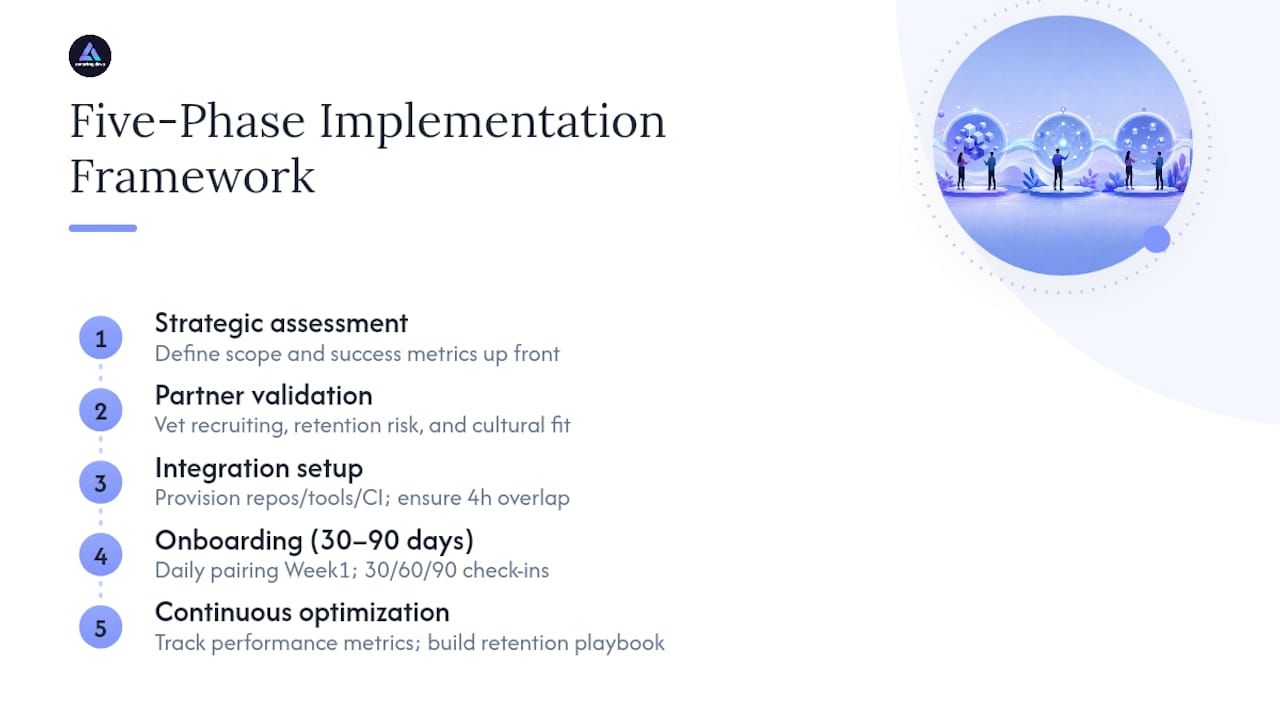
1. Strategic assessment. Before you talk to a single vendor, define the scope precisely: which roles, how many, and for how long. Set success metrics up front, not after the developer starts. A vague target like “help with backend work” produces vague results.
2. Partner validation. Vet the staffing partner’s recruiting process the same way you’d vet a candidate. Ask how they screen for technical depth, how they assess retention risk, and how they evaluate cultural fit, not just coding ability. A partner that can’t describe a structured vetting process beyond “we interview them” is a red flag. Practical guides on starting a team extension engagement consistently point to the same governance checklist: assign an internal technical lead early, agree on SLAs for access and code review turnaround, and put IP ownership in writing before day one.
3. Integration setup. This happens before the developer’s first day, not during it. Provision access to your repositories, your project management tool, your CI/CD pipeline, and your communication channels in advance. Set up the same permissions a full-time hire would get. Establish an overlap window, ideally at least four hours of shared working hours per day, so real-time collaboration is possible during the critical early weeks.
4. Onboarding and the first 30 to 90 days. The first two weeks matter more than almost anything else in the engagement. Daily pairing sessions during Week 1 accelerate context transfer far faster than documentation alone. Structured, relationship-focused onboarding with frequent early touchpoints measurably improves retention and speed-to-productivity for remote hires, and there’s no reason to think team extension developers are the exception. Run a 30/60/90 day check-in cadence: at 30 days, confirm they’re contributing to real tickets; at 60, review code quality and communication patterns; at 90, formally assess whether the engagement should scale up.
5. Continuous optimization. Once the ramp period ends, shift from onboarding metrics to performance metrics: cycle time, pull request throughput, and code review turnaround compared to your existing team’s baseline. Build a retention playbook, because losing an extended developer six months in costs you the ramp time you just invested. Regular one-on-ones, growth conversations, and inclusion in team planning sessions keep extended developers engaged past the initial project.
Pro Tip: Track pull request cycle time separately for extended team members during the first 90 days. If it’s still noticeably slower than your core team’s average by day 60, that’s an integration problem, not a skill problem, and it’s fixable with more pairing, not a replacement request.
How to Integrate Extended Developers Without Creating a Two-Tier Team
The single biggest failure mode in team extension isn’t a bad developer. It’s a vendor silo, where the extended team ends up running its own Jira board, its own standup, and its own code review standards, disconnected from everyone else. Atlassian’s research on breaking down organizational silos points to the same root cause across industries: separate tools and separate processes create separate teams, even when the org chart says otherwise.
Practical steps that prevent this:
- Give extended developers the exact same tool access as everyone else on day one: Slack, your repository, your dashboards, your documentation. No separate vendor-only workspace.
- Enforce a minimum four-hour overlap window between your core team’s working hours and the extended developer’s, even across time zones, so real-time collaboration stays possible.
- Run daily pairing sessions for at least the first two weeks. This isn’t busywork. It’s the fastest way to transfer undocumented context that no onboarding doc captures.
- Set up a buddy program specifically designed for remote integration, pairing each extended developer with a core team member who owns their first-month social and technical onboarding.
- Record key meetings, especially architecture reviews and planning sessions, and store decisions in a shared, searchable space so context isn’t locked inside a live call someone missed.
A practical rule from developer-integration guides is worth adopting directly: pair daily during the first two weeks and enforce full tool parity from day one, because both steps compress the time it takes an outside developer to stop feeling outside.
Nearshore engagements have a structural advantage here that farshore arrangements don’t: closer time zone alignment makes four-hour overlap windows, and even full-day overlap, realistic without asking anyone to work odd hours. That single factor removes one of the most common friction points in distributed team integration before it starts.
If your team already runs on Jira, a practical guide to using it as a single source of truth can help you avoid the exact silo problem described above, keeping extended and core developers working off the same board instead of two parallel ones.
What Does Team Extension Actually Cost?
Pricing in this model almost always follows a monthly, per-role retainer rather than an hourly rate, though hourly billing shows up for short-term or highly variable workloads. The retainer model is more common because it matches how the arrangement actually works: you’re paying for dedicated capacity, not a metered task list.
What drives the price:
- Seniority is the biggest lever. A senior backend engineer with five-plus years of production experience costs meaningfully more than a mid-level generalist.
- Specialization adds a premium. Security engineering, machine learning, and platform reliability roles command higher rates than general full-stack work.
- Recruitment difficulty matters too. If a role requires a rare combination of skills, expect the rate to reflect how hard that person was to find.
- Required overlap hours can factor into pricing, since a partner sourcing talent in a closely aligned time zone is solving a different staffing problem than one sourcing globally with no overlap constraint.
Industry guidance on team extension costs confirms that rates vary widely by region and seniority, and that the model remains a common way to close persistent skill gaps rather than a short-term stopgap. Treat any vendor quote that skips seniority and specialization as a single flat number with some suspicion. It usually means the pricing hasn’t been thought through, not that you’re getting a deal.
Costs that don’t show up in the initial quote:
- Ramp time. The first month or two of reduced productivity while a new developer learns your codebase is a real cost, even if it’s not itemized anywhere.
- Management time. Someone on your team spends hours each week on onboarding, check-ins, and code review that wouldn’t exist if the role didn’t exist at all.
- Tool licenses. Extra seats for your project management, communication, and monitoring tools add up faster than people expect.
- Knowledge transfer at exit. If an engagement ends, budget time and a formal process for transferring context back to your core team, or that knowledge simply walks out the door.
Where Team Extension Engagements Go Wrong
Most of the risk in this model is operational, not technical. The developers you hire are usually competent. The failure comes from how they’re integrated, governed, and secured.
The most common failure patterns and how to prevent them:
- Vendor silos. Watch for early signs: a separate standup time, a separate task board, or code review comments that only happen inside the vendor’s internal system. The fix is structural, not motivational: put everyone on the same board, the same PR template, and the same review SLA from day one.
- Security and IP exposure. Every extended developer should sign an NDA before touching your codebase, and access should be role-based, not blanket. If your company handles sensitive data, ask whether the staffing partner’s internal processes support SOC 2 or ISO 27001 requirements, and get IP ownership terms in writing before the engagement starts, not after.
- Quality drift. Extended developers should work against the exact same PR templates, CI gates, and review SLAs as your core team. The moment you create a “lighter” review process for extended contributors, you’ve created a two-tier quality standard, and it shows up in production eventually.
- Messy exits. Plan the offboarding before you need it. Define a knowledge-transfer timeline, confirm repository ownership sits entirely with you, and document any tribal knowledge that lived only in the departing developer’s head.
Pro Tip: Put a specific exit clause in every extension contract: a minimum 30-day knowledge-transfer window before the engagement ends, with a written handoff document as a deliverable, not an afterthought.
How Amazing Devs Approaches Team Extension
Our recruitment process screens Brazilian developers for technical depth first, then runs a separate cultural-fit and communication assessment, so the developers who join your team are ready to work inside your existing rituals from week one, not months later.
Contracts, payroll, and the bureaucratic friction of hiring across borders are handled by the staffing partner, which removes the administrative burden that usually slows down a company’s first international hire. That frees your engineering managers to focus on integration and technical direction instead of compliance paperwork.
Clients working with nearshore talent through Amazing Devs get the timezone overlap that makes daily pairing and real-time standups realistic, paired with proactive support from the engineering team when questions come up during onboarding or delivery. The combination of rigorous vetting and hands-on contract management is designed to shorten the distance between “we need this skill” and “someone is productively shipping code against it.”
What I’ve Learned Running Team Extension Engagements
The biggest misconception I keep running into is that team extension is primarily a cost play. It isn’t, or at least it shouldn’t be the reason you choose it. The engagements that actually work are the ones where a leader had a specific skill gap or a specific timeline problem, and extension solved that problem faster than hiring locally would have. When cost is the only justification, the integration effort usually gets skipped, and that’s exactly the corner you can’t afford to cut.
Three things have repeatedly separated the engagements that work from the ones that quietly fail. First, someone internal has to own the relationship, not just the ticket queue. Second, the first two weeks decide more than the next six months combined. Third, treating an extended developer’s access and tooling as “temporary” or “lite” is a guaranteed way to make them feel, and perform, like an outsider.
I’d push back on team extension in one specific case: if you don’t have a technical lead who can actually direct the work day to day, don’t bother. You’ll end up paying for capacity you can’t point in a useful direction, and that’s a management problem, not a staffing one.
One checklist item worth using on your very next vendor call: ask them to walk you through what happens in the first 14 days after a contract is signed. If the answer is vague, that’s your answer too.
— Gabriel
Ready to Extend Your Team? Here’s How Amazing Devs Fits In
The service provider is built specifically for the integration challenges this article just walked through: rigorous technical and cultural-fit vetting up front, full contract and payroll management behind the scenes, and developers who work inside your existing sprints instead of a separate vendor track.
That structure means less time spent untangling admin and more time spent shipping. Instead of running your own cross-border hiring process from scratch, or gambling on a vendor that treats cultural fit as an afterthought, you get developers who are ready to pair with your team from the first week and a partner who handles the bureaucratic friction that usually slows international hiring down. If you’re weighing whether team extension is the right fit for your roadmap, the next step is a technical assessment call to scope roles, timeline, and overlap needs before committing to a full engagement. You can also start with a single pilot hire to see how integration goes before scaling the team further. Get in touch with Amazing Devs to talk through what a pilot could look like for your stack.
Sources
- Atlassian: Break down silos, boost collaboration
- Onboarding remote hires into an office-heavy team (Rework resources)
FAQ
What Is the Team Extension Model in Simple Terms?
It means adding external developers who work inside your existing team, tools, and processes, while your internal lead keeps control over architecture and daily direction.
What’s the Difference Between Team Extension and a Dedicated Development Team?
Team extension developers embed directly into your sprints and report to your internal leadership, while a dedicated team usually operates as a semi-independent unit with its own vendor-side project management.
What Are the 5 C’s of a Team?
Definitions of this framework vary by source, and no single version is universally standard, so it’s worth checking whichever framework your organization already follows rather than assuming a fixed list.
What Does “Extended Team” Mean?
An extended team is a group of external developers who function as an extension of your in-house staff, working in the same systems and rituals rather than as a separate, self-contained unit.
How Long Does a Typical Team Extension Engagement Last?
Most engagements run anywhere from three months to over a year, since the model is built around sustained integration rather than a short, fixed-scope task.
Does Amazing Devs Handle Contracts and Payroll for Extended Developers?
Yes. Amazing Devs manages contracts, payroll, and the administrative side of hiring Brazilian developers, so clients can focus on integration and technical direction instead of cross-border paperwork.