Developer Hiring Time: How Teams Reach 28 Days With Stage Targets
Senior engineering hires average 95 days from posting to accepted offer. Teams that run structured funnels report getting to 28 days or fewer. The biggest lever is pairing a capped async assessment with a fast offer cadence, so senior engineers spend hours on finalists instead of everyone.
TL;DR:
- Set first screening within five business days, track every stage separately, and aim to extend an offer within five business days after final interviews.
- Cap asynchronous technical assessments at 90 minutes, review submissions within a day, and reserve final interview slots before results arrive to avoid scheduling delays.
- Measure hiring from posting to accepted offer, distinguish it from offer timing and start date, and track notice periods and onboarding separately.
- For Brazilian hires, nearby time zones can simplify interview scheduling, but notice periods, role seniority, and contract reviews still shape the start date.
- Define essential skills, deliverables, and compensation before posting, then use shared scorecards with same day notes to prevent restarted searches and delayed decisions.
Table of Contents
- What does time to hire actually measure?
- Where do the days pile up in a developer hiring process?
- How do you cut calendar time without lowering the bar?
- Which metrics should you track, and what should they look like?
- What does the evidence say about long searches and structured funnels?
- How long does hiring take for nearshore developers from Brazil?
- How do cultural and business alignment checks affect the timeline?
- How do contracts and paperwork slow down hiring?
- How does nearshore staff augmentation compare with in-house hiring on speed?
- Where I would start if I could only make two changes
- Start with vetted developers in weeks, not months
- FAQ
- Sources
What does time to hire actually measure?
Three terms get mixed up constantly, and mixing them hides where your delay lives.
- Time-to-hire: days from a candidate entering your funnel (or the posting going live) to an accepted offer.
- Time-to-offer: days from first contact to the moment you extend an offer, which excludes the candidate’s decision time.
- Time-to-fill: days from the requisition opening to the new hire’s start date, so it includes approvals, notice periods and onboarding.
Which clock you read changes the answer. A team that reports a fast time-to-offer can still wait longer for the person to start, because notice periods and equipment setup sit outside the offer clock.
Industry reporting puts the average for senior software engineering roles at 95 days, measured from job posting to accepted offer. Treat that as the number to beat, not a norm to accept.
The practical calendar stretches further. A notice period, laptop and access setup, and ramp-up mean full productivity can land well after the requisition opened. Track the stages separately so you know which one to attack first.
Where do the days pile up in a developer hiring process?
Most delay sits in handoffs, not in the work itself. A candidate waits for a recruiter, a recruiter waits for a manager, a manager waits for a calendar slot. Here is a realistic budget for each stage if you want to run lean:
- Role definition and approval. Agree on must-haves, deliverables and compensation band before you post. Skipping this step is the most common reason searches restart.
- Sourcing and outreach. Targeted outreach to a defined candidate profile beats waiting for inbound applications.
- First screen (under 5 business days from application). A recruiter call or short async questionnaire. The HackerRank playbook sets time-to-first-screen under five business days as a target.
- Technical assessment, including review. A capped async test, ideally reviewed within a day of submission.
- Interviews. One technical round and one team or culture round, scheduled back to back where possible.
- Decision and offer (under 5 business days). The same source recommends keeping time-to-offer under five business days.
- Acceptance, notice and onboarding. Largely outside your control, but a prepared onboarding checklist shortens the ramp.
Interviewer hours follow the same shape. Recruiter time is cheap and abundant. Senior engineer time is the scarce, expensive input, and it is spent mostly in stages four and five. Every candidate you can filter out before a senior engineer joins a call saves hours that would otherwise stretch the calendar, because those engineers also have sprints to ship.
How do you cut calendar time without lowering the bar?
Speed comes from removing waiting, not from lowering standards. These tactics work stage by stage.
- Write a focused role spec. List must-have skills and the deliverables for the initial period. Move everything else to nice-to-have. A tight spec filters applicants before anyone spends time on them.
- Source deliberately. Define the profile, then run warm outreach to people who match it. Our guide on skills-based sourcing for engineers covers how to do this without drowning in noise. AI tools can help with early sorting, and CorLab’s analysis of AI in software development gives useful context on where automation fits.
- Cap async assessments at 90 minutes. Longer tests lose strong candidates who have other options. Automate the first-pass review and have a human check only those who clear the bar. See our walkthrough on capping technical screens.
- Use structured interviews with scorecards. Each interviewer scores the same criteria on the same scale, then submits notes the same day. A template scoring matrix can make debrief meetings more efficient.
- Pre-approve the offer. Settle compensation bands before interviews start, keep a templated offer ready, and set an acceptance window of a few days.
- Prepare onboarding in advance. Accounts, hardware, a starter ticket and a named buddy should be ready before day one.
Pro Tip: Book the final-round slots before the assessment results arrive. Holding two or three interview windows open each week removes the scheduling delay that quietly adds a week to most searches.
Which metrics should you track, and what should they look like?
You cannot shorten what you do not measure. Track these seven numbers per role:
- Time-to-first-screen: target under five business days.
- Time per stage: days spent in each step, so bottlenecks show up.
- Time-to-offer: target under five business days from final interview.
- Total time-to-hire: under 30 days for a structured workflow.
- Interviewer hours per hire: especially senior engineer hours.
- Offer acceptance rate: a falling rate often signals a slow or uncompetitive process.
- Candidate drop-off by stage: shows where people lose interest.
The HackerRank playbook reports that structured teams reach 28 days or fewer in total time-to-hire. Use that as your stretch goal.
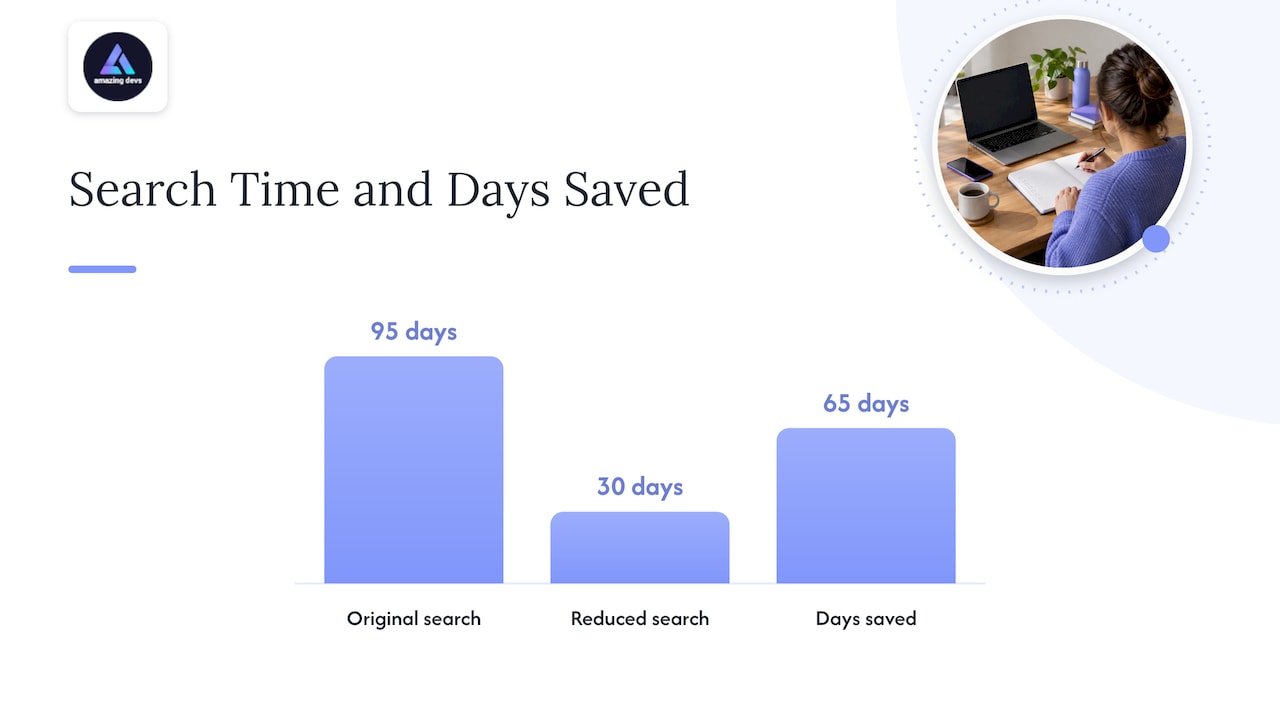
To prove the return, pick an honest daily cost for the open seat. Say the vacancy costs $400 a day in delayed delivery and stretched teammates (an illustrative figure, so substitute your own). Cutting a 95-day search to 30 days saves 65 days, or $26,000 on that one role. For broader context on spend, see our breakdown of the cost to recruit developers.
What does the evidence say about long searches and structured funnels?
Two findings anchor the targets in this guide.
- The long average is real. The 95-day figure describes senior software engineering roles, counted from posting to accepted offer. It reflects sequential handoffs and unstructured evaluation more than any shortage of capable candidates.
- Structured funnels shorten the cycle. HackerRank’s practitioner reporting says teams using async coding assessments can screen many candidates with far fewer senior interviewer hours, and that structured teams report finishing in 28 days or fewer.
- Early testing moves work upstream. Coverage in Forbes on pre-employment testing explains that testing helps companies screen applicants earlier in the funnel, which cuts screening time.
- Vacancy has a price. Hiring leaders prioritize speed because an empty seat delays roadmap work and pushes load onto the current team. Slow processes also lose candidates to faster offers.
How long does hiring take for nearshore developers from Brazil?
Nearshore searches follow the same stages, but a few local factors move the numbers. Brazilian developers often work in the same or a nearby time zone as U.S. teams, so interviews fit inside normal working hours and scheduling rarely adds days. That alone removes a common source of delay on cross-border searches.
Local market conditions matter too. Strong demand from both domestic and international employers means good candidates field several conversations at once, so a slow process loses people just as it does anywhere else. Remote and flexible work also shapes who is available: Forbes coverage highlights it as a factor in candidate availability and hiring patterns for tech roles.
Notice periods also differ from U.S. norms, and contractors can often start sooner than salaried employees who must wrap up with a current employer. We do not publish a guaranteed timeline because it depends on the role and seniority, but our own guide on hiring Brazilian developers describes a timeline for U.S. teams. Treat your own funnel discipline as the larger variable: a clear spec and a capped assessment do more than geography.
How do cultural and business alignment checks affect the timeline?
Alignment checks look at communication habits, ownership, working hours and how a candidate handles ambiguity. They matter more with distributed teams, because a skilled developer who works poorly with your process costs more time later than the check costs now.
The mistake is treating alignment as a separate stage added after the technical rounds. That adds scheduling time. The faster approach folds it in. Add structured questions to a round you already run, score them on the same scorecard, and let the interviewer note the evidence immediately. A short written exercise, such as summarizing a technical tradeoff for a non-technical reader, tests communication and technical judgment in one go.
Done this way, alignment adds hours rather than days. Done as a late, standalone interview, it adds scheduling delay and a second debrief. The same principle applies on our side: we assess cultural fit and business alignment during recruitment, before candidates reach you, so you meet people who have already cleared that bar.
Keep the questions tied to how the work actually happens: how the person handles unclear requirements, how they report blockers, and what overlap hours they can commit to. Those answers predict day-to-day friction better than general personality questions.
How do contracts and paperwork slow down hiring?
Paperwork is the hidden stage. A candidate can accept an offer verbally and still wait weeks for a contract review, legal sign-off, payment setup and compliance checks. For cross-border engagements the list is longer: contractor agreements, intellectual property terms, tax handling and sometimes local entity questions.
Three habits streamline it:
- Standardize the contract. Keep an approved template with IP and confidentiality terms already agreed by legal. Our piece on developer contracts that protect IP describes the rules we use.
- Run checks in parallel. Start background screening while the offer is out, matching depth to system access. See our guide to access-tier background checks.
- Decide payment and time tracking up front. Agreeing on verified time tracking before day one prevents billing disputes later.
For nearshore staffing, the largest saving comes from not building the machinery yourself. When we place developers, we manage the contract and the local bureaucracy. That removes a step that can otherwise add weeks to the schedule.
How does nearshore staff augmentation compare with in-house hiring on speed?
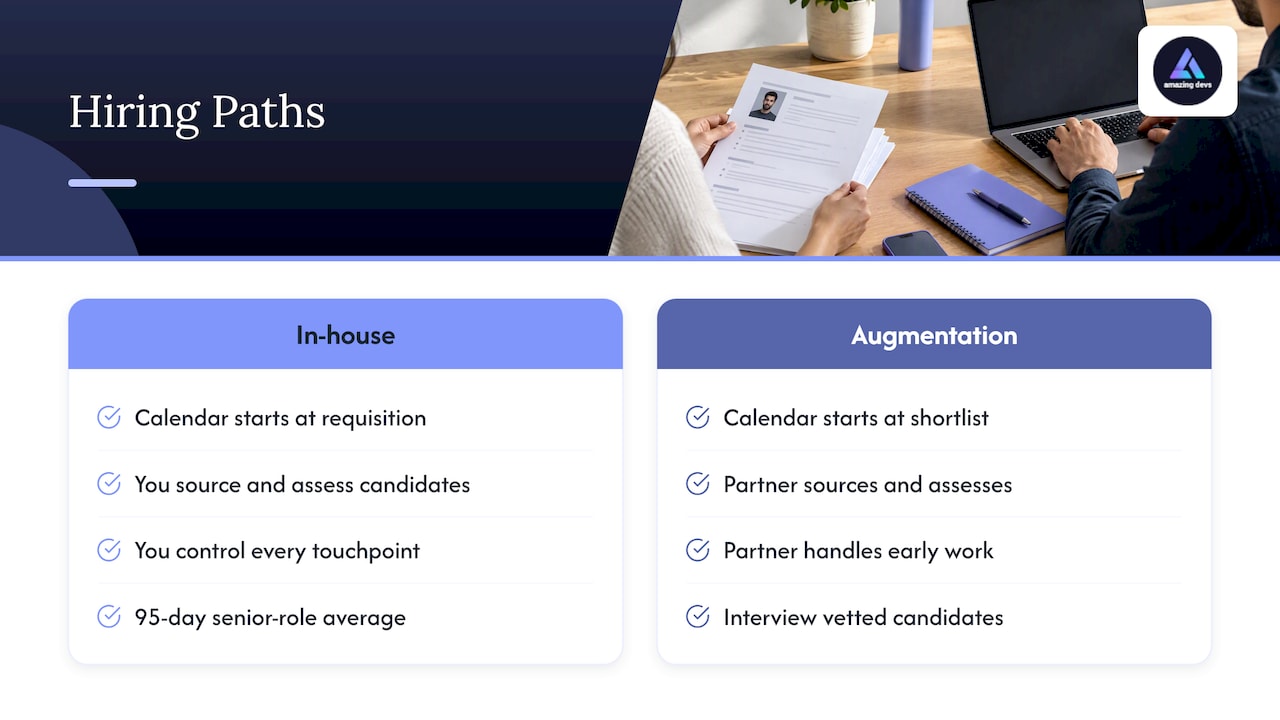
Compare the stages, not just the totals. An in-house search carries the full 95-day average for senior roles, plus notice periods and onboarding. Even a well-run structured process aims for 28 days or fewer to an accepted offer, before the new hire starts.
Staff augmentation changes the starting point. Sourcing, technical assessment and alignment checks happen before you see a candidate, so your calendar begins at the shortlist rather than at a blank requisition. You interview a handful of vetted people instead of screening a funnel. That is why the approach suits teams that need to start a project now rather than after a quarter of recruiting.
The tradeoff is not quality but control over process: in-house hiring gives you every touchpoint, while an augmentation partner shortens the path by doing the early work. Our overview of staff augmentation pros and cons and the use cases we see most will help you decide which fits a given role. If you are weighing whether to commit headcount at all, the cost view in our recruiting cost guide helps frame it.
Where I would start if I could only make two changes
Start with the role spec and the async assessment. A sharp spec removes most unqualified applicants, and a 90-minute capped test replaces the first senior interview for everyone who does not clear it. Then protect senior engineers’ time by moving decisions onto scorecards, and keep pre-approved offers and an onboarding checklist ready so closing takes days, not weeks. Those few moves recover more calendar time than any sourcing trick.
— Gabriel
Start with vetted developers in weeks, not months
If a 95-day search does not fit your roadmap, we can shorten it. Our nearshore staff augmentation and Team Extension Model put pre-assessed Brazilian developers in front of you, screened for technical skill, cultural fit and business alignment. We handle contracts and the bureaucracy behind them, so your team skips the paperwork stage.  Tell us the role and the stack, and we will introduce candidates. Request an introduction.
FAQ
What is a good time to hire developers?
A good target for a structured process is 30 days or less from first contact to accepted offer. HackerRank’s practitioner reporting says structured teams reach 28 days or fewer, well below the 95-day average for senior engineers.
How long does it take to hire a senior software engineer?
Industry reporting puts the average at 95 days from job posting to accepted offer. Notice periods and onboarding come on top of that.
What is the fastest way to hire developers?
Combine a focused role spec, a capped async assessment and a pre-approved offer. Each removes a waiting step without lowering the technical bar.
Does hiring nearshore developers take less time?
It often does, because sourcing, assessment and contract handling happen before you interview anyone. Exact timing depends on the role and seniority, so treat any quoted window as a range.
Sources
- Time-to-Hire for Engineers: 95 Days in 2026 – DEV Community
- How to Hire Software Engineers: A Practical Playbook for 2026
- Forbes