$150,000–$220,000 to Recruit Developers in 2026, for Hiring Managers
The fully loaded first-year cost to recruit a developer typically lands in the mid-six-figure range, covering salary, benefits, recruiting fees, and the productivity gap while the seat sits empty. It excludes long-term equity and annual raises, which compound separately. The breakdown below shows exactly where that range comes from and how to build your own number instead of guessing.
TL;DR:
- Recruiter fees and advertising can add between $20,000 and $45,000 per hire, significantly raising total costs depending on competitiveness.
- Seniority and specialization greatly influence costs, with senior or scarce-skill engineers exceeding $220,000 in first-year expenses, while generalist roles are generally lower.
- Nearshore team extension can cut sourcing and administrative costs, shortening time-to-productivity and reducing total first-year expenditure compared to traditional hiring models.
Table of Contents
- Line-by-line cost components you must budget for
- How time-to-fill and vacancy cost inflates recruiting expense
- Direct hire vs contractor vs nearshore team extension
- Worked budgeting example: a mid-level full-stack developer hire
- Practical tactics to reduce cost-per-hire while keeping quality high
- How Amazing Devs reduces recruiting friction and cost through nearshore team extension
- Cost variations by developer seniority level and specialization
- Author perspective: synthesis and budgeting recommendation
- A faster path to a full-stack hire without the agency fee
- Sources
- FAQ
Line-by-line cost components you must budget for
The headline range is only useful once you know what feeds into it. Break it into five buckets and you can rebuild a defensible budget for any role.
Start with base salary. The U.S. Bureau of Labor Statistics puts the median annual pay for software developers at $133,080, with the bottom 10% under $79,850 and the top 10% above $211,450. That median is your starting point, not your total. Multiply it by a benefits and payroll load, commonly 1.25 to 1.4, to account for health insurance, payroll taxes, retirement matching, and paid time off. A $133,080 salary becomes roughly $166,000 to $186,000 once loaded.
Recruiting hard costs stack on top. Job board postings, applicant tracking system fees, skills assessments, and paid advertising typically run from a few thousand dollars to well over $10,000 for a competitive role, depending on how aggressively you advertise.
Either model can add $20,000 to $45,000 to a single hire.
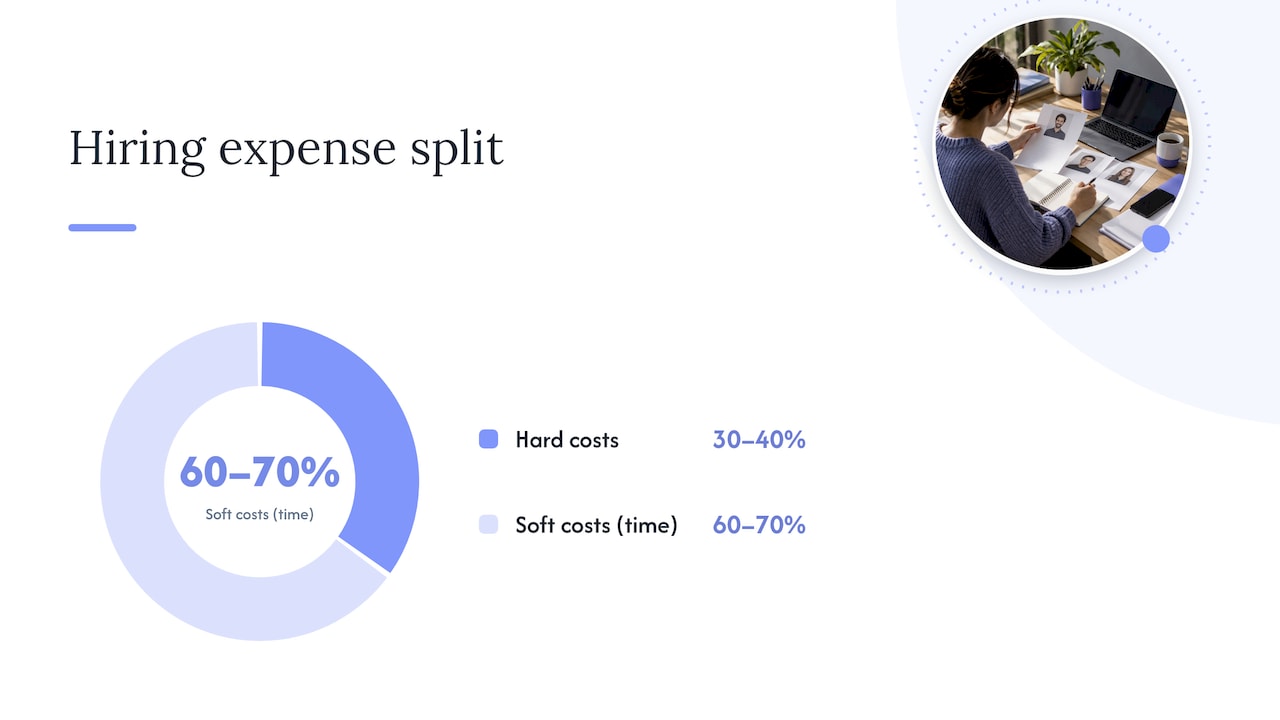
Then there are soft costs, which SHRM’s research on recruitment expense finds are often the largest and least visible piece. Practitioners estimate hard costs make up only 30% to 40% of total hiring expense, with the remainder tied up in hiring manager and interviewer time. A five-round loop with four interviewers at 45 minutes each, repeated across several candidates, adds up fast once you price out those hours at loaded salary.
Finally, budget for onboarding, training, background checks, and any relocation or sign-on bonus. These vary widely by company, but a realistic estimate for a mid-level hire includes:
- Background checks and compliance screening, typically $50 to $200 per candidate
- Onboarding and training time, often four to eight weeks before full productivity
- Sign-on bonuses for competitive roles, commonly $2,000 to $10,000
- Relocation packages, when offered, ranging from a few thousand dollars to $20,000 or more
- Equipment and software licensing setup, usually $1,500 to $3,500 per new hire
Add these five buckets together and the $150,000 to $220,000 range stops looking arbitrary and starts looking like arithmetic.
How time-to-fill and vacancy cost inflates recruiting expense
Every day a seat stays open is a day the business absorbs a cost that never shows up on a recruiting invoice. SHRM’s benchmarking data puts the median time-to-fill for nonexecutive roles at 39 calendar days, and more than two-thirds of organizations report meaningful difficulty hiring. Senior and specialized engineering roles routinely run longer.
The formula is straightforward:
- Calculate the role’s daily value to the business, either from expected output or by dividing loaded annual salary by working days and adding an uplift for lost opportunity, a method BLS-aligned vacancy-cost guidance supports.
- Multiply that daily value by the number of days the role sits open.
- Add the result to your direct recruiting spend for the true total cost.
Say a loaded developer role is worth several hundred dollars a day to the business in delayed output and missed delivery. A typical vacancy lasting several weeks adds significant cost in lost productivity, before a single recruiting fee is counted.
Direct hire vs contractor vs nearshore team extension
The same role produces very different first-year totals depending on how you staff it, and the right model depends on how much you value speed, control, and long-term retention.
- Direct hire carries the full loaded-salary-plus-benefits stack, higher retention potential, and full IP ownership, but the longest time-to-fill and the highest soft-cost exposure from interview loops.
- Independent contractors or freelancers cut benefits load and often shorten time-to-fill, but typically charge a premium hourly rate, offer less long-term continuity, and require more oversight to protect IP and code quality.
- Nearshore staff augmentation or team extension shifts sourcing, screening, contract administration, and payroll compliance to a vendor, which reduces internal recruiter and interviewer hours and can compress time-to-productivity, though it works best for well-scoped roles rather than highly specialized leadership hires.
- Employer-of-record (EOR) arrangements solve legal and payroll complexity for distributed hiring but add a per-employee management fee on top of salary.
Nearshore augmentation tends to reduce total cost most clearly when the bottleneck is sourcing time and administrative overhead rather than a shortage of qualified local candidates. It reduces cost less when the role demands deep, company-specific institutional knowledge that only comes from long internal tenure.
Worked budgeting example: a mid-level full-stack developer hire
Assume a $130,000 base salary for a mid-level full-stack developer, a 30-day interview process, and standard onboarding.
- Loaded salary: $130,000 x 1.3 benefits multiplier = $169,000.
- Sourcing and recruiter cost: agency fee at 20% of base = $26,000, or in-house sourcing hard costs around $6,000.
- Interviewer hours: four interviewers, three hours each across the loop, at an average loaded hourly rate of $80, equals $960.
- Onboarding and ramp: six weeks to full productivity at partial output, estimated at $8,000 in lost productivity.
- Vacancy cost: 39-day median time-to-fill at $650 daily value equals $25,350.
Direct hire total: totals in the low to mid six figures depending on specifics.
Agency-assisted hire total: costs incrementally higher due to agency fees.
Nearshore augmentation total: tends to reduce some costs by shortening ramp time and outsourcing administrative work, often landing lower than direct hire totals.
Substitute your own base salary, multiplier, and time-to-fill to rebuild this for any role.
Practical tactics to reduce cost-per-hire while keeping quality high
Lowering cost-per-hire is mostly a process problem, not a sourcing problem.
- Build a role scorecard before you post the job, so every interviewer evaluates the same criteria instead of drifting into redundant questions.
- Cap interview rounds at three or four and set a firm decision SLA, since delayed decisions are a leading driver of lost candidates and extended time-to-fill.
- Publish pay ranges in job postings. SHRM and Appcast’s recruitment marketing analysis found that postings with clear pay ranges produce higher apply rates and often lower cost-per-application, even as overall recruitment marketing costs rose in 2025.
- Prioritize internal mobility before opening external searches. SHRM’s 2025 recruiting outlook points to internal pipelines as a meaningful lever for both cost and retention.
- Negotiate performance-based fee structures with agencies rather than flat contingency percentages, and evaluate nearshore partners specifically for managed onboarding and ramp support.
- Use an AI skill assessment tool to filter candidates earlier in the funnel and cut the number of live interview hours spent on unqualified applicants.
Track cost-per-hire, cost-per-qualified-applicant, and interviewer-hours-per-hire on a simple dashboard, and normalize channel performance by accepted offers rather than raw application volume, since that’s the only way to spot which sourcing spend is actually working.
Pro Tip: Charge interviewer time into your hiring budget as a real line item. It usually reveals that soft costs, not job board spend, are your biggest lever.
How Amazing Devs reduces recruiting friction and cost through nearshore team extension
Much of the cost detailed above comes from sourcing time, screening rounds, and administrative overhead rather than salary itself. Amazing Devs addresses that specific gap by handling sourcing and technical and cultural-fit assessment before a candidate reaches a client’s interview loop, which reduces the number of interviewer-hours a hiring team spends per accepted offer. Some nearshore staffing providers also manage contracts and bureaucratic work tied to hiring talent, which can shift administrative burden away from internal HR and shorten the path to productivity.
Reducing the hours your own team spends screening and negotiating contracts is often what separates a fast hire from an expensive one.
Cost variations by developer seniority level and specialization
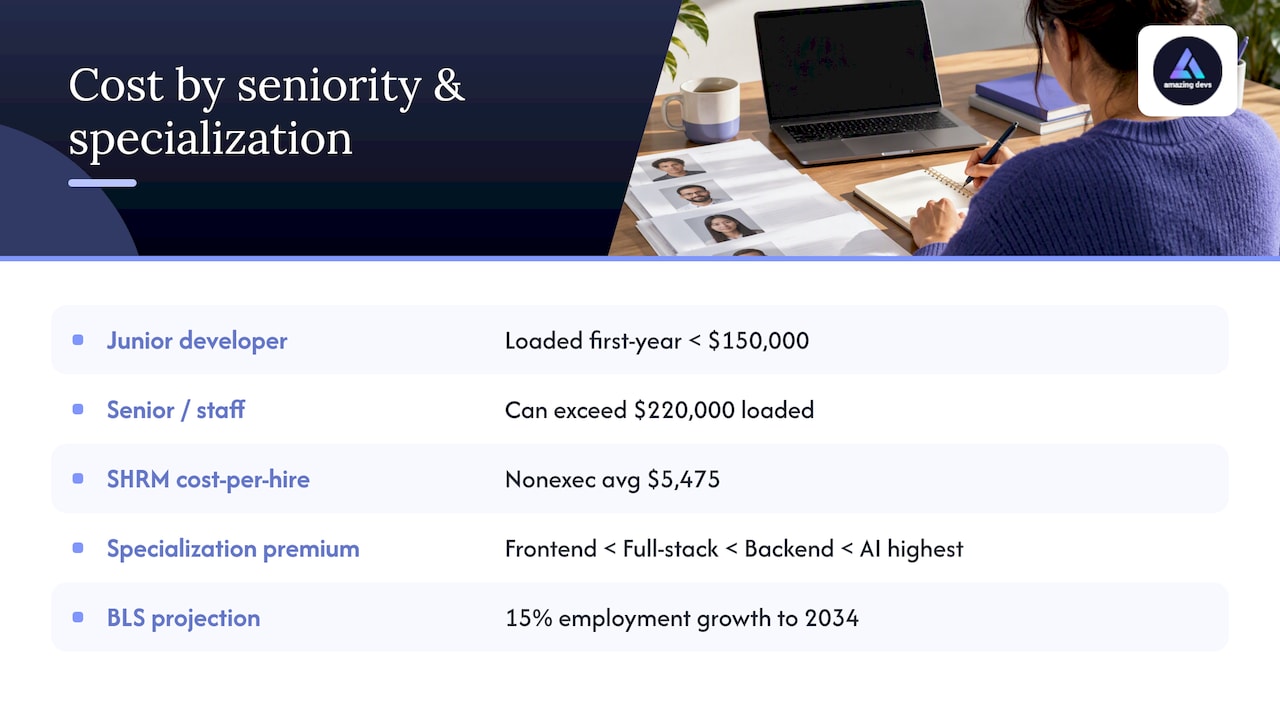
Seniority moves the budget more than almost any other single variable. A junior developer might carry a loaded first-year cost well below the $150,000 floor discussed earlier, while a senior or staff-level engineer, especially in a scarce specialization, can push past $220,000 once recruiter fees and extended time-to-fill are factored in. SHRM’s benchmarking data shows nonexecutive cost-per-hire averaging around $5,475, with executive-level hiring costing substantially more, a pattern that holds directionally for senior engineering roles as well.
Specialization matters almost as much as seniority. Backend and infrastructure roles requiring specific cloud or distributed-systems experience often take longer to fill than generalist frontend roles, which widens the vacancy-cost component. Full-stack developers sit in the middle: broad enough to fill faster than deep specialists, but commanding a salary premium over single-stack frontend roles because they cover more ground. Emerging specializations, including AI-enabled engineering roles, currently command some of the steepest premiums because supply hasn’t caught up with demand, a dynamic consistent with the BLS’s projected 15% employment growth for the broader occupation group through 2034.
Author perspective: synthesis and budgeting recommendation
Salary sets the floor, but vacancy days and recruiter fees are what actually swing a budget by tens of thousands of dollars. If you only fix one thing, fix time-to-fill: a faster decision process saves more money than negotiating a slightly lower agency rate. Pay for speed when a role blocks revenue or delivery, invest in retention when the role is core to your product, and consider nearshore team extension when the real bottleneck is sourcing and administrative overhead rather than a shortage of qualified people nearby.
— Gabriel
A faster path to a full-stack hire without the agency fee
Every line item in this article, sourcing hours, screening time, contract administration, ramp, is exactly what Amazing Devs’ nearshore staff augmentation and Team Extension Model are built to absorb. Instead of running a 39-day search and managing your own contracts and compliance work, you get pre-vetted Brazilian developers matched for technical and cultural fit, with the paperwork handled on your behalf.
If your current search is stretching past a month or your recruiter fees are substantial, an initial conversation with a nearshore augmentation provider can help determine whether this approach fits your budget. Reach out through the staffing and outsourcing page to start that conversation.
Sources
- U.S. Bureau of Labor Statistics — Software developers, quality assurance analysts, and testers
- SHRM — The real costs of recruitment
FAQ
How much does it cost to hire a developer?
A fully loaded first-year hire, including salary, benefits, recruiting fees, and vacancy cost, typically runs $150,000 to $220,000, depending on seniority and specialization. Base salary alone has a median of $133,080 before benefits and recruiting costs are added.
How much does it cost to recruit?
Recruiting cost varies widely by role level, but SHRM benchmarking reports a nonexecutive average cost-per-hire around $5,475, with executive roles costing substantially more. That figure covers direct recruiting spend and typically excludes vacancy cost and interviewer time.
How much does it cost to hire dedicated developers through nearshore augmentation?
Amazing Devs does not publish fixed pricing, since costs depend on role, seniority, and engagement length; pricing is available on request through a nearshore staffing consultation. Nearshore augmentation generally reduces sourcing, screening, and administrative costs compared to a fully in-house search.
Is AI replacing coders?
AI tools are changing how developers work and how candidates are screened, but the BLS projects continued employment growth of 15% for software developers through 2034, with about 129,200 openings a year. That points to sustained demand rather than replacement, though specific tasks within the role continue to shift.