Tech Leaders: Choose the Right Nearshore Partnership Model in 90 Days

If you need embedded capacity and long-term ownership, pick a dedicated nearshore team; for short-term skill gaps, pick staff augmentation; for fast-moving product work, an agile pod fits best; and for finite deliverables, a project-based team wins. Hybrid onsite plus nearshore and co-sourcing round out the field for companies that need shared control or a blended footprint. The right choice depends on how long you need the capacity, how much oversight you want to keep, and how fast you need people in seats.
TL;DR:
- Staff augmentation can have a developer contributing within a few weeks, making it ideal for fast skill gaps, while dedicated teams require longer setup times.
- Dedicated teams and agile pods usually need several weeks for recruiting and onboarding, but fixed-scope project teams can deliver faster once established.
- Nearshore teams benefit from real-time collaboration, cultural alignment, and faster hiring compared to offshore options, provided compliance and privacy are properly managed.
- Clear governance, documentation, and assigning a single owner during onboarding significantly improve retention and ramp-up efficiency in nearshore engagements.
- Key questions to ask nearshore providers include how they recruit, manage retention, handle legal employment, and protect intellectual property before signing any contract.
Table of Contents
- Common nearshore engagement models at a glance
- How each model actually runs day to day
- Nearshore versus offshore and onshore, and where the risk hides
- How to choose the right nearshore model
- Getting a nearshore team running in the first 90 days
- How Amazing Devs applies these models in practice
- Where to start if you’re weighing your options
- Ready to build your nearshore team
- Sources
- FAQ
Common nearshore engagement models at a glance
Each nearshore partnership model solves a different staffing problem, and understanding commercial structures for nearshore technology partnerships helps clarify these differences beyond the marketing copy around them.
- Dedicated nearshore team: A group of developers works exclusively for you under the partner’s employment, best for long-term product ownership, with the trade-off being a longer setup than augmentation.
- Staff augmentation: Individual developers plug directly into your existing team and processes, best for filling specific skill gaps fast, though it demands more of your own management bandwidth.
- Agile pod: A self-contained cross-functional squad (developers, QA, sometimes a scrum lead) owns a feature area, best for teams that want outcomes rather than headcount, with the trade-off being less granular control over individual assignments.
- Project-based team: A partner delivers a defined scope on a fixed timeline, best for one-off builds or migrations, though scope changes get expensive fast.
- Hybrid onsite plus nearshore: Some roles stay local while execution moves nearshore, best for companies that need a client-facing presence, with coordination overhead as the cost.
- Co-sourcing: You keep strategic control and the partner supplies workforce, infrastructure, and expertise, a model Deloitte frames as a middle ground that preserves internal visibility, unlike traditional outsourcing where a function is often handed off with less day-to-day collaboration.
Across every model, someone has to own payroll, benefits, and local compliance. That role usually sits with the partner acting as an employer of record, or, less commonly, with a direct-hire structure where you carry that liability yourself.
How each model actually runs day to day
The gap between picking a model on paper and running it in practice comes down to three things: who manages whom, what the contract actually says, and how long ramp-up really takes.
- Dedicated team: The partner recruits, employs, and pays the developers; you own the product roadmap and day-to-day technical direction. Contracts are typically retainer-based with a monthly rate per seat, and IP assignment clauses need to explicitly cover work product created under the partner’s employment.
- Staff augmentation: The partner sources and manages the employment relationship, but your engineering leads run standups, code review, and sprint planning. These engagements run on time-and-materials billing, since scope shifts with your backlog.
- Agile pod: The partner assembles the full squad and often supplies a delivery lead, while you set the product goals and priorities. Pricing blends retainer and outcome-based elements, since the pod is judged on delivered features rather than hours logged.
- Project-based team: The partner owns delivery against a signed scope, with your role limited to acceptance testing and sign-off. Fixed-price contracts dominate here, which shifts estimation risk onto the partner and rewards tight requirements upfront.
- Hybrid onsite plus nearshore: You directly manage the onsite layer while the partner manages nearshore staffing and local employment. Contract shapes mix retainer for the nearshore side with standard employment costs for the onsite side.
- Co-sourcing: Governance stays split by design. You retain strategic ownership and sign-off authority while the partner supplies staffing, infrastructure, and specialist skills, as Deloitte describes for finance functions and which applies equally to engineering.
Ramp times vary by model but follow a pattern. Staff augmentation can have someone productive inside your codebase within a few weeks once contracts are signed, since you’re slotting an individual into an existing process. Dedicated teams and pods usually need a longer ramp-up period, because recruiting, onboarding, and internal tooling access all have to happen before the first sprint counts. Project-based teams front-load time into scoping, often requiring several weeks before development starts, but once running they move fast because the deliverable is fixed. What shortens ramp across all models is a documented onboarding packet and early access to your repositories and communication tools; what lengthens it is unclear requirements, delayed access provisioning, or a partner without an established local recruiting bench.
Nearshore versus offshore and onshore, and where the risk hides
Nearshore’s core appeal is proximity. Time zones close enough for real-time overlap, cultural habits closer to your own market, and hiring cycles measured in weeks rather than months make it easier to run agile processes without the friction that deep offshore introduces. Offshore delivery can still cost less per hour, and onshore hiring keeps everything local, but nearshore tends to sit in the middle: faster to staff than onshore, more collaborative in real time than offshore.
- Time-zone overlap: Nearshore teams typically share several working hours with your headquarters, which supports live standups and same-day feedback loops.
- Cultural alignment: Shared business norms and holiday calendars reduce the friction that deep offshore engagements often carry.
- Speed to hire: Established nearshore markets have deep talent pools, cutting search time compared with competitive local markets.
- Hidden costs: Training time, occasional travel, and compliance overhead for cross-border payroll and tax obligations can erode the headline savings if left unmanaged.
The main risks worth planning for are data privacy, intellectual property protection, and the tax and social security obligations that come with cross-border employment. Tools like Remote.com and Deel can handle some of that administrative load, but contract terms still need auditing, a point the strategic playbook for offshore collaboration makes clearly. Overlap windows, shared documentation, and an async-first default for non-urgent communication go a long way toward closing the remaining gap.
Pro Tip: Put your IP assignment and confidentiality clauses in writing before the first developer touches your repository, not after.

How to choose the right nearshore model
Start with five questions before you talk to any partner: how fast do you need people producing work, how much day-to-day control do you want to keep, what security and compliance exposure can you tolerate, how ready is your internal team to manage remote collaborators, and how much will this team need to scale over the next year.
- Speed: If you need someone contributing within a month, staff augmentation usually beats standing up a new dedicated team.
- Ownership: If the work is core to your product long term, a dedicated team or pod gives you more continuity than a project engagement.
- Security: Regulated data or sensitive IP calls for tighter contract review regardless of which model you pick.
- Internal readiness: Teams without an engineering manager used to remote collaboration will struggle with augmentation and do better with a pod that includes a delivery lead.
- Scale needs: If headcount will grow fast, confirm the partner’s recruiting bench can keep pace before signing.
Bring this checklist to vendor conversations:
- How do you recruit and vet candidates, and what does the technical and cultural assessment look like?
- What’s your average developer retention rate, and how do you handle a bad fit?
- What contract structure do you use, and who owns IP and confidentiality?
- Can you provide client references in a comparable industry or team size?
- What does your onboarding plan look like for the first 30 days?
Walk away if a partner can’t explain who legally employs the developers, won’t share a written IP clause before you sign, or gives vague answers about retention. Those are the moments a good nearshore versus offshore comparison can help sharpen before you commit.
Getting a nearshore team running in the first 90 days
The models above only pay off if onboarding is deliberate.
- Days 1 to 30: Provision repository and tool access on day one, pair new developers with an internal buddy for shadowing, and set a concrete first-sprint goal instead of a vague ramp-up period.
- Days 31 to 60: Move the team into your normal sprint cadence, assign real backlog items, and set 90-day OKRs that tie to delivery metrics, not just attendance.
- Days 61 to 90: Review velocity, code quality, and retention signals, then decide whether to scale the engagement or adjust the model.
Governance works best with a fixed overlap window for live meetings, an async-first rule for anything that isn’t urgent, and a single source of truth for documentation, an approach the offshore integration playbook also recommends through tools like Jira and Slack. Retention improves when nearshore developers get included in team rituals and recognition, not just deadlines.
Pro Tip: Assign a single internal owner for the nearshore relationship during the first 90 days so onboarding questions don’t stall in a committee.
How Amazing Devs applies these models in practice
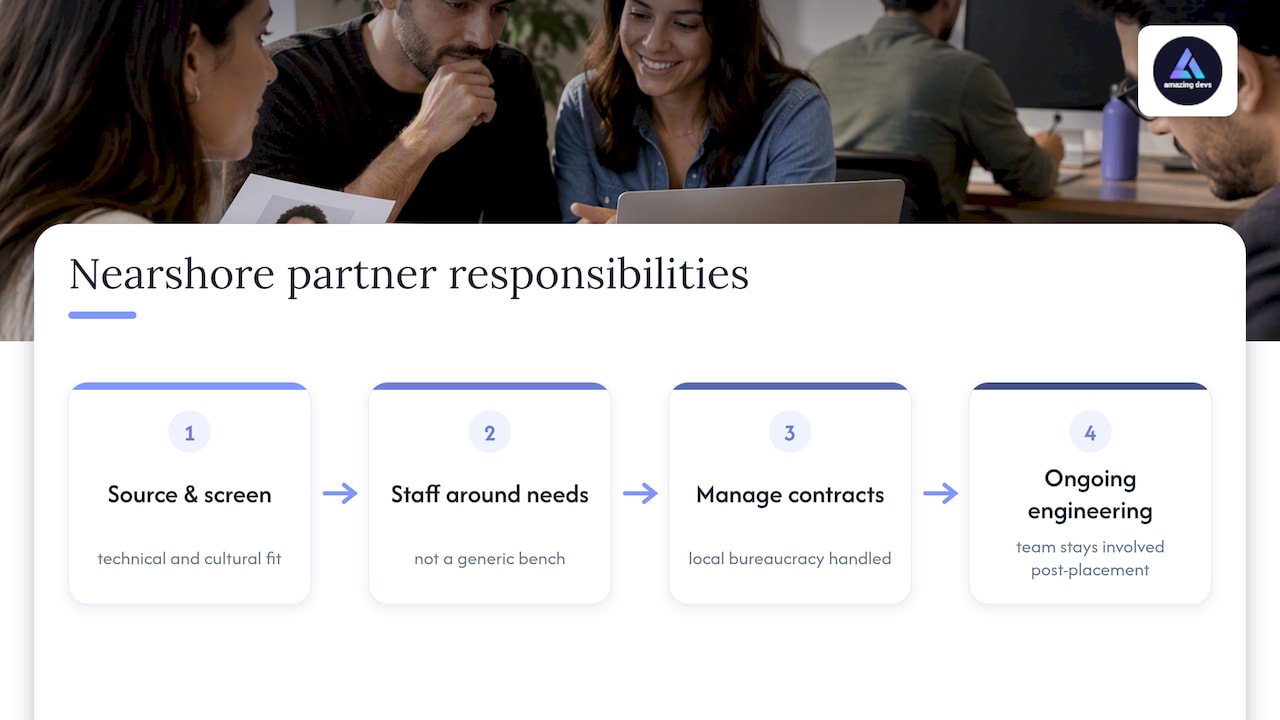
A nearshore partner sources developers and screens them for technical skill and cultural fit, then builds staffing around a client’s actual needs rather than a generic bench. The partner manages contracts and local bureaucracy directly, and their engineering team stays involved after placement to keep delivery on track.
Where to start if you’re weighing your options
Audit your internal readiness first, then pilot with staff augmentation or a small dedicated pod rather than committing to a full team. Set 90-day metrics for retention and delivery, and let those results decide whether you scale or adjust.
— Gabriel
Ready to build your nearshore team
If the models above point you toward filling a specific skill gap fast, nearshore staff augmentation puts a vetted Brazilian developer into your workflow without you managing recruitment or local payroll. If you need a longer-term embedded group instead, the Team Extension Model is built for that ownership structure, with Amazing Devs handling contracts and bureaucracy so your team can focus on delivery.
Reach out to talk through which model fits your roadmap and get a plan for your first 90 days.
Sources
- Why cosource vs. outsource accounting and reporting | Deloitte US
- How to work with offshore teams: the strategic playbook for seamless global collaboration
- Integrating offshore talent into project teams – Bristow Holland
FAQ
What’s the difference between co-sourcing and outsourcing?
Co-sourcing keeps strategic control and daily oversight with the client while the partner supplies workforce and infrastructure, whereas traditional outsourcing often transfers the entire function with less ongoing collaboration, as Deloitte describes it. Co-sourcing suits companies that want visibility into how work gets done, not just the result.
How is nearshore different from offshore development?
Nearshore places developers in nearby time zones, which supports real-time collaboration and closer cultural alignment, while offshore typically spans a much larger time difference. Both can reduce cost compared to local hiring, but nearshore tends to fit teams that need frequent live communication.
How long does it take to ramp up a nearshore team?
Staff augmentation can have a developer contributing within a few weeks of signing, while dedicated teams and agile pods usually need longer for recruiting and onboarding before the first sprint. Clear documentation and fast access provisioning are what most reliably shorten that timeline.
What questions should I ask a nearshore partner before signing?
Ask how they recruit and assess candidates, what their developer retention looks like, who legally employs the team, and how IP and confidentiality are handled in the contract. A partner that can’t answer these clearly is a sign to keep looking.
Does Amazing Devs offer both dedicated teams and staff augmentation?
Amazing Devs offers nearshore staff augmentation for filling specific roles and a Team Extension Model for building a longer-term embedded group, both sourced from its Brazilian developer network. Contract and compliance handling are managed by the company for both engagement types.