How to Scale an Engineering Team Fast Without Breaking It

To scale an engineering team fast, don’t start by posting ten job ads. Start by finding the one constraint that slows delivery today, add people only where that constraint lives, and keep a fast, repeatable way to bring each new engineer to productive work. Speed comes from a short hiring pipeline, clear ownership and stable delivery practices. Headcount alone doesn’t produce it. Below is the plan we’d hand a CTO or founder who needs to grow in weeks, not quarters.
TL;DR
- Name the bottleneck first. Adding engineers to the wrong team raises coordination cost and slows everyone down.
- Treat stability as part of speed. DORA’s research frames healthy delivery as a balance of four measures, not one fast number.
- Hire in small batches of two or three, with a fixed onboarding path, and measure each batch before the next.
- Use a nearshore model when you need senior capacity quickly and want contracts, payroll and vetting handled for you.
- Adding AI tools doesn’t replace testing. Strengthen your fundamentals as adoption grows.
Table of Contents
- What “fast” should mean for your team
- Find the constraint before you add people
- Choose your hiring route by timeline
- A four-week plan to add engineers fast
- Protect quality as you grow
- Where nearshore Brazilian engineers fit
- Our perspective
- How Amazing Devs can help
- Measure whether the scaling worked
- FAQ
- Sources
What “fast” should mean for your team
Most leaders who search for this want one of three things: a funded roadmap needs more hands this quarter, a key launch date is slipping, or attrition has opened gaps. Each calls for a different move, so define the outcome in a sentence before you open a requisition.
A useful definition: more shipped, working software per month, without more incidents. That second half matters. The DORA program measures delivery with four keys: change lead time, deployment frequency, change fail percentage and failed deployment recovery time. A team that doubles its output while its change fail rate climbs hasn’t scaled. It has borrowed against next quarter, and the repayment arrives as rework.
Before hiring, record your current numbers for those four measures. Rough figures from your deployment tool and incident tracker are enough. They become your tripwire: if lead time grows or failures rise after a hiring batch lands, you slow the next batch and fix the cause.
Find the constraint before you add people
Headcount is the most expensive answer to a delivery problem, so check whether it is the right one. Ask these questions in order:
- Where do tickets wait? If work sits in review, QA or deployment queues, more feature developers will lengthen those queues.
- Who is overloaded? One or two staff engineers who approve everything are a bottleneck no junior hire fixes.
- Is a team carrying too much? Team Topologies argues that scaling is more about managing cognitive load than adding people. Leaders often keep piling responsibilities onto a team until it breaks, then label it underperforming.
- Are there hand-offs you could remove? The same source recommends teams that own a value stream end to end, rather than splitting QA and development into separate silos that create coordination overhead.
If the answer to the first three is “no,” and the roadmap simply exceeds capacity, hire. If you find a bottleneck, fix it first or hire into it directly, for example a QA or DevOps engineer rather than a fifth backend developer.
Shape teams before you grow them
A team that owns a product area from idea to production can absorb a new engineer in days. A team that depends on three others for every change cannot. Keep teams small enough that each member understands the whole area. When a team’s scope outgrows that, split it along a product boundary and staff both halves, instead of stretching one group.
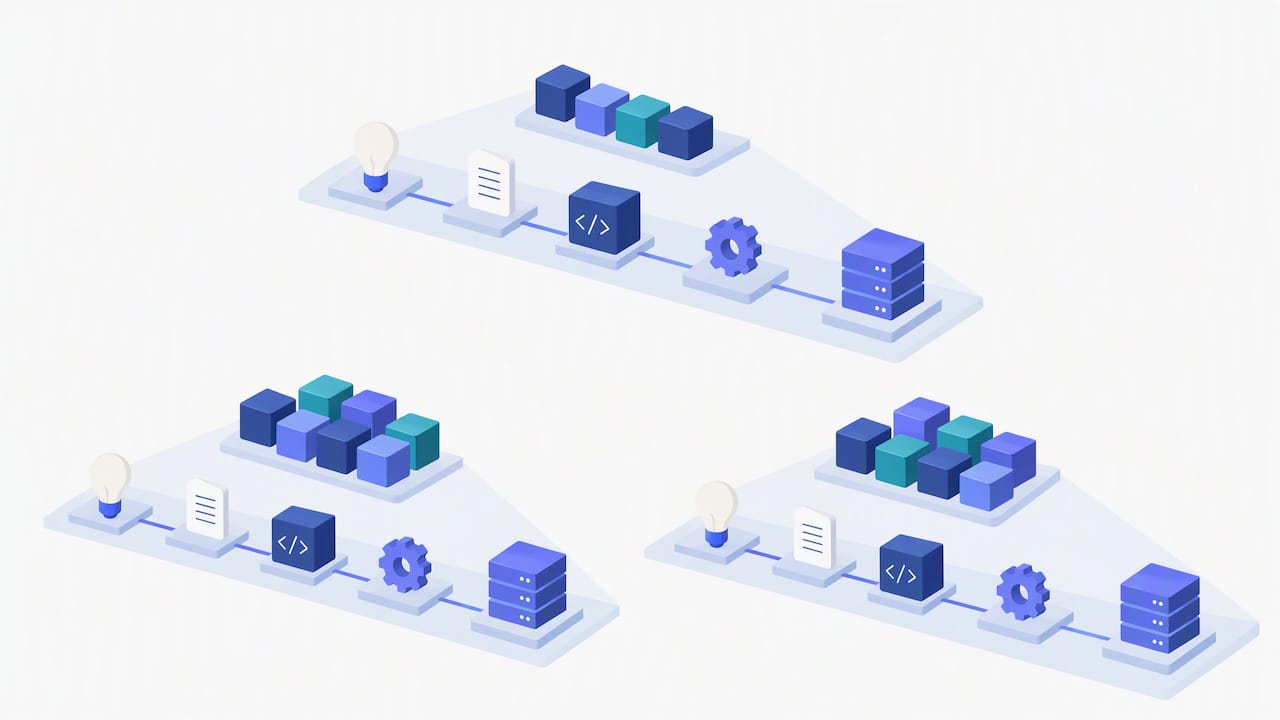
One caution from the same research: don’t create a platform team too early. Teams that build a platform team before stream-aligned teams have a steady flow of value often ship tools that the product teams cannot use, which adds load instead of removing it. Get product teams shipping first, then extract shared capability where the pain repeats.
Choose your hiring route by timeline
There are four realistic routes. They differ most in time to first commit and in what you carry afterward.
| Route | Typical strength | Main risk | Fits when |
|---|---|---|---|
| Direct U.S. hiring | Full control, long-term culture | Slow cycles and high cost | You have months and a strong recruiting engine |
| Agency recruiters (permanent) | Wider reach | Fee per hire, variable quality | You need specific senior profiles |
| Freelance marketplaces | Very fast start | Retention, depth of commitment | Short, well-bounded tasks |
| Nearshore staff augmentation | Dedicated engineers, overlapping hours, vetting and contracts handled | Needs good onboarding on your side | You need sustained capacity in weeks |
Cost matters in this decision, and U.S. figures are steep. CBRE’s Scoring Tech Talent 2025 reports that the total annual labor bill for a 500-person tech company ranges from about $35 million in lower-cost hubs to $87 million in places like the San Francisco Bay Area. The same report puts general software engineering salaries at around $171,539 as of mid-2025, and AI and machine learning roles higher, at roughly $178,510. When you need ten or fifteen engineers, those numbers push many teams to look beyond their home market. For a deeper breakdown of what a direct hire really costs, see our piece on what it costs to recruit developers.
A four-week plan to add engineers fast
This sequence works whether you hire locally or nearshore. The aim is to turn hiring from a project into a pipeline.
Week 1: Define roles by outcome
Write each role as the result you need in 90 days, with the stack, the level, and the two or three skills that matter most. Resist long wish lists. A narrow, honest brief shortens screening and raises match quality. Decide who on your team owns each hire’s first month: a named buddy and a named manager.
Week 2: Screen for job-relevant skill
Assess what the person will actually do. SHL’s 2025 report on hiring software developers finds that teams assessing job-relevant skills and potential, rather than leaning on pedigree or degree requirements, tend to see better placement rates and longer team tenure. Keep technical tests short. We suggest capping take-home or live exercises at about 90 minutes, and explain the reasoning in our guide to technical screening for developers. Add a conversation about how the candidate works with others, because a technically strong hire who clashes with your team’s habits costs more than a slower start.
Week 3: Decide quickly, in batches
Interview in a tight window so you can compare candidates side by side, and give answers within a day or two. Strong engineers rarely wait. Aim to onboard two or three people together. A cohort shares questions, builds a small peer network and lets your buddies work in a rhythm.
Week 4: Onboard against a checklist
The first commit to production in the first week is a good target. To make that realistic, prepare before day one:
- Accounts, repository access and a working local environment script.
- A small, real, low-risk first ticket with a clear definition of done.
- A written overview of architecture, deployment and on-call expectations.
- A 30-60-90 day goal list shared with the new hire.
If your onboarding doc is stale, fix it now. Every later hire benefits.
Protect quality as you grow
The usual failure when scaling fast is not a bad hire. It is a thinning of the practices that kept the code healthy: reviews get rushed, tests lag, batches get bigger.
Three habits hold the line:
- Keep changes small. Small batches are easier to review, test and roll back. This is a core theme of the DORA findings.
- Automate the checks. Continuous integration, automated tests and a consistent review checklist let new people contribute safely.
- Put QA inside the flow. A dedicated tester embedded in a team, rather than a downstream gate, finds problems while they are cheap.
AI-enabled engineers: fast, with guardrails
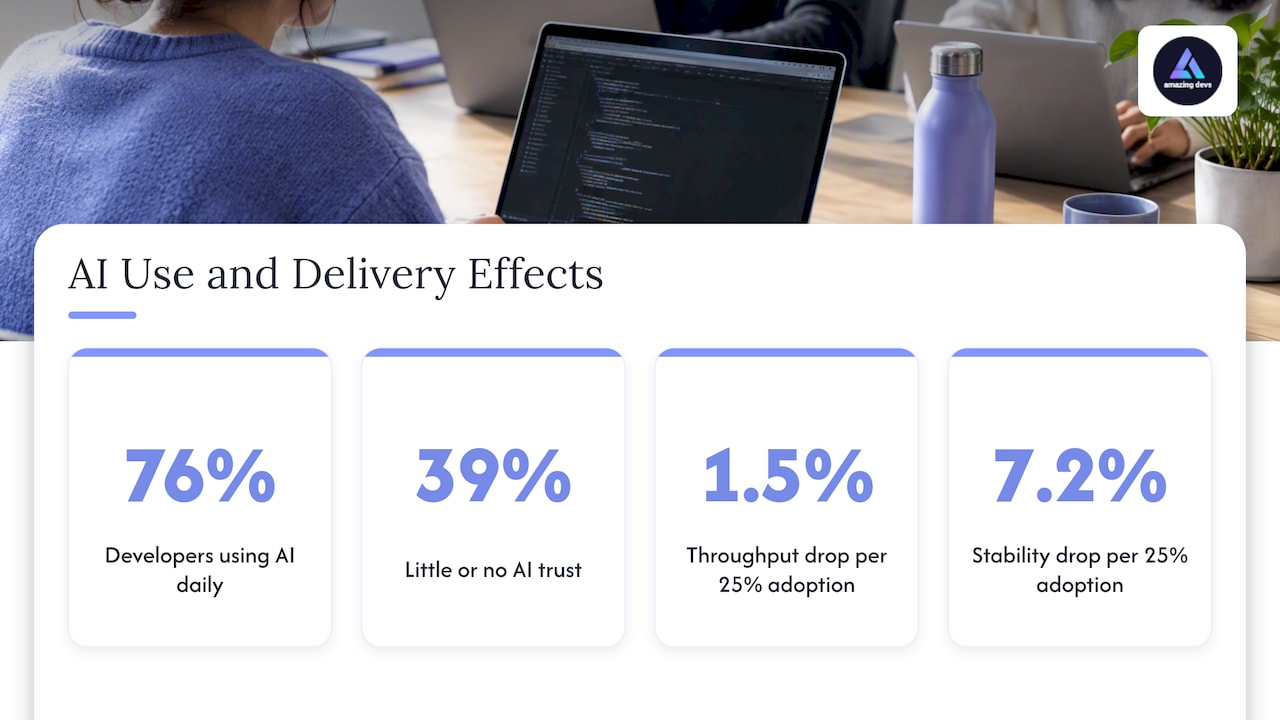
Many teams now want engineers who work fluently with AI coding tools. That is reasonable, but handle it with care. The 2024 DORA report, summarized by Google Cloud, found that 76% of developers used AI for daily tasks such as writing and summarizing code, while 39% reported little or no trust in AI-generated code. The research also associated higher AI adoption with an estimated 1.5% decrease in delivery throughput and a 7.2% reduction in delivery stability for each 25% increase in adoption, where fundamentals such as testing were neglected.
The lesson is practical. When you hire AI-enabled engineers, screen for how they validate output: do they write tests, read generated code critically, keep pull requests small? An engineer who uses AI to move faster and holds a high review standard is the one who helps you scale.
Where nearshore Brazilian engineers fit
Nearshore staff augmentation means engineers in a nearby region join your team as dedicated members, working your sprints, standups and tools, while a partner handles recruiting, contracts and local compliance. For U.S. teams, Brazil is an attractive source because its working hours overlap with U.S. business hours far better than offshore regions do. That overlap lets a new engineer pair, ask questions and join incident calls live. If you want to think through the practicalities, our notes on timezone management cover meeting design and handoffs, and What Is Nearshore Outsourcing for IT Teams? covers the basics.
Nearshore is not a shortcut around management. It works when you treat the engineers as teammates: same tickets, same standards, same access to context. It works poorly when work is thrown over a wall. If you are weighing models, outsourcing versus staff augmentation explains the trade-offs, and the pros and cons of staff augmentation is candid about where it does not fit. To budget, look at nearshore developer rates in LATAM and the costs that U.S. quotes often leave out.
What to ask any nearshore provider
- How do you assess technical skill, and how do you assess communication and cultural fit?
- Who manages the contract, payroll and local legal requirements?
- Can I interview every engineer before they start?
- What happens if the fit is wrong in the first weeks?
- Will the engineer be dedicated to my team, or split across clients?
Good answers are specific. Vague ones mean you will carry the risk.
Our perspective
We see the same pattern with clients who come to us in a hurry. The request is usually “five engineers by next month,” and the real need is often two engineers in the right place plus a cleaner onboarding path. So our first conversation is about the roadmap and the team’s current shape, not a headcount number.
What we have learned to protect is fit. A developer who passes a technical test but doesn’t match how your team communicates will slow you down, which is why we put technical assessment and cultural and business alignment on equal footing in our recruitment process. We also take on the contract and bureaucratic work that otherwise lands on your engineering managers, so the people who should be coaching new hires aren’t buried in paperwork.
Our advice to any leader scaling quickly: hire fewer people than your anxiety suggests, hire them in cohorts, and keep your delivery measures visible. If those measures hold steady as people join, add more. If they slip, the problem is probably not a lack of engineers.
— Gabriel
How Amazing Devs can help
If your plan calls for dedicated engineers in weeks, our nearshore staff augmentation service provides pre-vetted Brazilian developers who join your team under a structure we manage. Prefer to grow an existing squad? The Team Extension Model adds engineers who work as part of your team. If testing is the constraint, our nearshore QA contractors can embed in your flow. Tell us the roles and stack, and we will start with the bottleneck. You can reach us through getamazingdevs.com.
Measure whether the scaling worked
Review these every two weeks during the ramp, and compare them against your starting numbers:
| Signal | Healthy sign | Warning sign |
|---|---|---|
| Change lead time | Flat or shorter | Growing as new people join |
| Deployment frequency | Rising gradually | Rising with more incidents |
| Change fail percentage | Stable | Climbing |
| Recovery time | Stable or faster | Slower because few people know the system |
| Time to first merged change | Under one week | Several weeks |
| Senior engineer review load | Shared | Concentrated on one or two people |
Activity counts such as lines of code or tickets closed tell you little. For remote and distributed engineers in particular, look at broader outcomes, as we explain in our piece on remote developer productivity.
FAQ
How fast can you realistically scale an engineering team?
A focused team can add two or three engineers in four to six weeks if roles are defined and onboarding is ready. Going much faster usually means skipping assessment or onboarding, and the cost shows up later as rework. A nearshore partner with a vetted pipeline can shorten the sourcing step, but your onboarding speed still sets the pace.
What is the biggest mistake when scaling quickly?
Adding people without removing the bottleneck. Extra engineers on an overloaded team increase coordination and cognitive load. Find where work waits, fix that, and hire into the gap.
Should I hire seniors or juniors when I need speed?
Favor experienced engineers for the first wave, since they need less guidance and can set standards for later hires. Add junior engineers once onboarding and review habits are solid and a senior can mentor them.
Is nearshore staff augmentation better than a freelance marketplace?
For sustained work, usually yes. Nearshore engineers are dedicated to your team, work overlapping hours and are supported by a provider that manages contracts. Marketplaces suit short, tightly scoped tasks.
How do I keep quality up when using AI tools?
Keep pull requests small, require tests and review generated code as carefully as any other code. DORA’s research links AI adoption to lower delivery stability when fundamentals are neglected, so make those fundamentals non-negotiable.
Sources
- DORA Accelerate State of DevOps Report 2024
- 2024 DORA Accelerate State of DevOps report (PDF)
- Announcing the 2024 DORA report, Google Cloud Blog
- Key concepts, Team Topologies
- Building a successful platform team at CROZ, Team Topologies
- Scoring Tech Talent 2025, CBRE
- Hiring the right software developers report, SHL (May 2025)