Remote Developer Productivity: Managers, SPACE Exposes Activity Traps
Remote developers can match or exceed the output of colocated teams, but only when managers protect focus time, measure delivery outcomes instead of activity, and build onboarding that replaces hallway learning with structured pairing. The evidence on this is specific, not anecdotal. What follows is the research and the exact tactics to apply it.
TL;DR:
- Block at least two uninterrupted focus hours daily, cap pull requests near 200 changed lines, and review teammates’ submissions within four business hours.
- Start with two delivery metrics and one satisfaction signal, baseline them for two weeks, then adjust processes based on changes rather than activity counts.
- Give new hires a buddy on day one, schedule pairing in week one, and target their first merged pull request within three to five days.
- Use monthly office days for mentorship, onboarding, and pair review workshops; randomized trials link coordinated office contact to more communication and lower attrition.
- Let developers shift working hours to match their energy patterns; research linked lower daily energy variability at home with stronger goal progress.
Table of Contents
- 1. Priority checklist: top tactics to boost remote developer productivity now
- 2. How to measure remote developer productivity: use SPACE and DORA without misreading activity
- 3. Async and coordination practices that preserve flow
- 4. Onboarding and mentorship at distance: ramp remote and nearshore hires faster
- 5. Tools and workflows that reduce friction (code review, CI/CD, remote pairing)
- 6. Designing hybrid or occasional co-location to strengthen learning and retention
- 7. Manager playbook: rituals, questions, and trust signals that support productivity
- 8. How Amazing Devs operationalizes productive remote teams
- 9. Handling distractions and work-life balance effectively in a remote work setting
- 10. Author note: pragmatic first step and tradeoffs
- Get hands-on help building this into your team
- FAQ
- Sources
1. Priority checklist: top tactics to boost remote developer productivity now
Most productivity problems on remote teams trace back to a handful of fixable habits. Start here before touching tools or org charts.
- Protect long focus blocks. Block at least two uninterrupted hours daily on your calendar and treat meeting-free mornings as a team default, not an individual favor.
- Keep pull requests small. A PR that touches fewer files gets reviewed faster and sits in queue less time, which directly shortens lead time.
- Set review SLAs. Commit to reviewing teammates’ PRs within a fixed window, such as four business hours, so work never stalls waiting on a glance.
- Default to async communication. Write decision logs, use issue templates, and set response-time expectations by urgency instead of assuming instant replies.
- Measure delivery outcomes, not activity. Track lead time, deployment frequency, and review turnaround rather than commit counts or hours online.
- Pair for onboarding and hard problems. Scheduled pairing sessions transfer knowledge faster than documentation alone, especially for less-tenured engineers.
- Set timezone overlap rules. Define two to four hours of guaranteed overlap and push everything else to async handoffs. Our timezone management strategies guide covers specific rules for distributed teams.
Pro Tip: Cap PR size at around 200 lines changed. Reviewers approve smaller diffs faster and catch more bugs doing it.
2. How to measure remote developer productivity: use SPACE and DORA without misreading activity
Activity metrics lie. A developer who sends fifty Slack messages a day is not necessarily shipping more than one who sends five. The SPACE framework addresses this by evaluating five dimensions together: Satisfaction, Performance, Activity, Communication, and Efficiency or flow. No single number in that list is meant to stand alone.
Pair SPACE with concrete delivery data from DORA’s metrics:
- Lead time for changes, the time from commit to production.
- Deployment frequency, how often code ships safely.
- Mean time to restore (MTTR), how fast a failure gets fixed.
- Change failure rate, the share of deployments that cause problems.
- PR review time, a strong leading indicator of lead time.
Faster code review consistently correlates with higher software delivery performance, according to DORA’s research, which makes review speed one of the first levers worth pulling.
To roll this out, pick three metrics to start, two delivery metrics and one satisfaction signal, baseline them for two weeks, then adjust process based on what moves.
3. Async and coordination practices that preserve flow
Collaboration and flow are not opposites, but most teams structure communication as if they were. The fix is an async stack that answers questions before they get asked.
- Decision records that log why a choice was made, searchable by anyone later.
- Issue templates that force context upfront instead of a back-and-forth thread.
- Detailed PR descriptions covering what changed, why, and how it was tested.
- Channel rules separating urgent pages from non-urgent questions, each with its own response SLA.
- Timeboxed syncs that require prework, so the meeting itself only resolves disagreements.
A daily async status update, three lines covering yesterday’s progress, today’s plan, and current blockers, replaces most standup meetings and cuts follow-up questions dramatically.
4. Onboarding and mentorship at distance: ramp remote and nearshore hires faster
New hires learn fastest from proximity to experienced coworkers who can review their code and answer quick questions. Remote onboarding has to manufacture that proximity deliberately instead of hoping it happens.
- Assign a buddy on day one and schedule pairing sessions in the first week, not whenever time allows.
- Hand over small, reviewable tasks early so new hires get feedback within days, not weeks.
- Maintain a searchable onboarding playbook with setup steps, architecture notes, and past decision logs.
- Protect senior engineers’ mentoring time by blocking it on the calendar, so it does not get eaten by their own delivery pressure.
Our onboarding playbook for nearshore developers walks through a process built around these same steps.
Pro Tip: Give new hires their first merged PR within the first three to five days. Early wins build confidence and surface gaps in the onboarding docs fast.
5. Tools and workflows that reduce friction (code review, CI/CD, remote pairing)
The right workflow changes shrink lead time without adding headcount.
- Automate checks in CI so reviewers focus on logic and design, not formatting or lint errors.
- Adopt small-batch PRs with reviewer rotation to prevent one person from becoming a bottleneck.
- Standardize remote pairing sessions on a shortlist of tools rather than letting each pair pick ad hoc. Our guide to testing remote pair programming tools covers a quick way to trial a shortlist in under an hour.
- Track PR age and flaky test rates as telemetry that flags where the pipeline is actually stuck.
For teams building out their communication layer, our async stack guide and code review tooling guide go deeper on specific setups. If infrastructure changes are part of the bottleneck, Terraform best practices for teams is a useful technical reference for reducing deployment friction.
6. Designing hybrid or occasional co-location to strengthen learning and retention
Remote does not mean never in person. Randomized trials cited in NBER working paper research show that limited, coordinated in-person contact, such as a scheduled monthly office day, increases communication and reduces attrition. One cited trial found additional minutes of colleague communication in the week following a coordinated office day, alongside measurable productivity gains in other settings.
- Use co-location for mentorship, pair-review workshops, and onboarding sprints, not routine status meetings.
- Keep it occasional and purpose-built. Co-location is a complement to remote work, not a replacement default.
7. Manager playbook: rituals, questions, and trust signals that support productivity
Managing remote developers well means asking different questions, not tracking more hours.
- Run 1:1s around blockers, PR queue status, and goal progress, never time logged online.
- Publish reviewer SLAs and capacity limits so nobody wonders how fast a PR should move.
- Hold short retrospectives focused on delivery blockers, then test one process change at a time.
- Protect deep-work windows team-wide and treat psychological safety as part of the job, not an extra.
Pro Tip: If a 1:1 spends more time on “where were you at 10am” than on blockers, the metrics you’re using are wrong.
8. How Amazing Devs operationalizes productive remote teams
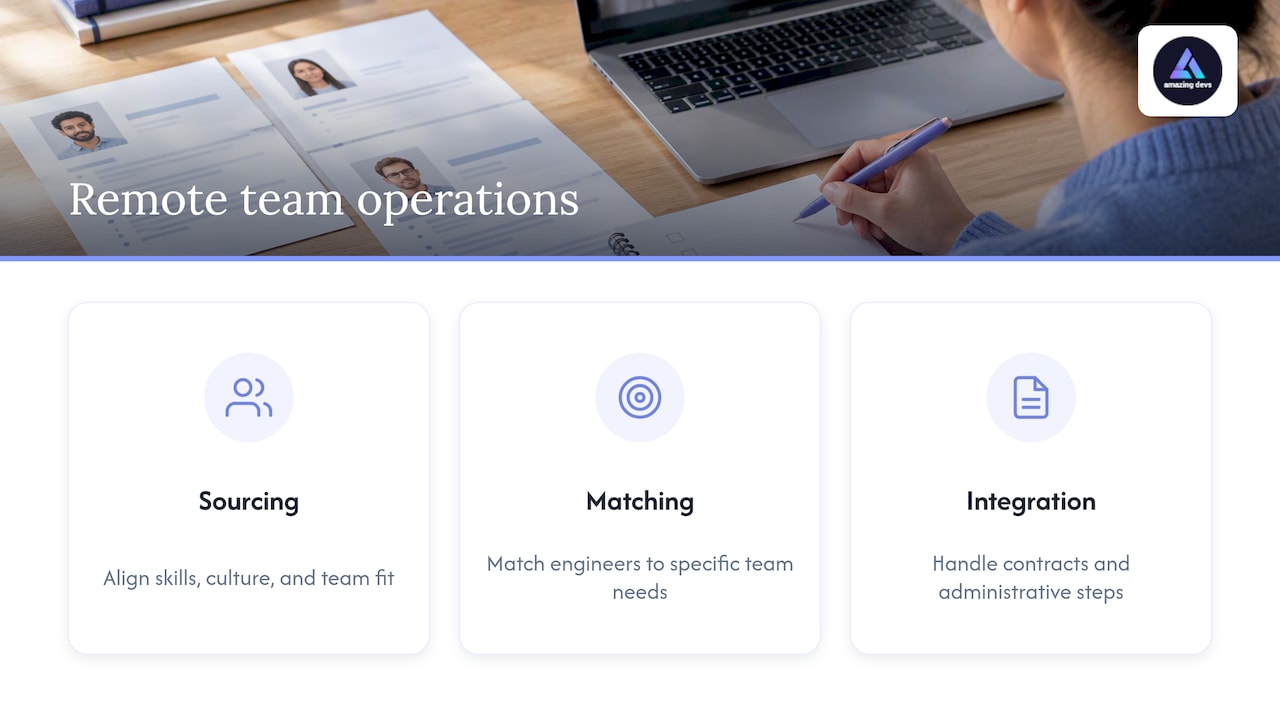
We focus on sourcing nearshore developers aligned with technical skills, cultural fit, and how client teams function. Our recruitment and assessment process aims to match engineers to specific team needs rather than generic roles. We handle contracts and administrative steps involved in bringing on nearshore talent to simplify integration into client workflows.
9. Handling distractions and work-life balance effectively in a remote work setting
Distractions at home differ from distractions in an office, and they demand different fixes. Household interruptions, notifications, and the temptation to multitask across work and personal tasks all chip away at focus in ways open-plan offices rarely did.
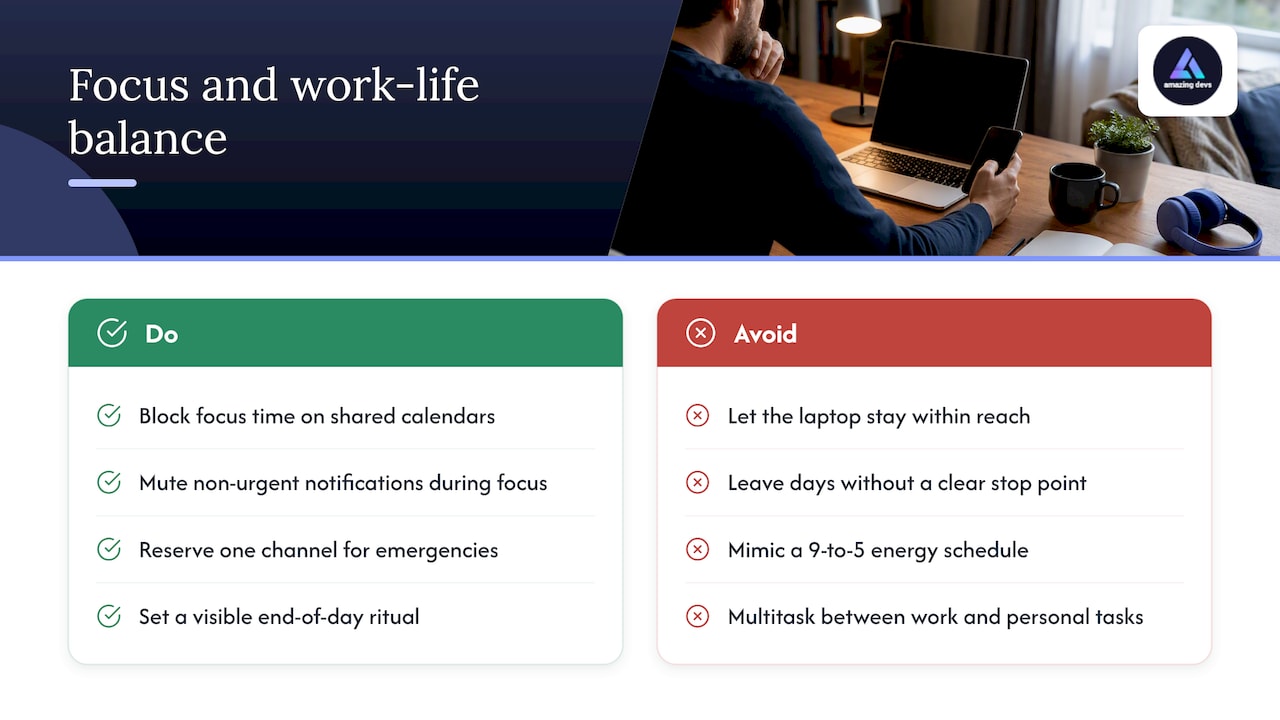
The most effective fix is structural, not willpower-based. Block focus time on a shared calendar so interruptions from colleagues stop by default, not just household ones. Turn off non-urgent notifications during those blocks and reserve a single channel for genuine emergencies.
Work-life balance on remote teams tends to break in one of two directions: people either never log off because the laptop is always in reach, or they drift into unstructured days with no clear stop point. Both hurt sustained output. Setting a visible end-of-day ritual, even something as simple as a closing status update, signals to the rest of the team that the day is done and prevents the slow creep of always-on expectations.
Energy matters as much as hours. Research on remote work and daily energy found that employees show much less energy variability on days working from home, and that a reduction in energy variability is linked to significantly higher goal progress and goal-progress velocity. That finding reframes flexible scheduling: it is not a perk, it is a direct lever on output. Letting developers shift their hours to match their actual energy patterns, rather than mimicking a 9-to-5 office schedule, is one of the simplest ways to capture that effect.
10. Author note: pragmatic first step and tradeoffs
Run a two-week pilot: cap PR size and add a review SLA, nothing else. You’ll see lead time move before you touch mentorship or hiring. The tradeoff is real: faster shipping can crowd out the slower work of teaching juniors, so protect pairing time separately.
— Gabriel
Get hands-on help building this into your team
We help managers put this playbook into practice by providing pre-vetted nearshore developers through our nearshore staff augmentation service or a fully embedded Team Extension Model. Request a team profile and see who fits your stack.
FAQ
Can remote developers really be as productive as in-office teams?
Yes, when teams protect focus time and measure delivery outcomes instead of activity. A 2026 meta-analysis of 82 studies found a small but positive average effect of working from home on productivity, varying by hybrid versus fully remote setups.
What metrics should managers track for remote developer productivity?
Use DORA metrics like lead time, deployment frequency, and change failure rate alongside the SPACE framework’s satisfaction and flow dimensions. Activity counts like commits or messages sent are not reliable productivity signals on their own.
How often should remote teams meet in person?
Evidence from randomized trials suggests even monthly coordinated office days can increase communication and reduce attrition. Use these days for mentorship or onboarding sprints rather than routine status updates.
Do AI coding assistants actually improve developer productivity?
A systematic literature review found that AI coding assistants often report positive effects on productivity, though results vary by context and task type. They are one input among several, not a replacement for good review and onboarding practices.
Sources
- Does Working from Home Improve Employees’ Productivity? Empirical Evidence from a Meta-Analysis
- Steady as She Goes: Remote Work Benefits Daily Goal Progress Through Reduced Energy Variability | Organization Science
- Randomized trial evidence on monthly co-location and remote work benefits (NBER working paper)
- DORA — DORA metrics
- The Impact of LLM-Assistants on Software Developer Productivity: A Systematic Literature Review