3–5 Days to a Merged PR for Managers Onboarding Nearshore Developers
Use a deliberate pre-boarding process plus a 7 to 30 day ramp that produces a merged pull request in week one and clear ownership by day 30. Success looks like this: accounts and access provisioned before the start date, a first shipped PR by day 3 to 5, and an engineer running their own sprint tickets with minimal senior support by the four-week mark.
TL;DR:
- Ensuring all accounts and access are provisioned before day one is critical to prevent onboarding delays that waste engineering hours.
- Achieving a merged pull request within five days depends heavily on effective pre-boarding, pairing, and a clear 30-day ownership plan.
- Consistent, minimal overlap hours for asynchronous communication and routine status updates are essential to maintaining nearshore team velocity.
- Using pre-assessed Brazilian developers with streamlined contract management reduces administrative friction and accelerates the onboarding process.
- Monitoring metrics like time-to-first-PR and help-request load provides objective indicators to troubleshoot stalled onboarding early.
Table of Contents
- Why Onboarding Nearshore Developers Matters (and Why the Time Zone Helps)
- Pre-Boarding: What to Provision Before Day One
- Week 1: How Do You Get a Nearshore Developer to Their First Merged PR?
- Weeks 2 to 4: Shifting From Paired Work to Ownership
- Tools and Communication Rhythms That Keep Nearshore Teams Fast
- What Metrics Tell You the Onboarding Is Working
- Common Onboarding Mistakes and How to Fix Them Fast
- How Amazing Devs Shortens the Ramp
- Start Onboarding a Nearshore Developer Without the Administrative Drag
- Sources
- FAQ
Why Onboarding Nearshore Developers Matters (and Why the Time Zone Helps)
A structured onboarding program correlates with roughly 50% higher new-hire productivity, and employees who go through one are about 69% more likely to stay three years. Skip the structure, and you pay twice: once in slow ramp time, again in turnover.
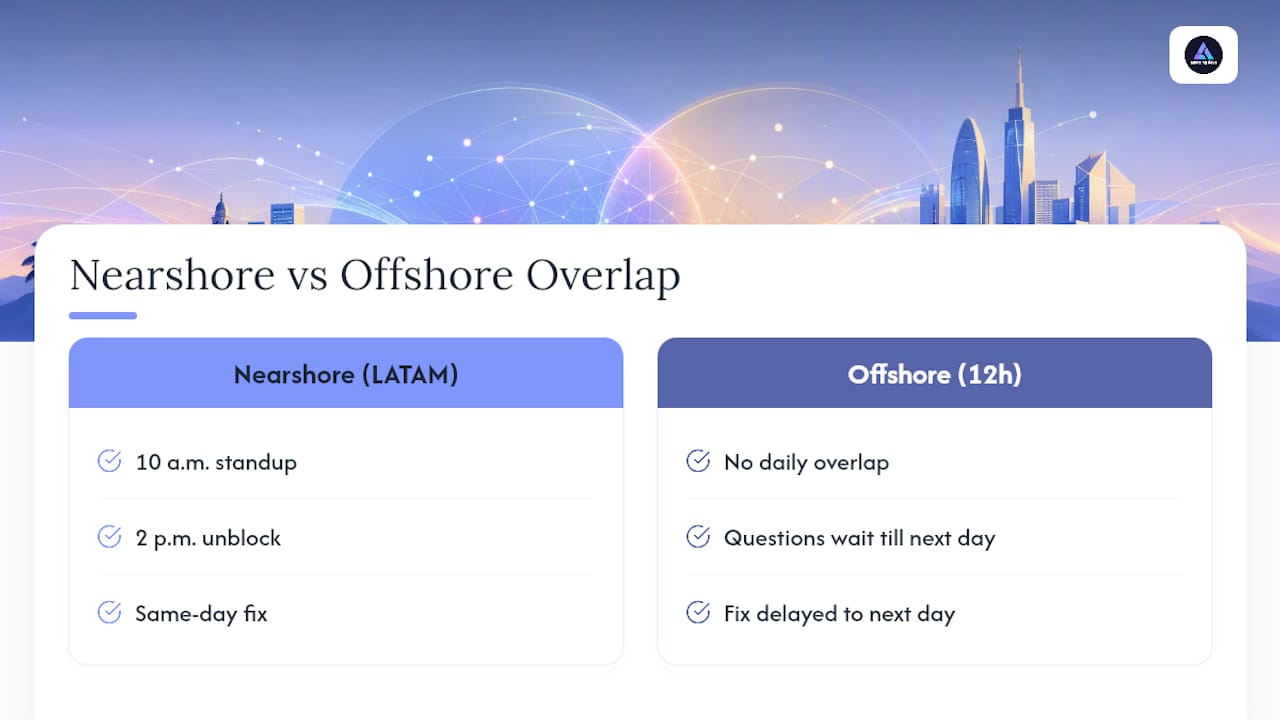
Nearshore hiring from Brazil solves half the onboarding problem before it starts. Overlap hours mean a developer in São Paulo or Recife can join your 10 a.m. standup, get unblocked at 2 p.m., and ship a fix before your team logs off. That daily overlap, paired with Latin America’s expanding engineering talent pipeline, is why the region has become a serious source for nearshore tech talent rather than a fallback option. Compare that to an offshore hire twelve time zones out, where every question waits until tomorrow. The nearshore advantage isn’t just cost. It’s velocity, and it changes how you should design the entire first month.
The nearshore math: Latin America’s IT market has grown large enough to support deep, specialized hiring pools, which means you can staff for a specific stack rather than settling for whoever is available.
Pre-Boarding: What to Provision Before Day One
Treat pre-boarding as a project with a deadline, not paperwork. Everything below should be done before the developer’s first login, because the alternative is a new hire spending their opening days chasing IT tickets instead of writing code.
- Provision core accounts. Repository access (GitHub, GitLab), CI/CD pipeline, ticketing system (Jira or Linear), cloud console, Slack or Teams, and VPN credentials.
- Confirm the build environment. Local build runs clean, test suite passes, staging access works, and laptop or remote-desktop config is verified, not assumed.
- Assemble living documentation. An architecture overview, current READMEs, on-call runbooks, key architecture decision records (ADRs), and a written Definition of Done.
- Assign an onboarding buddy. Pick a mid-to-senior engineer, not the busiest lead on the team, and put recurring 15-minute syncs on the calendar for week one.
- Send a welcome packet. Team org chart, meeting schedule, and a one-page “who to ask about what” cheat sheet.
Skipping this step is the single biggest cause of onboarding drag. Missing access and undocumented systems routinely turn day two into a scavenger hunt, and that scavenger hunt burns your most expensive engineering hours.
Pro Tip: Have your onboarding buddy log in with the new hire’s exact credentials the day before start date. Broken access is far cheaper to fix at 4 p.m. Tuesday than at 9 a.m. Wednesday with the new hire staring at a login screen.
Week 1: How Do You Get a Nearshore Developer to Their First Merged PR?
Experienced engineers can hit shipping productivity fast when the ramp is designed, not improvised. Aim for a merged PR by day 3 to 5, not “sometime this sprint.”
- Day 1: Architecture walkthrough with the tech lead, clear statement of 30-day goals, and a hands-on check that the local environment actually builds and tests pass.
- Day 2 to 3: Pair on a live ticket with the onboarding buddy, then hand off a small, well-scoped ticket the new hire can own solo.
- Day 4 to 5: Independent work on that ticket through to PR submission, a walk-through of your code review process and turnaround expectations, and a short week-one retro to surface blockers before they compound.
That sequence matters more than the tasks themselves. Treating the first two weeks as a designed delivery system rather than an HR formality is what actually separates a fast ramp from a slow one. Same checklist, same tools, same team. The only variable is whether someone planned the sequence in advance.
Weeks 2 to 4: Shifting From Paired Work to Ownership
The second and third weeks are where you widen scope, and where a lot of managers move too slowly or too fast. The right pace is gradual: move from a single paired ticket to independent ownership of a defined feature area, not the whole backlog at once.
- Hand over one ceremony at a time. Let the developer run standup updates in week two, then own sprint planning input by week three.
- Keep a standing weekly 1:1, separate from standup, focused on blockers and feedback rather than status.
- Track whether help requests to senior engineers are trending down. If they’re flat by week three, scope was probably too broad too soon.
- By day 30, the developer should own a defined module, understand the Definition of Done without prompting, and need senior input only for genuinely new problems.
Write the 30-day plan down and share it on day one. A developer who knows exactly what “ownership” looks like in week four works differently than one guessing at the finish line.
Tools and Communication Rhythms That Keep Nearshore Teams Fast
Keep the stack minimal on purpose. One chat tool (Slack or Teams), one video tool, one tracker (Jira or Linear), a shared wiki, and version control with CI. Every extra tool is a place onboarding documentation goes stale.
- Reserve synchronous overlap hours for pairing, standups, and unblocking, not status updates.
- Push routine status reporting to async channels, like a written end-of-day note in the team channel.
- Set a code review SLA (same-day response during overlap hours) so PRs don’t sit waiting on a review that never comes.
Guidance from nearshore team management practice is consistent on this point: async-first status keeps your limited synchronous window free for the conversations that actually need a live person. If your team burns overlap hours on standup readouts everyone could have written in Slack, you’re wasting the exact thing nearshore hiring gives you.
Pro Tip: If a new hire’s help requests spike outside overlap hours, that’s a signal they’re stuck alone overnight. Move their first two weeks of tickets to ones that can be fully resolved within the shared window.
What Metrics Tell You the Onboarding Is Working
Subjective impressions lag. Objective metrics like time-to-first-PR and help-request load catch a stalled onboarding before a manager notices anything is wrong.
| Metric | Healthy target | Warning sign | Remediation |
|---|---|---|---|
| Time-to-first-PR | 3 to 5 days for experienced hires | No PR by day 7 | Rescope the first ticket smaller; check environment access |
| PR cycle time | Trending down week over week | Flat or rising after week 2 | Tighten review SLA; pair more on scope definition |
| Help-request load on seniors | Declining after week 2 | Still spiking by week 4 | Reassign a dedicated buddy; revisit documentation gaps |
| Sprint carryover | Comparable to co-located peers | Consistently high for the new hire | Reduce ticket size; add a mid-sprint check-in |
Baseline these against your existing co-located team’s own numbers, not an industry average, since team size and codebase complexity swing the raw figures more than onboarding quality does.
Common Onboarding Mistakes and How to Fix Them Fast
Most failed onboardings trace back to the same handful of causes, and all of them are fixable in a day, not a quarter.
- Access delays. Enforce the pre-boarding checklist as a hard gate. Nobody starts until every account works.
- Missing documentation. Write the architecture overview once, then update it every sprint. Stale docs are worse than no docs.
- Vague acceptance criteria. Every first-week ticket needs a written Definition of Done before it’s assigned.
- Over-meeting. If a new hire’s calendar has more than two hours of meetings on day two, cut it. They need coding time, not a lecture series.
If progress stalls past week two, check the three usual suspects first: broken access, an unclear ticket, or a buddy who’s too busy to respond inside overlap hours.
How Amazing Devs Shortens the Ramp
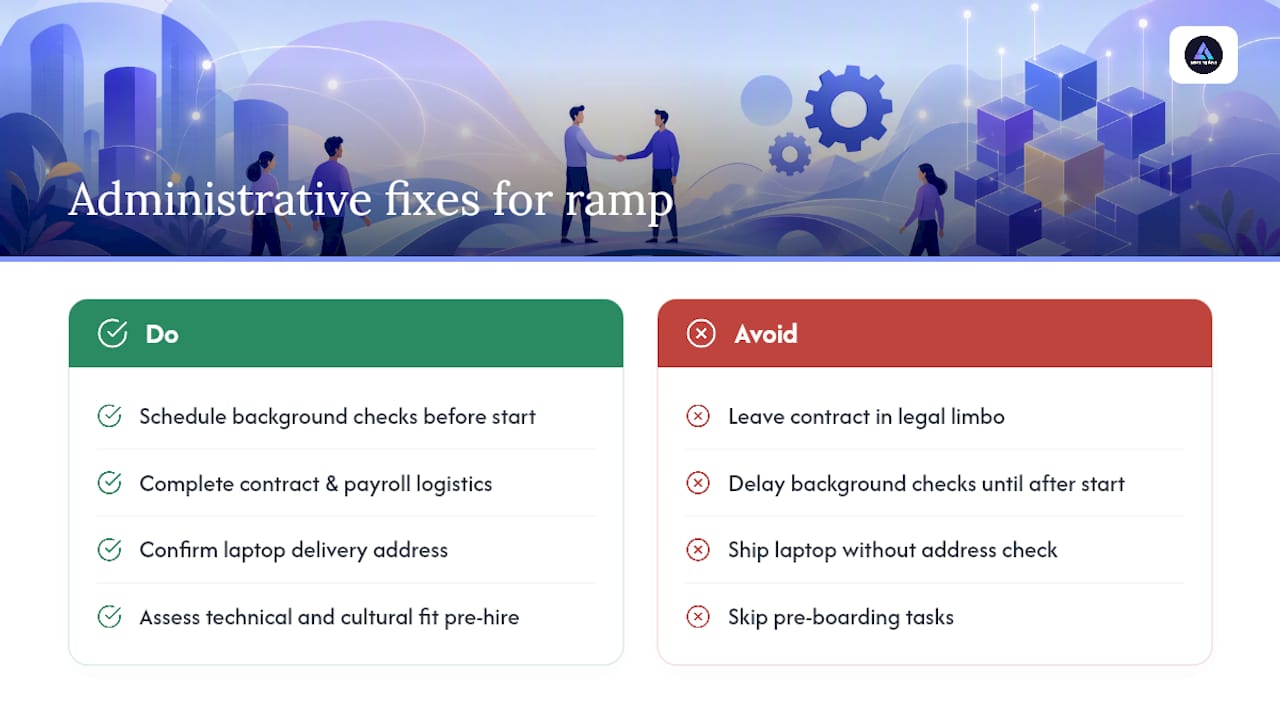
Most onboarding delays aren’t technical. They’re administrative: a contract stuck in legal review, a background check nobody scheduled, a laptop shipped to the wrong address. Technical and cultural fit assessment and contract and payroll logistics management mitigate the administrative delays that otherwise eat the first two weeks of a nearshore hire’s calendar.
That matters because the fastest ramp only works if pre-boarding actually happens on schedule, and administrative friction is the most common reason it doesn’t. Removing that friction is the difference between a developer who’s writing code on day one and one who’s still waiting on IT.
— Gabriel
Start Onboarding a Nearshore Developer Without the Administrative Drag
The scenario described requires a fast, structured ramp that depends on vetting and paperwork being sorted in advance. Using pre-assessed Brazilian developers matched to your stack, with contract and payroll handling done before onboarding day one, can help streamline the process.
If you’re weighing whether to build this process from scratch, read about the nearshore staff augmentation model to see how the engagement works, or head straight to Amazing Devs’ hiring page to start a conversation about your open role. The sooner the paperwork is off your plate, the sooner your day-one checklist actually starts on day one.
Sources
- Easy
- How to Onboard a Nearshore Engineer in 14 Days: The Actual Checklist | Axented
- Latin America: IT market value by country | Statista
FAQ
How Long Should Onboarding a Nearshore Developer Take?
Plan for a 30-day structured ramp, with experienced hires reaching a merged PR within the first 3 to 5 days and full ownership of a feature area by day 30.
What Is the Single Biggest Cause of Onboarding Delay?
Access and account delays. Provisioning every account (repo, CI, ticketing, VPN) before the start date eliminates the most common source of lost time in the first week.
Which Metric Best Predicts Onboarding Success?
Time-to-first-PR is the earliest signal. Experienced nearshore developers should submit a merged pull request within 3 to 5 days when pre-boarding and pairing are handled correctly.
How Much Overlap Time Do U.S. Teams Get With Brazilian Developers?
Brazilian time zones align closely with U.S. business hours, giving teams several hours of daily overlap for pairing, standups, and same-day unblocking, which is the core operational advantage of nearshore hiring.
Can Amazing Devs Help With Onboarding Logistics, Not Just Sourcing?
Contract and payroll administration alongside technical and cultural fit vetting can remove the bureaucratic delays that typically slow down a new hire’s first two weeks.