6 Steps U.S. Developers Must Ship for HIPAA Compliant Development
HIPAA compliant development means building specific technical safeguards directly into your software development lifecycle: encryption, access controls, audit logging, and documented risk assessments. It also means locking down operational necessities like signed Business Associate Agreements and a tested incident response plan before you touch production data. The roadmap is straightforward even when the work isn’t: bake controls into design and code, verify them through testing, then keep the evidence organized so you can hand it to an auditor or a business partner without scrambling.
TL;DR:
- Building HIPAA-compliant software requires data encryption, access controls, audit logs, and documented risk assessments integrated into the development process.
- Only vendors handling protected health information on behalf of covered entities or business associates need to fully implement HIPAA safeguards, with key focus on persistent versus transient PHI access.
- Core technical safeguards include unique user IDs, role-based access, tamper-evident logging, hashing and signing data, and mandatory encryption in transit and at rest with proper key management.
- Ongoing processes like threat modeling, asset inventory, automated security testing, and maintaining a comprehensive audit trail are essential for continuous HIPAA compliance.
- External tools and vendors should be verified for signed BAAs, network segmentation, and proper configuration, with staff trained on HIPAA basics and operational controls enforced promptly.
Table of Contents
- Who Actually Needs to Build HIPAA Compliant Software?
- Core HIPAA Technical Safeguards, Mapped to Your Codebase
- A Step-by-Step Checklist for HIPAA Compliant Development
- Choosing Infrastructure That Supports HIPAA Secure Applications
- Risk Assessment and Testing: Building Your Audit Trail
- The Non-Technical Controls Developers Still Need to Coordinate
- Staffing HIPAA-Aware Engineering Teams Without the Guesswork
- Where Engineering Teams Should Actually Spend Their Effort First
- Building HIPAA-Ready Teams Without the Hiring Headaches
- Key Resources to Bookmark for Ongoing Compliance Work
- Sources
- FAQ
Who Actually Needs to Build HIPAA Compliant Software?
Not every health app falls under HIPAA. The law applies to covered entities (hospitals, insurers, clinics) and business associates, meaning any vendor that creates, receives, maintains, or transmits protected health information (PHI) on a covered entity’s behalf. If your software touches PHI at all, you’re probably a business associate, and HHS guidance on business associates spells out exactly where that line sits.
The distinction that trips up engineering teams is transient versus persistent access. A messaging app that merely routes encrypted data without ever reading it (a “conduit”) has a narrower compliance burden than a system that stores, indexes, or processes PHI.
Common scenarios and their typical scope:
- Patient portals: full persistent access to PHI, requiring the complete Security Rule toolkit.
- EHR integrations: often high volume, high sensitivity, and demands strict field level minimum necessary controls, a concept HHS defines in its PHI guidance.
- Telemetry and analytics SDKs: frequently overlooked, but third party trackers can create real exposure, a point HHS addressed directly in its guidance on HIPAA and online tracking.
Core HIPAA Technical Safeguards, Mapped to Your Codebase
The Security Rule reads like a legal document, but every clause maps to something you already build. Here’s the translation.
Access control starts with unique user IDs (no shared logins, ever) and role based access control that enforces least privilege. A billing clerk doesn’t need read access to clinical notes. Pair that with automatic session timeout and multi-factor authentication on any account that can reach ePHI, not just admin accounts.
Audit controls mean structured, tamper-evident logs that record who accessed what, when, and what changed. Write logs to append-only storage, retain them long enough to support an investigation (most teams target six years to match HIPAA’s documentation retention standard), and make them searchable. A log nobody can query during an incident is just a compliance liability with extra steps.
Integrity controls protect data from unauthorized alteration. Use hashing and checksums on stored records, version critical data changes, and sign transactions where data moves between systems. This is where a lot of teams cut corners because it feels invisible until an auditor asks how you’d detect tampering.
Transmission and at-rest encryption is non-negotiable in practice, even where HIPAA technically labels it “addressable.” Use TLS 1.2 or higher for anything in transit, and AES-256 for data at rest. Manage keys properly: envelope encryption with a dedicated key management service, not hardcoded secrets in a config file.
That “addressable” label matters less than it used to. Proposed updates to the Security Rule would push many previously flexible controls, encryption, MFA, network segmentation, and regular vulnerability scanning, toward mandatory status, according to analysis of the 2025 to 2026 rulemaking. Treat “addressable” as “required unless you can document a genuinely strong reason otherwise,” because that’s likely where regulators are heading anyway.
- Access control: unique IDs, RBAC, MFA, session timeout
- Audit controls: structured logs, tamper-evident storage, long-term retention
- Integrity controls: hashing, versioning, signed transactions
- Encryption: TLS 1.2+ in transit, AES-256 at rest, managed key rotation
Pro Tip: Don’t wait for a proposed rule to become final before implementing MFA and encryption at rest. Auditors and business partners already expect both as a baseline, regardless of what’s technically “required” today.
A Step-by-Step Checklist for HIPAA Compliant Development
Treat this as an ongoing loop in your development process, not a one-time setup task.
- Define security requirements before design. Run a lightweight threat model for any feature touching PHI. Ask what data it touches, who can reach it, and what happens if that access is abused.
- Inventory your assets and dependencies. Maintain a software bill of materials (SBOM) and map which components can actually reach ePHI. This reachability mapping is what separates useful vulnerability management from noise, an approach emphasized in developer-focused HIPAA compliance guidance.
- Write secure code and manage secrets properly. No credentials in source control, dependency patching on a fixed cadence, and code review that specifically checks for PHI handling mistakes.
- Automate your scanning. Run SAST and DAST tools in CI, generate SBOM reports on every build, and schedule penetration tests, at minimum annually, more often after major architecture changes.
- Monitor continuously and have a runbook ready. Logging without alerting is theater. Build incident response playbooks before you need them, not during a breach.
- Document everything as you go. Every stage above should generate evidence, a completed threat model, a scan report, a remediation ticket, that you can hand an auditor without reconstructing history from memory.
Building this into the SDLC rather than bolting it on afterward is the single biggest predictor of whether a team passes an audit calmly or scrambles for six weeks beforehand. If your team needs help operationalizing these steps without slowing releases, structured development practices built around security testing and documentation make the difference between compliance as a checklist and compliance as a habit.
Choosing Infrastructure That Supports HIPAA Secure Applications
Your cloud provider will not make you compliant. It can only give you the tools to become compliant, and only if you sign the right paperwork and configure things correctly.
Every cloud vendor handling ePHI needs a signed Business Associate Agreement, and that BAA should specify exactly which services are covered. Not every service under a given provider’s umbrella is automatically included. Confirm the specific list before you architect around it.
Beyond the BAA, configuration is where most gaps actually live:
- Segment networks with VPCs so PHI-handling systems sit isolated from general application traffic.
- Use a managed key management service with customer-managed keys (CMKs) and enforce regular key rotation.
- Route sensitive traffic through private endpoints rather than public internet paths where possible.
- Confirm backup and disaster recovery meet HIPAA’s contingency planning expectations, including encrypted backups and a documented, tested recovery process.
Managed services can speed up delivery, but vendor due diligence still falls on you. A vendor’s SOC 2 report is a good sign, not a substitute for verifying they’ll actually sign a BAA that covers your specific use case. If you’re evaluating secure file transfer or sharing components as part of your architecture, reviewing current secure document sharing patterns is worth the time before you commit to a design.
Risk Assessment and Testing: Building Your Audit Trail
Regulators don’t expect perfection. They expect evidence that you looked for problems and fixed the ones that mattered.
Start with a documented Security Risk Assessment (SRA) mapped directly to the safeguards in 45 CFR Part 164. This isn’t a one-page checklist; it’s a living document that identifies specific assets, threats, and existing controls, updated whenever your architecture changes meaningfully.
Vulnerability scanning should run on a fixed cadence, not “whenever someone remembers.” What separates a mature program from a noisy one is reachability analysis: prioritizing the vulnerabilities that are actually exploitable in your deployed configuration over the ones sitting in a dependency you never call.
Penetration testing frequency depends on your risk profile, but annual testing is the common floor, with additional tests after significant architecture or feature changes. Auditors generally want to see scope, methodology, findings, and remediation timelines, not just a clean summary page.
Keep an organized “book of evidence”: SRA documents, scan results, penetration test reports, remediation tickets, and updated threat models. Peer-reviewed research on health IT security practices consistently points to integrated risk analysis and logging as a defining factor separating organizations that detect problems early from those that discover them during a breach investigation.
- Document SRAs mapped to specific 45 CFR sections, updated on architecture change
- Prioritize vulnerabilities using reachability, not raw CVE severity scores
- Test penetration annually at minimum, more after major releases
- Retain logs, scan reports, and remediation tickets in one auditable location
The Non-Technical Controls Developers Still Need to Coordinate
Code alone doesn’t get you compliant. These operational pieces usually sit with legal or ops, but engineering needs to know they exist and feed into them.
Your BAA checklist with any vendor touching PHI should specify covered services, subcontractor obligations, breach notification timelines, and data return or destruction terms at contract end. Breach notification itself follows strict timelines: HHS requires notification to affected individuals without unreasonable delay and within a timely manner after discovery, with OCR reporting required for breaches affecting 500 or more individuals.
- Require signed BAAs before any vendor touches production PHI, no exceptions for “temporary” access.
- Train every employee touching PHI on HIPAA basics, with role-based deep dives for engineers and support staff.
- Build offboarding into your access control process so departing employees lose access same-day, not “eventually.”
- Apply the minimum necessary principle to data retention: don’t keep PHI longer than a documented business reason requires.
Staffing HIPAA-Aware Engineering Teams Without the Guesswork
Finding developers who understand both the code and the compliance context is harder than it sounds. A lot of engineers can write clean access control logic; fewer have actually sat through an OCR audit prep cycle or know why a BAA needs to name specific services.
When evaluating any staffing partner for HIPAA work, look for real experience with healthcare projects, a vetting process that tests for security judgment (not just syntax), and contractual clarity on who signs what BAA. Some staffing partners build nearshore placements around the combination of technical assessment paired with a cultural fit process, so the developer you get understands both your codebase and how your compliance obligations actually work in practice.
Integrating nearshore talent into a HIPAA SDLC works best with a clear onboarding sequence: scoped access from day one, documented knowledge transfer, and shared ownership of evidence artifacts like SRAs and audit logs. Amazing Devs handles the contract and access management side of that handoff, so your team focuses on the actual engineering work.
Where Engineering Teams Should Actually Spend Their Effort First
Most teams treat every HIPAA requirement as equally urgent, and that’s a mistake. Asset inventory, encryption, MFA, and signed BAAs deliver the largest reduction in both audit risk and breach exposure for the effort involved. Get those right before chasing more elaborate controls.
Continuous scanning matters, but a scanner that floods your backlog with unreachable, low-severity findings trains engineers to ignore it. Triage by exploitability, not by CVSS score alone.
External help earns its cost specifically for penetration testing, formal SRA documentation, and policy writing, work where an outside, credentialed perspective carries real weight with auditors. In-house effort is usually better spent on the daily discipline of access control and logging, the parts of compliance that never show up as a line item but decide whether your next audit takes days or weeks.
— Gabriel
Building HIPAA-Ready Teams Without the Hiring Headaches
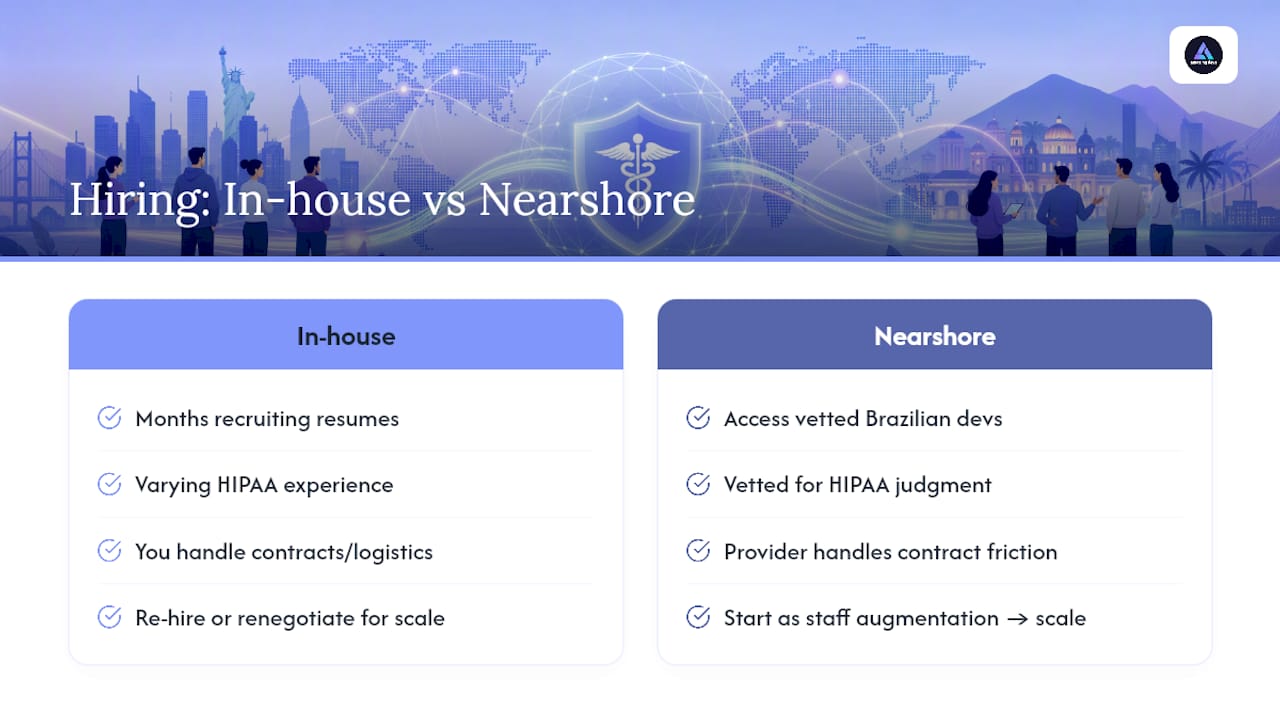
Working with a nearshore staffing partner is an alternative to spending months recruiting HIPAA-experienced developers on your own. Instead of screening dozens of resumes and hoping a candidate’s compliance experience holds up under scrutiny, you can access nearshore Brazilian developers who have been vetted for both technical depth and the judgment that HIPAA work demands.

Engagements with nearshore staffing providers often start as staff augmentation, with one or two developers embedded directly into your existing sprint cycle, while the provider handles contract logistics and the bureaucratic friction of cross-border hiring. As needs grow, that can scale into a managed team structure without renegotiating everything from scratch. Support beyond placement may be available for the kind of technical questions that come up mid-audit, when a fast answer is needed rather than a support ticket.
If your roadmap includes PHI-handling features and you need developers who can hit the ground running on access controls and audit logging, explore how Amazing Devs staffs HIPAA-aware teams and get a sense of how quickly a qualified developer could join your sprint.
Key Resources to Bookmark for Ongoing Compliance Work
Keep these on hand for the next audit or architecture review:
- HHS Security Rule guidance for required and addressable technical safeguards.
- NIST’s IT Laboratory security resources for control frameworks.
- CMS interoperability rulemaking for tracking regulatory shifts affecting data access.
Sources
FAQ
What Is the New HIPAA Rule for 2026?
Proposed updates to the Security Rule would convert many currently “addressable” safeguards, including encryption, MFA, and regular vulnerability scanning, into mandatory requirements, according to analysis of the proposed rulemaking. Final rule status and exact effective dates should be confirmed against current HHS publications before you finalize a compliance roadmap.
Did Recent Federal Changes Affect HIPAA?
Federal rulemaking under HHS and CMS has focused mainly on expanding patient access to their own health data and clarifying interoperability obligations, as outlined in CMS’s interoperability rule announcement. Core Security Rule and Privacy Rule obligations for developers remain grounded in the existing framework HHS maintains.
What Does HIPAA Compliance Actually Require in the U.S.?
It requires implementing the Security Rule’s administrative, physical, and technical safeguards, executing signed BAAs with any vendor touching PHI, and maintaining documented evidence like risk assessments and audit logs, all detailed in HHS’s official Security Rule guidance.
Can States Override or Add to Federal HIPAA Requirements?
States can enact privacy laws that are stricter than HIPAA, and where a state law provides greater protection, it generally applies alongside federal requirements rather than replacing them. Development teams working across multiple states should treat HIPAA as the federal floor, not the full picture, and confirm state-specific obligations for their particular market.