PCI Compliance Outsourcing: 3 Merchant Duties and a Contract Checklist
Outsourcing payment processing can shrink your PCI DSS footprint, but it never erases your obligations. You still have to verify your providers’ compliance and maintain written agreements under Requirements 12.8.2 and 12.8.4, and most fully outsourced e-commerce setups still validate through SAQ A. Before anything else, request the provider’s Attestation of Compliance, get a signed agreement in place, and put an annual monitoring review on the calendar.
TL;DR:
- Maintain an inventory of every payment provider, obtain its Attestation of Compliance for the exact service, and sign an agreement assigning card data responsibilities.
- SAQ A requires fully outsourced cardholder data functions and no electronic records; online merchants must protect checkout scripts or confirm that their provider does.
- If your servers influence checkout, payment handling is mixed, or assessor review is required, ask your acquirer which assessment applies; it determines eligibility.
- SAQ engagements with a QSA range from a few thousand dollars to the mid five figures; Level 1 ROC fees can reach six figures.
- Pair the annual review with quarterly checks, and reassess after incidents or contract renewals; assign an owner to track evidence and provider renewal dates.
Table of Contents
- What PCI outsourcing looks like: models that reduce merchant scope
- What you still must do: PCI DSS 12.8.x explained and an evidence checklist
- SAQ eligibility and validation paths: SAQ A, SAQ A-EP, and when you need a QSA or ROC
- Benefits and tradeoffs of outsourcing PCI responsibilities
- Typical costs and budget ranges for outsourced PCI validation and remediation
- How to choose and contract with a PCI outsourcing provider
- Practitioner tips: onboarding, monitoring, and contract negotiation
- When outsourcing is the pragmatic choice
- An adjacent option: extra hands for contract and vendor work
- FAQ
- Sources
What PCI outsourcing looks like: models that reduce merchant scope
A third-party service provider, or TPSP, is any vendor that stores, processes or transmits cardholder data on your behalf, or that could affect the security of your payment environment. Three outsourcing models show up most often among merchants trying to shrink their PCI footprint:
- Redirect to a processor: the customer leaves your site entirely to pay, which removes most cardholder data from your systems.
- Hosted or iframe payment pages: the payment form lives on the provider’s domain or an embedded frame, keeping card data off your servers.
- Fully outsourced processing: a TPSP handles authorization, settlement and storage end to end, often through an API or hosted checkout.
Redirects and hosted pages commonly qualify for SAQ A, the lightest validation path, but the web server hosting your redirect or iframe can still fall under a handful of PCI requirements if it’s compromised to tamper with payment page content. PCI DSS v4.x adds specific attention to script integrity on these pages, which matters for every model above.
What you still must do: PCI DSS 12.8.x explained and an evidence checklist
Outsourcing shifts technical work, not accountability. PCI DSS 12.8 spells out what stays on your plate:
- 12.8.1: keep a current inventory of every TPSP that touches cardholder data or your payment environment.
- 12.8.2: maintain a written agreement where the provider acknowledges responsibility for the cardholder data it handles.
- 12.8.4: monitor each TPSP’s PCI DSS compliance status at least once a year.
Hold onto a specific set of evidence for each provider: their current AOC, a responsibilities matrix that spells out who owns which control, ASV scan or penetration test reports where relevant, and the breach notification terms written into your contract. Assign an internal owner for this file, set a recurring calendar reminder for the annual review, and define who gets looped in if a provider’s status lapses or a notification arrives.
Pro Tip: Store every TPSP’s AOC and contract renewal date in one shared tracker so the annual review isn’t a scramble each year.
SAQ eligibility and validation paths: SAQ A, SAQ A-EP, and when you need a QSA or ROC
SAQ A applies to merchants that have fully outsourced all cardholder data functions to validated providers and keep no electronic records of their own. A 2025 PCI SSC clarification, FAQ 1588, tightened the rules around embedded scripts on checkout pages: merchants must either protect those scripts from tampering or confirm their TPSP already does.
You likely need SAQ A-EP or full QSA involvement and a Report on Compliance when:
- Your own servers control or influence parts of the payment page, not just a redirect target.
- You process a high transaction volume and your acquirer requires assessor-led validation.
- Your environment mixes outsourced and in-house payment handling.
Ask your acquirer directly which SAQ they expect for your setup. Acquirers, not the PCI SSC, enforce validation requirements and can override a merchant’s own assumption about eligibility.
Benefits and tradeoffs of outsourcing PCI responsibilities
Outsourcing payment processing genuinely reduces the burden for most merchants, but it trades one set of problems for another.
- Benefit: a smaller cardholder data environment means fewer systems to lock down and audit.
- Benefit: specialist providers bring dedicated security staff most merchants can’t justify hiring in-house.
- Benefit: some breach costs and notification duties shift toward the provider under contract.
- Tradeoff: you become dependent on a provider’s own controls and uptime.
- Tradeoff: monitoring has to stay active; a lapsed AOC or quiet contract renewal can leave a gap nobody notices until an audit.
Outsourcing tends to return the best value for smaller merchants and fast-growing e-commerce businesses that can’t staff a dedicated security function yet.
Typical costs and budget ranges for outsourced PCI validation and remediation
Budgets vary widely depending on how much of your environment still touches cardholder data directly. QSA-assisted SAQ engagements commonly run from a few thousand to the mid-five figures, while Level 1 merchants requiring a full Report on Compliance often see QSA fees range broadly into six figures or more, with first-year totals climbing higher once remediation and tooling are added in.
Cost drivers worth planning around include:
- The size of your cardholder data environment and how many systems still touch it.
- The number of physical locations or payment channels in scope.
- Remediation work uncovered during the assessment, plus penetration testing and vulnerability scanning.
- Ongoing tooling for logging, scanning and monitoring once validation is complete.
Shrinking your CDE through better segmentation remains one of the most reliable ways to lower both assessment and remediation costs, and building in a remediation contingency from the start avoids budget surprises mid-engagement. The hidden costs of transition and coordination during any outsourcing arrangement deserve the same line item.
How to choose and contract with a PCI outsourcing provider
Picking a provider is a contract exercise as much as a technical one. PCI SSC’s own guidance on managing provider relationships points out that contracts commonly lack explicit PCI acknowledgments or audit rights, which creates friction exactly when you can least afford it.
Work through this sequence before signing:
- Confirm the AOC actually covers the specific service you plan to use, not just the provider’s company as a whole.
- Request ASV scan or penetration test evidence if the provider’s service touches your network.
- Check whether a QSA was involved in validating the provider, and at what level.
- Negotiate explicit 12.8.2 acknowledgment language into the contract, not a vague reference to “industry standards.”
- Add audit cooperation, breach notification timelines, and data return terms for when the relationship ends.
- Confirm every contractor or provider agreement includes offboarding terms before data access is granted.
| Request from provider | Why it matters |
|---|---|
| Service-specific AOC | Confirms the exact service is validated, not just the company |
| Responsibilities matrix | Clarifies who owns which control |
| Breach notification clause | Sets timelines before an incident, not during one |
| Evidence-sharing cadence | Keeps your 12.8.4 review current without chasing documents annually |
For additional context on what procurement teams should require, our breakdown of security must-haves in outsourcing contracts covers the same ground from a broader IT procurement angle, and MARFI’s piece on accountability in CMMC IT outsourcing is worth a read if your contracts also touch federal compliance frameworks.
Practitioner tips: onboarding, monitoring, and contract negotiation
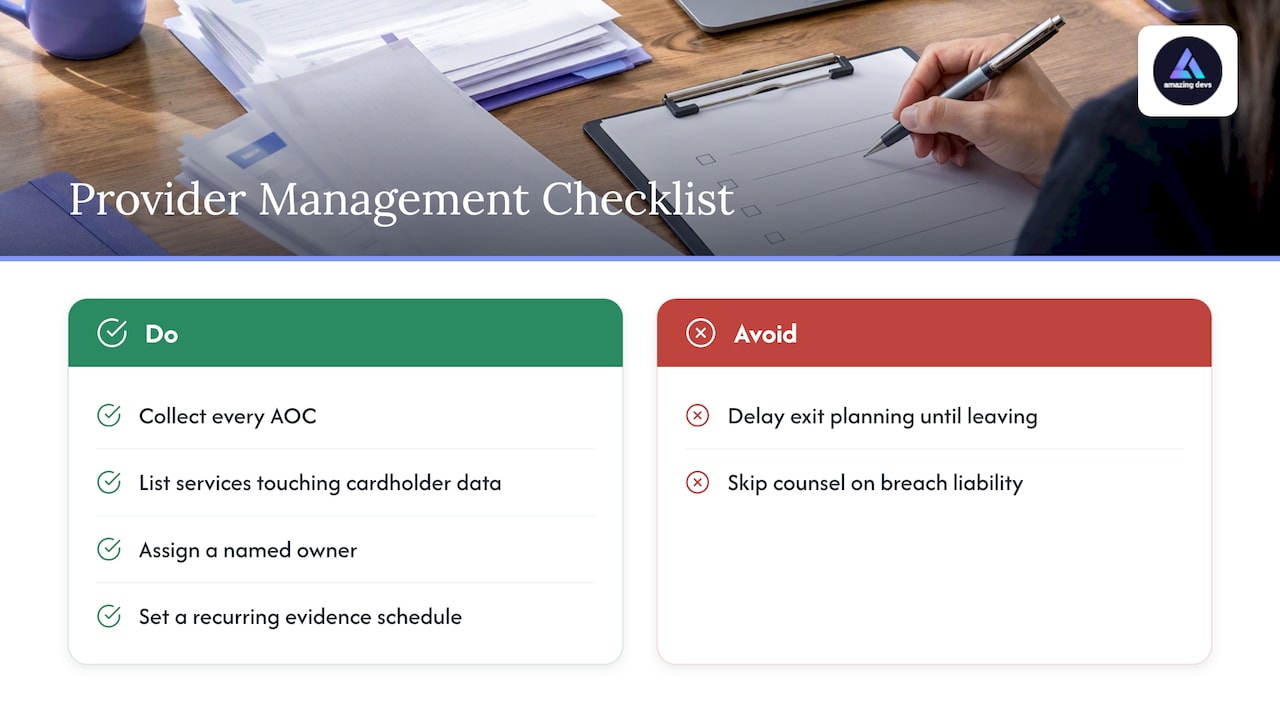
Build an onboarding checklist before the first provider goes live: collect every AOC, list which services actually touch cardholder data, assign a named owner, and set a recurring evidence schedule. Pair an annual formal review with light quarterly checks and an event-driven review whenever a provider reports an incident or renews its contract. When negotiating, plan the exit terms (data return, transition costs, cooperation during assessments) before you need them, and loop in counsel on anything touching breach liability.
Pro Tip: Negotiate your exit clause on day one, not when you’re already trying to leave a provider.
When outsourcing is the pragmatic choice
Outsourcing makes sense once the operational cost of running payment infrastructure yourself outweighs the discipline needed to monitor a provider well. If you’re not confident you can track AOCs and renewals on schedule, that’s the real test, not whether outsourcing sounds appealing. Start with a scope review this quarter, then shortlist providers or map an internal remediation plan.
— Gabriel
An adjacent option: extra hands for contract and vendor work
Managing TPSP contracts, evidence schedules and vendor questionnaires takes dedicated time most compliance or procurement teams don’t have spare. We’re not a PCI provider, but we built our practice around exactly the kind of contract management, vendor vetting and compliance-adjacent staffing that supports a program like this.

Through nearshore staff augmentation, we place vetted Brazilian developers and compliance-minded staff who can:
- Help your team track AOC renewals, contract clauses and evidence collection on schedule.
- Support onboarding and offboarding workflows for contractors handling sensitive systems.
- Assist with drafting vendor questionnaires before a procurement cycle starts.
Our team also handles the contract and payment logistics that come with hiring across borders, including the compliant handling of international contractor payments. If your compliance or procurement team needs extra capacity, talk to us about staff augmentation and we’ll walk through what fits your setup.
FAQ
Is PCI Compliance Manager a legitimate company?
Vendor names in this space change often, and we can’t confirm the legitimacy of a specific unnamed product from this answer alone. Before engaging any PCI compliance vendor, verify their service-specific AOC and check references directly rather than relying on the company name alone.
How much should PCI compliance cost?
Costs depend heavily on your validation path: QSA-assisted SAQ engagements commonly run from a few thousand to the mid-five figures, while Level 1 merchants needing a full Report on Compliance often see QSA fees range broadly into six figures or more. First-year totals can run higher once remediation and tooling are factored in.
Can I do PCI compliance myself?
Yes, smaller merchants often self-assess using the appropriate SAQ without hiring a QSA, provided their environment qualifies. Larger or Level 1 merchants, or those with more complex payment setups, typically need a QSA-led Report on Compliance instead.
Is PCI compliance a real thing?
Yes, the PCI Security Standards Council maintains PCI DSS as the security standard that applies to any merchant accepting card payments, even when payment processing is fully outsourced. Acquirers and card networks enforce it through contractual requirements with merchants.
Sources
- Does PCI DSS apply to merchants who outsource all payment processing operations and never store, process or transmit cardholder data? – PCI Security Standards Council
- PCI DSS v4.0 SAQ A – PCI Security Standards Council
- FAQ clarifies new SAQ A eligibility criteria for e-commerce merchants – PCI SSC blog