Remote Hiring: Run System Design Interviews in One Hour
The strongest format for a remote system design interview is a short, structured session built on a timed design prompt, question-level scoring against an anchored rubric, and a brief live collaboration exercise. Meta-analyses on employment interview validity consistently find structured formats predict job performance better than unstructured conversations. Score each answer immediately, while the discussion is still fresh, rather than waiting until the end.
TL;DR:
- Reserve 5 minutes for setup, 30 for the design prompt, 15 for collaboration, and the final 10 for candidate questions.
- Score each answer immediately against prewritten, anchored criteria, and record evidence; waiting until the end weakens consistency across interviewers.
- Pair past behavior questions with role specific hypotheticals for each competency, then ask every candidate the same one or two probes.
- Before interviews, have two or three interviewers independently score an anonymized sample during a 30 to 45 minute calibration session, then discuss differences.
- Set weighted score thresholds in advance: scores of 4.0 or higher qualify for an offer, while scores from 3.0 to 3.9 call for another interview.
Table of Contents
- Quick checklist: the recommended remote system design interview flow
- Design the interview structure and scoring
- Which question types to use and how to write them
- Remote tooling and logistics that make system design interviews work
- Candidate scoring matrix and sample rubric
- Interviewer training, calibration, and bias reduction
- Timing, cadence, and hiring workflow integration
- How Amazing Devs operational experience informs this approach
- Author perspective: tradeoffs when hiring remote system designers
- How Amazing Devs can help run vetted assessments and provide nearshore talent
- FAQ
- Sources
Quick checklist: the recommended remote system design interview flow
Run the interview in a fixed sequence so every candidate gets the same experience and your panel collects comparable data.
- Before the call: build a short competency list from a quick job analysis (scalability tradeoffs, data modeling, API design, failure handling).
- Minute 0 to 5: introduce the format and confirm screen sharing and audio work for both sides.
- Minute 5 to 35: walk through a timed design prompt tied to the role’s actual problems.
- Minute 35 to 50: move into a brief live collaboration segment, such as refining a diagram together or reacting to a changing requirement.
- Minute 50 to 60: leave time for candidate questions.
- Immediately after: score each question while the conversation is still fresh and write one or two lines of evidence per rating.
Skipping the immediate scoring step is the most common way teams lose the reliability this format is supposed to deliver.
Design the interview structure and scoring
Unstructured, free-flowing conversations feel natural, but they make it hard to compare candidates fairly. The McDaniel et al. meta-analysis found structured interviews produce meaningfully higher validity coefficients than unstructured ones, and later work in the structured interview literature ties much of that gain to building questions from a formal job analysis and rating each one on a defined scale rather than forming a single gut-feel impression at the end.
A few practices translate that research into something your team can run next week; for example, use proven behavioral interview question templates and explanations to build your question sets.
- Score each question on a defined scale right after the candidate answers it, not at the end of the call.
- Write a one-sentence anchor for each score level before the interview, so a 3 means the same thing to every interviewer.
- Decide in advance whether you want a panel or a single interviewer, as panels may increase reliability but can reduce rapport.
- When using a panel, agree whether you will average scores or discuss to consensus, and document whichever method you pick.
Pro Tip: Write your rubric anchors before you write your interview questions. It forces you to define what a good answer actually sounds like.
Which question types to use and how to write them
Past-behavior questions ask candidates to describe something they actually did (“tell me about a time you redesigned a system under load”), while situational questions pose a hypothetical (“how would you redesign this service if traffic tripled overnight”). The construct-specific meta-analysis in IJSA found that question type is one of the factors that moderates interview validity, so pairing both types against the same competency gives you a fuller picture than relying on one style alone.
Three templates worth adapting:
- Past-behavior: “Describe a system you built or maintained that had to scale. What broke first, and what did you change?”
- Situational: “This service currently handles 10,000 requests per minute. Walk me through how you’d redesign it to handle 100,000.”
- Collaboration-based: “Here’s a rough draft of our data flow. Where would you push back, and why?”
Probe consistently: ask the same one or two follow-up questions across every candidate instead of improvising new ones for each person, which keeps comparisons fair.
Remote tooling and logistics that make system design interviews work
A shaky connection or an unfamiliar whiteboard tool can tank a candidate’s performance before the design discussion even starts, so logistics matter as much as the questions.
- Confirm video, audio, and screen share work in a short tech check before the real interview begins, and have a backup plan if the connection drops.
- Use a shared, low-friction whiteboard such as Excalidraw or Miro, and let the candidate drive the diagram rather than narrating while you draw.
- Decide on a recording policy in advance and apply it the same way to every candidate.
- For a live collaboration segment, use remote pair programming tools that both sides are comfortable with, and give a short warm-up task before the real exercise.
- Timebox the collaboration portion to 10 to 15 minutes so no candidate gets extra runway simply because the conversation ran long.
Teams can borrow ready-made pair programming interview scripts rather than improvising a collaboration exercise from scratch.
Candidate scoring matrix and sample rubric
A reusable scoring matrix turns a 50-minute conversation into a decision you can defend. Build it around a handful of dimensions, each scored 1 to 5 with written anchors.
- System design reasoning: can the candidate identify bottlenecks and tradeoffs, not just name technologies.
- Communication clarity: does the explanation make sense to someone outside their head.
- Collaboration under live feedback: how they respond when you change a requirement mid-exercise.
- Practical judgment: whether proposed solutions fit the actual constraints you described.
Anchor example for “system design reasoning”: a 2 means the candidate names components without explaining tradeoffs; a 4 means they weigh at least two valid approaches and justify a choice.
Weight the dimensions that matter most for the role, average the weighted scores, and set thresholds in advance: for example, 4.0 or above moves to offer, 3.0 to 3.9 goes to a second interview, below 3.0 is a pass. Teams can build their own version of this matrix and reuse it across every open role.
Interviewer training, calibration, and bias reduction
A rubric only works if every interviewer applies it the same way. Run a 30 to 45 minute calibration session before your first real interview: have two or three interviewers score the same anonymized sample answer independently, then compare and discuss where scores diverged. The structured interview research ties this kind of calibration directly to higher inter-rater agreement.
- Require a written sentence of evidence for any score of 1 or 5, since extreme ratings are the ones most likely to reflect bias rather than signal.
- Use the same question bank for every candidate in a given role.
- Where possible, review written responses or recordings before learning the candidate’s name or background.
Pro Tip: Keep a short log of calibration disagreements. Patterns there often reveal which rubric anchors need clearer wording.
Timing, cadence, and hiring workflow integration
A practical cadence keeps the process fast without cutting corners on validity: an initial screen, one structured design interview, and a decision within 7 to 14 days. Use a second interview or a short paid trial when the first conversation leaves a real split between two strong candidates, rather than as a routine extra step for everyone.
- Log each interviewer’s scores and evidence notes in your ATS or spreadsheet immediately, before memory fades.
- Share the completed scoring matrix with stakeholders instead of a verbal summary, so the decision rests on the same evidence everyone saw.
- Set the decision deadline before the interview, not after, to avoid the process drifting.
How Amazing Devs operational experience informs this approach
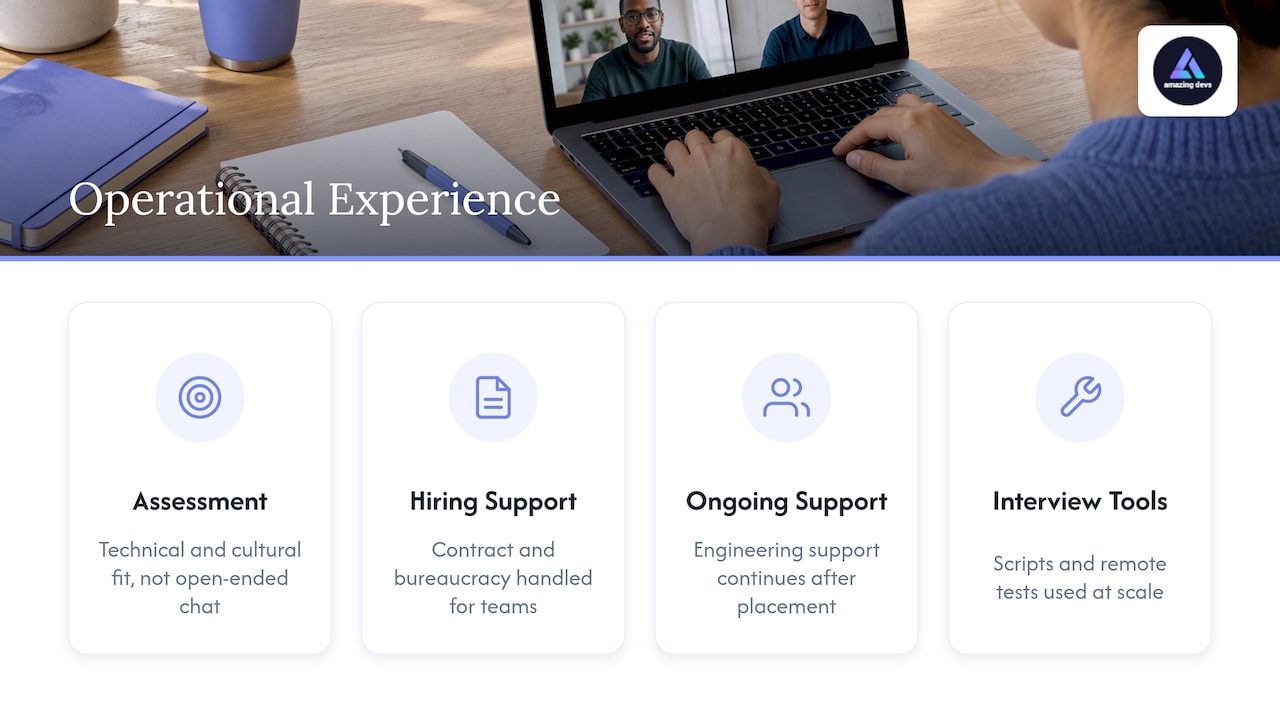
Our recruitment process for nearshore developers runs on the same logic: a rigorous technical and cultural fit assessment, rather than an open-ended chat, shapes who we put in front of clients. We handle contract and bureaucratic details so hiring teams can focus on the interview itself, and our engineering support stays involved after placement rather than disappearing once a contract is signed. The pair programming scripts and remote tooling tests we reference above come directly from running this process at scale.
Author perspective: tradeoffs when hiring remote system designers
A short structured interview is enough when the role is well-scoped and the rubric is solid. Reach for a longer evaluation, like a paid trial, when the role is ambiguous or when two candidates score close together. For nearshore hires specifically, a collaboration-focused sample tells you more than another round of talking. Whatever format you choose, score it the same way every time.
— Gabriel
How Amazing Devs can help run vetted assessments and provide nearshore talent
Running this entire process in-house takes time most engineering teams don’t have to spare, which is where we come in. Through nearshore staff augmentation, we hand you developers who have already cleared a rigorous technical and cultural fit assessment, so your structured interview becomes a final check rather than your only filter.
If you need to extend an existing team rather than fill a single seat, our Team Extension Model adds pre-assessed Brazilian developers who slot into your workflow and tooling. Reach out through our site to talk through your rubric and see candidates who already fit it.
FAQ
What makes a remote system design interview “structured”?
A structured interview uses the same set of questions, built from a job analysis, scored on a defined scale for every candidate. Research summarized in the structured interview literature ties this consistency directly to higher validity than free-form conversations.
Should we score during the interview or afterward?
Score each question immediately after the candidate answers it, while the discussion is still fresh. The IJSA meta-analysis links immediate, question-level scoring to better reliability than a single global rating assigned later.
Should we use a panel or a single interviewer for remote system design interviews?
Panels tend to increase reliability but can reduce rapport and the depth of interpersonal signal you get, according to the McDaniel et al. review. Use a single interviewer when you want a deeper read on collaboration style, and a panel when consistency across many candidates matters most.
How do we keep a remote system design interview fair if someone has technical trouble?
Run a short tech check before the real interview starts, and have a fallback plan, such as switching to phone audio or rescheduling the affected segment. Apply the same policy to every candidate so a connection issue doesn’t become an unfair advantage or penalty.
Can Amazing Devs run or supply candidates for this kind of interview?
Yes. Through nearshore staff augmentation and our Team Extension Model, we provide Brazilian developers who have already passed a technical and cultural fit assessment before you ever run your own structured interview.