Cut Coordination Delay: 3 Timezone Management Moves for Managers
Protect predictable overlap hours, standardize async handoffs, and use time-aware calendaring: those three moves cut coordination delays fastest for distributed teams. Multi-time-zone meetings now make up 30% of all meetings, so managers need templates and metrics, not improvisation. These patterns have been observed to play out across nearshore engineering partnerships over time.
TL;DR:
- Blocking overlap hours is the most cost-effective step and should be implemented first, as many teams overlook this simple fix despite its high impact.
- For tightly coupled work, protected overlap hours are essential, while loosely coupled tasks benefit more from follow-the-sun handoffs with clear artifacts and standardized procedures.
- Using calendar tools that display local times and automatically adjust for daylight saving makes scheduling across multiple zones more accurate and reduces errors.
- Distributing meeting hours fairly requires tracking local time-based meeting loads, rotating inconvenient slots, and offering compensatory time to prevent burnout.
- When process improvements and tooling are insufficient, nearshore staff augmentation can effectively fill the overlap gap without restructuring the entire team.
Table of Contents
- Priority strategies for managing teams across time zones
- Overlap hours versus follow-the-sun handoffs
- Structured async communication and documentation
- Calendaring tools and daylight saving time handling
- Equity, chronotypes, and uneven cross-time load
- Measuring and improving coordination over time
- Rolling out the changes: a 30/60/90 plan with templates
- Why this guidance reflects real nearshore team management
- Fixing process versus adding people to close the gap
- A staffing option when overlap gaps are structural
- Sources
- FAQ
Priority strategies for managing teams across time zones
Most coordination failures trace back to a handful of missing decisions. Fix these first, and the smaller problems tend to resolve themselves.
- Define sync versus async responsibilities so nobody guesses whether a question needs a live answer or can wait for a written one.
- Protect a fixed weekly overlap window that nobody books over, even for high-priority requests.
- Standardize async handoffs with a written template instead of relying on memory or chat scrollback.
- Adopt calendar tools that show local time per attendee and update automatically for daylight saving changes.
- Track meeting load and coordination delay so you know whether your changes are working or just feel like they are.
The order matters. Blocking overlap hours is the cheapest fix and the one teams skip most often: one study found that relatively few distributed teams used blocked time slots, even though most reported meeting during odd hours at least occasionally, a mismatch that a short calendar policy can close almost immediately, according to CHI 2023 research on cross-timezone scheduling. Async handoffs take longer to build but prevent the slow leak of context that makes every new day feel like starting over. Tooling and measurement come last because they only pay off once the first two habits exist. A manager who tries to buy better calendaring before fixing team norms usually ends up with a well-labeled version of the same chaos.
Overlap hours versus follow-the-sun handoffs
The right model depends on how tightly your team’s work is coupled, not on how many time zones you span.
Choose protected overlap hours when work is tightly coupled: design reviews, incident response, or anything where two people need to think out loud together. Synchronous tools measurably reduce coordination delay for pairs who share working hours, but that benefit disappears once the overlap window closes, according to a relational model of coordination delay published in globally distributed project research.
Choose follow-the-sun handoffs when work is loosely coupled and splits cleanly into phases, such as development in one region and testing in another. The follow-the-sun model can shorten time to market, but only when handoff efficiency is high and within-site coordination costs stay low. Without standardized artifacts, the model tends to break down instead of speeding anything up.
- Confirm the task splits into discrete phases with clear ownership boundaries.
- Write a handoff artifact before every shift change: current state, blockers, next step, owner.
- Automate tests so the receiving site can verify state without a live call.
- Rotate which site absorbs the least convenient hours, and track that rotation.
Pro Tip: Run follow-the-sun first on a narrow slice like QA or CI validation, where handoffs are simpler, before trying it on a full feature cycle.
Fairness still matters inside either model. Rotating inconvenient slots, blocking shared hours in advance, and offering comp time for late calls keep the arrangement sustainable rather than quietly resented.
Structured async communication and documentation
Async only works when it replaces the missing context a meeting would have provided, not when it becomes another place to lose information. Written email alone does not reduce coordination delay for pairs with no overlapping hours, a finding that should discourage any manager tempted to “just document more” without structure, per the coordination-delay study above.
- Use a fixed handoff template with five fields: current state, blockers with repro steps, next immediate action and owner, required links, and expected follow-up window, a structure drawn from practitioner guidance on follow-the-sun communication.
- Record standups instead of scheduling them live when the only purpose is status sharing across zones.
- Use AI transcription to generate searchable notes from those recordings, including timestamped sections for people who only need the part relevant to them.
- Set response-time SLAs (for example, four business hours) so async does not quietly become no response at all.
- Define an escalation path for anything blocking work past the SLA, naming who gets pinged and how.
A written handoff that takes five minutes to produce routinely saves the next person an hour of digging through chat history, and that trade only holds when the template is actually filled out every time, not just when someone remembers.
Calendaring tools and daylight saving time handling
Calendar software is where good intentions quietly fail. Many tools make it hard to see more than two or three time zones at once, which pushes managers back toward manual math and the errors that come with it, according to the CHI 2023 findings on cross-timezone scheduling.
- Require multi-time-zone view so every attendee sees the meeting in their own local time, not a converted guess.
- Enable automatic daylight saving updates rather than trusting anyone to remember which regions shifted and when.
- Rely on vendor-maintained timezone databases instead of manual offset tables, since the underlying rules change more often than most people expect, per the tz database documentation.
- Put local times for at least two sites directly in the invite title, not just the body.
- List meeting purpose and required prework in every invite so the meeting has earned its place on someone’s calendar.
30% of meetings now cross multiple time zones, and late-night meetings after 8:00 PM local time have increased notably year over year, a trend that makes calendar clarity a daily operational issue rather than an edge case, per the Microsoft Work Trend Index. A tool built for calendar automation across distributed operations, like CentriOps, can remove much of this manual overhead for teams managing several regions at once.
Equity, chronotypes, and uneven cross-time load
Coordination costs rarely land evenly. One person often absorbs most of the late calls while the rest of the team barely notices, and that pattern compounds quietly until it shows up as attrition.
- Measure meeting hours by local time per person, not just meeting count, to spot who is actually paying the cost.
- Rotate the inconvenient slot across team members on a visible schedule rather than defaulting to whoever is most available.
- Offer comp time for calls that fall well outside someone’s normal working hours.
- Collect chronotype preferences directly, since aligning scheduling with individual energy peaks reduces friction more than geography alone, according to research on chronobiology and timing.
- Mark daylight saving transition weeks as higher risk, since offsets become unreliable for a short window and critical launches should avoid that period where possible, per guidance on daylight saving impacts.
Pro Tip: Review the meeting-hours-by-person report monthly, not quarterly. Load imbalances creep in fast and are easy to miss until someone burns out.
Fairness tactics also support broader prioritization work, something covered in more depth in guidance on reducing engineering costs through better prioritization.
Measuring and improving coordination over time
You cannot fix what you are not tracking, and most teams only notice coordination problems once they show up as missed deadlines.
Track three numbers: the percentage of meetings spanning multiple time zones, the count of meetings starting after 8:00 PM local for any attendee, and a coordination-delay proxy such as average time between a blocker being raised and being resolved. Run changes as four-week pilots: set a baseline in week one, introduce one change (a new overlap block or handoff template), then compare weeks three and four against the baseline.
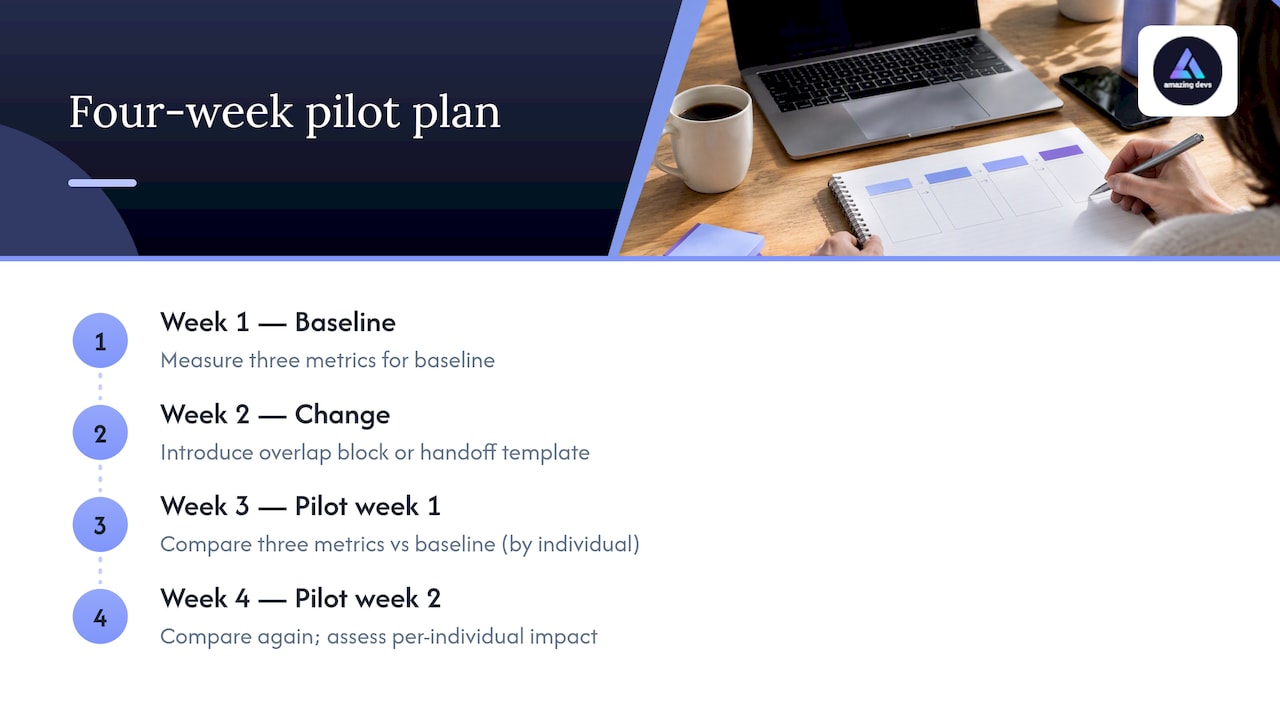
Break results out by individual, not just by team average, to surface whether the fix helped everyone or just the people already least burdened.
Rolling out the changes: a 30/60/90 plan with templates
Treat this as a staged rollout, not a one-time announcement.
- Days 1 to 30: pilot one overlap block and one handoff template with a single team; log baseline metrics.
- Days 31 to 60: expand to two more teams, adjust the template based on what got skipped or misused.
- Days 61 to 90: roll out team-wide, publish the final templates, and set a recurring review cadence.
Meeting rules template, pasted into the invite body:
- Local times listed for every required attendee.
- Agenda and required prework linked, not described.
- Hard stop time enforced. No running over by default.
Async handoff template, filled out at every shift change:
- Current state in two sentences.
- Blockers with repro steps if applicable.
- Next immediate action and its owner.
- Links to required artifacts.
- Expected follow-up window.
Practical rollout tactics like these pair well with broader remote work practices around recurring overlap blocks and shared workload norms.
Why this guidance reflects real nearshore team management
This playbook draws on patterns Amazing Devs has observed while managing nearshore engineering partnerships, where Brazilian developers routinely work alongside teams in other regions and overlap design becomes a daily operational question rather than a theoretical one. Handling contracts and staffing logistics across time zones requires the same discipline described above: clear handoffs, protected overlap, and tools that do not require manual timezone math.
— Gabriel
Fixing process versus adding people to close the gap
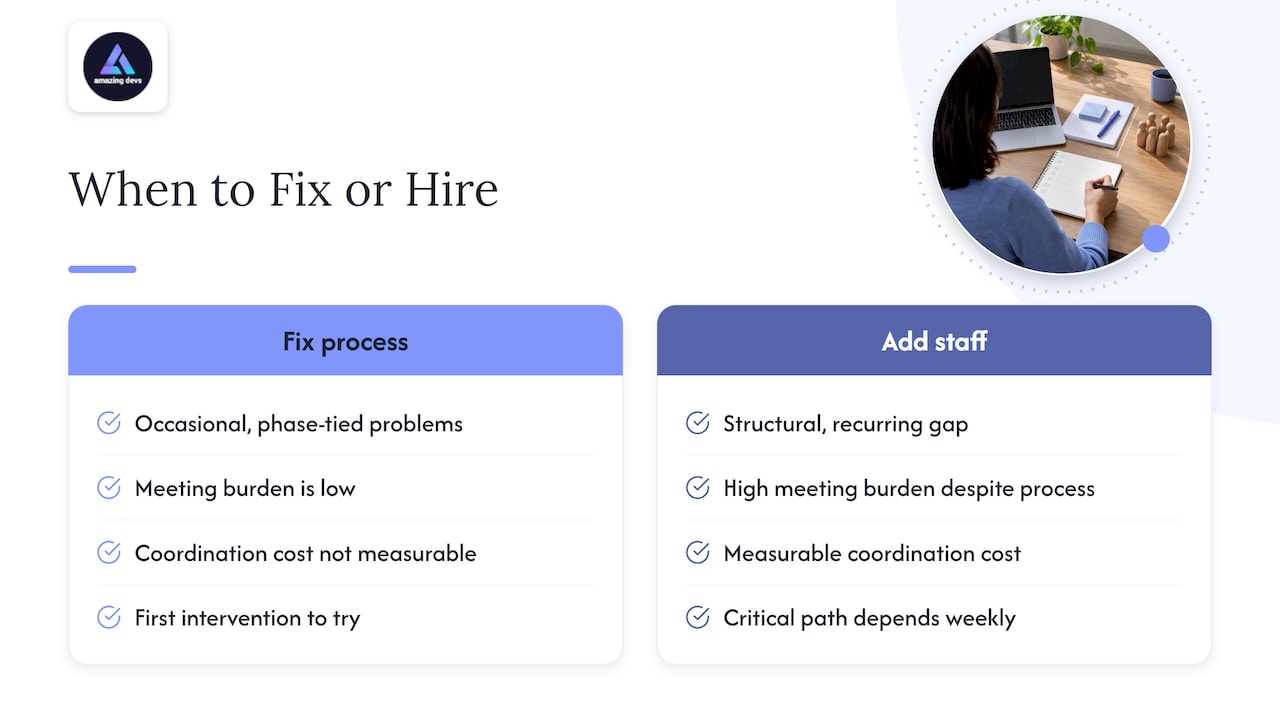
Fix process first when coordination problems are occasional and tied to a specific project phase. Consider adding staff when the gap is structural: your critical path regularly depends on hours your current team does not cover, and meeting burden is already high despite good process.
Nearshore hires can tactically extend overlap without a full time-zone shift for existing staff, since Brazilian time zones sit close to many North American working hours. Ask: is this a recurring need, is the coordination cost measurable, and does the critical path depend on it weekly? If yes to all three, staffing changes likely outperform further process tweaks.
A staffing option when overlap gaps are structural
When process changes and better tooling still leave a coverage gap, adding nearshore developers through nearshore staff augmentation is one practical way to extend working-hour overlap without restructuring your entire team. Amazing Devs’ Team Extension Model adds pre-vetted Brazilian developers matched for technical and cultural fit, handling contracts and logistics so you are not managing bureaucracy on top of scheduling.

This is one option among several covered here, not a replacement for the process work above. If overlap hours, not process, are your bottleneck, view nearshore staff augmentation options or reach out to discuss a team extension.
Sources
- Breaking down the infinite workday (Microsoft Work Trend Index)
- Crossing spatial and temporal boundaries in globally distributed projects: A relational model of coordination delay
- Follow the sun (FTS) model overview
- CHI 2023: Empirical findings on cross-timezone scheduling
FAQ
What are the most effective time management strategies for distributed teams?
Protecting predictable overlap hours, standardizing written async handoffs, and using calendar tools that show local time automatically are the three highest-leverage strategies. They address the root causes behind most coordination delays rather than just adding more meetings.
What are the four types of time management strategies for cross-timezone teams?
A practical grouping covers scheduling structure (overlap windows and rotations), communication format (sync versus async rules), tooling (time-aware calendars and automated DST handling), and measurement (tracking meeting load and delay). Definitions vary across sources, but these four categories consistently cover the operational gaps managers report.
What are practical tips for managing time effectively across time zones?
Block a recurring overlap window every week, require local times in every invite, and rotate inconvenient meeting slots so no one person absorbs them permanently. Pair those habits with a written handoff template so work does not stall when people are offline.
How do you handle daylight saving time in global team scheduling?
Rely on vendor-maintained timezone databases rather than manual offset tracking, since daylight saving rules change and manual math is a common source of error, per tz database documentation. Treat the transition weeks as higher risk and avoid scheduling critical launches during them.
Should managers add staff or change process to fix timezone coordination problems?
Start with process changes like overlap protection and async templates if the gap is occasional. If the mismatch is structural and tied to the critical path, adding nearshore talent through a team extension model can close the overlap gap directly.