Brazil Developer Rates: What US Teams Actually Pay in 2026

Budget roughly $30,000 to $78,000 a year per developer when you hire in Brazil as a US employer, and judge every quote by whether it is an all-in figure. That is the range in our all-in budget guide, and it works out to about $14 to $38 an hour on a standard 2,080-hour year. Where you land depends on seniority, specialty and, above all, on what the rate includes.
This article explains how to read Brazilian developer rates: what local salaries look like, why a salary is not a vendor rate, how to turn annual numbers into hourly ones, and where AI engineers sit.
TL;DR
- Plan $30,000 to $78,000 per developer per year on an all-in basis, which is roughly $14 to $38 per hour at 2,080 hours (our arithmetic on the range from our budget guide).
- Salary and rate are different numbers. Employer charges and benefits can add 35 to 37 percent on top of base pay, before recruiter margin and legal management.
- Local averages mislead: Brazil’s average monthly earnings were R$3,738 in Q2 2026, and developers working for international companies sit in a very different market.
- AI engineers are the top-paid technical role in Brazil, at R$19,500 to R$27,100 a month in local compensation.
- The cheapest quote is rarely the cheapest outcome. Undercutting usually means cut corners on compliance or benefits.
Table of Contents
- Salary, loaded cost and vendor rate are three different numbers
- What local salary data tells you, and what it hides
- Turning annual numbers into hourly rates
- Why the lowest quote often costs more
- Freelancer or full-time: pricing models compared
- AI engineers and specialists cost more
- What else belongs in your budget
- Our perspective: price the whole engagement, not the hour
- How we can help
- FAQ
- Sources
Salary, loaded cost and vendor rate are three different numbers
Most confusion about Brazil developer rates comes from mixing three things.
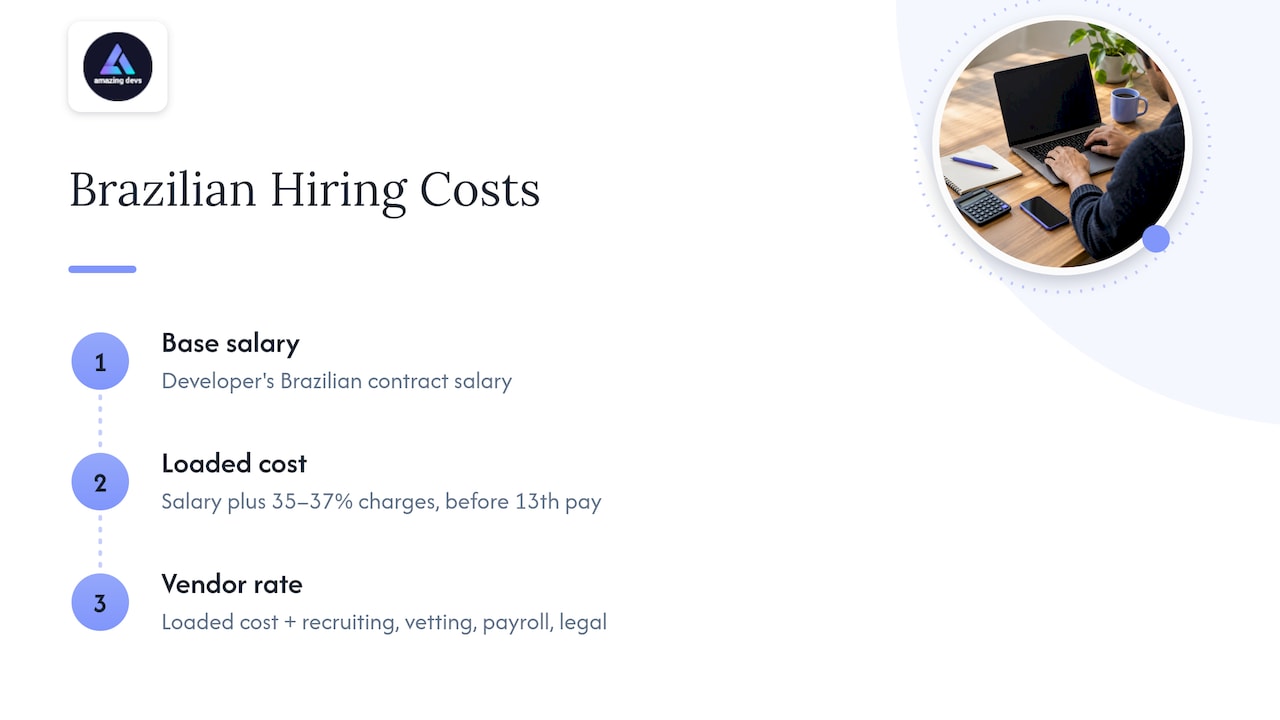
Base salary is what the developer sees in a Brazilian contract. Salary sites quote this, usually in reais and usually monthly.
Loaded cost is base salary plus the charges and benefits an employer in Brazil carries. According to Global Software Companies, benefits and social charges can add 35 to 37 percent to base salary. HiveDesk cites the same 35 to 37 percent range for employer on-costs, noting it applies before the 13th-month pay is counted.
Vendor rate is what you pay a partner. It covers the loaded cost and also recruiting, vetting, payroll, contract management and the legal work of employing someone in another country.
A US manager who compares a salary-site number with an agency’s hourly rate will think the agency is padding. A manager who compares a loaded cost with an agency rate sees what the margin and services actually are. Compare like with like.
What local salary data tells you, and what it hides
It is tempting to start with national statistics. Brazil’s minimum wage is R$1,621 per month from January 1, 2026, set by Decree No. 12,797, and average monthly earnings from work were R$3,738 (about US$728) in the second quarter of 2026, per HiveDesk’s summary of IBGE data.
Those figures are useful for one thing: they show how far developer pay sits from the general economy. English-fluent engineers who work for foreign companies operate in a premium segment that has little to do with national averages. Do not take the national average, or a developer’s local salary at a domestic firm, as your hiring benchmark.
Two more local quirks matter when you read salary threads and surveys:
- Bonuses and the 13th month. Brazilian pay is often discussed with bonuses and an extra month’s salary. Check whether a number is base, base plus bonus or total compensation.
- Fluid seniority. A “senior” title at a small local company can match a mid-level role at a globally oriented one. Look at what the person has shipped, particularly production-grade cloud or AI systems, rather than at title or years of experience.
Turning annual numbers into hourly rates
US teams often budget hourly, especially for contractors. The conversion is simple: divide the annual all-in cost by 2,080 hours (40 hours times 52 weeks).
| Annual all-in cost | Approx. hourly equivalent |
|---|---|
| $30,000 | $14.42 |
| $42,000 | $20.19 |
| $58,000 | $27.88 |
| $78,000 | $37.50 |
The $30,000 to $78,000 span is the planning range from our budget guide. The hourly column is our own arithmetic, not a quote, and a real engagement is priced to the role and scope.
Two caveats when you use this table:
- Billable hours are not the same as paid hours. Brazilian employees have paid holidays and leave. A model that bills only hours worked will carry a higher hourly figure than a monthly fixed fee for the same person. Ask which one you are being quoted.
- Third-party hourly figures vary widely. Public rate calculators and vendor blogs report very different hourly ranges for Brazil. They mix freelancers, agency rates, different seniority definitions and different date ranges. Use them to sanity-check, never as a quote.
Why the lowest quote often costs more
Global Software Companies warns that failing to account for loaded costs often leads buyers to choose providers who undercut on price by cutting corners on compliance or benefits. That fits what we see in practice. A rate that is too low to cover social charges and benefits has to come from somewhere, and the usual places are misclassified contractors, thin benefits and no replacement plan when someone leaves.
When you review quotes, ask each provider:
- Is the rate all-in, covering salary, charges, benefits, equipment and management?
- Who is the legal employer, and what is the engagement structure?
- What happens if a developer resigns in month four?
- What is the notice period, and is there a minimum term?
- Which costs are billed separately, such as recruiting fees, equipment or conversion fees?
If the answers are vague, the low number is probably not the full number. Our own overview of nearshore developer rates in LATAM goes through the costs US quotes tend to miss.
Freelancer or full-time: pricing models compared
Brazil developer rates look different depending on the model.
| Model | How it is priced | Best for | Watch out for |
|---|---|---|---|
| Freelancer or independent contractor | Hourly or project rate | Short, well-scoped work | Availability gaps, no replacement, classification risk |
| Dedicated developer through a staffing partner | Monthly all-in rate | Ongoing roles in your team | Make sure the rate includes charges and benefits |
| Your own Brazilian entity | Salary plus charges plus admin | Large, long-term teams | Setup time, accounting and legal overhead |
| Project outsourcing | Fixed fee or time and materials | Defined deliverables | Less control over who does the work |
Freelance pricing has its own logic, and the thinking behind value-based pricing for independent consultants helps explain why independent rates often differ from salaried equivalents. For an ongoing role inside your team, a dedicated developer on a monthly all-in basis is usually the cleaner comparison to a US hire.
If you want to skip the entity question, see how US teams hire Brazilian developers without a local entity.
AI engineers and specialists cost more
Specialty moves the number more than almost anything else. According to Exame, citing Robert Half, AI engineers hold the highest salary among technical roles in Brazil in 2026, at R$19,500 to R$27,100 a month between the 25th and 75th percentiles. That is local monthly pay, before the employer on-costs described above.
Demand is growing from a small base. PwC’s AI Jobs Barometer reports that 3.6 percent of Brazilian job postings required AI skills in 2025, up from 1.1 percent in 2024. Competition for people with real production experience is rising, and the broader picture of why hiring is getting harder in 2026 applies to AI roles most of all.
The Exame reporting also stresses that a portfolio and production deployment experience count for more than certifications. When you screen, ask for systems that run in production, not course badges. Our guides on hiring AI engineers and the AI engineer skills to screen first cover the process in more detail, and data engineers follow a similar logic.
What else belongs in your budget
The rate is not the whole cost of a hire. Add these before you compare Brazil to a US salary:
- Time zone fit. Brazil’s UTC-3 offset gives a team 6 to 7 hours of overlap with Eastern time and 3 to 4 with Pacific on a 9-to-5 assumption. That reduces coordination cost compared with offshore options. See our time zone management moves for how to make the most of it.
- Management time. Cultural and communication differences cost nothing on an invoice but they take effort. Our Brazil work culture guide helps foreign managers plan for that.
- Equipment and tools. Confirm whether the rate includes a laptop and software licenses.
- Recruiting and replacement. Check how a vendor handles a developer who leaves.
- Compliance. Contractor classification and employment rules in Brazil are not something to improvise.
If you are weighing Brazil against another region, our Brazil vs. India comparison puts cost beside time zone and communication.
Our perspective: price the whole engagement, not the hour
We place Brazilian developers with US companies, and the same pattern shows up in nearly every first conversation. A buyer arrives with an hourly number from a calculator or a competitor’s quote and asks whether we can match it. The better question is what the number includes.
A rate that is honest about charges, benefits, vetting and contract management will never be the lowest on a spreadsheet. It will, however, be the one that does not change in month three. We handle contracts and the bureaucracy so you do not have to, and we put candidates through a technical and cultural-fit assessment before you see them. That is where the money in a hire is made or lost: a developer who matches your stack, your communication style and your pace stays, and replacing a bad fit costs far more than a few dollars an hour.
Our advice is to decide the role first, with seniority defined by what the person has built and not by title. Then ask every provider for an all-in monthly figure and compare those. If one quote is far below the rest, find out what it leaves out.
— Gabriel
How we can help
If you want a developer, a small team or QA capacity from Brazil, our nearshore staff augmentation service covers sourcing, technical and cultural-fit assessment, and contract management. For teams that want Brazilian engineers working as part of their own, the Team Extension Model is built for that. Rates depend on role and scope, so we scope them with you, and we do not publish a fixed price list.
FAQ
How much does a developer in Brazil cost a US company?
A reasonable planning range is $30,000 to $78,000 per developer per year on an all-in basis, according to our budget guide. That is roughly $14 to $38 an hour at 2,080 hours. Your actual number depends on seniority, stack and engagement model.
Is the Brazilian minimum wage relevant to developer pay?
Not really. The minimum wage is R$1,621 a month in 2026, and the average monthly income was R$3,738 in Q2 2026 per HiveDesk. Developers working for international companies earn well above both, so these figures are not a hiring benchmark.
Why is a vendor rate higher than a developer’s salary?
The vendor rate has to cover charges and benefits, which can add 35 to 37 percent to base salary, plus recruiting, vetting and contract management. That is why comparing a salary figure with a vendor’s hourly rate is misleading.
Do AI engineers in Brazil cost more than other developers?
Yes. AI engineers are the best-paid technical role in the country in 2026, with monthly pay of R$19,500 to R$27,100 between the 25th and 75th percentiles. Expect a premium over general software roles, and screen for production experience.
Sources
- Outsourcing Brazil: Costs, Talent, Risks, and Vendor Selection
- Average Salary in Brazil (2026): IBGE Data, Roles, and Costs | HiveDesk
- Decree No. 12,797 of 2025 (Planalto)
- Salário de engenheiro de IA, dados e cibersegurança (Exame)
- Brazil report, 2026 AI Jobs Barometer (PwC)