Nearshore vs In-House Cost: What a Developer Really Costs
Nearshore is usually cheaper than in-house, but the gap is not the one you see when you compare a US salary with a nearshore hourly rate. One side of that comparison is missing its overhead, the other side its management time. Counting the fully loaded cost on both sides, outsourcing usually comes in 30 to 50% cheaper than an in-house team, and nearshore keeps that saving without the time-zone penalty of offshore. This guide shows how to build the comparison yourself, line by line, and where in-house still wins.
TL;DR
- A US in-house developer costs far more than salary: recruiting, taxes, benefits, equipment, onboarding and management time all sit on top of it.
- A nearshore developer from Brazil costs less on paper and in practice, as long as you count rework and coordination as well as the hourly rate.
- Nearshore beats offshore on effective cost for most US teams because the working day overlaps with yours.
- In-house still wins for core proprietary IP and rare specialist domains.
- The cheapest rate is a poor selection criterion. Cultural fit and vetting decide whether the saving survives.
Table of Contents
- Why the headline numbers mislead
- What an in-house US developer costs
- What a nearshore developer from Brazil costs
- Side by side: nearshore vs in-house
- Nearshore vs offshore: why overlap protects the saving
- The hidden costs that can erase the saving
- When in-house still wins
- It is not only about cost
- Our perspective
- How to run your own comparison
- Where Amazing Devs fits
- FAQ
- Sources
Why the headline numbers mislead
Most cost comparisons put a US salary next to a nearshore monthly rate and declare a winner. That is not a like-for-like comparison.
The US figure is a salary. The Bureau of Labor Statistics reports a median annual wage of $135,980 for software developers as of May 2025, with the top 10% earning over $214,670. Quality assurance analysts and testers have a median of $104,300. Those are wages. They exclude everything an employer pays on top.
The nearshore figure is usually a rate that already bundles the provider’s recruiting, payroll and local compliance. So the fair comparison is between two fully loaded numbers: what the developer costs you per year, all in, and what you get in productive output for it.
What an in-house US developer costs
Build the in-house number from these lines:
- Base salary. The BLS median above is a sensible anchor for a generalist software developer. Senior and AI-focused engineers sit higher, and pay varies a lot by metro area.
- Payroll taxes and benefits. Health insurance, employer payroll taxes, retirement matching and paid leave. The percentage depends on your plan, so use your own finance team’s loading factor rather than a generic one.
- Recruiting. Job boards, recruiter fees or internal recruiter time, plus interview hours from your engineers. Our own breakdown of what it costs to recruit developers shows how large this line gets when a search drags on.
- Equipment, software and workspace. Laptop, licenses, security tooling, and office space if you have it.
- Onboarding ramp. The first months of partial productivity while someone senior spends time on setup and context.
- Vacancy cost. Every week the seat is empty, the roadmap slips. This rarely appears in a spreadsheet but it is real.
A worked illustration
The numbers below are an illustration, not a quote. Take the $135,980 median salary and assume your own overhead loading is 25%. Your real figure may differ, so replace it with your finance team’s number.
| Line | Annual amount |
|---|---|
| Base salary (BLS median) | $135,980 |
| Assumed taxes and benefits at 25% | $33,995 |
| Loaded cost before recruiting and equipment | $169,975 |
Add a recruiting fee, equipment and a ramp period, and the first-year cost climbs further. The point is not the exact total. It is that the salary is only the first line of the invoice.
What a nearshore developer from Brazil costs
Nearshore means working with people in a nearby country whose hours overlap yours. Experts typically define it as a 0 to 4 hour time-zone difference from the US, which allows live daily collaboration, real-time coaching and direct sprint integration. Brazil fits that for most US teams. If the concept is new to you, see what nearshore outsourcing means for IT teams.
For budgeting, our guide on Brazil salaries suggests US employers plan $30,000 to $78,000 per developer as an all-in budget. The range is wide because seniority and stack drive it. A mid-level web developer sits near the lower half and a senior engineer with cloud or AI skills sits higher. Our breakdown of nearshore developer rates in LATAM covers the line items that US quotes tend to leave out.
With a nearshore partner, what you pay for typically includes:
- The developer’s compensation.
- Sourcing and vetting.
- Local contracts, payroll and compliance.
- Partner management fee.
What you do not pay for is a US recruiting cycle, US benefits administration, or the cost of a bad hire that has to be replaced from scratch.
Side by side: nearshore vs in-house
| Cost factor | US in-house | Nearshore (Brazil) |
|---|---|---|
| Base pay | Median $135,980 for developers (BLS, May 2025) | Much lower, set by Brazilian market |
| Taxes and benefits | Employer-paid, adds a significant loading | Typically bundled into the engagement |
| Recruiting | Your cost: fees, interview time, vacancy | Handled by the provider |
| Contracts and compliance | Your HR and legal team | Handled by the provider |
| Time to start | Often months | Typically faster, depending on the role |
| Scaling up or down | Slow, with severance and rehiring costs | Flexible by engagement terms |
| Time-zone overlap | Full | Usually 0 to 4 hours of difference |
| Management load | Normal | Slightly higher than in-house, far lower than offshore |
The savings cluster in the rows people forget: recruiting, vacancy time and flexibility.
Nearshore vs offshore: why overlap protects the saving
Offshore rates can look even lower. But hourly rates hide what the practitioner literature calls the effective rate: the hourly rate plus rework, communication overhead and the management time needed to oversee a dispersed team. Nearshore tends to produce a lower effective rate than offshore because it avoids the coordination tax of a large time-zone gap.
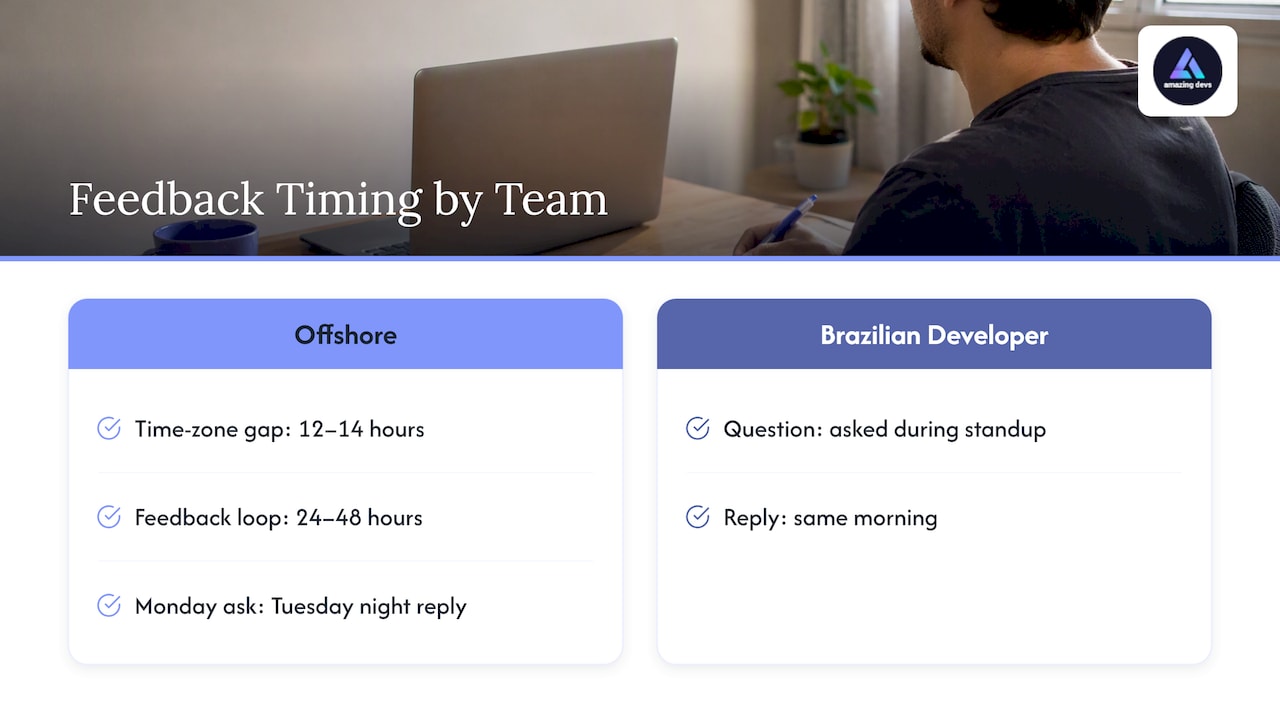
The pattern is easy to picture. Teams working 12 to 14 hours apart can see 24 to 48 hour feedback loops, so a question asked on Monday afternoon gets answered Tuesday night. With a Brazilian developer, you ask in a standup and get the answer the same morning. If your managers lose hours a week to handoffs, those hours are a cost. We cover practical fixes in three time-zone management moves for managers, and our nearshore vs offshore guide goes deeper on the trade-off.
The hidden costs that can erase the saving
Nearshore is not automatically cheap. The saving survives only if you avoid these traps.
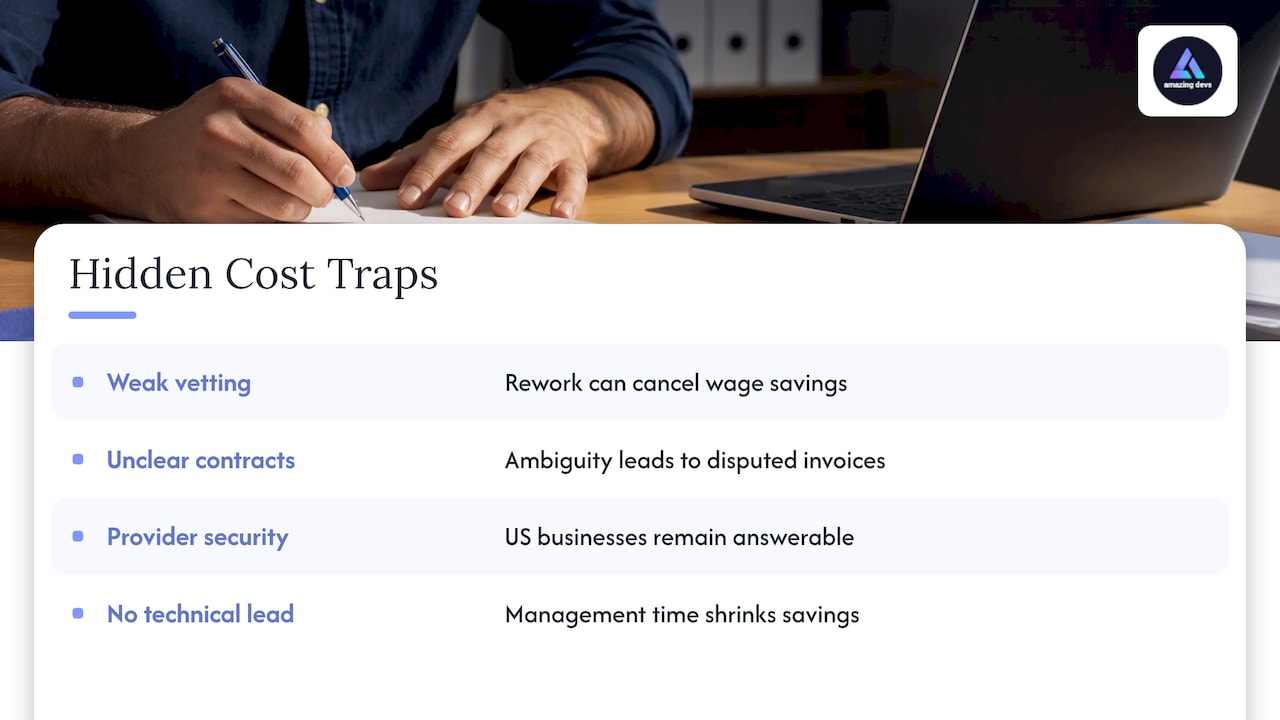
Rework from weak vetting. Practitioners warn that vendors with very low hourly rates often carry high hidden costs from rework, poor English proficiency or cultural misalignment, which can cancel the wage saving and derail timelines. A cheap developer who ships code your team rewrites is the most expensive hire you can make. Our piece on the hidden costs of outsourcing lists the usual culprits.
Billing disputes and unclear contracts. Ambiguity about hours, deliverables and IP ownership turns into invoices you argue over. See our notes on developer contracts that protect IP and on verified time tracking.
Security responsibility you cannot hand off. US businesses stay answerable for what happens on a provider’s side. The FTC’s guidance tells companies to check a service provider’s security practices, write security requirements into the contract and monitor compliance. Budget some time for that diligence, and consider background checks for developer hires where they access sensitive systems.
Management time. A distributed developer still needs direction. If you have no technical lead to give it, the saving shrinks.
When in-house still wins
Cost is not the only axis, and a fair comparison says so. The same YuSMP analysis finds in-house still wins in two cases: core proprietary IP, and a deep-specialist domain where few engineers exist. Add a third from experience: a team that must sit together physically, for hardware or regulated on-site work.
A practical split many US companies use:
- In-house: architects, the engineering lead, anyone who owns your core algorithm or data model.
- Nearshore: feature development, integrations, QA, maintenance, and scaling for a launch.
This hybrid captures most of the saving without handing over what makes your company distinct.
It is not only about cost
Cost drives the first conversation, but not always the decision. Deloitte’s 2024 outsourcing survey reports that skilled talent and agility now rival cost reduction as top drivers for outsourcing, as companies struggle to hire specialized, cloud-native and AI-enabled talent domestically. If your search for an AI-capable engineer has been open for months, the real cost of staying in-house is the product you did not ship.
When you compare partners, weigh collaboration quality and outcomes alongside price. A vendor assessment checklist written for health IT founders is a useful template for the questions to ask any technology vendor: how they vet people, how they report, what happens when something goes wrong.
Our perspective
We place Brazilian developers with US companies, so we see the same pattern in nearly every cost conversation: the buyer compares a salary with a rate, and the comparison is wrong in both directions. In-house is more expensive than the salary suggests, and cheap nearshore is more expensive than the rate suggests.
The saving we want clients to keep comes from three things. First, a rigorous technical and cultural assessment, so the developer fits how your team works and you do not pay for rework. Second, handling the contracts and bureaucracy on the Brazilian side, so your managers spend their time on the product. Third, proactive support from our engineering team once the developer starts, so small problems do not turn into missed sprints.
Our advice: do not start with the cheapest quote. Start with the role, the overlap you need and the person who will manage the work, then compare total cost per shipped feature. Nearshore from Brazil wins that comparison for most of the teams we talk to. When it does not, we say so.
— Gabriel
How to run your own comparison
- List the roles. Separate core roles from roles that any capable engineer could fill.
- Price in-house fully loaded. Use BLS wages as an anchor, then add your real benefits loading, recruiting, equipment and ramp time.
- Price nearshore all in. Ask for the full monthly cost and what it includes. Our Brazil budget guide gives a reference range.
- Add the soft costs to both. Management hours, rework risk, vacancy time and security diligence.
- Test the model. Many teams begin with one or two nearshore developers before committing to more. See the partnership models for ways to structure it.
- Decide on cost per outcome. Compare what each option costs for a shipped feature, not for a seat.
Where Amazing Devs fits
If you want to price this for real, we offer nearshore staff augmentation with pre-vetted Brazilian developers matched on technical skill and cultural fit, plus contract management on our side. If you want developers who work as part of your team under your direction, the Team Extension Model is built for that, and we also supply nearshore QA contractors. Tell us the roles and the stack at getamazingdevs.com and we will help you build a like-for-like comparison.
FAQ
Is nearshore really cheaper than hiring in-house?
Usually, yes. Once you count salaries, taxes, benefits, recruiting and onboarding, outsourcing typically comes in 30 to 50% cheaper than a fully loaded in-house team. The saving shrinks if vetting is weak and the work has to be redone.
What is the difference between nearshore and offshore?
The difference is mostly time zone. Nearshore teams sit within about 0 to 4 hours of the US, while offshore teams are 8 to 12 hours away, so communication is often asynchronous. That overlap is why nearshore often has a lower effective cost even when its hourly rate is higher.
Which costs do people most often forget when comparing?
On the in-house side: recruiting, vacancy time and onboarding. On the nearshore side: management time, rework and security diligence. The FTC expects you to vet and monitor service providers rather than assume they are covered.
Should I move my whole engineering team nearshore?
Usually not. Keep core proprietary IP and architecture ownership in-house, and use nearshore developers for feature work, QA and scaling. That balance keeps control where it matters and the saving where it is largest.
Sources
- U.S. Bureau of Labor Statistics: Software Developers, Quality Assurance Analysts, and Testers
- YuSMP: Outsourcing vs In-House Software Development
- Callforce: What Is Nearshore Outsourcing?
- Codebrand: Nearshore vs Offshore Development Guide
- FTC: Stick with Security
- Deloitte: 2024 Global Outsourcing Survey