Plan $30,000–$78,000 for Brazil Developers: How US Employers Build an All In Budget
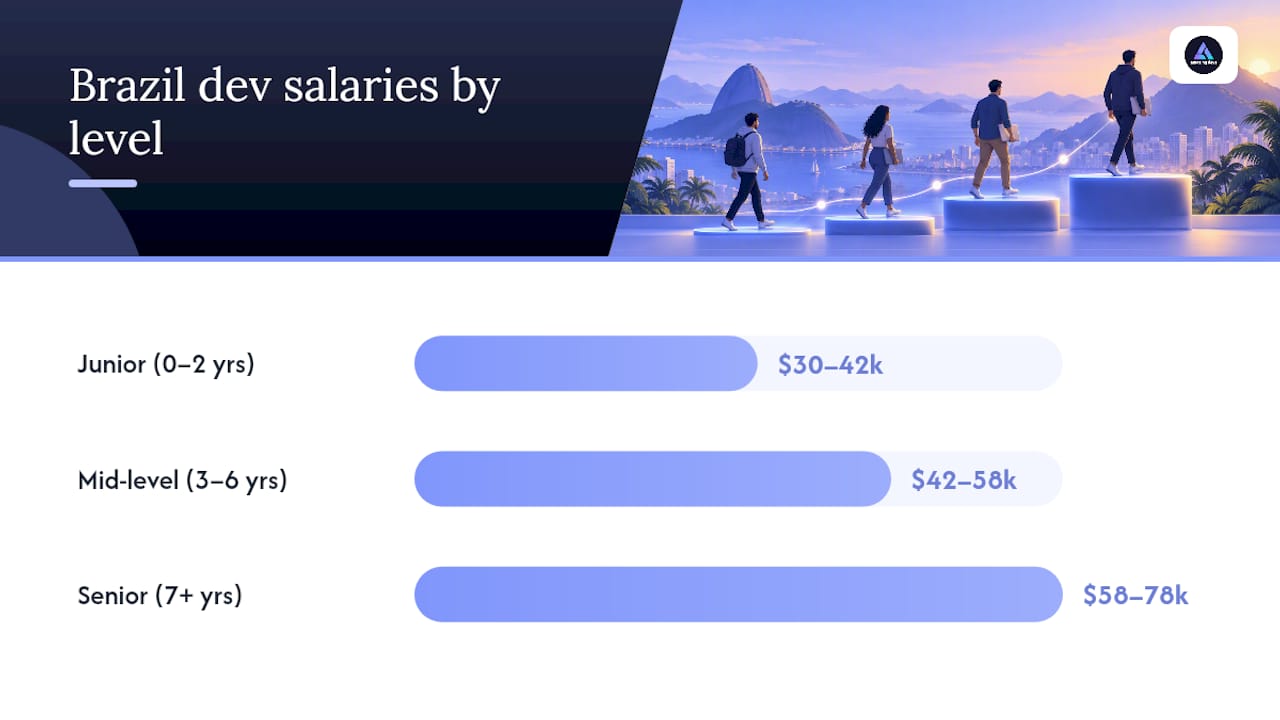
Expect to pay roughly $30,000 to $42,000 all-in for a junior Brazilian developer, $42,000 to $58,000 for mid-level, and $58,000 to $78,000 for senior talent, based on vendor benchmarks US buyers commonly reference. The catch: those figures only work if you know whether you’re looking at base salary, total compensation, or a vendor’s bundled all-in price. Mixing them up is the single most common budgeting mistake employers make, and the employer-cost breakdown below shows why.
TL;DR:
- Employer costs for hiring in Brazil generally range from 1.50 to 1.56 times the base salary, depending on role, location, and legal structure.
- Statutory costs such as the 13th salary, vacation bonus, and social security contributions add roughly 11% to 12% on top of base salaries and can increase total employer expense by over 43%.
- Specialized roles like data engineering and security command premiums well above the standard salary bands, especially in high-demand areas such as São Paulo.
- Converting Brazilian salaries into US dollars requires building an itemized cost model in BRL, adding an FX buffer for currency volatility, and requesting detailed vendor quotes.
- Choosing the right hiring model (direct employment, EOR, contractor, outsourcing) impacts statutory cost responsibilities and flexibility, with managed options favored for speed and compliance ease.
Table of Contents
- Brazil Developer Salaries by Seniority and Role
- How to Read Brazil Salary Data Without Mixing Up the Numbers
- Building the Real Employer-Cost Model Under CLT
- Direct Hire, EOR, Contractor, or Managed Outsourcing: What Changes
- Turning BRL Numbers Into a US Hiring Budget
- What Vetted Nearshore Partners Handle Differently
- How Brazil Stacks Up Against Other Latin American Tech Hubs
- Why Inflation and the Real’s Swings Move Your Budget
- What’s Actually Included in a Brazilian Developer’s Package
- The Budgeting Mistake Most Employers Repeat
- Get an Itemized Brazil Hiring Quote From Amazing Devs
- Where These Numbers Come From
- Sources
- FAQ
Brazil Developer Salaries by Seniority and Role
The all-in USD ranges above are a starting point, not a universal price tag. Role family and specialization move the number just as much as seniority does.
- Junior developers: roughly $30,000 to $42,000 all-in, corresponding to entry-level CLT hires with 0 to 2 years of experience.
- Mid-level (pleno) developers: roughly $42,000 to $58,000 all-in, typically 3 to 6 years of experience and independent ownership of features.
- Senior developers: roughly $58,000 to $78,000 all-in, usually 7-plus years, architecture responsibility, and mentoring duties.
These bands come from vendor-published hiring benchmarks that already fold CLT statutory costs and vendor fees into a single number. Local survey data tells a slightly different story on the base-pay side. Código Fonte’s annual salary survey reports median BRL salaries by level and distinguishes CLT contracts from PJ (contractor-style) arrangements, which often carry a different tax treatment and no statutory benefits. If you’re comparing a CLT offer to a PJ quote, you’re comparing two different cost structures, not just two numbers.
Specialized roles skew well above these baseline ranges. Data engineering, machine learning, and security roles routinely command a premium over general backend or frontend work, largely because demand for AI and data talent has outpaced the supply of engineers with production experience in those stacks.
Location matters too. Brazil is Latin America’s largest software development market, but pay is not uniform across it. São Paulo commands the highest salaries nationally, reflecting its concentration of multinational tech offices and venture-funded startups. Florianópolis, often called Brazil’s “Silicon Island,” and Recife’s tech corridor both run below São Paulo but above smaller secondary cities, making them attractive for employers who want strong engineering talent without São Paulo’s cost premium.
How to Read Brazil Salary Data Without Mixing Up the Numbers
Every Brazil salary figure you find online falls into one of three buckets, and treating them as interchangeable is where budgets go wrong.
- Base salary: what the developer’s contract states, before benefits or employer taxes. Survey data like Código Fonte’s report typically reflects this.
- Total compensation: base plus bonuses, equity, and reported perks, self-submitted by employees. Levels reports a median total comp around R$182,419 for software engineers, with wide percentile spreads.
- Vendor all-in price: what a staffing or EOR provider charges the employer, already including statutory costs, margins, and administration.
The common error is treating a total-comp figure as your employer cost, or assuming a vendor’s all-in price maps directly to the developer’s take-home pay. If you’re building an offer letter, work from base salary data. If you’re building a budget for finance, work from vendor all-in figures or your own itemized CLT model.
Building the Real Employer-Cost Model Under CLT
Base salary is only the starting line. Brazil’s CLT labor framework layers mandatory costs on top of every monthly wage, and skipping any of them is how budgets blow past forecast.
A defensible model itemizes these lines separately rather than folding them into one “burden rate”:
- Twelve monthly base salaries
- 13th salary (an extra month’s pay, split into two installments)
- Paid vacation plus a one-third vacation bonus
- Employer INSS social security contributions
- FGTS deposits (with a 40% penalty exposure on involuntary termination)
- RAT/FAP work-accident insurance contributions
- Sistema S levies (funding vocational training programs)
- Termination exposure, benefits, equipment, and payroll administration or EOR fees
Statistic Callout: The 13th salary and vacation premium alone add roughly 11.11% on top of 12 monthly base salaries. Layer in INSS, FGTS, and the other statutory lines, and a worked sensitivity case shows total annual employer cost landing 43.33% to 45.56% above the base salary figure under simplified assumptions. Separate estimates from Multiplier put the total employment cost multiplier around 1.50x to 1.56x base salary, depending on which benefits and statutory assumptions get included.
Neither figure is a universal rule. The right multiplier for your hire depends on the role, the legal entity structure, the CNAE (industry activity code) governing Sistema S rates, and the state or city where the employee is registered.
Direct Hire, EOR, Contractor, or Managed Outsourcing: What Changes
The hiring model you choose determines which cost rows sit on your side of the ledger and which move to a provider’s invoice.
- Direct CLT employment: you own every statutory line item directly, which means the lowest theoretical cost but full compliance exposure and no built-in replacement guarantee if a hire doesn’t work out.
- Employer of Record (EOR): the EOR handles payroll, statutory contributions, and compliance for a service fee, giving you a single itemized invoice instead of a dozen filing obligations.
- Independent contractor (PJ): lower statutory overhead, but Brazilian labor authorities scrutinize misclassified contractor relationships, so understanding the legal line between contractor and employee matters before you sign anything.
- Managed outsourcing or staff augmentation: a provider sources, vets, and manages the developer, bundling statutory costs, recruiting, and often a replacement guarantee into one price.
Whichever model you pick, demand the same itemized quote: base salary, statutory costs, vendor margin, equipment, termination reserves, and the FX assumption used to convert BRL to USD. An EOR or managed outsourcing model tends to win when you need speed, don’t have Brazilian legal infrastructure, or want a pilot period with an exit clause built in.
Turning BRL Numbers Into a US Hiring Budget
Converting a Brazilian payroll model into a defensible USD number is a four-step process, not a single exchange-rate lookup.
- Pick your measurement type first. Decide whether you’re benchmarking base salary, total comp, or vendor all-in, and name the exact role, seniority, and city you’re pricing.
- Build the BRL itemized model. Stack base salary, 13th salary, vacation premium, INSS, FGTS, RAT, and Sistema S as separate line items, not a single multiplier.
- Convert to USD with an FX buffer. Add a margin of several percentage points to your working exchange rate, since BRL volatility can shift your budget between the quote and the signed contract.
- Request itemized vendor quotes. Any staffing partner should break out base pay, statutory costs, and their own fee, not hand you one blended number.
Before signing, run through a short negotiation checklist: benefits package, probation period length, notice period on both sides, replacement clauses if the hire doesn’t work out, and whether a paid pilot with defined deliverables makes sense before a long-term commitment.
Pro Tip: Structure your first engagement as a bounded, paid pilot with named deliverables and a clear exit plan. It tests the working relationship without turning evaluation into unpaid production work.
What Vetted Nearshore Partners Handle Differently
Amazing Devs sources and vets Brazilian developers for both technical skill and cultural fit, then manages the contract and payroll complexity that trips up first-time buyers. That includes navigating INSS, FGTS, and the other CLT obligations covered above, so the client sees one itemized quote instead of a dozen compliance line items.
When vetting any nearshore partner, ask four questions: What’s the itemized cost basis behind this price? What’s the replacement SLA if a developer doesn’t work out? What IP and security controls apply to the engagement? What are the exact pilot terms? A partner-managed model tends to make sense when you lack in-country legal infrastructure or want to move fast; direct hiring makes more sense once you’ve scaled to a size that justifies your own Brazilian entity.
How Brazil Stacks Up Against Other Latin American Tech Hubs
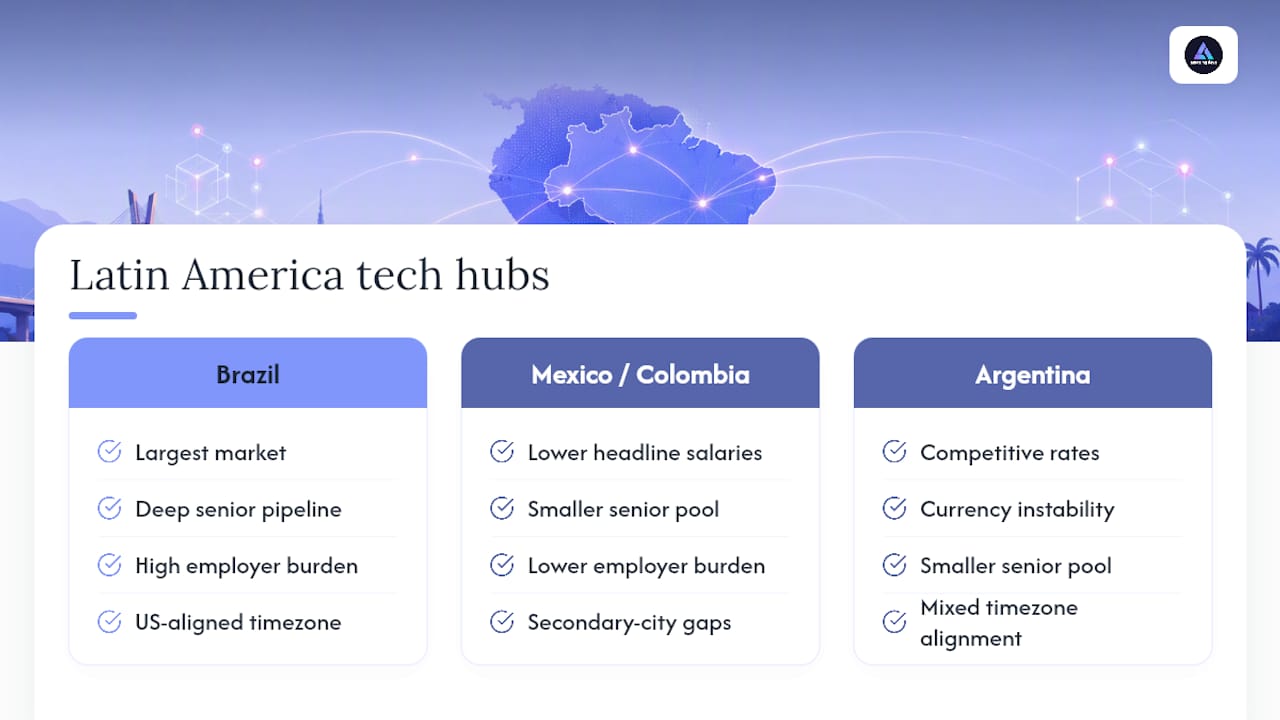
Brazil isn’t the cheapest Latin American market for developer talent, and it doesn’t need to be. It’s the largest, with the deepest bench of mid-level and senior engineers, and its CLT framework produces some of the highest employer burden rates in the region because of the stacked statutory contributions covered above.
Mexico and Colombia often quote lower headline base salaries in secondary cities, but the gap narrows once you account for Brazil’s stronger senior-engineer pipeline and its timezone alignment with US business hours on the East Coast and in Chicago. Argentina has historically offered competitive rates too, though currency instability there has made long-term budget planning harder than in Brazil, where FX volatility exists but tends to be less extreme.
For US employers, the practical takeaway isn’t “Brazil is cheaper” or “Brazil is more expensive” than its regional neighbors. It’s that Brazil offers the deepest talent pool for specialized roles like data engineering and machine learning, at a cost structure that’s transparent once you’ve built the itemized model. Buyers evaluating multiple Latin American markets should request the same itemized breakdown from every country they consider, since headline salary comparisons across borders hide wildly different statutory and tax assumptions.
Why Inflation and the Real’s Swings Move Your Budget
Brazil’s inflation history means BRL-denominated salaries adjust more frequently than US employers might expect. Annual raises tied to inflation indices are common practice, and a developer’s BRL salary that looked competitive last year can require a raise conversation this year purely to keep pace with the cost of living, independent of performance.
The bigger budgeting risk for US buyers isn’t inflation itself. It’s currency movement. Because most Brazilian salaries are negotiated and paid in BRL, a swing in the exchange rate can shift your USD-denominated cost by a meaningful margin between when you build a headcount plan and when you actually sign a contract. This is exactly why the FX buffer step in the benchmarking process matters: a budget built on a single point-in-time exchange rate is fragile.
Cost of living also varies sharply by city, which is part of why São Paulo salaries run higher than Recife or Florianópolis. Developers in more expensive metros need higher nominal pay to maintain equivalent purchasing power, and that dynamic feeds directly into the location differentials covered earlier in this guide. If you’re hiring in multiple Brazilian cities, price each one separately rather than applying a single national average.
What’s Actually Included in a Brazilian Developer’s Package
Salary is only part of what a CLT employee in Brazil expects, and the benefits stack is more standardized than in most US hiring markets. Paid vacation of 30 days annually, plus the one-third vacation bonus mentioned earlier, is a legal requirement, not a perk employers can trim.
Beyond the statutory minimums, competitive employers typically add: private health insurance (since public healthcare wait times push most professionals toward private plans), meal or food vouchers (vale-refeição or vale-alimentação), transportation allowances, and increasingly, a home-office stipend given how common remote work has become in Brazilian tech. Many companies also offer a profit-sharing bonus (PLR), which is tax-advantaged under Brazilian law and has become a standard retention tool for mid-level and senior engineers.
None of these are optional extras in a serious offer. A developer comparing two offers with identical base salaries will weigh the benefits package heavily, and a package missing health insurance or a PLR bonus will read as noticeably weaker to a Brazilian candidate, even if the raw BRL number looks competitive on paper. Employers modeling total cost should treat these benefits as a real budget line, not an afterthought bolted onto the CLT statutory calculation.
The Budgeting Mistake Most Employers Repeat
Every employer researching Brazil developer salaries eventually finds three different numbers for what looks like the same role, and most never figure out why. The honest answer is that nobody’s lying. Levels.fyi, Código Fonte, and vendor benchmark pages are each measuring something legitimately different, and the SERP results rarely say so out loud.
A flat percentage hides whether you’re accounting for termination exposure as a real cost or a contingent one, whether Sistema S rates apply to your CNAE, and whether your FX assumption survives a currency swing between quote and signature. Those aren’t rounding errors. They’re the difference between a budget that holds and one that gets revised mid-quarter.
If you take one thing from this guide, make it this: decide your measurement type before you look at a single number. Base salary for offer letters, vendor all-in for procurement budgets, total comp only when you’re benchmarking against other engineers’ self-reported packages. Get that sequencing backward, and every other calculation downstream inherits the error.
— Gabriel
Get an Itemized Brazil Hiring Quote From Amazing Devs
Some providers offer an alternative to running your own CLT payroll setup or piecing together a contractor arrangement yourself by providing one itemized quote that accounts for the statutory costs covered in this guide.
Amazing Devs handles sourcing, technical and cultural fit assessment, and the contract and payroll complexity that trips up first-time Brazil buyers, whether you need a single nearshore staff augmentation hire or an ongoing team extension engagement. Contract management and bureaucratic navigation are handled on your behalf, so the number you see is the number you budget against. Request a quote and see what an itemized Brazil hire actually costs for your specific role and timeline.
Where These Numbers Come From
- Hire employees in Brazil (OysterHR): breaks down statutory payroll components including INSS, FGTS, and termination exposure.
- Brazil payroll employment costs (GlobalSoftwareCompanies): worked sensitivity model for total employer cost uplift.
- Levels: total-compensation benchmark dataset.
- Cost of employment in Brazil (Multiplier): employer cost multiplier estimates and regional context.
- Pesquisa Salarial de Programadores (Código Fonte TV): BRL salary survey by seniority level.
Consult these primary sources directly for contract-level modeling, since your specific role, entity structure, and location will shift the exact figures.
Sources
- Hire employees in Brazil — OysterHR
- Brazil payroll employment costs: Salary, benefits, CLT, & total cost — GlobalSoftwareCompanies
- Levels
- Brazil Software Engineer Salary & Hiring Cost Benchmarks 2026 — Howdy
FAQ
What Is Considered a Good Salary for a Developer in Brazil?
A good salary depends heavily on city and seniority, but a senior developer earning toward the top of the $58,000 to $78,000 all-in range is well-positioned relative to Brazil’s overall cost of living, even in São Paulo. Outside major metros, that same income stretches considerably further.
Which Kind of Engineer Commands the Highest Pay in Brazil?
Specialized roles in data engineering, machine learning, and security consistently command a premium over general backend or frontend work, since demand for AI and data talent has grown faster than the supply of engineers with production experience in those areas. Six-figure USD packages remain rare even at the senior end of these specialties, but they sit meaningfully above standard senior developer ranges.
Can a Developer Live Comfortably on $3,000 a Month in Brazil?
Yes, in most Brazilian cities outside São Paulo’s most expensive neighborhoods, a monthly income that covers a comfortable lifestyle including housing, private health insurance, and discretionary spending. That figure sits well above the median monthly income for mid-level developers reported in local salary surveys.
Is $1,000 a Month Considered a Lot of Money in Brazil?
an income above Brazil’s national minimum wage that can cover basic living costs in most secondary cities, though it sits below typical mid-level developer pay. For context, junior developer packages in this guide start well above that threshold once benefits are included.
How Do I Convert Brazilian Salary Data Into a US Hiring Budget?
Start by choosing whether you’re working from base salary, total compensation, or vendor all-in pricing, then build an itemized BRL cost model before converting to USD with an FX buffer. Amazing Devs can provide that itemized breakdown directly as part of a staffing quote, removing the guesswork from the conversion step.