Access Tier Background Checks: 4 Essential Screens for Developer Hires
For a software developer hire, run four checks at minimum: identity verification, employment history, education or credential verification, and criminal record searches tied to every address in the candidate’s history. If you’re using a third-party consumer reporting agency, the Fair Credit Reporting Act applies regardless of whether the person is an employee or a contractor, which means disclosure and written consent come before the report, not after.
TL;DR:
- Identity verification is essential for all developers to prevent synthetic identities and confirm candidate authenticity before any access is granted.
- Checks for employment history and technical references are crucial, especially for mid- to senior-level roles with system access, to verify actual responsibilities and skills.
- For roles with high system access or sensitivity, incorporate federal criminal searches, sanctions screening, and verify education only if role-specific or legally required.
- International candidates require localized consent forms, source verification, and longer verification timelines, often ranging from one to six weeks depending on the country.
- Background checks must be conducted after a conditional offer, with proper FCRA compliance, and tailored to access levels, never before extending a finalized job offer.
Table of Contents
- What Checks Actually Matter for Developer Background Screening
- How Do You Scope Checks by Access Level and Role?
- Hiring Developers Abroad: What Changes for International Candidates
- FCRA, Contractors, and Staffing Agencies: The Legal Must-Dos
- A Step-by-Step Workflow for Running Developer Background Checks
- Amazing Devs’ Approach to Developer Screening
- Get Vetted Developers Without Building a Screening Process From Scratch
- Where to Go Deeper on Developer Screening Compliance
- Sources
- FAQ
What Checks Actually Matter for Developer Background Screening
Developers touch source code, customer data, and sometimes production systems on day one. That access profile changes which checks are worth your money and which ones just add friction.
Identity verification confirms the person applying is the person who shows up for onboarding, using a Social Security number trace and address history. It’s the foundation every other check builds on, and it catches synthetic identities and stolen credentials before they get anywhere near your repositories.
Employment verification and technical reference checks matter more for developers than almost any other check on the list. Resume inflation is common in tech: candidates claim “led the migration to microservices” when they touched one config file. A structured reference call with a former engineering manager, asking specifically what the candidate owned versus what the team owned, catches this fast.
Education and certification verification only matters when the role or client contract requires a specific degree or certification. A lot of strong developers are self-taught, and requiring a computer science degree for a mid-level backend role filters out good candidates without reducing risk. Verify it when a client mandate or compliance requirement demands a degree, and skip it otherwise.
Criminal searches should follow the candidate’s actual address history, not just their current zip code, since county court records don’t consolidate nationally the way many employers assume. A multi-jurisdiction search mapped to seven years of residential history catches records a single-county search misses entirely.
Add-on checks depend on the role. A motor vehicle record check makes sense for zero developers. A credit check makes sense only for finance-system roles with direct payment access. Sanctions and watchlist screening matters when the developer will touch export-controlled code or work with regulated financial data.
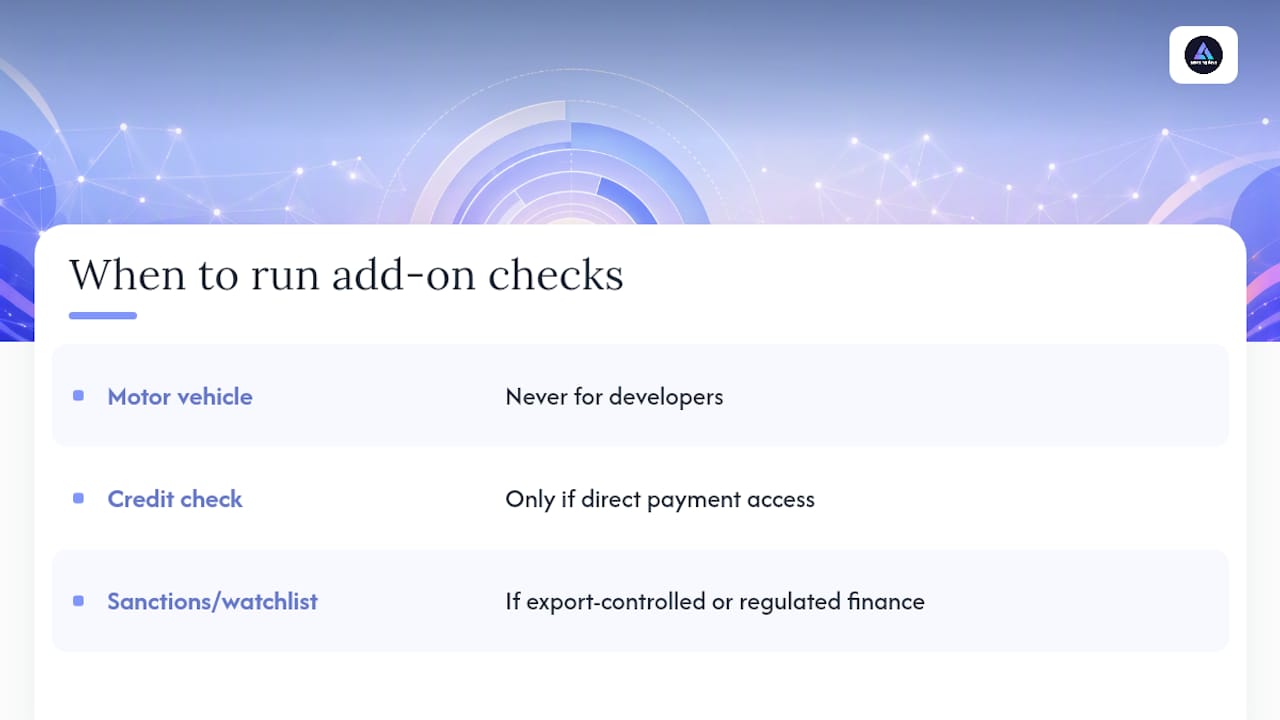
Pro Tip: Skip the credit check unless the developer has direct, unsupervised access to payment processing or financial disbursement systems. Running one on a frontend developer is a common compliance overreach that adds cost without reducing real risk.
How Do You Scope Checks by Access Level and Role?
Not every developer needs the same screening package, and treating a junior frontend contractor the same as a senior engineer with production database access wastes budget on one and under protects you on the other. Access level, not job title, should drive the decision.
- Low access — Frontend developers, junior engineers on sandboxed environments, no production credentials. Minimum package: identity verification, employment verification, single-state criminal search.
- Medium access — Backend developers, DevOps engineers with staging access, anyone touching customer PII in a non-production environment. Add: multi-jurisdiction criminal search, education verification if role-specific, technical reference checks.
- High access — Senior engineers with production database access, anyone with admin credentials to client systems, developers on financial or healthcare platforms. Add: federal criminal search, sanctions/watchlist screening, and for contractor engagements, a signed data-handling agreement reviewed alongside the background report.
Document the tiering decision in writing, tied to the role’s actual system permissions rather than the job title, and require the same tiering framework from any staffing vendor supplying you contractors. The BIB screening guidance recommends this access-based approach specifically because a default one-size package either over-screens low-risk roles or under-screens high-risk ones.
Pro Tip: Ask your staffing vendor to show you their tiering framework before signing, not after. If they can’t explain why a QA contractor and a senior backend engineer get the same package, that’s a gap you’ll inherit.
Hiring Developers Abroad: What Changes for International Candidates
Screening a developer in São Paulo or Warsaw is not the same process as screening one in Ohio, and treating it that way is where most compliance failures start.
- Consent forms need to be translated and localized, not just run through a translation tool, because a form that doesn’t meet local legal standards can void the consent entirely.
- Privacy law compliance shifts by country. Brazil’s LGPD and the EU’s GDPR impose stricter rules on data handling and storage than U.S. law does, and a violation exposes both the employer and any staffing vendor involved.
- There’s no single global database that replicates what a U.S. criminal record search does domestically. Verification has to happen at the source: contacting the university directly, confirming licensure with the issuing body, and running watchlist screening separately.
- Turnaround stretches. Domestic checks often complete in 24 to 48 hours for standard searches, but international verification can take one to six weeks depending on the country and how responsive the local institutions are.
Set expectations with hiring managers before the requisition opens. Nothing frustrates a hiring manager faster than a great candidate stuck in verification limbo for a month with no explanation. For teams building nearshore teams specifically, remote-working arrangements and contractor payment compliance both intersect with the screening timeline, so plan them together rather than sequentially.
FCRA, Contractors, and Staffing Agencies: The Legal Must-Dos
The single most common compliance mistake employers make is assuming FCRA doesn’t apply because the developer is a 1099 contractor, not a W2 employee. It applies whenever a third-party consumer reporting agency runs the check and the report factors into a hiring decision.
FCRA requires standalone disclosure separate from the job application, written consent before the report is pulled, a pre-adverse action notice with a copy of the report and the Summary of Rights if you’re leaning toward rejection, a reasonable waiting period, and a final adverse-action notice if you proceed with the rejection.
The steps in sequence:
- Provide standalone disclosure and get signed, written consent before ordering any report.
- If results raise concerns, send pre-adverse action notice with the report attached and the FCRA Summary of Rights.
- Wait a reasonable period, typically five business days, before finalizing the decision.
- Send the adverse-action notice if you proceed with rejection.
Classifying someone as a contractor doesn’t erase negligent-hiring exposure either. If a screen would have surfaced a relevant risk and you skipped it, you’re still exposed. When you rely on a staffing agency for contractors, get written certification of their screening standards, and reserve the right to run independent checks on any high-access placement.
A Step-by-Step Workflow for Running Developer Background Checks
Run background checks after the conditional offer, not before. Pulling a report pre-offer invites bias claims and wastes money on candidates who’d decline anyway.
- Extend a conditional offer, contingent explicitly on passing the background check.
- Provide disclosure, obtain written consent, and order the appropriate tier of checks the same day.
- Set access provisioning to trigger only after checks clear. Never give repository or system credentials before results come back.
- Track turnaround against expectations: domestic checks typically clear within a few business days, international checks can run several weeks.
- Route results through a documented adjudication process with clear pass/fail criteria and a named sign-off authority, not an ad hoc judgment call from whoever’s available.
Pro Tip: Build a standard adjudication rubric before you run your first check, not after a borderline result forces you to invent criteria on the spot under time pressure.
Amazing Devs’ Approach to Developer Screening
A provider can run technical and cultural fit assessment alongside standard screening for developers, handling the sourcing, vetting, and contracting so hiring teams don’t manage that process alone. Clients with high-access roles or regulated data should still layer on their own checks, since vendor-managed screening covers general fit and baseline verification, not every industry-specific requirement a client’s compliance team might need.
— Gabriel
Get Vetted Developers Without Building a Screening Process From Scratch
Running FCRA-compliant screening in-house, especially for international candidates, eats weeks of HR time you probably don’t have. Amazing Devs’ nearshore staff augmentation service handles the sourcing, technical and cultural fit assessment, and contract logistics before a Brazilian developer ever reaches your onboarding checklist.
That’s the concrete trade: instead of standing up your own international consent workflow, translated disclosure forms, and a six-week verification timeline, you get pre-assessed candidates ready for a technical interview. If you need one developer integrated into an existing team long-term rather than a full placement, the Team Extension Model fits that pattern instead. Either way, high-access roles handling sensitive client data still warrant your own supplemental checks. Reach out through Amazing Devs to talk through which model fits your next hire, and get a shortlist moving this week instead of next month.
Where to Go Deeper on Developer Screening Compliance
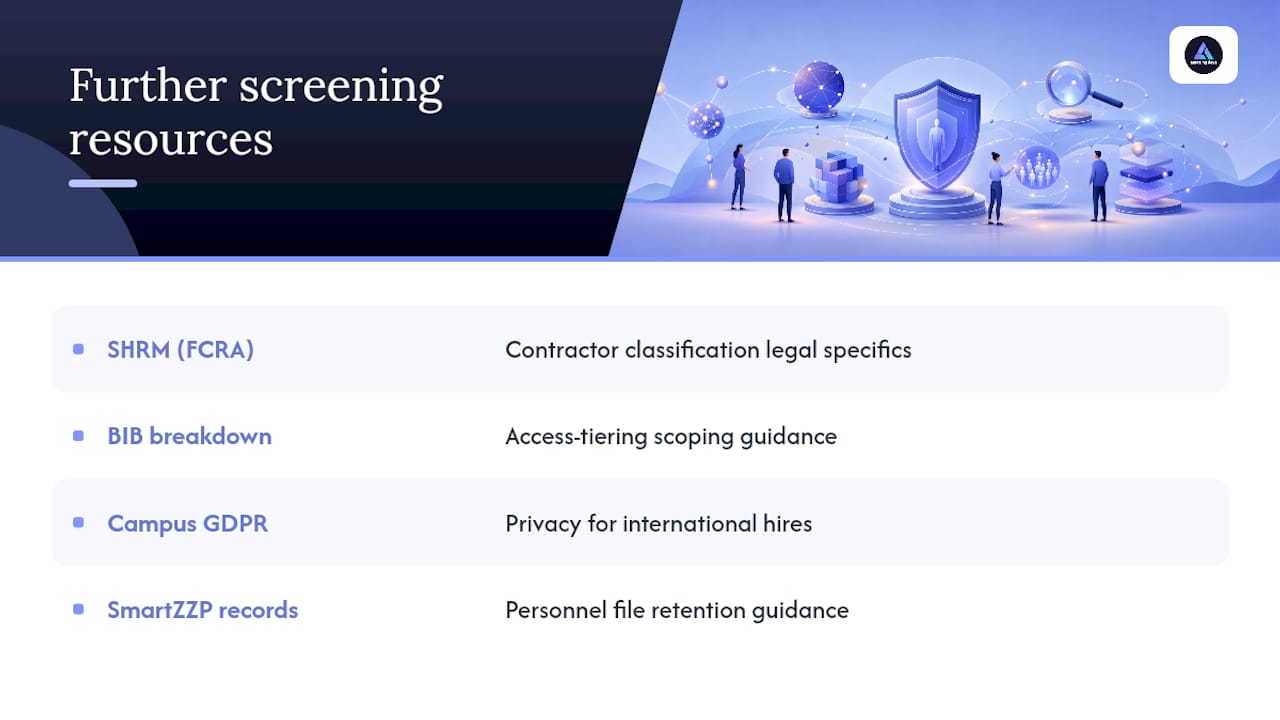
For the legal specifics on contractor classification, SHRM’s FCRA guidance is the clearest primary reference. For scoping decisions, BIB’s contractor screening breakdown covers access-tiering in more detail. For privacy compliance on international hires, consult Campus Consulting’s GDPR resource, and for record retention practices, see SmartZZP’s personnel file guidance.
Sources
- SHRM: FCRA and independent contractors
- Background checks for contractors: what employers need to know — BIB
- International background checks: what you need to know for global hiring – INSTAHIRE Check
- deepidv background checks — vendor features and turnaround claims
FAQ
Does FCRA Apply to Contract Developers?
Yes. FCRA applies whenever a third-party consumer reporting agency runs the check and the results factor into a hiring or engagement decision, regardless of whether the developer is classified as a contractor or employee. Standalone disclosure and written consent are required either way.
How Long Does a Developer Background Check Take?
Domestic checks for identity, employment, and criminal history typically complete within 24 to 48 hours for many searches. International checks take considerably longer, often one to six weeks depending on the country’s verification infrastructure.
What’s the Minimum Background Check for a Software Developer?
At minimum, run identity verification, employment history confirmation, and a criminal search covering every address in the candidate’s residential history. Higher-access roles need federal criminal searches and sanctions screening added on top.
Do I Need to Background Check International Developers Differently?
Yes. International hires require localized, translated consent forms, source-level verification of degrees and employment since no single global database covers this, and compliance with local privacy laws like LGPD or GDPR depending on the candidate’s country.
Can a Staffing Vendor Handle Developer Screening for Me?
Vendors like Amazing Devs manage sourcing, technical assessment, and baseline vetting as part of nearshore staff augmentation, which removes most of the operational burden. Employers with high-access or regulated roles should still confirm the vendor’s screening scope and layer on any checks their own compliance policy requires.