Brazilian work culture runs on relationships, not schedules. It’s high-context, hierarchical, and far more flexible with time than most Western offices expect, and the single biggest predictor of success is whether you invest in personal rapport before you push for output. Brazilian employees typically work close to the legal cap of 44 hours a week, but the hours matter less than how you spend the first ten minutes of a meeting.
If you skip the small talk and jump straight to the agenda, you haven’t saved time. You’ve signaled that the relationship doesn’t matter, and in Brazil, that’s the thing everything else depends on.
Before your next call with a Brazilian colleague or team, keep these in mind:
- Rapport comes before task talk, every time.
- Feedback is almost always indirect and private.
- Deadlines are targets, not contracts.
Pro Tip: Open your next email or call by asking about the person’s weekend or family before mentioning the project. It reads as respect, not delay.
Key Takeaways
Success working with Brazilian colleagues depends on prioritizing personal rapport, reading indirect communication accurately, and building legal and cultural groundwork before day one.
| Point | Details |
|---|---|
| Relationships come first | Invest in small talk and personal rapport before pushing tasks or deadlines. |
| Communication is indirect | Watch for soft phrases like “we’ll try” that often signal a polite no. |
| Hierarchy shapes decisions | Build buy-in privately with senior stakeholders before group meetings. |
| Time is flexible, not absent | Build buffer time into schedules while respecting the legal 44 hour workweek cap. |
| Visas require multiple steps | Expect residence authorization, a consular visa, and Federal Police registration. |
Table of Contents
- What Defines Brazil Work Culture at Its Core
- How Do Brazilians Communicate at Work?
- How Does Hierarchy Shape Decisions in Brazil?
- Why Is Time So Flexible in Brazilian Workplaces?
- What Should You Know About Meeting Etiquette in Brazil?
- How Do You Give Feedback to Brazilian Colleagues?
- What Are Brazil’s Work Hours and Visa Basics?
- What Is Jeitinho Brasileiro and Why Does It Matter?
- Do Workplace Norms Vary Across Brazil?
- How Do You Manage Remote Teams With Brazilian Colleagues?
- How Do You Hire and Onboard Brazilian Developers Successfully?
- What Does Diversity and Inclusion Look Like in Brazilian Workplaces?
- How Do Gender Roles Play Out in Brazilian Offices?
- What Does Work-Life Balance Actually Look Like in Brazil?
- How Does Brazil’s Economy Shape Its Workplace Culture?
- Building Distributed Teams the Right Way
- A Manager’s Take on Working With Brazilian Teams
- Sources
- FAQ
What Defines Brazil Work Culture at Its Core
Four traits show up again and again in Brazilian offices, from startups in São Paulo to manufacturing plants in the south. Understanding them upfront saves you from misreading normal behavior as unprofessionalism.
Relationships come first. Brazilians tend to do business with people they trust, not just people who show up with the right proposal. Commisceo Global’s guide to doing business in Brazil notes that investing time in small talk and hospitality is often essential just to make business progress at all, not a nice extra.

Communication runs high-context. Meaning lives in tone, timing, and what’s left unsaid as much as in the words themselves. A colleague who says “we’ll try” is often saying no, politely.
Hierarchy is real but not cold. Managers hold clear authority, and most Brazilian workplaces still expect deference to seniority. But leadership style leans paternalistic: bosses are expected to know their employees personally and show genuine concern for their lives outside work.
Time bends around relationships. Deadlines exist, but a meeting running fifteen minutes over because someone’s catching up on a colleague’s new baby is normal, not a failure of discipline. Alongside this flexibility sits a strong, often underestimated work ethic: long hours and hard work are common, especially in tech and multinational firms.
- Rapport is the foundation, not a courtesy.
- Context and tone carry more weight than literal wording.
- Authority is respected, but leaders are expected to be personally invested.
- Time is elastic around people, not around tasks.
How Do Brazilians Communicate at Work?
Spoken and written communication in Brazil often look like two different cultures. In person, colleagues are warm, expressive, and quick to soften disagreement. A blunt “no” rarely happens. Instead you’ll hear phrases like “vamos ver” (let’s see), “pode ser” (it could be), or “vou pensar” (I’ll think about it), which usually mean the answer leans toward no without saying so directly.
Written communication, especially formal email, tends to be more structured and polite than the spoken equivalent, though Slack and WhatsApp messages between trusted colleagues loosen back up fast. Talaera’s guide to Brazilian work culture points out that feedback in particular follows this pattern: delivered indirectly, and almost always in private rather than group settings.
For cross-cultural communicators, a few habits go a long way:
- Do ask open questions (“What would it take to hit this deadline?”) instead of yes/no questions that invite a soft, non-committal answer.
- Do follow up verbal agreements with a short written recap to confirm what was actually decided.
- Don’t interpret hesitation or a vague “maybe” as agreement.
- Don’t call out disagreement or mistakes in front of the group.
Frameworks like Erin Meyer’s Culture Map help explain why this indirectness reads as evasive to low-context cultures when it’s actually a relationship-preserving habit.
How Does Hierarchy Shape Decisions in Brazil?
Brazilian organizations tend to be top-down. Decisions usually flow from senior leadership, and junior staff often hesitate to openly challenge a manager’s call, even when they privately disagree. This isn’t passivity. It reflects real respect for seniority and a leadership style that mixes clear authority with personal warmth, what Commisceo Global describes as an approachable, paternalistic management style where leaders are expected to direct and to care.
For foreign managers, this means buy-in often has to be built one-on-one, before a group meeting, not during it. Save open debate for smaller settings. Loop in senior stakeholders early if you need a decision to stick, since a junior employee agreeing in a meeting doesn’t guarantee their manager will back it later.
- Build consensus privately before big group decisions.
- Involve the right senior person early, not after the fact.
- Give feedback to junior staff privately, never in front of peers.
Pro Tip: If a Brazilian colleague seems to agree too quickly in a meeting, follow up privately afterward. That’s often where the real answer surfaces.
Why Is Time So Flexible in Brazilian Workplaces?
Time-fluidity is one of the most misunderstood parts of Brazil work culture. A meeting scheduled for 30 minutes might run an hour because relationship maintenance takes priority over the clock, and newcomers often mistake this for a lack of discipline when it’s actually a cultural choice about what matters first.
Legally, the standard workweek is capped at 44 hours, with employees typically averaging around 40 and any additional time treated as overtime. In practice, especially in cities like São Paulo, the workday often starts later than in North American or European offices, then stretches later into the evening.
- Build 10 to 15 minutes of buffer into scheduled meetings.
- Set internal deadlines a few days ahead of the real one.
- Confirm hard deadlines explicitly in writing, since “flexible” doesn’t mean “optional.”
What Should You Know About Meeting Etiquette in Brazil?
Meetings in Brazil rarely start with the agenda. Expect 5 to 15 minutes of genuine personal conversation first, about family, weekend plans, or local news, before anyone opens a laptop. Skipping this isn’t efficient. It reads as cold.
Greetings tend to be warm: a firm handshake for new business contacts, sometimes a cheek kiss or hug once a relationship is established. Business cards are still exchanged, usually with both hands and a moment of acknowledgment rather than a quick pocket. Dress in major cities leans stylish and professional, not overly formal.
- Do build small talk into your meeting invite’s time slot, not squeeze it out.
- Do dress a notch sharper than you might for a similar meeting elsewhere.
- Don’t schedule back-to-back meetings with zero buffer.
- Don’t treat a written agenda as more important than the relationship in the room.
How Do You Give Feedback to Brazilian Colleagues?
Direct, public criticism lands badly in Brazil. Feedback tends to be delivered privately, softened in tone, and framed as development rather than correction, protecting the relationship even when the message is critical.
Instead of “this report has errors,” try “let’s look at this together, I think we can make it stronger.” Frame corrections as growth, not blame, and always deliver them one-on-one.
To get candid input back, ask specific, low-stakes questions rather than open-ended ones: “What’s one thing that would have made this easier?” tends to surface more honesty than “any feedback?”
- Give critical feedback privately, never in group settings or copied emails.
- Frame it around growth and next steps, not what went wrong.
- Ask specific questions to invite detail instead of a polite “it’s fine.”
What Are Brazil’s Work Hours and Visa Basics?
Brazil’s legal standard workweek tops out at 44 hours, with most employees averaging closer to 40 and overtime governed by labor law. Vacation and severance protections under Brazil’s CLT framework also shape how employers structure contracts and headcount.
For foreigners, work authorization is rarely a single step. Most professionals need employer-sponsored authorization under CLT rules, with the digital nomad visa (VITEM XIV) as a narrower exception for remote employees of foreign companies who meet specific income and documentation requirements. The process itself typically runs through residence authorization, a consular visa if applying from abroad, and Federal Police registration after arrival to get the official foreigner ID.
- Confirm which route applies: CLT sponsorship versus VITEM XIV eligibility.
- Prepare corporate documentation early, since incomplete filings are the top cause of delay.
- Expect a multi-step timeline, not a single approval.
Pro Tip: A clean, complete submission through the government’s MigranteWeb portal is the single biggest lever for avoiding processing delays, according to legal guidance on Brazil’s work permit process.
What Is Jeitinho Brasileiro and Why Does It Matter?
Jeitinho brasileiro is the Brazilian habit of finding a creative, informal workaround when the official path is slow or blocked. A supplier missing a signature might get a project moving anyway through a personal favor. A client stuck on paperwork gets a manager’s direct cell number instead of waiting in a queue.
Used well, jeitinho reflects real adaptability and resourcefulness under pressure. Used carelessly, it can slide into cutting corners on compliance or contracts.
- Do appreciate creative problem-solving when it saves a deal without breaking rules.
- Don’t let informal shortcuts replace documented agreements on anything contractual or legal.
Do Workplace Norms Vary Across Brazil?
Don’t treat Brazil as culturally uniform. São Paulo runs fast and business-focused; Rio blends professionalism with a more relaxed social rhythm; Brasília, as the political capital, leans formal; smaller interior cities tend to be more traditional and relationship-heavy than any of them.
Sector matters too. Tech companies and multinational offices are usually more schedule-driven and closer to global norms. Local SMEs and family-run businesses lean harder into personal relationships and slower, hierarchy-driven decisions.
- Adjust your pace and formality by city and by sector, not by a single national assumption.
How Do You Manage Remote Teams With Brazilian Colleagues?
Distributed teams lose the hallway conversations that build trust in Brazilian offices, so you have to recreate them on purpose. Talaera’s research on Brazilian work culture recommends replacing in-person rapport with deliberate rituals rather than assuming Slack messages will fill the gap.
- Open every recurring meeting with a five-minute personal check-in before the agenda.
- Schedule a recurring “virtual coffee” with no work agenda at all, once every week or two.
- Add a non-work call to the calendar periodically, just to talk.
- Paste a rapport-building line directly into meeting invites: “First 5 minutes: how’s everyone doing?”
Practical remote work guidance for distributed teams backs this pattern up consistently.
Pro Tip: On video calls, keep cameras on whenever possible. Tone and facial expression carry a huge share of meaning in high-context communication, and losing them over audio-only calls is where misunderstandings start.
How Do You Hire and Onboard Brazilian Developers Successfully?
Cultural fit and legal groundwork both need attention before day one, not after problems show up.
- Screen for Portuguese and English proficiency during interviews, and use scenario-based prompts to test cultural fit, not just technical skill.
- Verify documentation and confirm the contract type upfront: CLT employment versus a remote/contractor arrangement changes obligations significantly.
- Set a 30/60/90 day onboarding plan: days 1 to 30 focus on relationship-building and tool access, days 30 to 60 on real project ownership, days 60 to 90 on independent delivery.
- Watch for payroll quotas, tax residency triggers, and dependencies tied to employer sponsorship before they become compliance issues.
Strong soft skills screening during hiring catches cultural mismatches early, when they’re cheap to fix instead of expensive to unwind six months in, as detailed in this international hiring and employer compliance resource.
What Does Diversity and Inclusion Look Like in Brazilian Workplaces?
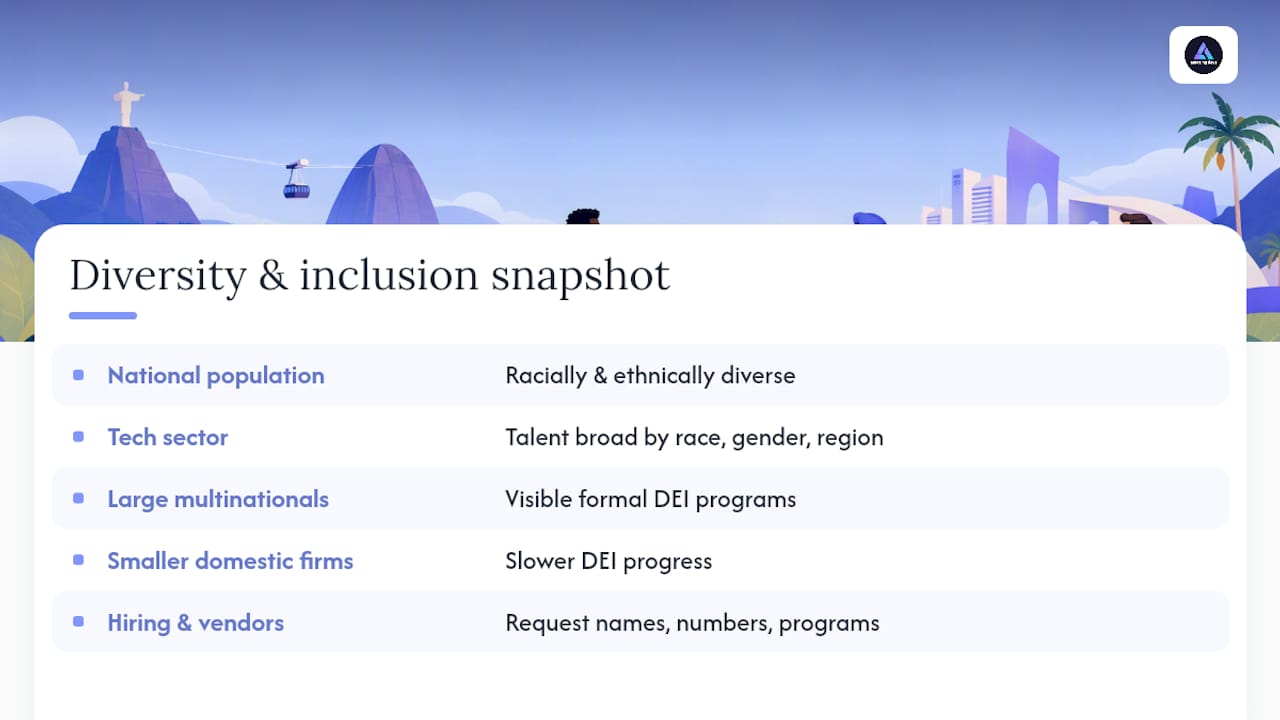
Brazil is one of the most racially and ethnically diverse countries on earth, but that diversity doesn’t automatically translate into equal representation in corporate leadership. Larger multinationals and tech companies have made visible progress on formal diversity, equity, and inclusion programs over the past decade, often modeled on global parent-company standards. Smaller domestic firms and traditional industries move slower.
Race, class, and regional origin all intersect in ways that shape who gets hired and promoted, more visibly than in many Western markets. Executive teams in large Brazilian corporations still skew disproportionately white and male relative to the country’s population, even as public conversation around equity has grown louder.
For foreign managers building distributed teams, this cuts both ways. Brazil’s tech talent pool is genuinely broad across race, gender, and geography, especially outside the traditional São Paulo and Rio corridors, but you shouldn’t assume a company’s stated diversity commitments match daily practice without asking direct questions during vendor or hiring conversations.
If inclusion matters to your engineering culture, ask specific questions: How diverse is the current engineering team? Are there formal mentorship or advancement pathways? Vague answers usually mean the commitment is aspirational rather than structural. Specific answers, with names, numbers, or programs attached, are the better sign.
How Do Gender Roles Play Out in Brazilian Offices?
Brazilian workplaces have grown more progressive on gender over the past two decades, but traditional expectations haven’t disappeared. Women make up a substantial share of the university-educated workforce and hold growing numbers of mid-level management roles, particularly in tech, finance, and services.
Senior leadership still tells a different story. Executive and board-level positions remain disproportionately held by men, and the gap widens the further up the org chart you look, a pattern that echoes trends across much of Latin America rather than something unique to Brazil.
Workplace dynamics can carry traditional undertones, especially in more conservative sectors or smaller interior cities: expectations around appearance, deference in meetings, and informal social roles at work events sometimes reflect older gender norms even in otherwise modern companies.
For foreign managers, this means paying attention to how meetings actually run, not just who’s in the room. If a woman on a Brazilian team is consistently talked over or her ideas get credited to someone else, that’s worth addressing directly rather than assuming it will self-correct. Setting clear norms around speaking turns and credit in kickoff meetings helps distributed teams avoid importing this pattern by accident.
What Does Work-Life Balance Actually Look Like in Brazil?
Work-life balance in Brazil is a study in contrasts. The culture places real value on family time, long lunches, and social connection, yet the standard workweek still runs close to the legal 44-hour ceiling, and long hours are common in competitive sectors like tech, finance, and law.

What differs from a North American or Northern European model is where the flexibility shows up. Brazilians are far more likely to step away for an extended lunch, attend a child’s school event mid-afternoon, or leave slightly early for a family obligation, then make the time up later or the next day. The boundary isn’t rigid clock-in, clock-out discipline. It’s a looser give-and-take that assumes personal life and work life constantly overlap.
Vacation time (férias) is legally protected and, unlike in some other markets, genuinely taken. A Brazilian employee’s annual leave isn’t treated as optional or something to bank indefinitely. Expect colleagues to fully disconnect during their time off rather than checking email from the beach.
For foreign managers, the practical lesson is this: don’t measure commitment by rigid hours logged. A developer who leaves at 4 p.m. for a family commitment and logs back on at 9 p.m. isn’t slacking. Judge by delivery and communication, not by strict adherence to a 9-to-5 template that doesn’t map onto local norms anyway.
How Does Brazil’s Economy Shape Its Workplace Culture?
Brazil’s economic volatility over the past few decades, cycles of inflation, currency swings, and periods of political uncertainty, has shaped a workforce that values stability and personal networks as a hedge against unpredictability. When formal institutions feel unreliable, relationships become the backup system, which partly explains why rapport-building carries so much practical weight in Brazilian business.
This history also shapes risk tolerance. Brazilian companies and employees often favor negotiated, flexible solutions over rigid, contract-only approaches, because rigid systems have periodically failed to protect people during past economic disruptions. That’s part of the cultural root of jeitinho brasileiro, not just a personality quirk but a practical response to institutions that haven’t always worked smoothly.
Labor law itself reflects this context. Brazil’s CLT framework includes strong worker protections, like mandatory vacation and severance rules, that came from decades of labor advocacy responding to real economic instability. These protections raise the cost and complexity of formal hiring, which is part of why staff augmentation and nearshore arrangements have grown popular as a way to access Brazilian talent without absorbing every layer of that complexity directly.
Social inequality also shapes workplace access unevenly. Quality education and English proficiency correlate strongly with income and region, which means the most competitive tech talent tends to cluster in and around major urban centers rather than spreading evenly across the country.
Building Distributed Teams the Right Way
Getting Brazil work culture right on paper is one thing. Actually screening for cultural fit, managing a CLT contract, and staying ahead of visa and payroll compliance is a different job entirely, and it’s easy to underestimate until you’re mid-hire and stuck.
Amazing Devs specializes in nearshore staff augmentation with Brazilian developers, built specifically around this gap. The process pairs technical vetting with cultural fit assessment so you’re not learning the hard lessons in this guide on your own team’s time. Contract management and bureaucratic navigation are handled directly, which matters given how many steps the Brazilian work authorization process actually involves.
For businesses evaluating whether nearshore or offshore staffing fits their engineering roadmap, the comparison between nearshore and offshore outsourcing lays out the tradeoffs in scheduling overlap, communication, and long-term cost. Companies that need to scale an engineering team without wading through visa filings, payroll quotas, and cultural onboarding from scratch can start with Amazing Devs’ outsourcing services.
A Manager’s Take on Working With Brazilian Teams
Most guides to Brazilian work culture treat hierarchy, time-fluidity, and indirect feedback as quirks to tolerate. That framing gets it backward. These aren’t obstacles standing between you and productivity. They’re the actual mechanism productivity runs on in Brazil, and treating them as friction to minimize is exactly how foreign managers sabotage their own teams.
The conventional advice tells you to “be patient” with meeting small talk or “adjust” to indirect feedback, as though these are concessions you’re generously making. The more useful mindset is to recognize that skipping rapport-building doesn’t save time, it just moves the cost downstream into misunderstandings, quiet disengagement, or turnover you won’t see coming until it’s expensive.
If there’s one thing to prioritize above all else, it’s this: stop measuring a Brazilian colleague’s professionalism by how closely their communication style matches yours. A “we’ll try” isn’t wishy-washy. It’s information, delivered the way trust requires it to be delivered here. Learn to read it, and half the friction in cross-cultural management disappears on its own.
This article is general information, not a substitute for advice from a qualified lawyer. Consult a qualified legal professional about your own circumstances before acting on anything here.
Sources
- Prospects
- Brazilian Work Culture: A Guide for Global Teams | Talaera
- Brazil work permit requirements, types and process | Legal Clarity
- Brazil work permits and work visas 2026: the complete guide | Baby in Brazil
- Doing Business In Brazil: Business Culture Guide | Commisceo Global
FAQ
What Is the $2,000 Rule in Brazil?
There’s no official “$2,000 rule” tied to Brazilian labor law or visas. It’s an informal benchmark some expats use to describe a comfortable monthly cost of living in mid-sized Brazilian cities, though actual costs vary widely by region and lifestyle.
Is $3,000 a Month a Lot of Money in Brazil?
Yes, relative to local wages, $3,000 USD a month puts someone well above typical Brazilian salaries in most cities, including São Paulo and Rio de Janeiro, and covers a comfortable lifestyle outside the most expensive neighborhoods.
Can You Live on $2,000 a Month in Brazil?
In most Brazilian cities outside the priciest parts of São Paulo or Rio, $2,000 USD a month supports a comfortable lifestyle covering housing, food, and transportation, though costs run higher in premium urban areas.
How Often Do Brazilians Shower?
This isn’t a workplace culture question with a sourced answer here, but it reflects a broader stereotype about Brazilian personal habits rather than anything tied to professional norms or business etiquette.
How Many Hours Is a Standard Workweek in Brazil?
Brazil’s legal standard workweek is capped at 44 hours, with most employees averaging closer to 40 hours and any additional time treated as overtime under labor law.