Vendor Security Questionnaire: How to Build and Review One
A vendor security questionnaire works when its length matches the vendor’s risk, its answers are backed by evidence, and it is refreshed when something changes. For a company bringing in outside developers, that vendor is often the one with the deepest access: people who will touch your code, your repositories and your customer data. Get the questionnaire right for that relationship and the rest of your vendor program gets easier.
This guide is for startups and growing companies that hire engineering talent through partners, including nearshore teams in Brazil. It covers what to ask, how long the form should be, what proof to expect, and how often to repeat it.
TL;DR
- A vendor security questionnaire is a standard set of questions that documents how a third party protects your data. It is one input to a risk assessment, not the whole assessment.
- Tier vendors first. A developer partner with repository and production access is a high tier. A stationery supplier is not.
- Start from a recognized format such as SIG or CAIQ instead of writing a form from scratch, and keep it focused.
- Treat answers as claims. Match each one to evidence with the right scope, period and result.
- Re-run the questionnaire at least yearly and whenever the vendor changes hosting, subprocessors, ownership or has an incident.
Table of Contents
- What a vendor security questionnaire is
- Why a developer partner belongs in the top tier
- Step 1: Tier the vendor before you send anything
- Step 2: Start from a standard format
- Step 3: Keep it short enough to be answered well
- Step 4: Ask for evidence, not just answers
- Step 5: Handle exceptions with judgment
- Step 6: Repeat it on a schedule and on triggers
- Where US rules come in
- Perspective
- Hiring developers through Amazing Devs
- A sample question set for a developer partner
- FAQ
- Sources
What a vendor security questionnaire is
A security questionnaire is a set of questions designed to identify cybersecurity weaknesses among third- and fourth-party vendors, meaning your suppliers and the suppliers behind them. You may also see it called a vendor risk questionnaire, a third-party risk questionnaire or an information security questionnaire. It usually arrives as a spreadsheet, a Word file or a PDF, or as a form in a risk platform.
Typical topics include information security and privacy, physical and data center security, web application and infrastructure security, access control, incident response, business continuity, and governance and compliance. A vendor security questionnaire can also check requirements such as HIPAA or PCI DSS, depending on the data involved.
Two points shape everything below:
- The questionnaire records what a vendor says about itself. It becomes useful when you pair it with documents, audit reports and other outside evidence.
- Its purpose is a decision: approve, approve with conditions, or decline. Drata’s guidance makes the same point, that results should shape decisions and can trigger new vendor requirements, rather than serve as a compliance checkbox.
Why a developer partner belongs in the top tier
When you add contract developers, you are not buying a product. You are extending your engineering team, so the vendor’s people, laptops and habits sit inside your delivery pipeline. That changes what you ask.
For a staffing or staff augmentation partner, the questions that matter most are about people and access:
- How are developers screened before they start, and how is that documented?
- Who owns the contract, and what confidentiality and IP terms bind each developer?
- Which of your systems will each person reach, and how is that access granted and removed?
- What devices and networks do they work on, and how are they secured?
- What happens on offboarding, and how fast is access cut?
We cover the people side in more depth in our guide to access-tier background checks for developer hires and the contract side in four rules for developer contracts that protect IP. The questionnaire is where you confirm those controls exist on paper before work begins.
Step 1: Tier the vendor before you send anything
The most common reason questionnaires fail is that every vendor gets the same long form. Vendors abandon it or rush it, and your team drowns in answers about low-risk suppliers.
Guidance from the University of Wisconsin System recommends keeping an inventory of third-party IT vendors and tiering them High, Moderate or Low by inherent risk, then matching the depth of review to the tier. A low-risk vendor may get only a light review.
Tier on what the vendor can reach, not on reputation. Rescana’s tiering guide lists data sensitivity, integration depth and privileged access, the subprocessor chain, and regulatory scope. Certa adds a few intake questions: what data the vendor will hold, whether they connect to your network or identity provider, whether they support a critical function and how hard they are to replace.
Certa’s working mapping is a useful starting point for sizing the form:
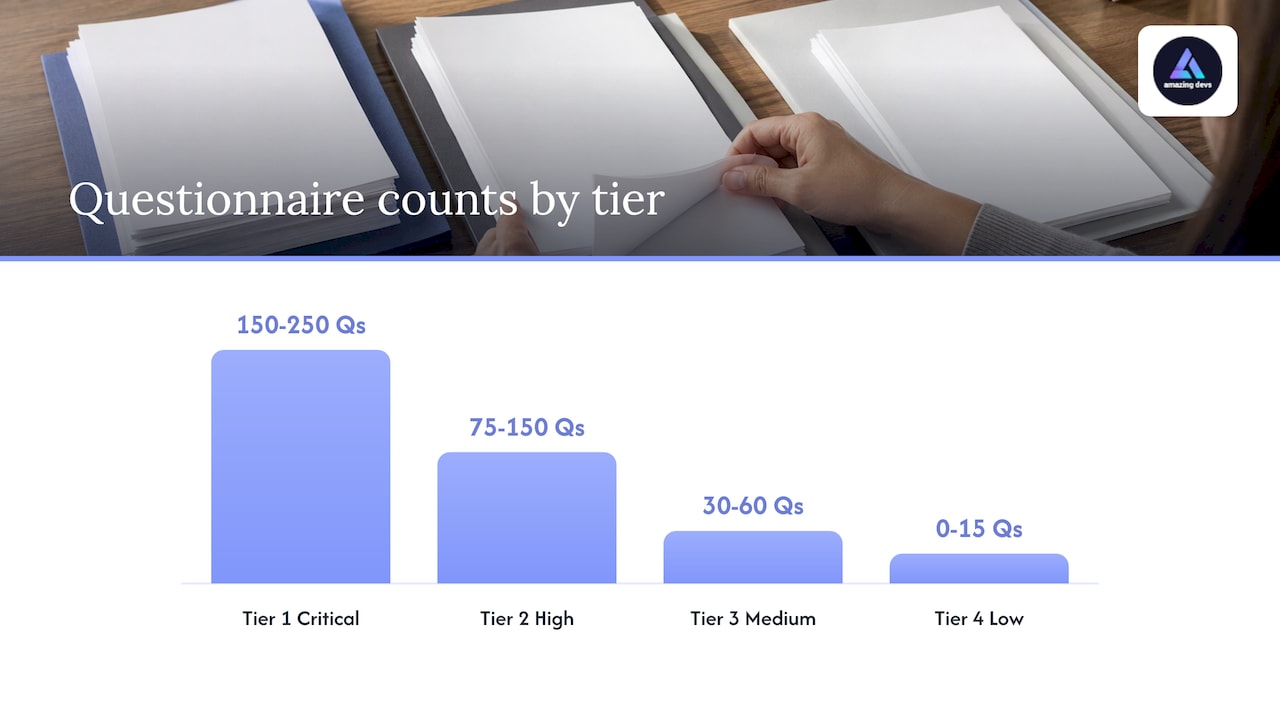
| Tier | Example vendor | Questions | Evidence expected |
|---|---|---|---|
| 1 Critical | Developers with production or source-code access | 150 to 250 | SOC 2 Type II, ISO 27001, pen test summary, business continuity results, subprocessor list, cyber insurance |
| 2 High | Partner with access to customer data in limited systems | 75 to 150 | Core reports plus targeted follow-up |
| 3 Medium | Tools with limited data | 30 to 60 | SIG Lite, review by exception |
| 4 Low | No data, no integration | 0 to 15 | Attestation only |
These are one vendor’s suggested ranges, not a regulation. Adjust them to your size. A twenty-person startup will not run 250-question reviews, and it does not need to. Document the tier, the factors behind it, who decided and the date, as Copla recommends.
Our tiered onboarding checklist for procurement shows how the same tiering logic carries into vendor onboarding.
Step 2: Start from a standard format
Do not write your own form unless you have to. Two formats dominate US enterprise reviews: the Shared Assessments SIG and the Cloud Security Alliance’s CAIQ. ServiceNow’s trust team argues that starting from them yields a faster, more complete and more defensible result than a homegrown form.
Some practical notes:
- SIG is developed by the Shared Assessments Program. Certa’s explainer says it covers 19 risk areas, including access control, application security, HR security and network security, and that it maps to GDPR, PCI DSS and HIPAA. A lighter version, SIG Lite, suits lower tiers.
- CAIQ is the cloud-focused counterpart, a good fit when the vendor mainly hosts or runs cloud services.
- CISA’s Vendor Supply Chain Risk Management template is a free government option. The April 2021 template standardizes questions on ICT supplier risk, builds on NIST SP 800-161, lets vendors answer N/A or Alternate, and allows supporting documents to be attached.
If you operate in a regulated sector, add the questions your rules require. The NERC guideline for the power sector advises that every question should map to a risk in your own supply chain risk plan, and that questions borrowed from industry forms should be added only when they match a real risk. Good advice for any company.
For an overview of the core cybersecurity topics to cover when assessing software and IT providers, see this practical TPRM guide to vendor security questionnaires.
Step 3: Keep it short enough to be answered well
Length drives quality. ServiceNow recommends 50 to 100 focused questions aligned to a recognized framework, which in its view gets more specific answers and faster turnaround than 300 or more generalized ones. It also recommends a comment box on every question, one question per answer field, visible conditional logic and clear section labels.
The same logic explains why vendors complain about oversized forms. In one Reddit thread, a respondent called a 203-question questionnaire the largest they had seen. For a Tier 1 vendor, a long form can be justified. For everyone else, it is just friction.
Set a realistic due date. UpGuard’s framework notes that questionnaires should match the vendor’s tier and industry, with a due date that leaves time for review and follow-up. For large, complex suppliers, the NATF reports that a full criteria-based assessment typically takes 2 to 10 weeks. If you need developers in weeks, plan the review into your hiring timeline rather than after it.
Step 4: Ask for evidence, not just answers
A yes in a questionnaire is a claim. Diligent describes the limit well: a questionnaire is a point-in-time snapshot that the vendor reports itself, so it does not reliably give an objective view. Pair it with documents. AppSecure’s checklist lists the usual set: a SOC 2 Type II report, an ISO 27001 certificate with scope statement, the latest penetration test report, a cyber insurance certificate, business continuity and disaster recovery test results, an incident response plan and a data processing agreement.
Then test each document with four checks, from RiskTemplates:
- Scope. Does it cover the legal entity, product, environment and locations in your engagement?
- Period. Does it cover a useful stretch of operation?
- Result. Does it disclose exceptions, failed tests and remediation, not just completion?
- Traceability. Can you connect the document to the specific answer and record your conclusion? (source)
For a people-based service such as staff augmentation, scope is the check that matters most. A certificate for a company’s office network says little about the laptops a remote developer uses. Ask which devices, accounts and locations the evidence covers.
Smaller vendors may not have a SOC 2 report. That is not automatically a failure. Arphie’s guide separates four response states: not applicable, alternative or compensating control, planned change with an approved roadmap, and unresolved gap. The rule is that a future state is never written as if it already exists. Use the same four labels when you score answers.
For technology-based checks to complement self-reported answers, this overview of website security practices for small businesses is a useful companion.
Step 5: Handle exceptions with judgment
Not every gap is a deal-breaker. GRC Workshop suggests asking, for each material exception, which requirement was missed, which systems were affected, how long it lasted, whether it recurred, what caused it, whether other safeguards reduced exposure and whether the fix was verified. Severity should not come from counting exceptions. One delayed access review matters less than repeated failures on privileged accounts.
When you approve with conditions, write the condition down with a date. RiskTemplates gives the example of recording a commitment to share a new penetration test within 30 days as a follow-up trigger. A defensible file also holds the tier and its rationale, the completed questionnaire with its date and version, documents requested versus received, and the final decision.
Step 6: Repeat it on a schedule and on triggers
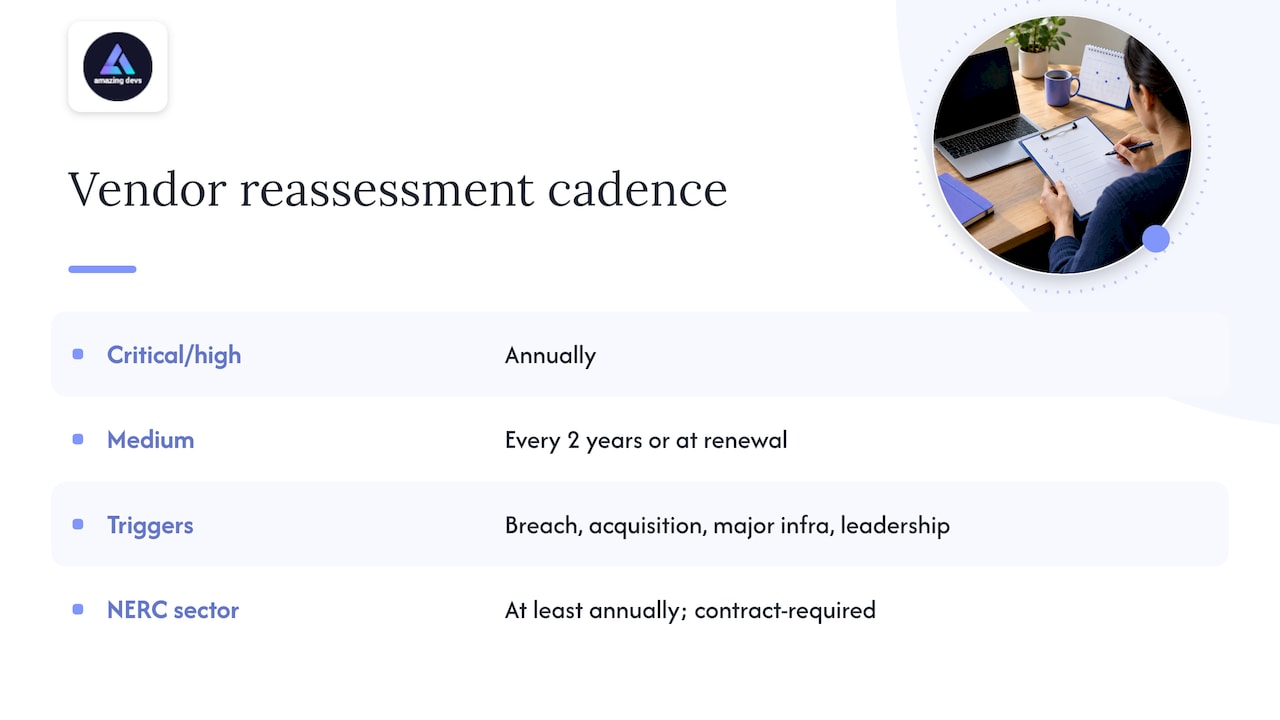
An answer from last year may be wrong today. A workable cadence, from AppSecure, is critical and high-risk vendors annually, medium vendors every two years or at renewal, and any vendor right after a breach notice, acquisition, major infrastructure change or leadership change. NERC’s guideline goes further for its sector and says questionnaires should be sent at least annually and be contractually required.
Put the obligation to answer, and to report changes, in the contract. Otherwise the reassessment depends on goodwill.
Where US rules come in
If your company is a bank or works for one, the June 2023 Interagency Guidance on Third-Party Relationships from the Federal Reserve, FDIC and OCC expects risk management across planning, due diligence, contracting, monitoring and termination, in proportion to criticality. For health data, the HIPAA Security Rule requires covered entities to get satisfactory assurances from business associates. Confirm the specifics with your counsel or compliance lead, since they decide which rules bind you.
Perspective
Most startups we talk to treat the security questionnaire as paperwork that comes after the deal. We see it the other way around. The people you add to your team are the vendor relationship, and the questionnaire is the cleanest way to write down who has access to what.
That is why we build our process around the hiring itself. Our recruitment and assessment looks at technical skill and cultural fit, and we handle the contract and bureaucratic work so you are not juggling it while you try to ship. When a partner takes that load off your plate, your security lead gets a smaller, clearer set of questions to review: a dedicated, pre-vetted developer, a defined contract, a defined scope.
Our advice is to tier the engagement honestly, put access rules in the contract, and review again when the team grows. Nearshore Brazilian developers working in your time zones make that review easier, because your security and engineering leads can sit in the same call.
Gabriel
Hiring developers through Amazing Devs
Amazing Devs provides nearshore IT talent from Brazil for startups and established companies. We source and vet developers through a technical and cultural-fit assessment, manage the contracts and handle the bureaucratic work, and our engineering team supports you as the engagement runs. We place AI-enabled and traditional software engineers, and QA contractors as well.
If you are scaling a team and want a partner whose process is built around vetted people and clear contracts, start with our nearshore staff augmentation service. If you want developers who work as a long-term part of your own team, see the Team Extension Model.
For planning, our guides on data security in outsourcing and outsourcing versus staff augmentation help you decide which engagement model fits your risk tier.
A sample question set for a developer partner
Use this as a starting shape for a Tier 1 or Tier 2 review. Trim it to your tier.
People and contracts
- How are developers screened, and what is recorded in each file?
- What confidentiality, IP assignment and acceptable use terms bind each developer?
- How is offboarding handled, and how quickly is access removed?
Access and devices
- How is access to code, cloud accounts and data granted, approved and logged?
- Is multi-factor authentication enforced on every remote access path?
- What are the standards for devices, disk encryption and patching?
Data and subprocessors
- Where is client data stored or processed, and which subprocessors touch it?
- What happens to data at the end of the contract?
Incidents and continuity
- What is the incident response process, and how fast are customers notified?
- When was the continuity plan last tested?
Governance
- Which audits or certifications exist, and what do they cover?
- Who owns security at the vendor, and how are exceptions approved?
The multi-factor question deserves attention. NERC cites a DHS finding from 2018 that Russian state actors penetrated remote-access systems of at least 200 U.S. electric power industry vendors, and advises that a vendor without MFA set a date to implement it and include that provision in the next contract revision.
FAQ
How many questions should a vendor security questionnaire have?
It depends on the tier. Certa’s working ranges run from 0 to 15 questions for low-risk vendors up to 150 to 250 for critical ones. ServiceNow suggests 50 to 100 focused questions for most reviews. Fewer, better-aligned questions usually get faster and more specific answers.
Is a questionnaire enough to approve a vendor?
No. It captures what the vendor reports about itself at one moment. Pair it with evidence such as audit reports, a penetration test summary and a data processing agreement, and match each document to the scope and period of the answer.
When should we send the questionnaire to a developer partner?
Before access is granted, ideally during selection. Drata notes that the earlier a questionnaire is launched and assessed, the earlier risks can be addressed. For staffing engagements, send it before contracts are signed so conditions can go into the agreement.
How often should we repeat it?
At least annually for critical and high-risk vendors, and sooner after a breach notice, ownership change, new subprocessor, new hosting location or significant change of service. Medium-risk vendors can follow a two-year or renewal cycle.
Sources
- What is a Security Questionnaire? | UpGuard
- The Questions You Need in a Security Questionnaire | Panorays
- Third-Party Risk Management Questionnaire: Best Practices | Drata
- Guide to Vendor Risk Assessments | University of Wisconsin System
- Vendor tiering | Rescana
- How to Build a Vendor Risk Assessment Questionnaire | Certa
- Vendor security and risk assessment questionnaires | Copla
- ServiceNow TrustShare
- SIG Questionnaire | Certa
- CISA Vendor Supply Chain Risk Management Template
- NERC Security Guideline
- Using the risk assessment framework | UpGuard
- NATF Using Solution Providers
- Vendor Security Questionnaires: What is too big? | Reddit
- Third-party vendor risk assessment questionnaire | Diligent
- Vendor Risk Assessment Checklist | AppSecure
- Vendor Risk Questionnaire Review | RiskTemplates
- Vendor Due Diligence Techniques | RiskTemplates
- SIG Questionnaire Guide | Arphie
- Assessing Supplier Security Controls and Evidence Gaps | GRC Workshop
- Building a Third-Party Risk Management Program | 360factors