Decide in 4–8 Weeks: Brazil or India Developers for IT Decision Makers
If you need developers who overlap with your working hours and communicate with minimal friction, Brazil tends to be the better fit. If you need to scale a large team fast at the lowest possible hourly rate, India usually wins. Most buyers land somewhere between the two, and the right call depends on whether you’re optimizing for speed and collaboration or for sheer headcount and cost.
TL;DR:
- India’s lower hourly rates can be offset by taxes, vendor fees, currency exposure, and rework, so compare fully loaded role costs rather than quotes.
- A Brazil team can join a 10 a.m. Eastern standup, while India teams often need async documentation, a rotating overlap hour, and clear handoff notes.
- India’s enterprise strengths include Java, .NET, SAP, QA, and maintenance, while Brazil’s often include data, AI integration, mobile development, and product ownership.
- A role specific coding assessment tied to your actual stack is more reliable than country labels or generic tests when validating seniority.
- A paid pilot lasting four to eight weeks, with clear scope, overlap rules, and a vendor managing payroll, can test fit before a longer commitment.
Table of Contents
- Talent and skill strengths: who excels at what
- Costs and pricing shapes
- Time zones, overlap, and collaboration cadence
- Cultural and language fit, communication risks
- Market and regulatory environment: stability, reforms, and business risk
- Engagement and hiring models (nearshore, offshore, staff augmentation)
- How Amazing Devs solves the Brazil nearshore option
- Education systems and developer training backgrounds
- Infrastructure quality and the technology ecosystem
- Case studies and examples of successful projects
- Innovation levels and adoption of new technologies
- What this means if you’re deciding this quarter
- How to get started with nearshore Brazil developers
- FAQ
- Sources
Talent and skill strengths: who excels at what
India’s developer workforce is large and deep in enterprise stacks: Java, .NET, SAP, and large-scale QA and maintenance work benefit from decades of outsourcing infrastructure. Brazil’s talent pool has grown fastest in data engineering, AI and machine learning integration, mobile development, and product teams that work closely with U.S. founders rather than at arm’s length.
- India generally offers more senior enterprise architects and faster bench availability for large teams.
- Brazil tends to produce engineers comfortable owning product decisions, not just executing tickets.
- Both markets have strong mid-level talent, but validating seniority claims through a role-specific coding assessment matters more than the country label.
- A scorecard tied to your actual stack (not a generic test) catches mismatches before they cost you a sprint.
Costs and pricing shapes
Headline hourly rates rarely tell the whole story; understanding the comparison between U.S. and offshore development teams can provide useful supplementary insight into cost structures and buyer checklists. India’s rates are often lower on paper, but layered fees, communication overhead, and rework from timezone gaps can close much of the gap. Brazil’s rates sit higher than India’s but often lower than onshore U.S. hires, and nearshore overlap tends to reduce the hidden costs of back-and-forth clarification.
- Landed cost includes the hourly rate plus payroll taxes, benefits, vendor management fees, and currency exposure.
- Senior roles narrow the price gap between markets faster than junior roles do.
- Vendor-managed models shift payroll and compliance costs into the fee, which can still beat the cost of running your own entity abroad.
- Compare total cost-to-deliver a feature, not the quoted hourly number alone.
Pro Tip: Ask every bidder for a fully loaded monthly cost per role, not just an hourly rate, before comparing proposals side by side.
Time zones, overlap, and collaboration cadence
Brazil shares most or all of its working day with U.S. time zones, while India’s workday starts as the U.S. workday ends. That gap shapes how teams actually collaborate day to day.
- A Brazil-based team can join your 10 a.m. Eastern standup live; an India-based team usually can’t without working off-hours.
- Debug sessions and urgent fixes resolve same-day with Brazil overlap, while India-based fixes often wait for the next cycle.
- Teams managing India-based developers typically rely on detailed async documentation, a rotating single overlap hour, and clear handoff notes to compensate.
- Deadlines tied to same-day decisions, like a release gate or a client demo, move faster with Brazil’s overlap than with a handoff-based model.
Cultural and language fit, communication risks
English proficiency varies by individual in both markets, and documentation discipline matters more than accent or fluency. Brazilian teams working with U.S. clients tend to adopt direct, business-English communication quickly, partly because many have worked nearshore for years. Cultural norms around feedback and deadlines also differ: some engineering cultures favor indirect pushback, which can delay flagging a risk until it’s already a problem.
- Set a communication SLA upfront: response time, update cadence, and escalation path.
- Build a short onboarding checklist covering tools, standups, and documentation format before day one.
- Clarify how your team gives and expects to receive critical feedback, since assumptions here cause more friction than language ever does.
Pro Tip: Run a one-week trial sprint before a multi-month commitment to surface communication gaps early.
Market and regulatory environment: stability, reforms, and business risk
Brazil has moved through a round of structural and tax reforms that affect how predictable it is to run a multi-year engagement there. IMF staff analysis documents a VAT reform designed to simplify the tax system and improve business equity, which reduces administrative friction for companies planning to scale a nearshore team over several years.
Brazil’s medium-term growth prospects have improved alongside structural reforms, with a labor market showing rising formalization and lower unemployment.
That assessment comes from the IMF’s 2025 Article IV review of Brazil. For any multi-year engagement, check local labor classification rules, payroll tax obligations, and currency exposure before signing contracts, since these are the line items most likely to surprise an unprepared buyer.
Engagement and hiring models (nearshore, offshore, staff augmentation)
Three models cover most buyer needs, and the right one depends on how much management overhead you’re willing to carry.
- Staff augmentation adds individual developers to your existing team and structure, giving you direct control but requiring you to manage day-to-day performance.
- A vendor-managed nearshore partner, often called a team extension model, handles recruitment, contracts, and payroll while you manage the work itself.
- Direct contractor hiring gives the most control but puts compliance, tax withholding, and termination risk on you.
- For most mid-sized teams, a vendor-managed model reduces time-to-value because sourcing, vetting, and legal setup happen before the developer starts, not after.
A short onboarding checklist, access, tools, a defined sprint cadence, and a named point of contact, shortens the ramp regardless of which model you pick.
How Amazing Devs solves the Brazil nearshore option
When Brazil fits your decision triggers, we run a recruitment and assessment process built around both technical skill and cultural fit, so the developer who joins your team can actually work the way your team works. We handle contract setup and the bureaucratic parts of hiring in Brazil, including payroll and compliance, so your engineering lead doesn’t become a part-time HR administrator.
Our nearshore staff augmentation model covers dedicated developers and nearshore QA contractors for teams that need testing coverage alongside development. For deeper operational detail, our guide on hiring data engineers in Brazil walks through sourcing specifics for that role.
Education systems and developer training backgrounds
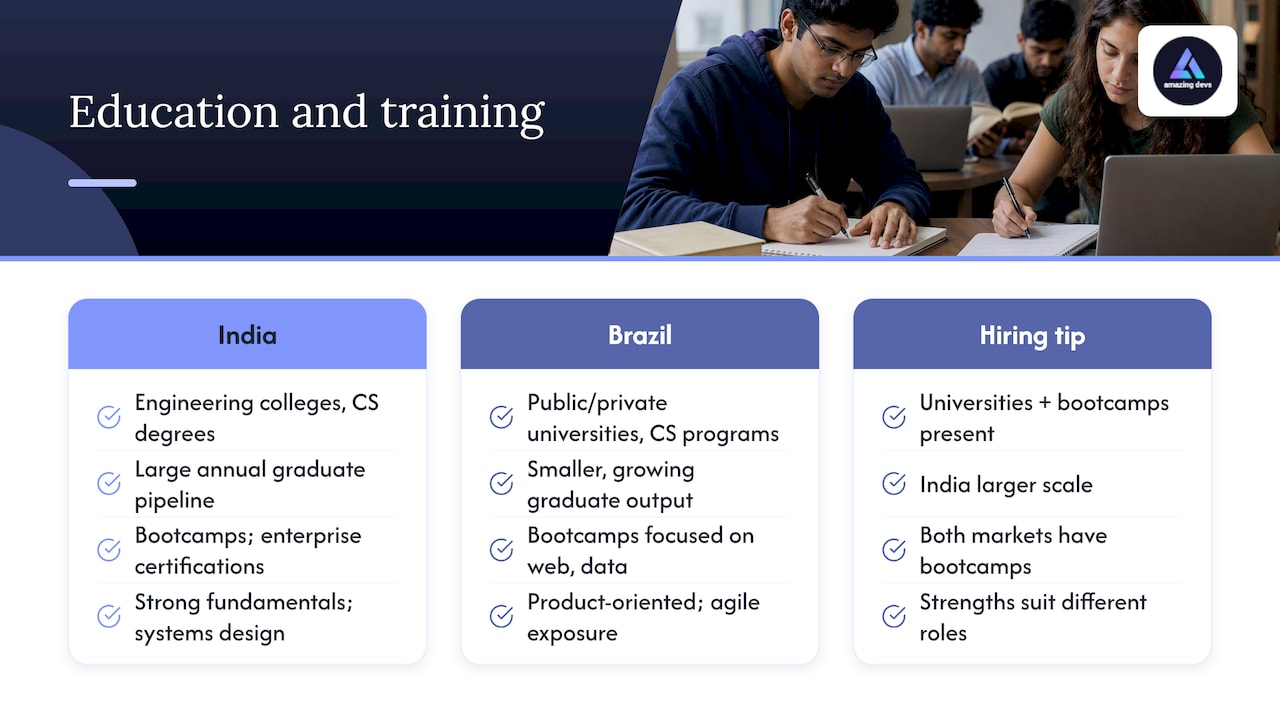
India’s technical education system is built around a large network of engineering colleges producing a steady annual pipeline of computer science and IT graduates, reinforced by specialized coding bootcamps and certification programs tied to enterprise platforms like SAP and Oracle. That scale is a direct product of decades of investment in IT-focused higher education aimed at the outsourcing industry.
Brazil’s developer training path runs through public and private universities with strong computer science and engineering programs, complemented by a fast-growing bootcamp sector focused on web development, data science, and mobile engineering. Brazilian computer science graduates often enter the workforce with exposure to agile methodologies and product-oriented coursework, which lines up with the kind of ownership-driven work nearshore clients tend to ask for.
Neither system is strictly better for every role. A candidate from an Indian engineering college tends to arrive with strong fundamentals in data structures and large-system design, useful for enterprise maintenance work. A candidate from a Brazilian university or bootcamp more often arrives comfortable working directly with a product owner and iterating quickly, useful for startup-style product teams. The practical takeaway for a hiring manager is the same in both cases: a credential signals a baseline, but a role-specific technical assessment is still the only reliable way to confirm a candidate can do the actual job you need done.
Infrastructure quality and the technology ecosystem
Reliable infrastructure underpins both markets, but the shape of that infrastructure differs. India’s major tech hubs, Bangalore, Hyderabad, Pune, have dense fiber networks and a mature outsourcing ecosystem built over two decades, with large IT parks designed specifically for global delivery work. That maturity shows up as deep bench strength and established delivery processes for large-scale projects.
Brazil’s tech ecosystem is concentrated in São Paulo, Florianópolis, and a handful of other hubs with strong startup and venture activity, supported by generally solid broadband infrastructure in major metro areas. Brazil’s ecosystem skews toward product companies and startups rather than large-scale outsourcing delivery centers, which shapes the kind of engineering culture that trains there: closer to product ownership than to ticket-based delivery.
For a buyer, the practical question isn’t which country has better infrastructure overall. It’s whether your remote developer has reliable connectivity for daily standups and pair programming, which is a question to verify at the individual or vendor level rather than assume from country-level averages. Both markets have major cities with infrastructure on par with most U.S. remote-work expectations, and both have regions where connectivity is less consistent, so this is a diligence item for any specific hire rather than a market-wide differentiator.
Case studies and examples of successful projects
Public examples of outsourced success rarely name the specific nearshore or offshore vendor behind them, since most client companies don’t disclose staffing arrangements. What’s visible instead is the pattern: global game studios and tech showcases increasingly feature homegrown teams from both India and Brazil, reflecting how both countries have built creative and technical industries capable of producing original, globally distributed products rather than only executing outsourced specs.
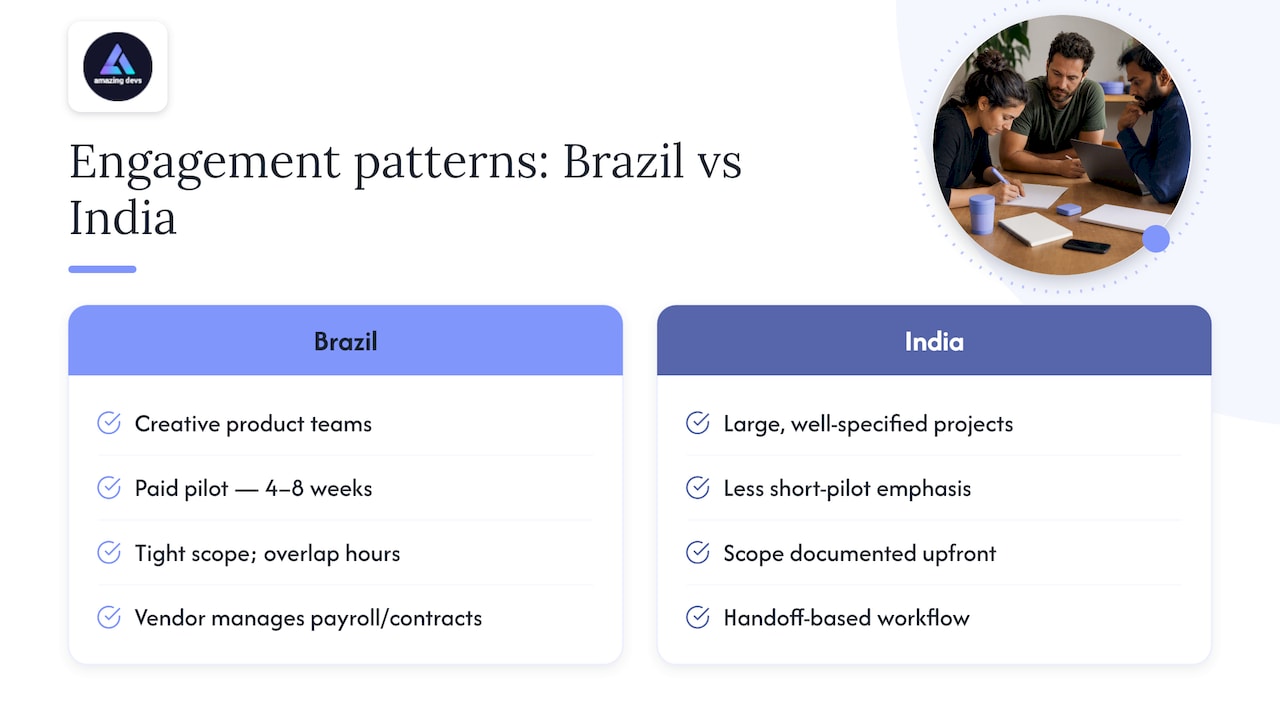
In practice, the clearest pattern of success for nearshore Brazil engagements looks less like a single flagship case study and more like a repeatable structure: a short paid pilot, typically four to eight weeks, with a tight scope, a defined overlap-hour policy, and a vendor handling payroll and contract details in the background. Teams that start this way tend to convert the pilot into a longer engagement because both sides know within weeks whether the working relationship functions, rather than finding out six months into a larger commitment.
For India-based engagements, the stronger pattern tends to show up on large, well-specified projects: QA automation at scale, legacy system maintenance, or enterprise platform rollouts where the handoff-based workflow is less of a liability because the scope is clearly documented upfront. The lesson for a buyer evaluating either market isn’t to look for a named success story, since those are hard to verify independently, but to structure your own engagement the way successful ones tend to be structured: small first step, clear deliverable, defined communication rhythm.
Innovation levels and adoption of new technologies
Both markets are active in AI-enabled development, cloud-native architecture, and modern data tooling, but the adoption pattern differs by context rather than by country-wide capability. India’s large enterprise outsourcing sector has pushed broad adoption of AI-assisted coding tools and automation within established delivery processes, since efficiency gains at scale translate directly into margin for large vendors.
Brazil’s innovation activity shows up more at the product and startup level, with developers who’ve worked on AI integration, modern data pipelines, and mobile-first products as part of smaller, faster-moving teams. That context matters for a buyer: a developer who has spent years inside a large, process-heavy delivery organization brings different instincts than one who has spent years inside a startup shipping features weekly.
Neither pattern makes one country’s talent more innovative as a blanket rule. What the comparison actually tells a hiring manager is to ask about the context a candidate worked in, not just the country they worked from. A candidate from either market who has hands-on experience integrating large language models into a production feature, or who has shipped a data pipeline from scratch, demonstrates the thing you actually care about far better than a country-level generalization does.
What this means if you’re deciding this quarter
The real choice isn’t Brazil or India in the abstract. It’s whether your project needs tight daily collaboration or raw scale at the lowest cost, and most teams already know which one matters more once they’re honest about it. Run a short pilot before committing either way.
— Gabriel
How to get started with nearshore Brazil developers
If overlap, communication, and faster feedback loops matter more to you than the lowest possible hourly rate, nearshore Brazil is worth a direct test. We work with developers experienced in U.S.-aligned hours, assessing both their technical skills and communication under real project pressure, and manage contract and payroll details so your team can focus on the work itself.
Our team extension model is built for teams that want a predictable, managed way to add nearshore capacity without opening a local entity. Start with a short pilot and a skills audit through our nearshore staff augmentation page to see how fast a Brazilian developer can get productive on your stack.
FAQ
Is Brazil more developed than India?
Development is multidimensional, and the two countries rank differently depending on the measure. IMF reporting on Brazil’s economy points to improving labor formalization and moderate growth, but neither country is simply “more developed” in a way that predicts which one has better software developers for your project.
Is Brazil’s economy strong?
Brazil’s economy showed improved per-capita income and continued progress in 2025, including lower inflation and rising formal employment, according to a 2026 IMF country note. Ongoing structural reforms are aimed at supporting more sustainable, predictable growth going forward.
What is the difference between India and Brazil for hiring developers?
The biggest practical differences are time zone overlap and typical engagement scale: Brazil shares most of the U.S. workday, while India’s workday runs opposite to it. India generally offers a larger talent pool and lower headline rates, while Brazil tends to offer closer collaboration and faster feedback cycles for product-focused work.
Which engagement model works best for a first nearshore hire?
A short paid pilot, often four to eight weeks, with a vendor-managed contract and payroll setup, is the lowest-risk way to test a new hire or market before committing to a longer engagement. This lets you evaluate real working fit before scaling the team.
Do you only place Brazilian developers?
Yes, placements focus specifically on nearshore Brazilian developers, matched through a technical and cultural fit assessment, with contract and payroll managed on the client’s behalf. Pricing details for staffing and team extension engagements are available by request through our staffing and outsourcing page.
Sources
- Brazil’s VAT reform: improving equity (IMF WP, 2026)
- Brazil: 2026 Article IV Consultation — Staff Report (IMF Country Report No. 26/191)