Best Applicant Tracking Systems in 2026: How to Compare
The best applicant tracking system is the one that fits your hiring stage. For a startup making a handful of hires, that usually means a light, low-cost tool such as Breezy, JazzHR or Zoho Recruit. For a team making 20 or more hires a year, it means a structured-hiring platform such as Ashby, Greenhouse, Lever or Workable. This guide compares the leading options on price, strengths and AI features, then shows how to choose without overbuying.
TL;DR
- Match the ATS to your volume: Paraform groups lightweight tools for companies under 50 employees and analytics-heavy tools for Series A-C teams making 20 or more hires a year.
- Ashby is the most common ATS among 967 tracked seed-to-Series C startups, at 39%, ahead of Greenhouse at 13%, according to Recruiting From Scratch.
- Published prices range from free for one open job to several thousand dollars a year, and Greenhouse and Lever are quote-only.
- An ATS organizes candidates. It does not find them. If your bottleneck is a shortage of qualified engineers, pair the software with a sourcing partner.
Table of Contents
- Quick comparison of the leading ATS options
- How to choose an ATS before you compare brands
- The best applicant tracking systems, one by one
- Which ATS fits which stage
- AI features: what to test
- Integrations and collaboration checklist
- What an ATS does not solve
- When the bottleneck is talent, not tracking
- FAQ
- Sources
Quick comparison of the leading ATS options
Prices below are the starting figures that comparison sites reported in 2026. Vendors change plans often, so confirm on the vendor’s pricing page before you budget.
| ATS | Best for | Reported starting price |
|---|---|---|
| Breezy HR | Small teams, first ATS | Free for one active job; $157 to $189 a month for unlimited jobs |
| Ashby | Funded startups that want analytics | $400 a month for up to 100 employees |
| Greenhouse | Structured hiring at scale | Quote only |
| Workable | Growing SMBs | $299 to $719 a month by employee tier |
| Lever | ATS plus recruiting CRM | Quote only |
| JazzHR | Budget-conscious SMBs | $1,000 to $5,508 a year by plan |
| Zoho Recruit | Teams already on Zoho | Free for one active job; paid plans from about $25 per recruiter a month |
| Manatal | AI sourcing | $19 per person a month |
| Teamtailor | Workflow automation, employer branding | Quote only |
| Pinpoint | Multi-stream and in-house teams | Quote only |
Sources for the figures: TechnologyAdvice lists Breezy at $189 a month, Manatal at $19 per person a month and BambooHR at $10 per person a month. The People Ops Manager lists Breezy from $157 a month on annual billing, JazzHR at $1,000 to $5,508 a year, Workable at $299 to $719 a month and Ashby Foundations at $400 a month. Rework lists Zoho Recruit at $25 per user a month.
How to choose an ATS before you compare brands
Feature lists look alike. What separates a good pick from a regretted one is fit with your workload. Four checks do most of the work.
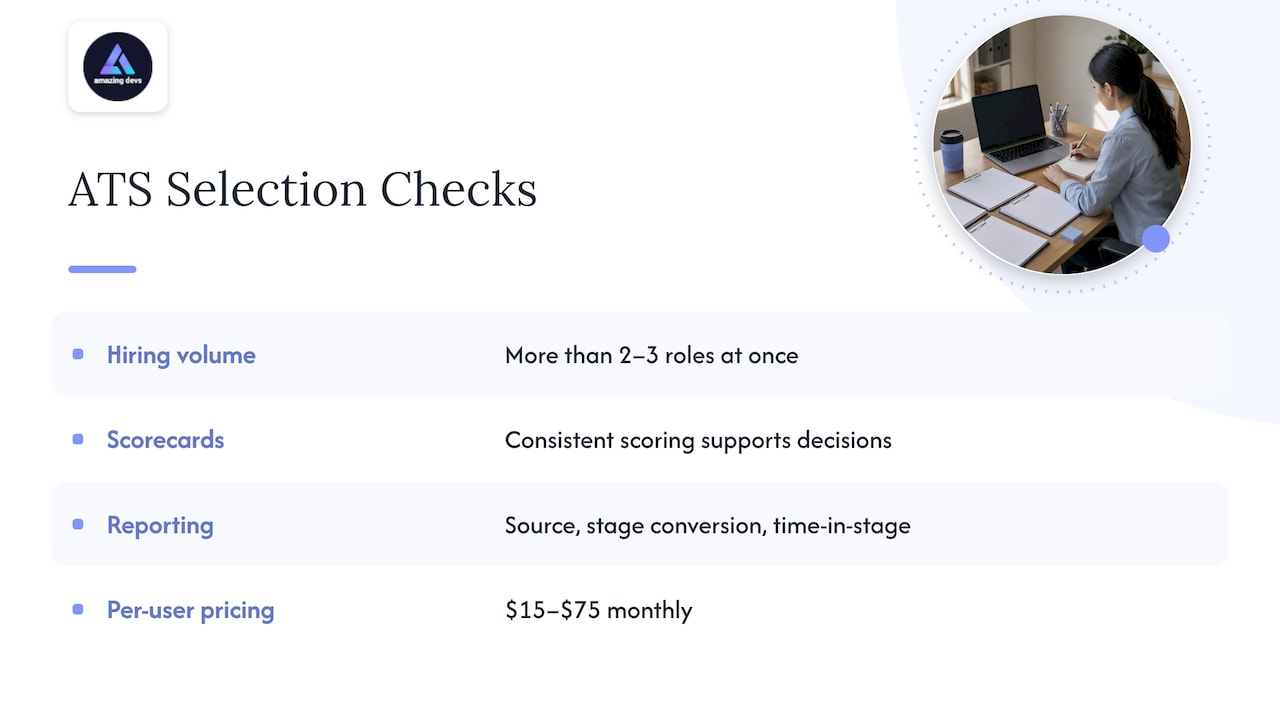
1. Your hiring volume. Deel suggests that an ATS starts paying off when you hire more than two or three roles at once, candidates slip through the cracks, or time-to-hire rises without a clear cause. For most startups that happens between ten and twenty employees. Below that, a spreadsheet and a shared inbox can survive. Above it, they cost you candidates.
2. Structured interviews and scorecards. Consistent scoring is what turns an ATS from a database into a decision tool. If you do not yet have a scoring framework, build one first. Our candidate scoring matrix guide walks through a template you can finish in an afternoon, and it works inside any system on this list.
3. Reporting you will read. Source-of-hire, stage conversion and time-in-stage matter more than a long dashboard menu. Recruiting From Scratch also tells startups to check how the system handles outside recruiting agencies, and to get a quote for the headcount they expect in 12 months, not just today.
4. Pricing that scales. Some tools charge per seat, some by job count, some by employee band. Per-seat models bite when founders, hiring managers and interviewers all need access. Dover puts entry-level per-user pricing at $15 to $75 a month, which adds up fast once ten interviewers need logins.
Standalone ATS or an HR suite
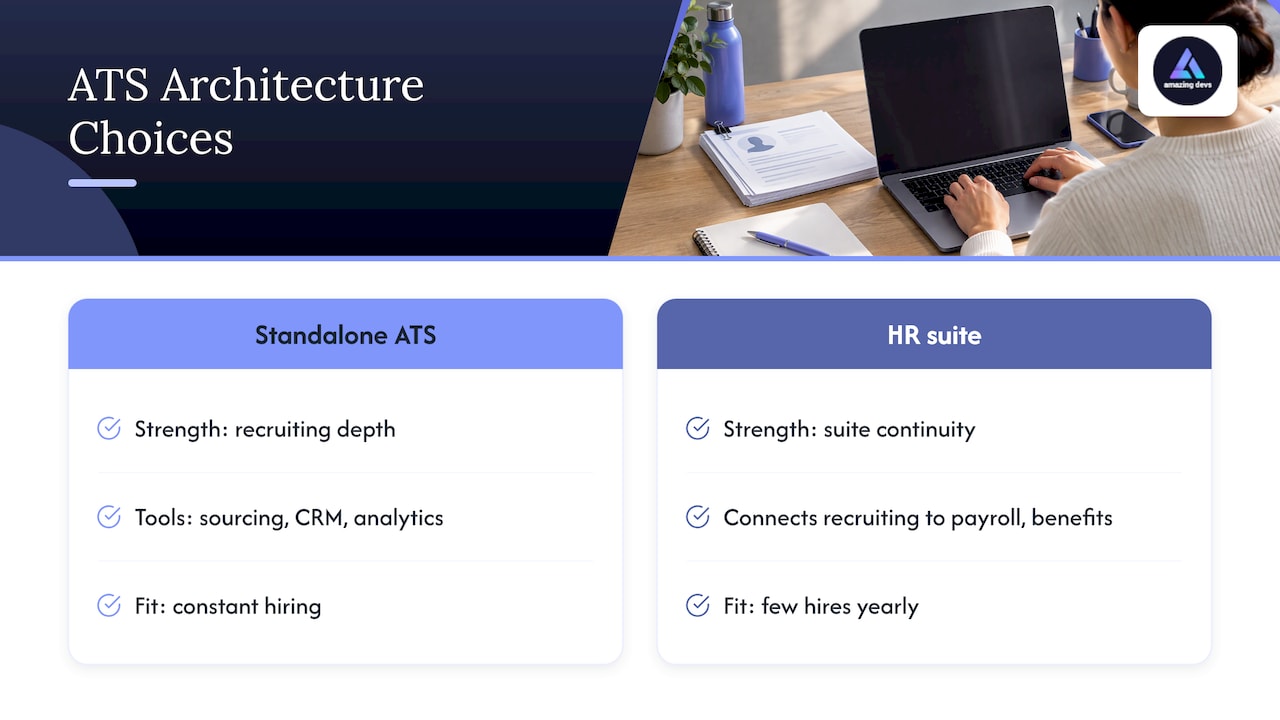
The biggest architectural choice is specialist depth versus suite continuity. Paycor notes that standalone products such as Greenhouse and Workable typically offer deeper recruiting, sourcing, CRM and analytics. HCM-embedded systems such as ADP, UKG, Paycor, Paycom and Workday cut data silos by tying recruiting to payroll, benefits and workforce management.
If you hire constantly and recruiting is a core function, lean standalone. If you hire a few people a year and want one login for everything, an HR suite such as BambooHR or Rippling may be enough.
The best applicant tracking systems, one by one
Breezy HR: best for a first ATS
TechnologyAdvice ranked Breezy best overall in its October 2026 test of 12 tools across six criteria. The free tier covers one active position, which is enough to try a real hiring round. Paid plans were reported at $157 a month on annual billing and $189 a month for unlimited positions. It suits teams with no dedicated recruiter that need fast setup and a low learning curve. Breezy can also pass hired candidates on to BambooHR or HiBob, according to The People Ops Manager.
Ashby: best for funded startups that want analytics
Ashby is the most common choice in the Recruiting From Scratch dataset of 967 startups. Its Foundations plan was reported at $400 a month for up to 100 employees. Rework notes that the cost climbs sharply once you pass 100 employees, so ask for a quote at your 12-month headcount. It syncs with Rippling and Workday, per The People Ops Manager.
Greenhouse: best for structured hiring
Greenhouse describes itself as a hiring ecosystem that combines sourcing, interviewing and ATS, with AI tools, scheduling, reporting and hundreds of pre-built integrations. TechTarget reports more than 500 prebuilt integrations and an open API. TechnologyAdvice picked it for structured hiring and candidate experience. Pricing is quote-only. Third-party estimates run into the thousands of dollars a year, so it fits teams with a dedicated recruiting lead more than a founder doing hiring on the side.
Workable: best for growing SMBs
Workable’s reported pricing runs from $299 to $719 a month depending on employee tier, per The People Ops Manager. Paycor describes AI sourcing, resume parsing, interview scheduling and 200-plus job-board integrations. Spark Hire reports that scorecards, interview kits and shared candidate profiles are in the Standard plan, while one-way video, SMS and assessments are paid add-ons. Budget for the add-ons if you plan to use them.
Lever: best if you want an ATS and a recruiting CRM in one
Spark Hire describes Lever as combining an ATS with a recruiting CRM and deep LinkedIn Recruiter integration. That suits teams that nurture passive candidates over months. Pricing is by quote.
JazzHR: best for budget-conscious teams
JazzHR’s plans were reported at $1,000 to $5,508 a year, and it supports unlimited users, which helps when many people weigh in on hires, according to the U.S. Chamber of Commerce. It exports to HRIS partners including Sapling, Gusto and Justworks.
Zoho Recruit and Manatal: best for AI sourcing on a budget
Zoho Recruit has a free tier for one active job and converts hired candidates into Zoho People employees. Manatal, at $19 per person a month in the TechnologyAdvice listing, was picked for AI sourcing. TechnologyAdvice reports it distributes jobs to more than 2,500 channels and offers a database of more than 700 million candidate profiles.
Teamtailor, Pinpoint and suite options
Teamtailor won the workflow-automation slot in the TechnologyAdvice test and is quote-based. Pinpoint is built for multi-stream hiring, from deskless to executive roles, with AI candidate prioritization, interview self-scheduling and more than 100 native integrations. If you want recruiting inside a broader HR platform, TechnologyAdvice picked Rippling for recruiting analytics, and BambooHR was listed at $10 per person a month.
Which ATS fits which stage
Paraform recommends Breezy HR, Zoho Recruit or JazzHR for startups under 50 employees. For Series A-C companies making 20 or more hires a year, it points to Ashby, Greenhouse, Lever or Workable. 100Hires adds more detail:
- Under about 50 employees: one-click job posting, a pipeline that needs no admin, fast setup and a flat, predictable price.
- Fast-scaling startups (10 to 150 employees): customization that scales, sourcing, and pricing that grows with you.
- Mid-market (100 to 1,000): structured scorecards, workflow configuration and source-of-hire analytics.
- Enterprise (1,000+): requisition approvals, predictive analytics, compliance and SSO.
At around 250 employees, Recruitee advises prioritizing adoption and ease of use over feature depth, and cross-team visibility over experimental AI.
AI features: what to test
Nearly every vendor now advertises AI. The features differ. TechnologyAdvice describes Manatal’s sourcing, recommendations and AI Interviewer, Teamtailor’s AI assistant, Breezy’s AI Interview Analysis and Greenhouse’s AI matching. HiBob lists AI CV matching, AI-generated scorecards and job descriptions, and a conversational hiring assistant.
Test each capability on its own, using a real role: resume ranking, matching past candidates to new roles, external sourcing suggestions, automated scheduling, and interview summaries. Keep a human in the loop for every ranking decision. If you want a framework for using AI responsibly when you source engineers, see our guide to skills-based hiring and responsible AI.
Integrations and collaboration checklist
An ATS that does not talk to your other tools creates manual work. Compare these before you sign:
- Email and calendar sync, and Slack or Teams alerts.
- Job-board distribution and a branded careers page.
- Handoff to your HRIS and payroll, so a hired candidate does not have to be retyped. Deel calls this candidate-to-employee transition the differentiator most startups notice too late.
- API and webhook support. Greenhouse, for example, supports candidate-hired webhooks and the Harvest API, per The People Ops Manager.
- Role-based permissions and audit trails.
- Hiring-manager access that does not require a full paid seat for every interviewer.
Ask each vendor to demo a realistic scenario: schedule a panel, collect feedback, run a report, and hand off a hire. Kula’s view is that the main scaling risk is fragmented tooling. If your stack is already a patchwork, a guide to project management tools for recruitment agencies shows how teams consolidate.
What an ATS does not solve
An ATS moves candidates through stages. It cannot create qualified candidates. If your pipeline for senior engineers is thin, the best-configured system will show you an empty board. Hiring cycles are also long: our breakdown of developer time-to-hire shows how teams set stage targets to reach 28 days, and the cost of recruiting developers is worth reading before you decide how much of your budget belongs to software and how much to sourcing.
Perspective
We work with startups and established companies that have an ATS and still cannot fill engineering seats. The software was never the problem. The problem is that the pipeline feeding it is thin, or that candidates are screened for résumé keywords instead of fit with the team.
Our view is simple. Pick an ATS that your hiring managers will actually open, run structured scorecards in it, and then put your effort into who enters the funnel. That is where we come in: we source Brazilian developers, assess them for technical skills and cultural fit, and manage the contracts and paperwork, so your team spends its interview hours on candidates who are already pre-vetted.
The ATS tracks the process. A good nearshore partner shortens it.
Gabriel
When the bottleneck is talent, not tracking
If your ATS is set up and engineering roles are still open, a staffing partner can fill the gap. Amazing Devs provides nearshore developers from Brazil through nearshore staff augmentation, covering sourcing, technical and cultural assessment, and contract management. Our approach is built around dedicated, pre-vetted developers who can join your workflow and your existing tools.
If you prefer to grow an embedded team, see the Team Extension Model, or start from our home page to tell us what roles you need to fill.
FAQ
What is the best applicant tracking system for startups?
There is no single winner, because the right choice depends on headcount and hiring volume. Breezy HR, Zoho Recruit and JazzHR are commonly recommended for teams under 50 employees. Ashby, Greenhouse, Lever and Workable suit teams making 20 or more hires a year. Ask for a quote at the headcount you expect in 12 months.
How much does an ATS usually cost?
Reported entry prices in 2026 range from free for one open job (Breezy, Zoho Recruit) to $400 a month for Ashby and $299 to $719 a month for Workable. JazzHR was reported at $1,000 to $5,508 a year. Greenhouse, Lever and Teamtailor use quotes, so expect to talk to sales.
Do I need an ATS if I only hire a few people a year?
Not always. Deel suggests an ATS becomes worthwhile when you run more than two or three searches at once, candidates fall through the cracks, or time-to-hire grows. A free tier is a low-risk way to start before you commit to a paid plan.
Should I pick a standalone ATS or an HR suite?
Pick standalone if recruiting is a constant, high-volume function and you want deeper sourcing and analytics. Pick an HR suite if you hire occasionally and value one system for recruiting, payroll and benefits. Paycor frames this as specialist depth versus suite continuity.
Sources
- TechnologyAdvice: Top Applicant Tracking Systems
- The People Ops Manager: Best Applicant Tracking Software
- Rework: Best Applicant Tracking Systems 2026
- Recruiting From Scratch: Which ATS Should a Startup Use?
- Paraform: Best ATS for startups
- Deel: Applicant Tracking Systems for Startups
- Dover: ATS for Inbound Applications
- Paycor: Best Applicant Tracking Systems
- Greenhouse
- TechTarget: 16 top applicant tracking systems
- Spark Hire: Best Applicant Tracking System Software
- U.S. Chamber of Commerce: Best Small Business ATS
- Pinpoint ATS
- HiBob: Hiring platform
- 100Hires: How to Choose an ATS
- Recruitee: How to choose the right ATS