Best Global Payroll Providers in 2026: How to Choose

The best global payroll provider for a US company depends on how many countries you pay in and who does the work. Deel, Remote and Papaya Global are the usual shortlist for fast-moving teams, and ADP and Rippling suit larger or HR-heavy setups. Published entry prices cluster between US$9 and US$29 per employee per month. If your goal is hiring engineers abroad, the payroll question may disappear entirely, and we explain how below.
TL;DR
- Entry prices for global payroll run from US$9 to US$29 per employee per month, with Deel, Papaya Global and Remote all starting at US$29 (prices checked November 1, 2026).
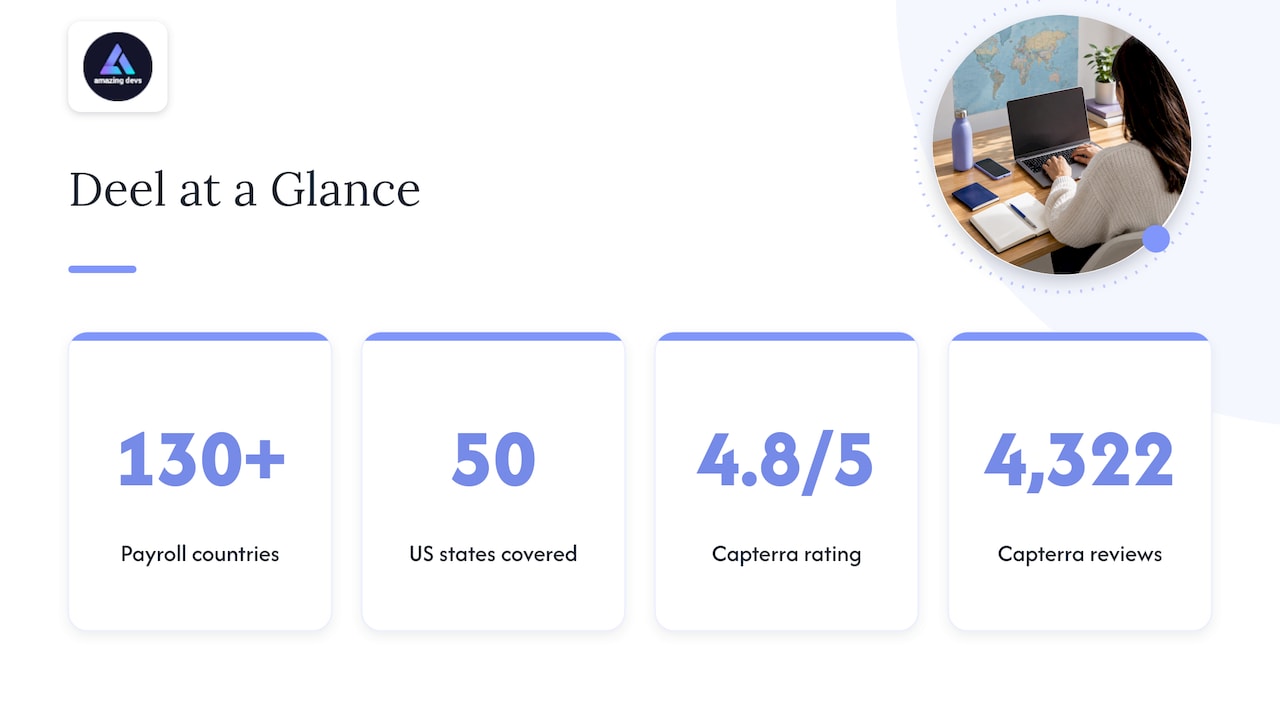
- Coverage is broad across the leaders: Deel reaches 130+ countries, ADP 140+ and Remote 100+ for payroll.
- Reviews are strong for Deel (4.8/5 on Capterra) and Rippling (4.9/5), while Papaya Global holds 4.5/5 on G2 from a smaller review pool.
- Setup, minimum, payment and statutory fees can raise the real bill above the headline price, so ask for a full quote.
- If you need Brazilian developers, a nearshore partner such as Amazing Devs manages the contracts for you, so you skip building a payroll stack for those hires.
Table of Contents
- What global payroll providers actually do
- The best global payroll providers compared
- How the main providers differ
- How to choose: six criteria that matter
- A worked example: three engineers in Brazil
- Hiring Brazilian developers without a payroll stack
- Shortlist by company profile
- FAQ
- Sources
What global payroll providers actually do
A global payroll provider pays your own employees in several countries. It calculates gross-to-net pay, withholds local taxes, files the required reports and sends money in local currency. Some run payroll with their own experts, some give you self-service software, and some use local partners behind a single dashboard. EOR Prices describes this split between managed service and self-service, and notes that local partners are sometimes involved.
This is different from an employer of record (EOR), where the provider legally employs the worker for you, and from contractor payments, where no payroll is involved at all. Many vendors sell all three, which is why comparison pages blur them. Decide first which one you need:
- Global payroll: you already have a legal entity in the country and employees on your books.
- EOR: you have no entity and want the provider to be the employer.
- Contractor management: the worker is independent and you pay invoices.
The rest of this guide focuses on payroll, with a note on EOR where it changes the answer.
The best global payroll providers compared
The table shows published starting prices per employee per month, as compiled by EOR Ledger on October 23, 2026, plus the service model each provider is known for. ADP and Rippling quote only, so they have no listed price.
| Provider | Starting price (per employee per month) | Best suited to |
|---|---|---|
| Playroll | US$9 | Small teams that want the lowest entry price |
| RemotePass | US$15 | Startups mixing employees and contractors |
| Lano | €19 | Teams paying in euros |
| Multiplier | US$20, billed annually | Growing companies wanting one platform |
| Borderless AI | US$29 | Teams that want a newer AI-led platform |
| Deel | US$29 | Multi-country payroll with expert-run or self-service options |
| Papaya Global | From US$29 | Mid-sized to large enterprises |
| Remote | From US$29 | Companies wanting payroll, EOR and contractors under one roof |
| ADP Global Payroll | Quote only | Large enterprises already on ADP |
| Rippling | Quote only | Companies that want HR, IT and payroll unified |
A low entry price is not the whole story. EOR Prices points out that setup, minimum, payment and statutory fees can add to the headline rate. Its listing of Deel shows the pattern: US$29 per employee per month in 130+ countries, with Deel experts running payroll, self-service limited to the US and Canada, and an extra US$10 for Treasury Services.
How the main providers differ
Deel
Deel is the name most US teams meet first. According to G2’s product description, it emphasizes gross-to-net payroll, local statutory requirements, country-specific reporting, multi-currency payouts and US coverage across all 50 states. Its payroll reaches 130+ countries per EOR Prices. On Capterra it scores 4.8/5 from 4,322 reviews, with 4.8 for ease of use and 4.7 for customer service. G2 reviewers praise the interface and reliable payments, though some report slower-than-expected transactions or support resolution.
Remote
Remote bundles global payroll, EOR, US PEO and contractor tools. Its payroll covers 100+ countries, with either self-service or a Remote specialist, according to EOR Prices. Payroll starts at US$29 per employee per month. It is a good fit if you expect to move between payroll, EOR and contractors as your footprint changes, since you stay in one system.
Papaya Global
Papaya Global positions itself for larger organizations, and review roundups tend to place it with mid-sized to large enterprises. Its payroll starts at US$29 per employee per month per EOR Ledger. On G2 it holds 4.5/5 from 55 reviews, with users praising ease of use, support and timely payments, and some noting slower support replies and occasional integration accuracy issues. The smaller review pool means the score moves more with each new review than Deel’s does.
ADP Global Payroll
ADP is listed as covering 140+ countries and territories. It prices by quote, which usually points to enterprise contracts. If your US payroll already runs on ADP, adding its global product keeps one vendor relationship, which procurement teams often value.
Rippling
Rippling is the choice when payroll is one piece of a broader HR and IT system. Capterra lists it at 4.9/5 from 4,886 reviews, with 4.9 for ease of use and 95% of reviewers recommending it. Pricing is by quote.
Budget and newer options
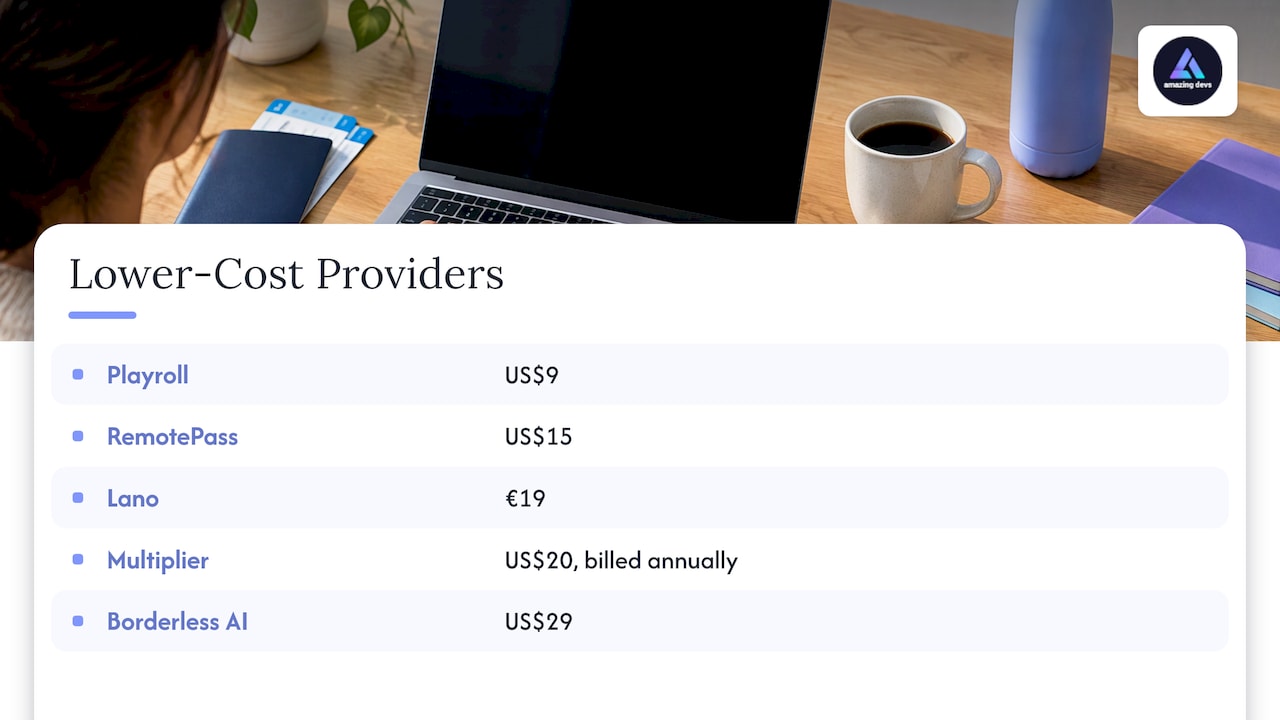
Playroll (US$9), RemotePass (US$15), Lano (€19), Multiplier (US$20 billed annually) and Borderless AI (US$29) are the lower-cost and newer names in the EOR Ledger comparison. They deserve a look if your team is small and your countries are common ones. Confirm that each of your target countries is on the provider’s list before you compare price.
How to choose: six criteria that matter
- Country list, not country count. A provider with 180 countries is no use if one of your three countries needs a local partner that adds weeks. Write down your countries and ask for the delivery model in each.
- Who runs the payroll. Self-service means your finance team does the work. Expert-run means the vendor does. The model can differ by country, as Deel’s US and Canada self-service shows.
- All-in price. Ask for setup fees, minimums, payment fees and statutory fees in writing. Compare the total per employee, not the headline.
- Integrations. Check your accounting and HR stack. Deel lists NetSuite, QuickBooks, Xero, SAP, Sage Intacct, BambooHR, HiBob, Workday and others, and Papaya Global advertises connectors for HCM, HRIS and ERP systems, per the research on each vendor’s integration pages.
- Review quality. Look at volume as well as score, and read the complaints. Support speed and integration accuracy are the recurring themes. A roundup of HR software can help you see how user feedback shapes a shortlist.
- Tax handling in the US. For US employees, confirm the vendor handles federal, state and local taxes and files the quarterly and year-end forms. ADP’s SmartCompliance page lists registrations, filings, remittances and agency-notice management across those levels, a useful checklist for any vendor.
A worked example: three engineers in Brazil
Say a US startup wants three senior developers in Brazil. There are three routes.
- Open a Brazilian entity and use global payroll. You pay a payroll fee per employee, but you also carry the entity setup, accounting and legal overhead.
- Use an EOR. No entity is needed, but you pay the EOR’s fee for each worker on top of salary.
- Use a nearshore partner. The partner finds, assesses and places the developers and manages the contracts, so you pay for matched developer hours instead of assembling payroll infrastructure.
The third route is what we do. For a team whose real goal is engineering capacity, comparing payroll vendors is often a detour. If you do go the contractor route yourself, our guides on paying foreign contractors and handling international contractor payments cover the US compliance side.
Our perspective
We talk to US founders and engineering leaders every week who start with a payroll question and end up with a hiring question. They search for global payroll because they want a developer in Brazil, and nobody told them there is a shorter path.
Global payroll tools are good at paying people you have already found and employed. They do not find the developer, check whether that person fits your stack and your culture, or remove the contract paperwork. Our approach is built around that gap: a rigorous recruitment and assessment process for technical and cultural fit, then contract management and the bureaucracy handled for you.
That is why we put hiring first and payroll second. If you want dedicated, pre-vetted Brazilian developers, including AI-enabled engineers, working in time zones close to yours, you can scale without opening an entity or learning another country’s employment rules. Payroll platforms remain the right tool when you employ staff directly in many countries. For engineering talent from Brazil, we aim to make that work disappear.
Gabriel
Hiring Brazilian developers without a payroll stack
If your reason for researching payroll is a plan to staff engineering from Brazil, look at our nearshore staff augmentation service. We handle sourcing, technical and cultural fit assessment and contract management, and you get developers who work as part of your team.
Our Team Extension Model fits companies that want dedicated developers embedded in an existing squad, and our nearshore QA contractors cover testing. For the timeline, see how to hire Brazilian developers without a local entity. Weighing regions? Our comparisons of LATAM and Eastern Europe and Brazil and Mexico can help. Pricing is scoped to your roles, so talk to us for a quote.
Shortlist by company profile
- Seed to Series A, a few countries: start with the lower-priced options and Deel or Remote, and confirm country coverage first.
- Scale-up with several entities: Deel, Remote and Papaya Global are the leading candidates. Compare the expert-run versus self-service model in each country.
- Enterprise already on a US payroll vendor: ADP Global Payroll or Rippling can keep one system of record.
- Engineering hiring in Brazil specifically: use a nearshore partner and avoid the payroll build altogether.
FAQ
What is the cheapest global payroll provider?
In the EOR Ledger comparison dated October 23, 2026, Playroll is the lowest at US$9 per employee per month. RemotePass follows at US$15, and Multiplier at US$20 billed annually. Fees for setup, minimums and payments can change the real cost, so request a full quote.
Is global payroll the same as an employer of record?
No. With global payroll, you are the employer and the provider processes pay and taxes. With an EOR, the provider is the legal employer in the country. Choose payroll if you have an entity, and EOR if you do not.
Which provider covers the most countries?
Coverage claims vary by product and by source. Deel is listed at 130+ countries for payroll, ADP at 140+ and Remote at 100+. Check your specific countries, since the delivery model can differ for each one.
Do I need a payroll provider to hire developers in Brazil?
Not if you work with a nearshore partner that manages contracts for you. At Amazing Devs we handle sourcing, assessment and contract management, so you do not have to set up local payroll for those developers.
Sources
- Best global payroll providers and services: prices compared (EOR Prices)
- Global Payroll Pricing 2026 (EOR Ledger)
- Deel Payroll Reviews 2026 (G2)
- Papaya Global Reviews 2026 (G2)
- Best Multi-Country Payroll Software 2026 (Capterra)
- SmartCompliance for Payroll Taxes (ADP)
- 7 Best HR Software for E-commerce Stores in 2026