Rippling vs Deel: Which Fits a U.S. Team Hiring Developers?
Choose Rippling if most of your workforce is in the U.S. and you want HR, payroll, IT and finance on one system. Choose Deel if your main job is hiring and paying people in many countries without opening local entities. Neither platform finds or vets engineers for you. If your real bottleneck is getting skilled developers on the team, that is a separate decision, and we cover it below.
TL;DR
- Rippling is a unified HR, IT and finance system with global payroll and EOR added as modules. It suits U.S.-first companies adding some international hires.
- Deel is built around employer of record (EOR) and contractor payments. It suits companies that hire mostly abroad.
- Deel publishes per-worker prices, starting at $49 per contractor and $599 per EOR employee per month. Rippling quotes by request, with core HR starting around $8 per employee per month.
- Both are employment and payroll tools. Neither sources or assesses developers, so many teams pair a platform with a talent partner.
- Check the Rippling and Deel legal dispute as part of vendor due diligence. It is unresolved, and nothing has been proven.
Table of Contents
- What each platform actually is
- Rippling vs Deel at a glance
- Pricing: published versus quoted
- Global hiring and compliance
- Ease of use, implementation and support
- Hiring developers: what the platforms do and do not do
- How to choose: a short decision guide
- The Rippling and Deel lawsuit: what is established and what is alleged
- When a platform is not the whole answer
- Add vetted Brazilian developers to your team
- FAQ
- Sources
What each platform actually is
The two products come from opposite directions, and that explains most of the differences you will see in a demo.
Rippling started as a workforce system with a single employee record at the center. Payroll, benefits, device management and IT sit on that record, and EOR was added later as another module. A 2026 comparison by Rework describes Rippling as a platform for U.S.-first companies that are adding global hires.
Deel started as a global employment platform built on EOR and contractor payments. It has since expanded into HR, payroll, benefits, hiring and mobility. The same Rework analysis frames Deel as the better fit for international-first teams.
In practice that means:
- Rippling is the system of record for the whole company. Hiring someone abroad is one more workflow inside it.
- Deel is the system for the people who sit outside your home entity. HR features are layered on top.
A review from PayrollRated reaches the same conclusion. Rippling wins for U.S.-heavy or mixed domestic and international teams, and Deel wins when the main problem is hiring and paying workers across many countries. Headcount geography is the deciding factor.
Rippling vs Deel at a glance
| Criteria | Rippling | Deel |
|---|---|---|
| Core idea | One employee record for HR, IT, payroll, finance | Global EOR and contractor payments, expanded into HR |
| Best for | U.S.-first teams, some global hires | International-first teams, many countries |
| Pricing model | Quote-based; core HR from about $8 per employee per month plus a monthly base fee | Published per-worker prices |
| Contractor fee | About $30 per contractor per month, per one review | $49 per contractor per month |
| EOR | Quoted on request; estimates of $499 to $599 per employee per month | From $599 per employee per month |
| Workflow automation | Deep, configurable automations | Lighter, simpler to learn |
| Native IT and device management | Yes | Offered as a Deel IT module |
The sections below explain each row, with sources.
Pricing: published versus quoted
This is where the two differ most visibly.
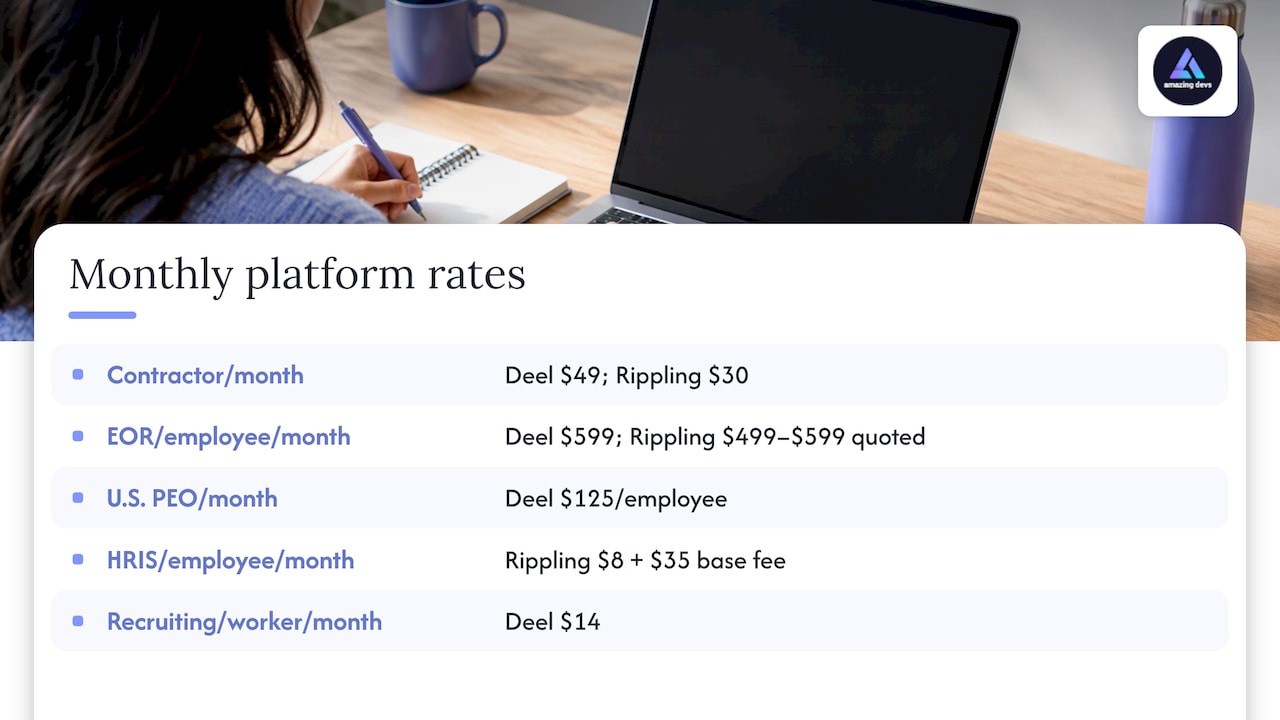
Deel publishes its rates. According to SpotSaaS’s September 2026 check, Deel charges $49 per contractor per month, $325 per contractor of record per month, $599 per EOR employee per month, $125 per U.S. PEO employee per month and $14 per worker per month for recruiting. The same source notes that Deel states there are no long-term contracts and that EOR fees cover payroll processing and tax filings.
Rippling does not publish a rate card. WhichPayroll reports that core HRIS starts at $8 per employee per month plus a $35 monthly base fee, and that EOR is quoted on request, with estimates between $499 and $599 per employee per month. It also lists Rippling contractor payments at $30 per contractor per month, against $49 at Deel.
For a single full-time hire abroad through an EOR, Eightx’s June 2026 review finds Rippling, Deel and Gusto all landing near $599 per month. At that point the decision moves to country coverage and support rather than price.
Costs that sit outside the sticker price
Two things are worth modeling before you sign with either vendor:
- Currency and withdrawal costs. Eightx reports a Deel FX markup of 0.6% to 2% above the mid-market rate, plus $5 to $25 in SWIFT withdrawal fees. The same review says these can push real cost well above the headline price for some payment patterns. Ask for your own corridors to be priced.
- Platform fees and add-ons. Rippling’s total depends on the modules you select, and some carry a monthly base fee. Eightx’s analysis cites roughly 270 anonymized buyer transactions putting the average Rippling contract at about $45,000 a year. That figure reflects larger, multi-module buyers, so treat it as a ceiling check rather than a forecast for a ten-person startup.
Global hiring and compliance
Both vendors cover a lot of countries, but the numbers are not directly comparable, and vendors count differently.
- Deel supports full EOR employment in 130+ countries and contractor payments in 120+ currencies, per SpotSaaS.
- Rippling states support for global workforces through payroll, EOR and contractor management in 185+ countries. Rework’s analysis puts its EOR at 80 countries and its native global payroll at 10 countries.
- Other aggregators list different Rippling EOR counts. Ask any vendor to confirm in writing the exact countries you plan to hire in.
On compliance, Deel leans on scale and tooling. Its own blog describes an AI-powered compliance hub monitoring wage thresholds, pension rules and leave policies across 150+ countries. Deel also pairs its contractor product with misclassification protection and localized contracts, according to WhichPayroll. Rippling’s strength is a tighter link between compliance and the rest of HR. Its contractor safeguards are described as lighter.
If you are weighing whether a given developer should be an EOR employee or an independent contractor, our guide to EOR vs contractor walks through the decision. For the tax and payment side of the contractor route, see how to pay foreign contractors from the U.S.
Ease of use, implementation and support
Deel is generally described as faster to implement and easier to learn. One June 2026 comparison summarizes it as winning on global hiring and compliance, while Rippling wins on depth and automation. A contractor on Deel is typically onboarded within 24 to 48 hours, and EOR employees in one to two weeks depending on the country, per FirmTools.
Rippling asks for more setup and returns more depth. Peorient’s May 2026 review gives these timelines:
- 2 to 3 weeks for Core HR plus payroll, under 50 employees, U.S. only
- 4 to 8 weeks for the full stack
- 6 to 12 weeks for multi-country with global payroll
- 8 to 16 weeks for enterprise, 500+ employees and multiple entities
The same review says standard plans get email and chat support, with phone support reserved for accounts of 150+ employees. On user ratings the two are level: Eightx cites a 4.8 out of 5 G2 rating for both.
If you are a small team running a smooth onboarding process matters well beyond payroll. This practical piece on service business onboarding practices covers the people side that a platform cannot automate.
Hiring developers: what the platforms do and do not do
For an engineering leader, the question is narrower than “which HR system is better.” It is how you get a strong developer on payroll or on contract, legally, in a few weeks.
Deel is widely used by technology companies to hire developers, designers and other technical contractors internationally, according to The Software Scout. Contractor workflows are core to it, including converting a contractor to an employee later. Rippling suits teams that want a new engineer’s laptop, apps, benefits and payroll all provisioned from one record.
Both do the same thing at the start of the process: nothing. They do not source candidates, run a technical assessment or judge whether someone will fit your team’s working style. Deel offers a recruiting add-on from $14 per worker per month, but a platform fee is not a vetting process. You still need a pipeline of qualified engineers, interviews and a way to make sure the person who joins can do the job.
That is the gap a talent partner fills. Time to hire is the number most engineering teams feel, and our write-up on how teams reach a 28-day developer hire shows where the days go.
Our perspective
We see the Rippling versus Deel question from the other side of the table. Teams come to us after they have picked an HR platform and still have an open engineering seat.
A platform answers how a person gets employed and paid. It does not answer whether the person is right for your codebase, your time zone and your team. We believe that second question deserves the same rigor as the first.
That is why our process combines technical assessment with a check on cultural fit and business alignment. We hire Brazilian developers who work in hours that overlap with U.S. teams, and we handle the contracts and the bureaucracy so you do not carry that load. Our team also supports you after the placement, not only before it.
Our advice is to decide the platform by headcount geography, and decide the talent route by how fast you need proven engineers. The two choices work well together.
Gabriel
How to choose: a short decision guide
Use these questions in order.
- Where will most of your people sit? If the large majority are in the U.S., Rippling’s single record is hard to beat. If you are hiring across many countries, Deel’s EOR and contractor tooling is the more direct match.
- Do you want published prices? Deel lists them. Rippling will quote after a conversation, which can be a fit if you want a bundle across HR, IT and finance.
- How many modules do you need? If you only need to employ a handful of people abroad, you may not need a full HR suite. If you want IT, spend and HR together, a unified system saves integration work.
- How much automation do you want? Rippling advertises 150+ cross-functional workflow automations and a configurable workflow studio. Note that this claim, and its comparison with Deel’s automations, comes from Rippling’s own comparison material, so see it in a demo.
- Who finds and vets the developers? This is outside both products. Decide it before you decide the platform, because it sets your timeline.
Small teams often do not need either full suite on day one. A company hiring two or three engineers abroad may be served by a staff augmentation partner that manages the contract and local compliance. Our page on nearshore staff augmentation explains that model, and staff augmentation pricing breaks down what teams typically pay.
If you are comparing HR tools for a different kind of business, such as an online store, this HR software comparison shows how the shortlist changes.
The Rippling and Deel lawsuit: what is established and what is alleged
You will see this dispute all over the search results for these two names, so here is the careful version.
Rippling sued Deel in March 2025 in the U.S. District Court for the Northern District of California. It alleged that Deel paid a Rippling employee, Keith O’Brien, to secretly gather confidential information. Bloomberg reported on the case, including claims of civil RICO and trade secret theft against Deel and several of its executives, in its July 2026 coverage.
According to YesPress’s summary, in February 2026 the judge let Rippling’s federal RICO, RICO-conspiracy and trade-secret claims survive dismissal. Deel filed its own counterclaims in March 2026 against Rippling, its CEO and O’Brien. They allege that Rippling used a fake customer identity to reach proprietary EOR materials. The same source is clear that no court has found Deel liable, and the February order did not decide whether Rippling’s allegations are true.
So the fair reading is that these are allegations on both sides, in active litigation. BeyondPayroll argues that for companies evaluating either vendor for EOR, contractor management or international payroll, the reported criminal investigation is a relevant due-diligence input. A practical response is to ask each vendor about continuity plans, data handling and contract exit terms. It should not decide your choice on its own.

When a platform is not the whole answer
Most startups that search this comparison are not really choosing software. They are trying to add engineers without a six-month hiring cycle, an entity abroad or a payroll project. A platform solves the paperwork once you have a candidate. It does not give you the candidate.
Our Team Extension Model is built for that case. We recruit and assess Brazilian developers, including AI-enabled and AI-native engineers as well as traditional software roles, and we manage the contract so you can scale without the usual hiring overhead. For a QA gap, we also place nearshore QA contractors.
Add vetted Brazilian developers to your team
If you have settled on an HR platform and still need engineers, we handle sourcing, technical and cultural assessment, and contract management, so you work with pre-vetted developers rather than a stack of resumes.
Tell us the roles and the stack through Amazing Devs, and we will start from what your team needs.
FAQ
Is Rippling better than Deel?
Neither wins on every count. Rippling is stronger for U.S.-heavy teams that want HR, IT, payroll and finance in one system. Deel is stronger for companies whose main task is hiring and paying workers in many countries. Count where your people will sit, then choose.
How much do Deel and Rippling cost?
Deel publishes its prices, starting at $49 per contractor and $599 per EOR employee per month. Rippling quotes by request, and reviewers report core HR starting around $8 per employee per month plus a monthly base fee. Your total will depend on the modules you choose and on currency and withdrawal costs.
Can I use Deel or Rippling to hire software developers abroad?
Yes, both can employ or pay developers internationally, through EOR or contractor products. They handle the employment and payment side only. Sourcing and assessing the engineers is a separate step that you or a talent partner has to do.
Is the Rippling and Deel lawsuit settled?
No. As of the latest reports, the claims and counterclaims are proceeding, and no court has found Deel liable. Treat it as a due-diligence item and ask each vendor how it protects your data and your continuity.
Should a startup start with EOR or with a contractor model?
It depends on how the person will work and on local rules. Our guide to EOR vs contractor covers the trade-offs, and your tax adviser should confirm the classification for your situation.
Sources
- Rippling vs Deel in 2026, Rework
- Rippling vs Deel (2026), PayrollRated
- Rippling vs Deel 2026: Pricing, Global Hiring, SpotSaaS
- Deel vs Rippling 2026: EOR vs Unified HR, WhichPayroll
- Deel for Ecommerce review, Eightx
- How Much Does Rippling Cost, Eightx
- Best Global Payroll Software, FirmTools
- Rippling Review 2026, Peorient
- Deel vs Rippling 2026, The Software Scout
- Deel moves to strike witness in Rippling lawsuit, Bloomberg
- The Payroll Rivals Who Turned Trust Into Evidence, YesPress
- Rippling-Deel RICO claims survive, BeyondPayroll