Greenhouse vs Lever: Which ATS Fits Your Hiring in 2026?
Choose Greenhouse if you hire at steady volume across many teams and want consistent, scorecard-driven evaluation and deep reporting. Choose Lever if your recruiters spend most of their time sourcing and nurturing candidates and want that pipeline in the same record as applicant tracking. Both are quote-based, so the real decision comes down to your hiring model, your headcount and how much setup work you can absorb.
This guide compares the two on what matters when you hire engineers: process, sourcing, AI, integrations, cost, implementation and reviews. It also covers what no ATS can do for you, which is supply the candidates.
TL;DR
- Greenhouse is built around structured hiring: interview kits, scorecards and consistent evaluation. It suits larger teams with many hiring managers.
- Lever combines an ATS and a recruiting CRM in one platform. It suits sourcing-heavy teams that nurture passive candidates.
- Neither publishes a full price list. Greenhouse prices by company headcount, and Lever by company size, volume and features, so request quotes from both.
- Capterra scores are close: Greenhouse 4.5 and Lever 4.6, with Lever ahead on ease of use.
- An ATS organizes candidates you already have. If your pipeline is thin, a sourcing partner fills it.
Table of Contents
- The quick verdict
- What each platform is
- Side-by-side comparison
- Recruiting workflow and structured hiring
- AI, integrations and reporting
- Pricing in the United States
- Implementation, migration and what to budget
- What recruiters and customers report
- Which one should you choose?
- Perspective
- Fill the pipeline your ATS will track
- FAQ
- Sources
The quick verdict
The two platforms overlap on the basics. Both track applicants, schedule interviews, manage offers and report on funnels. They differ in what they treat as the center of the job.
Greenhouse treats the interview process as the center. You define interview plans, attach kits and scorecards, and every interviewer scores candidates against the same criteria. Lever treats the relationship as the center. Candidates, whether applicants or prospects you found yourself, live in one CRM-style record that moves from nurture to active pipeline.
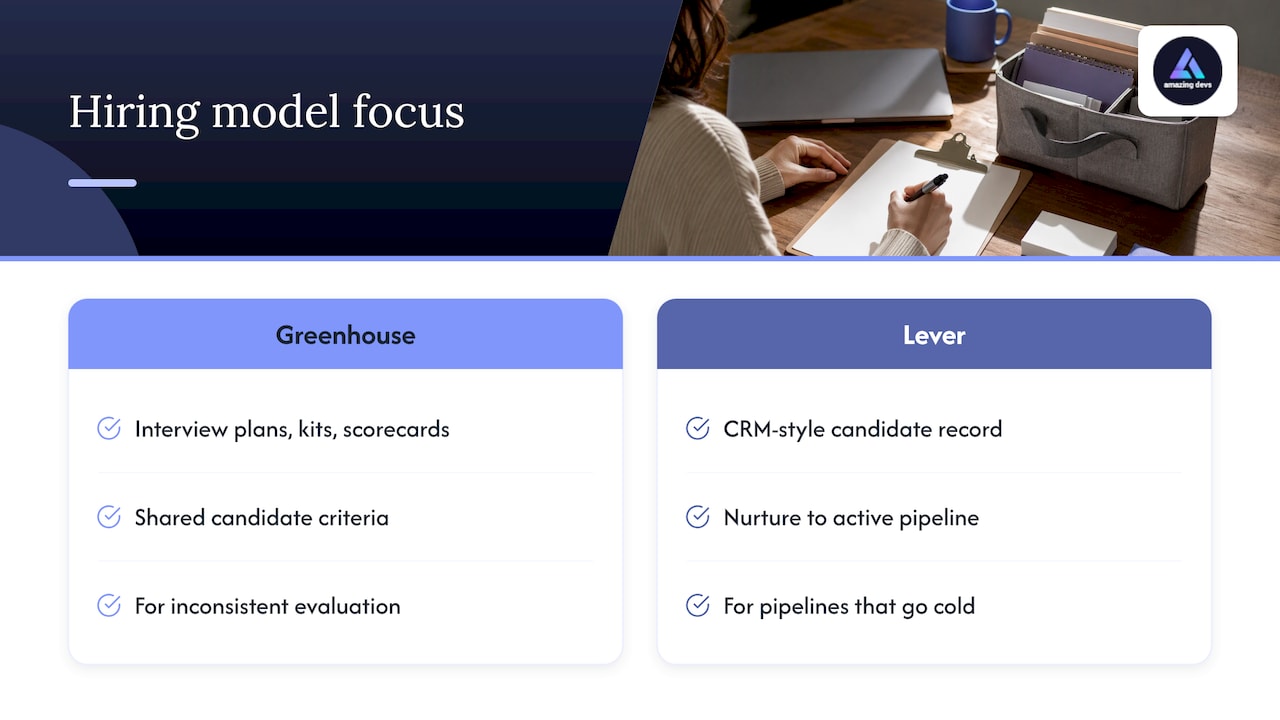
A useful shortcut: if your biggest hiring problem is inconsistent evaluation, lean Greenhouse. If your biggest problem is a pipeline that goes cold between roles, lean Lever. One review site’s summary of the market says the same thing: neither approach is wrong, they are optimized for different hiring models, and a mismatch means fighting the tool for a year.
What each platform is
Greenhouse
Greenhouse describes itself as a place for sourcing, interviewing and ATS tools in one system, including an AI-powered ATS for the full hiring lifecycle. Its plans are called Core, Plus and Pro. One comparison site reports 7,500+ customer companies for Greenhouse.
Lever
Lever calls itself a modern applicant tracking system and recruiting CRM that combines candidate relationship management, automation, analytics and collaborative hiring tools in one platform, built for small, mid-sized and enterprise organizations. It is owned by Employ Inc. and reports 26k+ hiring teams.
Side-by-side comparison
| Criterion | Greenhouse | Lever |
|---|---|---|
| Core idea | Structured hiring with kits and scorecards | ATS and candidate CRM in one record |
| Best for | Steady volume, many hiring managers, deep reporting | Sourcing-heavy teams nurturing passive talent |
| Plans | Core, Plus, Pro (quote-based) | Custom quote |
| AI highlights | Notetaker, talent matching, fraud and spam detection | Screening and matching, unlimited interview transcripts, fraud signals |
| Integrations | Hundreds of pre-built | Major HRIS products and job boards |
| Typical implementation | 6 to 12 weeks | 4 to 8 weeks |
| Capterra rating | 4.5/5 (766 reviews) | 4.6/5 (654 reviews) |
The sections below unpack each row. Implementation times come from a single comparison, so treat them as planning ranges and ask each vendor for your own estimate.
Recruiting workflow and structured hiring
This is where the two feel most different day to day.
In Greenhouse, a hiring manager opens a job, picks or builds an interview plan and assigns each stage a kit with questions and a scorecard. Interviewers submit scores before seeing others’ feedback in a well-run process, which keeps evaluation comparable across candidates. The Core plan includes structured interview kits and scorecards, plus sourcing and CRM, an AI notetaker, scheduling, reporting and SSO.
In Lever, the pipeline is built around the candidate relationship. Recruiters can nurture passive candidates and move them into active pipelines without re-entering data. Its core platform also includes ATS and CRM, dashboards and AI interview transcripts.
For engineering hiring, the practical implications are these:
- Consistency across interviewers. If five engineers interview each candidate, Greenhouse’s scorecard discipline makes comparisons easier. You can build the same rigor in any tool with a template-first scoring matrix.
- Passive candidates. Senior engineers rarely apply cold. Lever’s CRM-first record fits a team that messages engineers over months before a role opens.
- Technical screens. Neither platform replaces your coding assessment. Pair either with a clear policy such as capping tests at 90 minutes.
AI, integrations and reporting
AI features
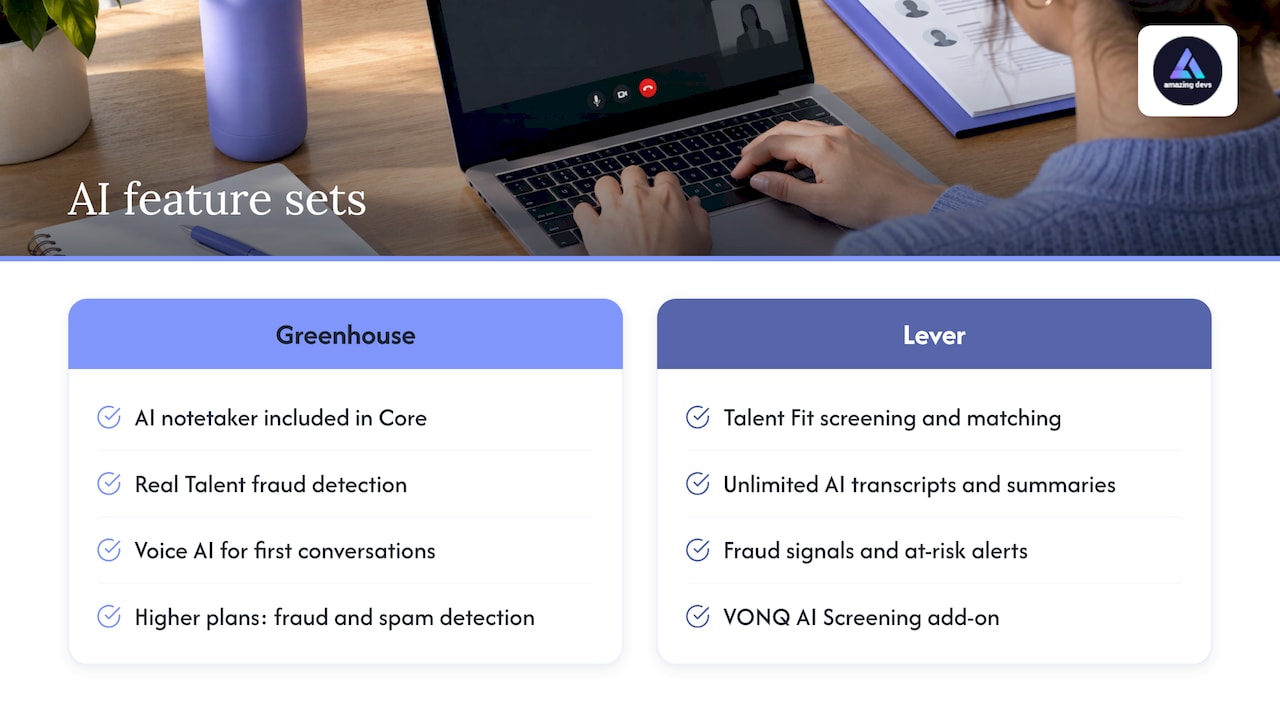
Greenhouse lists an AI notetaker (included in Core), Real Talent fraud detection and Voice AI for structured first conversations. Its higher plans add fraud and spam detection and AI-powered report filters. Greenhouse’s own blog says its AI tools follow a governance posture that includes monthly third-party bias audits with public results.
Lever’s AI features page lists AI screening and matching (Talent Fit), unlimited AI interview transcripts and summaries, fraud signals and at-risk candidate alerts, with AI Screening by VONQ as an add-on. Lever says its AI is designed to be transparent and explainable, and that recruiters always keep the final decision.
If you screen engineering candidates with AI, keep a human in the loop either way. Our guide on skills-based hiring and responsible AI covers how.
Integrations
Greenhouse has the broader marketplace. One comparison counts 500+ pre-built integrations across HRIS, background checks, assessments, scheduling, sourcing and analytics. Its breadth matters most if your stack already exists. With Lever, check any niche tool you depend on before you sign, since a missing native integration is the main risk.
Reporting and compliance
Greenhouse’s reporting and analytics are a strength, and one analysis finds its EEO reporting, OFCCP support and audit-ready trails more mature than Lever’s. For security, a professional review lists ISO 27001:2022, ISO 27701:2019 and annual SOC 1 and SOC 2 Type II audits for Greenhouse. If you are a federal contractor or have strict audit needs, that weighs toward Greenhouse.
Pricing in the United States
Neither vendor posts a complete price. Greenhouse says pricing is customized to hiring needs, volume and organizational complexity. Lever requires a custom quote based on company size, hiring volume, feature needs and implementation.
Public buyer reports vary widely, which is itself a signal to collect real quotes:
| Source (2026) | Greenhouse | Lever |
|---|---|---|
| Roles.at, citing Vendr data | Median about $27,000/year | Median about $15,801/year |
| Curriculo, 3-year cost for a 50-person startup with 10 seats | About $105,000 | About $95,000 plus LinkedIn Recruiter |
| Prepzo, 50-person company, year one all-in | Near $55,000 | Near $40,000 |
A few things drive the gap between reports:
- Headcount. Greenhouse’s standard contract is a one-year prepaid subscription priced on total company headcount, with discounts for two- and three-year prepayment.
- Add-ons. One analysis says add-ons can inflate Lever’s base by 40 to 60%, and that sourcing in practice often needs LinkedIn Recruiter at $8,000 to $10,000 per seat per year.
- Implementation fees. Roles.at reports Greenhouse implementation at $2,000 to $8,000 and Lever at $5,000 to $25,000 plus data migration.
- Renewals. Lever contracts are annual and auto-renew, with renewal increases of 8 to 12% reported in reviews.
The takeaway: ask both vendors for a quote that includes implementation, add-ons you need and the renewal uplift, then compare the three-year number, not the sticker price.
Implementation, migration and what to budget
Greenhouse implementations typically run 6 to 12 weeks with onboarding billed separately. Lever’s typically run 4 to 8 weeks. Plan interviewer training, scorecard design and job templates in that window, not after.
Switching later is costly. Moving between the two takes 4 to 8 weeks of data import, integration rebuilds, workflow re-creation and retraining. Leaving Lever tends to be harder because CRM data sprawls. Its self-serve export gives separate CSVs for candidates, opportunities and feedback, and the relationships between files must be rebuilt on import.
So choose with a two-to-three-year view. If you expect to double headcount, pick the platform that matches where you will be, not where you are now.
What recruiters and customers report
On Capterra, Greenhouse scores 4.5/5 from 766 reviews and Lever 4.6/5 from 654 reviews. Lever leads on ease of use (4.6 vs 4.4) and customer service (4.6 vs 4.4). Reviewers praise Greenhouse’s structured scorecards but mention reporting limits. Lever reviewers like centralized candidate data and collaboration, though some report interface friction, reporting problems and support issues.
On G2, a review roundup cites Greenhouse at 4.4/5 from 3,900+ reviews and Lever at 4.3/5 from 2,100+. The scores are close enough that fit, not rating, should decide.
Which one should you choose?
One comparison puts Greenhouse best for companies with 300+ employees, many hiring managers and a long list of HR tools, and Lever for sourcing-heavy teams that want ATS and CRM in one record. Another says Lever targets companies with 150+ employees and dedicated talent-acquisition teams. Use these as rough guides, not rules.
| If this describes you | Lean toward |
|---|---|
| Many hiring managers, need consistent scoring | Greenhouse |
| Strict compliance, audit trails, EEO reporting | Greenhouse |
| Large existing tool stack to connect | Greenhouse |
| Recruiters proactively source and nurture talent | Lever |
| Want a simpler interface and faster setup | Lever |
| Small team, hiring a few engineers a year | Get quotes from both, and weigh cost per hire |
If you are also weighing other categories of HR tools, this HR software comparison for e-commerce shows how another set of buyers frames the decision.
Perspective
We place Brazilian developers with US companies, so we see the step after the ATS decision every week. The software is rarely what slows an engineering hire. The slow part is a pipeline with too few qualified, culturally aligned candidates, and a hiring team stretched across too many open roles.
Whichever platform you pick, a few habits matter more than the logo. Write the scorecard before you open the role. Keep technical screens short and relevant. Check for cultural fit with real behavioral questions, not gut feel. We have written about each, from behavioral interview questions for developers to what it costs to recruit developers.
Our own approach is built on this view. We source, assess for technical and cultural fit, and manage the contracts, so your team spends its interview time on pre-vetted finalists instead of a wide, noisy funnel. Pair a good ATS with a strong source of candidates and both do their job better.
Gabriel
Fill the pipeline your ATS will track
An ATS tracks candidates, but it does not find them. If you are hiring developers and want a shorter route from open role to productive engineer, we provide dedicated, pre-vetted Brazilian developers through nearshore staff augmentation. We handle sourcing, technical and cultural fit assessment and contract management.
If you want to extend an existing team rather than build a new one, see our Team Extension Model. Brazilian engineers can work in time zones close to the US, and our guide to time zone management shows how teams keep coordination tight. Candidates who come through us can flow straight into whichever ATS you use.
FAQ
Is Lever an ATS?
Yes. Lever describes itself as an applicant tracking system and recruiting CRM in one platform. That means you can track applicants and also manage relationships with prospects you have not yet hired.
Is Greenhouse or Lever cheaper?
It depends on your headcount and add-ons. Several public reports put Lever lower, for example a median of about $15,801 vs $27,000 a year, but both are quote-based. Compare three-year totals including implementation, add-ons and renewals.
Which is better for hiring software engineers?
Both work. Greenhouse suits teams where many engineers interview and score candidates consistently. Lever suits teams that proactively source and nurture engineers over time. Many teams also add a sourcing partner so the funnel has enough qualified candidates.
How long does it take to switch between them?
Plan on 4 to 8 weeks for data import, integration rebuilds, workflow re-creation and retraining. Leaving Lever is usually harder because of CRM data. Decide with a multi-year view to avoid moving twice.
Sources
- Greenhouse | Orchestrated Hiring System
- Greenhouse Plans & Pricing
- Greenhouse blog: 13 best ATS software
- Lever | Modern Recruiting Software & ATS
- Lever AI features
- Lever pricing
- AppBreakup: Greenhouse vs Lever
- SaaSVersus: Ashby vs Greenhouse vs Lever
- AIToolsBakery: Greenhouse vs Lever
- ERP Research: Greenhouse review
- Roles.at: Greenhouse vs Lever
- Curriculo: ATS pricing transparency report
- Prepzo: Lever vs Greenhouse
- Select Software Reviews: Lever vs Greenhouse
- Marxel: ATS migration costs
- JuggleHire: JuggleHire vs Lever
- Rework: Greenhouse vs Lever
- Capterra: Greenhouse vs Lever
- HR software comparison for e-commerce