Best Contract Management Software in 2026: 14 Tools Compared
The best contract management software depends on your size and your contract volume. Small teams tracking renewals do well with a flat-priced repository such as ContractSafe or ContractWorks. Fast-growing startups tend to pick Juro, SpotDraft or PandaDoc. Larger companies with complex approvals look at Ironclad, Agiloft, Conga, DocuSign CLM or Icertis. Below you will find who each tool fits, what US buyers report paying, and what to check before you sign.
TL;DR
- Under 50 people, mostly storing and renewing contracts: a flat-priced, unlimited-user tool (ContractSafe, ContractWorks) or a budget full CLM (Concord) is usually enough.
- Startups that want business teams to self-serve: Juro, SpotDraft and PandaDoc are the names that recur in 2026 startup comparisons.
- Enterprise workflows and deep integrations: Ironclad, Agiloft, Conga, DocuSign CLM and Icertis, with quote-based pricing that reportedly starts in the tens of thousands per year.
- Rollout is the real cost: most teams report implementation taking longer than planned, so budget time and stakeholder buy-in as well as the license.
- Hiring contractors? Software tracks the paper. Who signs it, and under which legal structure, is a separate question we cover near the end.
Table of Contents
- What contract management software actually does
- Who tops the 2026 comparisons
- Side-by-side: fit and reported US pricing
- Best picks by team type
- AI features: what to look for
- Security and integrations to compare
- Plan the rollout before you pick
- Contracts for developers: what software won’t settle
- Hiring developers without the contract overhead
- FAQ
- Sources
What contract management software actually does
Contract lifecycle management (CLM) covers everything that happens to an agreement from the first request to the last renewal. Agiloft describes eight stages: request and initiation, contract generation, review and negotiation, approvals, execution, obligation and compliance management, renewal or termination, and record keeping. Juro’s buyer’s guide frames it as seven stages and notes that in 2026 CLM systems treat AI as a core component rather than an add-on.
When you compare tools, ask which stages you need today. A team that only needs a searchable home for signed PDFs and renewal alerts does not need a full negotiation and approval engine. ContractWorks, for example, spans requests, drafting, negotiation, e-signature, repository, analytics, obligations and renewals, so even mid-priced tools often cover the whole chain.
Who tops the 2026 comparisons
No single ranking agrees with another, which is itself useful information. Rework’s guide ranks 16 platforms, including Ironclad, DocuSign CLM, Icertis, Agiloft, Conga CLM, Juro, LinkSquares, Concord, SpotDraft, Gatekeeper, ContractSafe, Sirion and PandaDoc. The ISG Buyers Guide for CLM 2026, published November 3, 2026, evaluates 18 providers and ranks Conga, CobbleStone and Oracle as the top three overall. It rates CobbleStone, Conga, Docusign, Ironclad, Leah and Oracle as Exemplary.
Analyst rankings tend to favor breadth for large enterprises. Startup-focused roundups favor speed and price. Decide which buyer you are before you read either.
Side-by-side: fit and reported US pricing
Most enterprise vendors do not publish prices, so the figures below are reported ranges from buyer guides, not quotes. Treat them as a planning range and request a current quote.
| Tool | Best fit | Reported US pricing |
|---|---|---|
| ContractSafe | Small teams tracking renewals and obligations | From $450/month, unlimited users |
| ContractWorks | Simple needs, cheap entry | From $425/month billed annually, unlimited users |
| Concord | Budget-conscious teams wanting full CLM | $499/month (Essentials) to $1,299/month (Enterprise), plus per-user charges |
| PandaDoc | Sales-led teams turning proposals into signed deals | $19 to $49/user/month on Starter and Business |
| Zoho Contracts | Teams already in the Zoho ecosystem | From $25/user/month billed annually |
| Aline | AI-first drafting and redlining | From $200/full user/month (10 users) |
| HyperStart CLM | Mid-size teams buying through AWS | $79 per user per month on AWS Marketplace |
| Juro | Fast-growing startups, business self-serve | Reported $15K to $60K+/year; custom plan |
| SpotDraft | Startups where legal must not be a bottleneck | Reported $5K to $50K+/year |
| Agiloft | Configurable, integration-heavy deployments | Reported from about $6K/year |
| Ironclad | Scaling companies needing enterprise workflows | Reported $30K to $150K+/year |
| DocuSign CLM | Teams already on DocuSign | Reported $10K to $100K+/year |
| Conga CLM | Revenue-linked contracting | Reported $15K to $60K+/year standalone |
| Icertis | Large enterprises | Reported $150K to $500K+/year at scale |
Most of the reported ranges come from Rework’s 2026 guide. Juro’s own pricing page says it builds a custom plan for each team, so its range is only an indication. Another view comes from a cost guide, which puts SMB tools at $600 to $11,000 a year, mid-market CLM at $15,000 to $60,000 and enterprise CLM at $40,000 to $150,000 or more.
Best picks by team type
Small teams and lean startups
If you manage a few hundred contracts and mainly need renewal alerts, flat-priced tools win on predictability. ContractSafe’s own guide suggests that for teams under 50 people, an unlimited-user plan beats per-seat pricing, and a light per-seat repository can be cheaper on paper for teams under five people but is built for storage rather than renewal tracking. Keep in mind that this is a vendor view, so weigh it against your own headcount math.
For a very small contract volume, one startup comparison notes that a Docs, Drive and spreadsheet setup can still be enough for a dozen contracts. Once renewals start slipping, move to a tool.
Fast-growing startups
General Legal’s August 2026 comparison pairs tools to situations:
- PandaDoc for sales-led startups converting proposals into signed contracts at high volume.
- Juro for fast-growing startups that want business teams to self-serve contracts.
- Contractbook for lean startups automating operational workflows.
- Concord for budget-conscious startups wanting full CLM without enterprise pricing.
- SpotDraft for startups that need legal to support the business without becoming a bottleneck.
- Ironclad for scaling startups that need enterprise-grade workflows before they are enterprise-sized.
A June 2026 startup ranking from Bind Legal cites Vendr medians of about $31,164 a year for Juro, $25,278 for SpotDraft and $40,000 for Ironclad. It also notes that teams with fewer than 50 contracts can begin with Google Docs.
Larger and complex organizations
When approvals branch by region, product line or deal size, you need configurable workflow. DocuSign CLM’s product page describes a drag-and-drop editor with 100+ pre-configured workflow steps. Agiloft pairs configurability with more than 1,000 integrations. For analytics across hundreds of existing contracts, LinkSquares is positioned around AI-powered visibility.
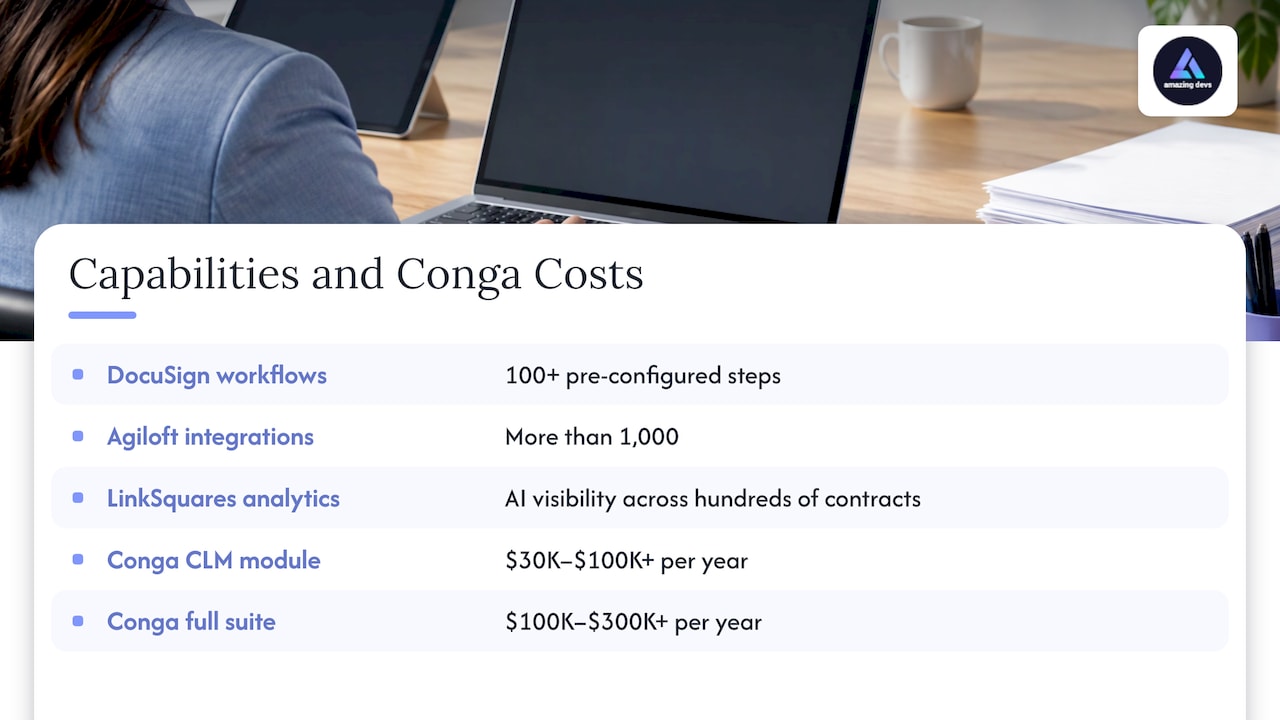
Conga’s pricing varies sharply by scope. One 2026 analysis puts the CLM module alone at $30K to $100K+ a year, the full suite at $100K to $300K+, and implementation at $50K to $165K over three to six months. Budget for that gap between the headline license and the total.
AI features: what to look for
Every vendor now advertises AI, so compare what it does inside your workflow:
- Drafting and review in Word. Spellbook’s comparison lists its own review, drafting and benchmarking inside Word.
- Contract intelligence and search. The same comparison lists Icertis’s Vera AI and Sirion’s agentic extraction with AskSirion conversational search.
- Playbook-based redlining. Aline says it runs multiple frontier models against an organization’s playbooks.
- Metadata extraction for renewals. HyperStart describes AI redlining, AI search and renewal metadata extraction.
ISG’s guide gives a sensible test for all of them: require AI-assisted findings to be explainable and open to human review, with decision traceability across the agreement lifecycle. Run your own real agreements through each shortlisted tool, including one that needs exception routing and one with obligations to track.
Security and integrations to compare
Contracts hold pricing, IP terms and personal data, so ask each vendor for certifications and hosting details in writing. Published examples show the level to expect:
- ContractSafe reports SOC 2 Type II, ISO 27001 and TX-RAMP Level 2, AES-256 encryption, SAML 2.0 SSO, and a policy of not using customer contracts to train AI models.
- Agiloft and Ironclad are reported with SOC 2 coverage and audit logging; Agiloft also reports ISO 27001 and 27701.
- LexisNexis CounselLink+ offers out-of-the-box connectors, open APIs and flat-file integrations for in-house legal teams.
Integration depth matters as much as the badge. PwC’s selection guidance tells evaluators to understand their technology landscape, including policy limits and the complexity of connected systems, before choosing.
Plan the rollout before you pick
The license is the visible part of the cost. PwC’s guidance says that failed implementations usually trace back to weak early stakeholder engagement, and that licensing, implementation and post-go-live support all belong in total cost of ownership.
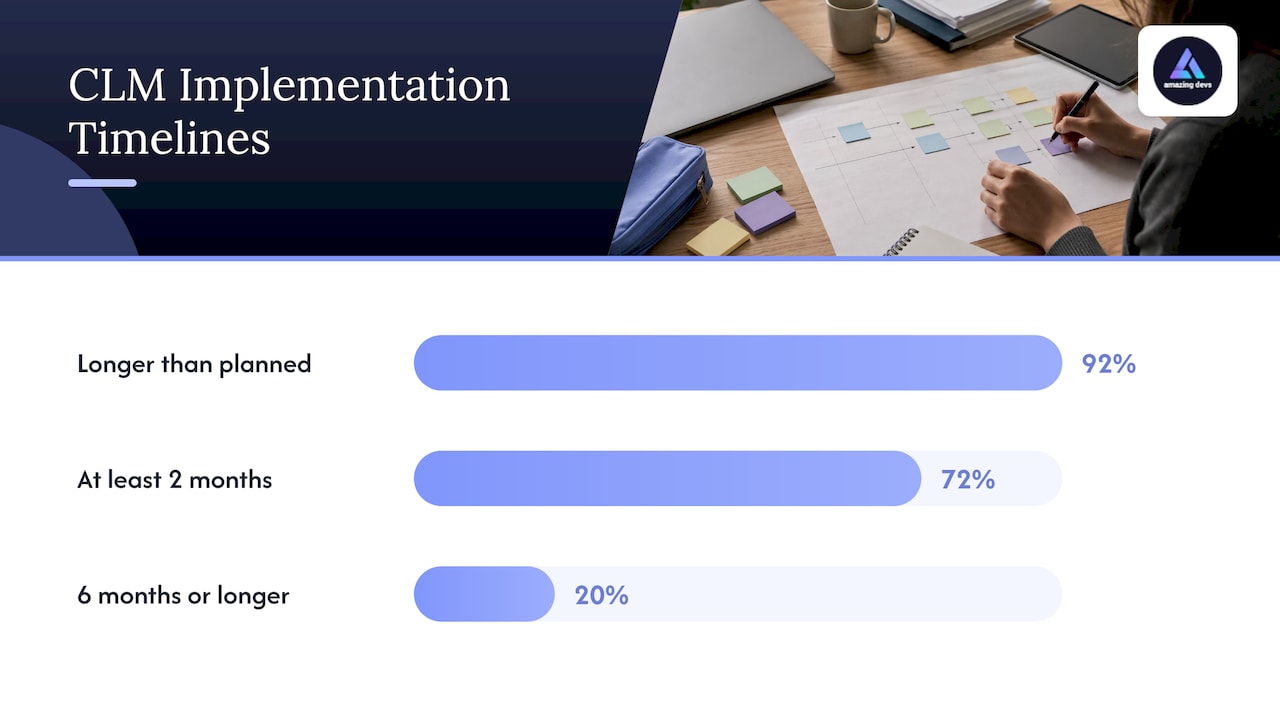
The numbers back this up. A July 2026 implementation guide citing Juro data says 92% of CLM implementations run longer than planned, 72% of teams took at least two months, and 20% took six months or longer.
A practical sequence:
- Pick one owner in legal or operations and one in sales or finance.
- List your top five contract types and the approvals each needs.
- Shortlist three tools and demo each with your own agreements.
- Confirm security documents and the integrations you need.
- Start with one contract type, then expand.
Approvals are where most workflows stall. If your team is small and approvals live in email, a clear quote approval process gives you the rules to automate before you configure any tool.
Our perspective on contracts and distributed engineering teams
We place Brazilian developers with US companies, so we see a side of contracting that CLM comparisons rarely cover. A contract tool stores and routes agreements well. It does not decide who employs the developer, who owns the code, or how offboarding works.
Our approach is built around handling that paperwork for you. We manage the contracts and the bureaucratic steps of a nearshore engagement, so your legal team is not drafting cross-border agreements from scratch for every hire. Your CLM then holds one clean agreement with us, instead of a growing pile of individual contractor files.
If you are choosing software because contractor agreements are multiplying, ask first whether the volume is the problem, or the model. For many engineering leaders, a managed staff augmentation relationship reduces the number of documents that need tracking at all.
Gabriel
Contracts for developers: what software won’t settle
Software helps with deadlines and approvals. The terms inside developer agreements still need care. Our guide to developer contract rules that protect IP covers the clauses engineering leaders should confirm, and our piece on NDAs for contractors covers confidentiality and offboarding. Once the paperwork is in place, performance management for contractors keeps the relationship productive. For jurisdiction-specific questions, talk to your own counsel.
Hiring developers without the contract overhead
If your contract backlog comes from hiring engineers, we can take that load off your team. Amazing Devs provides pre-vetted Brazilian developers through nearshore staff augmentation, with sourcing, technical and cultural-fit assessment, and contract management handled by us. Our Team Extension Model suits teams that want developers working as part of their own squad, and we also supply nearshore QA contractors.
Tell us the roles you need and we will match you with candidates, on the Amazing Devs site.
FAQ
What is the difference between contract management software and CLM?
The terms overlap. Contract management software often means a repository with search and renewal alerts. CLM usually adds the full chain: requests, drafting, negotiation, approvals, signature, obligations and renewal. Many vendors use both labels for the same product, so compare features, not names.
How much does contract management software cost in the US?
Small-team tools reportedly start around $425 to $499 a month, and per-seat tools such as PandaDoc start at $19 per user per month. Mid-market CLM is commonly reported at $15,000 to $60,000 a year, and enterprise CLM at $40,000 to $150,000 or more. Get a current quote, since most enterprise pricing is custom.
How long does implementation take?
Expect at least two months. Citing Juro data, one guide reports that 72% of teams needed two months or more and 20% needed six months or longer. Starting with one contract type shortens the first phase.
Do startups need CLM software at all?
Not always. With a dozen contracts, shared documents and a spreadsheet can work. When renewals, approvals and volume start to slip, a lightweight tool such as Concord, ContractSafe or Juro is the usual next step.
Sources
- Rework: Best Contract Management Software in 2026
- ISG Buyers Guide: Contract Lifecycle Management 2026
- General Legal: 8 Best Startup Contract Management Tools
- Spellbook: 11 Best Contract Management Software for 2026
- ContractSafe: 16 Best Contract Management Software Platforms
- ContractSafe: Security
- ContractWorks: Contract Lifecycle Management
- Agiloft: Contract Lifecycle Management
- Juro: Buyer’s guide to CLM
- Juro: Pricing
- Concord cost calculator, CostBench
- PandaDoc: Best contract management software
- Zoho Contracts
- Aline: Compare CLM platforms
- Aline
- HyperStart CLM on AWS Marketplace
- HyperStart
- Renamer: Contract management software cost
- Bind Legal: 10 Best CLM for Startups 2026
- Prospeo: Conga pricing
- DocuSign CLM
- Agiloft vs Ironclad, rfp.wiki
- LexisNexis CounselLink+
- PwC: Contract management technology selection
- SpendQube: Contract management system implementation