Snyk vs Checkmarx: Which AppSec Tool Fits Your Team?
Choose Snyk if your developers will run security scanning themselves and you want fast adoption with little central setup. Choose Checkmarx if a security team needs deep, tunable code analysis, central governance and compliance reporting. Either way, the tool finds problems and people fix them, so the decision that matters most after the purchase is who on your team owns the findings. That is a staffing question, and we cover it below.
This guide is for founders, engineering leaders and hiring managers who must pick an application security (AppSec) platform and then staff the work around it. It compares the two on what they scan, how they fit into developer workflow, what they cost in the United States and which teams each suits.
TL;DR
- Snyk is built around developer workflow: code, open-source dependencies, containers, infrastructure as code (IaC) and API/web testing, with a free tier and a $25/month Team plan.
- Checkmarx One is a unified enterprise platform covering SAST, SCA, DAST, IaC, containers and API security, with governance features. Full deployments are generally custom quoted.
- Small and mid-size teams that want quick adoption usually start with Snyk. Security-led, compliance-heavy organizations usually lean toward Checkmarx.
- Neither tool fixes anything alone. Findings need engineers with the time and skill to triage and remediate them.
- If your bottleneck is engineering capacity, solve that first or at the same time as the tool choice.
Table of Contents
- What Snyk and Checkmarx actually do
- Side-by-side comparison
- Scanning coverage: where they overlap and where they differ
- What a CVE is, and why it shows up in both tools
- Developer workflow: IDE, pull requests and CI/CD
- Pricing in the United States
- Which teams each tool suits
- The decision after the decision: who runs the tool
- Our perspective
- Add capacity for the remediation work
- FAQ
- Sources
What Snyk and Checkmarx actually do
Both are application security platforms. They scan the code you write and the software you depend on, then report vulnerabilities for your team to fix.
A few terms first:
- SAST (static application security testing) reads your own source code for flaws without running it.
- SCA (software composition analysis) checks the open-source libraries your code depends on for known vulnerabilities and license risk.
- DAST (dynamic application security testing) probes a running application from the outside, the way an attacker would.
- IaC scanning checks infrastructure configuration files, such as Terraform templates, for risky settings.
Snyk’s documentation describes the product as scanning, prioritizing and helping fix vulnerabilities in code, open-source dependencies, container images and cloud configurations. In Snyk’s naming, Snyk Code is the SAST product and Snyk Open Source is the SCA product, with Snyk Container and Snyk IaC covering the other two areas.
Checkmarx One is its unified, cloud-native platform. Gartner Peer Insights describes it as combining SAST, SCA, IaC (through its KICS engine), API, DAST, container and supply-chain security with application security posture management (ASPM) and an agentic-AI assistant family.
Side-by-side comparison
| Criterion | Snyk | Checkmarx One |
|---|---|---|
| Core idea | Developer-first security in the workflow | Unified enterprise AppSec platform |
| SAST | Snyk Code | SAST engine, 25+ languages and frameworks |
| SCA | Snyk Open Source, with fix pull requests | CxSCA, vulnerabilities and license risk |
| DAST | API & Web offering | Included in the suite |
| Containers and IaC | Snyk Container, Snyk IaC | Container scanning, KICS for IaC |
| Entry price | Free tier, Team from $25/month | Custom quote; minimum Marketplace deal $30,000 for one year |
| Typical fit | Engineering-led teams | Security-led, governed organizations |
The sections below explain the rows that tend to decide the purchase.
Scanning coverage: where they overlap and where they differ
On paper, the two cover nearly the same ground. The difference is emphasis.
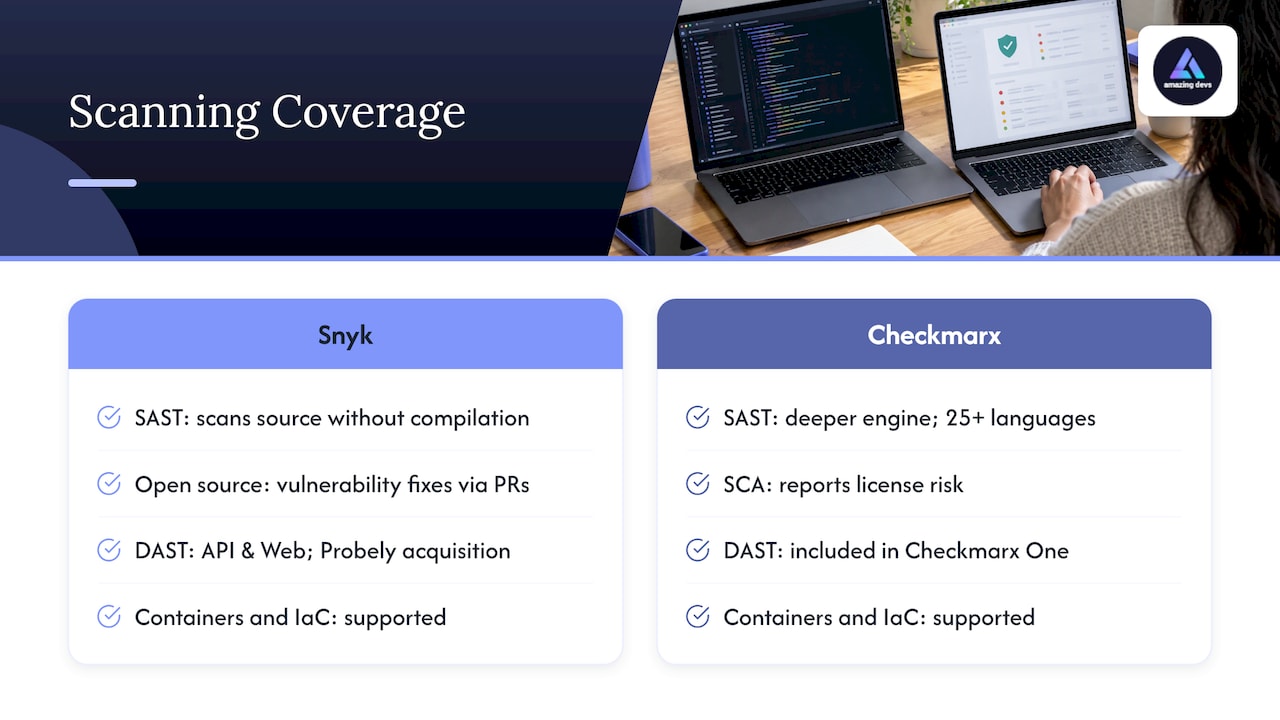
Static code analysis. Checkmarx’s SAST engine is the older and deeper of the two. Its AWS Marketplace listing says it supports 25+ languages and frameworks and that one event, such as a code commit, can trigger every scan type with results gathered in one place. Snyk’s own comparison says Snyk Code can scan source directly without a compile step, including in the IDE, pull requests and CI/CD. For a team that cannot easily produce a clean build for every service, that matters.
Open-source dependencies. This is Snyk’s home territory. Snyk Open Source offers vulnerability scanning and fix pull requests, and one independent comparison suggests you compare dependency coverage and proposed upgrades on your own project rather than trusting a feature list. Checkmarx’s SCA also reports license risk, which legal and compliance teams often ask for.
DAST. Snyk does offer dynamic testing, through its API & Web product. The same comparison says it came from the Probely acquisition, while Checkmarx includes DAST inside the Checkmarx One suite. If dynamic testing is a hard requirement, ask each vendor for a demo against one of your own running applications.
Containers and IaC. Both cover them. For a concrete picture of what container scanning output looks like, Docker’s walkthrough of Snyk scanning shows CVE identifiers, affected packages, severity and fixed versions, with pull-request remediation when source control is connected.
What a CVE is, and why it shows up in both tools
CVE stands for Common Vulnerabilities and Exposures. Snyk Learn explains that the CVE List is a standardized catalog of publicly known vulnerabilities, each with a unique identifier. It is a list of records, not an actionable database on its own.
That is why scanners matter. A tool matches the libraries and code in your project against CVE records and other research, then tells you which finding affects you and what upgrade removes it. Checkmarx reviewers also mention grouping findings in reports by CVE, which helps when a security lead reports to management. For a wider view of turning risk into action, this piece on website security and customer trust covers why remediation protects the business, not just the codebase.
Developer workflow: IDE, pull requests and CI/CD
A scanner that developers avoid protects nothing. Workflow is where the two products feel most different.
Snyk presents itself as workflow-oriented: findings appear in the editor, in pull requests and in the pipeline, with suggested fixes. That is a large part of why it is often described as the faster tool to roll out.
Checkmarx has closed much of this gap. Its Developer Assist feature offers real-time IDE scanning of human- and AI-generated code plus agentic remediation, first released in the Checkmarx One plugin for VS Code, Cursor and Windsurf. That matters if your engineers write a lot of code with AI assistants. Reviewers quoted on the AWS Marketplace review page value its IDE, CI/CD and source-control integrations for finding and fixing issues in the flow of work.
Whichever you pick, review discipline decides whether findings get fixed. If your team is distributed, a clear remote code review process keeps security fixes from stalling in the queue.
Pricing in the United States
The two vendors price in very different ways, so a like-for-like number does not exist. Treat everything here as a published figure from its source, and confirm it with a quote before budgeting.
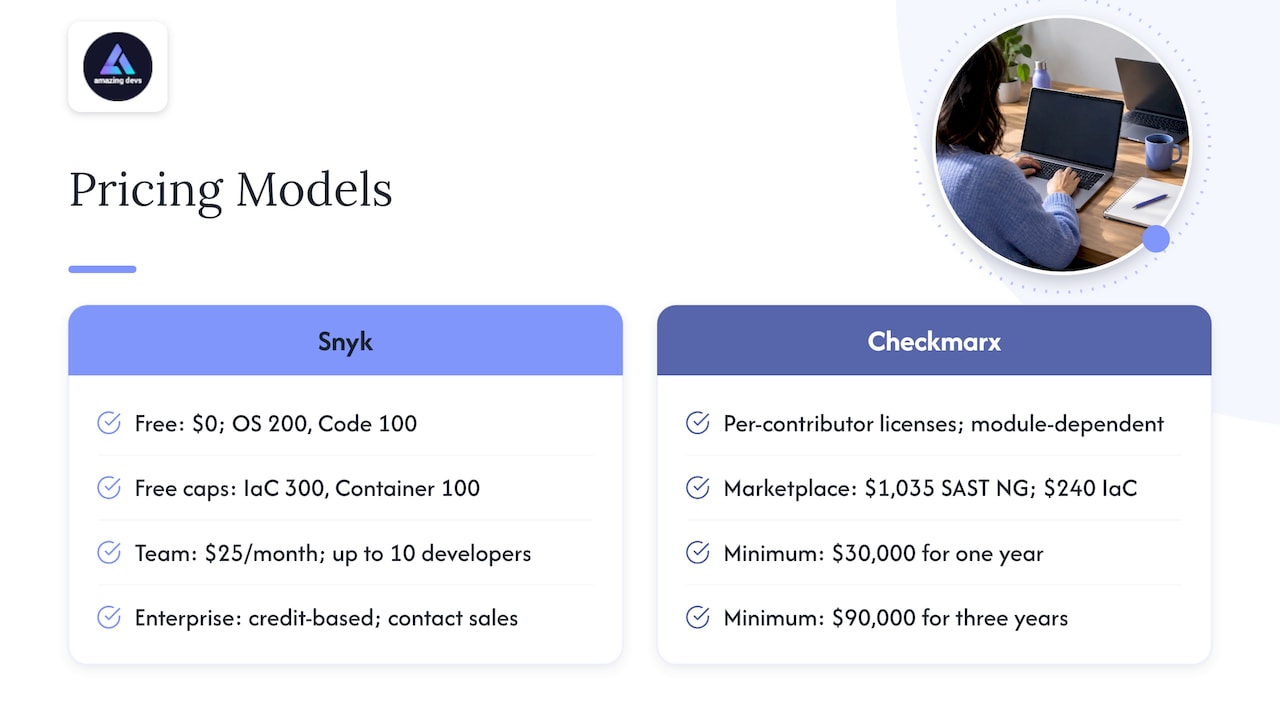
Snyk. Snyk’s pricing page lists a Free plan at $0 with test limits (200 Open Source, 100 Code, 300 IaC and 100 Container tests), a Team plan at $25/month for up to 10 developers with higher limits, and Enterprise with contact-sales, credit-based pricing. The Team cap is a real planning point: once you pass 10 contributing developers, you are in a sales conversation. A March 2026 breakdown notes that billing counts anyone who committed to a monitored private repository in the last 90 days, so contractors and new hires count.
Checkmarx. Gartner Peer Insights describes subscription pricing licensed per contributing developer, varying by the modules you select. The AWS Marketplace listing publishes 12-month per-license prices for individual modules (for example $1,035 for the Start with SAST NG package and $240 for IaC), but sets a minimum deal of $30,000 for one year or $90,000 for three. Those Marketplace SKUs are not a general full-platform price, and full deployments are generally custom quoted.
The practical reading: a startup with fewer than ten developers can begin on Snyk’s free or Team tier with almost no procurement. A company with a security department and a six-figure AppSec budget will find Checkmarx’s structure familiar.
Which teams each tool suits
An independent-style comparison on Safeguard frames the split this way: Snyk suits engineering-led teams that prioritize quick adoption, low central overhead and open-source dependency risk. Checkmarx suits teams that need deep, tunable SAST, centralized AppSec governance, compliance reporting or self-managed deployment.
Translated into situations:
- Seed to Series B startup, no security hire. Snyk. Fast to install, cheap to start and usable by the developers you already have.
- Scale-up approaching SOC 2 or customer security reviews. Either. Snyk if developers own the process, Checkmarx if a security lead will.
- Enterprise with a central AppSec team and audit obligations. Checkmarx. Checkmarx says it was founded in 2006 and serves more than 1,800 customers, including 60% of the Fortune 100, which reflects where it is strongest.
- Heavy use of AI coding assistants. Look hard at each vendor’s IDE scanning for AI-generated code, and run both on a real repository.
One more factor reviewers raise: scan speed and noise. A 2026 review page reports requests for better scan performance and fewer false positives alongside praise for remediation guidance. Wherever you land, plan engineering time for tuning rules and triaging results.
The decision after the decision: who runs the tool
Buying either platform creates work: configuring pipelines, tuning rules, triaging findings, writing fixes, upgrading dependencies, retesting. A tool that reports 400 findings to a team with no spare capacity produces a dashboard, not security.
This is where hiring comes in, and where most evaluations stop too early. Before signing, estimate the hours per sprint your team will spend on remediation and compare that with the capacity you have. If there is a gap, you have three routes: pull developers off the roadmap, hire locally in the U.S. market, or add nearshore engineers.
When you hire, screen for the work the tool creates. Ask candidates to triage a sample dependency report, review a pull request for an injection flaw and explain a CVE fix. A capped technical screening keeps that process short. If the new hires will touch sensitive systems, put background checks by access tier in place before they get production access.
Our perspective
We hear the same pattern from growing software companies: the scanner purchase is the easy part, and the capacity to act on its output is the hard part.
Our view is that a security tool and an engineering team should be planned together. Snyk or Checkmarx will tell you what is wrong. Developers who understand your stack, review code carefully and finish the remediation tickets are what make the report shrink.
That is why we build our service around the hiring work itself: sourcing Brazilian developers, assessing technical and cultural fit, and managing the contracts, so your engineering leaders spend their time on the roadmap and the backlog, not on recruiting. For teams that need AI-enabled or AI-native engineers, that includes people comfortable working with AI-assisted coding, which makes the IDE-scanning questions above part of daily work.
Pick the scanner that fits how your team works. Then make sure you have the people to use it.
Gabriel
Add capacity for the remediation work
If your evaluation shows more security and quality work than your team can absorb, Amazing Devs places pre-vetted Brazilian developers with U.S. companies. We handle sourcing, technical and cultural fit assessment, and contract management, so you do not carry the usual hiring overhead.
The model that fits depends on what you are building. Nearshore staff augmentation adds individual engineers to your team. The Team Extension Model builds a dedicated group that works as part of yours. If testing is the gap, our nearshore QA contractors can cover it.
FAQ
Is Snyk or Checkmarx better for a small team?
Snyk is usually the easier start for a small team. It has a free tier and a $25/month Team plan for up to 10 developers, and it is built around developer workflow. Checkmarx’s published Marketplace minimum deal is $30,000 for one year, which suits larger budgets.
Does Snyk have DAST?
Yes. Snyk offers dynamic testing through its API & Web product, which an independent comparison says came from the Probely acquisition. Checkmarx includes DAST in Checkmarx One. If dynamic testing is central for you, run both against one of your own applications.
What is a CVE in these tools?
A CVE is a standardized identifier for a publicly known vulnerability. Both tools match your code and dependencies against CVE records and other research, then show which findings affect you and what fix applies.
Do I need a security team to use either tool?
Not for Snyk’s developer-led setup, where engineers see findings in their normal workflow. Checkmarx’s governance and compliance reporting are designed for a central AppSec function. In both cases someone must own triage and remediation, and adding developers is often the quickest way to cover it.
Sources
- Snyk User Docs
- Checkmarx One Reviews & Ratings 2026, Gartner Peer Insights
- Snyk vs Checkmarx comparison, Snyk
- Checkmarx One, AWS Marketplace
- Checkmarx One reviews, AWS Marketplace
- Checkmarx vs Snyk 2026, AppSec Santa
- Automating Your Containers’ Security Scanning, Docker
- Common Vulnerabilities and Exposures, Snyk Learn
- Snyk Plans and Pricing
- Snyk Pricing in 2026, DEV Community
- OX Security vs Checkmarx pricing, RFP.wiki
- Snyk vs Checkmarx: Neutral 2026 Comparison, Safeguard
- Checkmarx company profile, Insight Partners Job Board
- Website security and customer trust