Best Recruitment CRM Software in 2026: Compared by Team Type
The best recruitment CRM depends on who is hiring. In-house teams do well with Gem, agencies with Loxo or Recruit CRM, and enterprises with Beamery or Avature. Published U.S. prices checked in October 2026 ran from $15 to $215 per user per month, with some tiers sold only by custom quote. If your real goal is to put skilled software developers on your team without building a recruiting operation, our nearshore staff augmentation takes sourcing, assessment and contracts off your plate, and a CRM becomes optional rather than a prerequisite.
This guide explains what a recruitment CRM does, compares the tools U.S. teams shortlist most often, and shows what each really costs once setup is counted.
TL;DR
- A recruiting CRM manages relationships with people who have not applied yet. An applicant tracking system (ATS) manages people who have applied to a specific role.
- Published U.S. per-user prices checked in October 2026 ranged from $15 to $215 per month. Enterprise platforms are quoted by contract and often need months of setup.
- Gem fits in-house outbound teams, Loxo and Recruit CRM fit agencies, Manatal fits tight budgets, and Beamery and Avature fit large enterprises.
- A CRM gives you a place to keep candidates. It does not find, vet or contract the developers for you.
- If the goal is developers on your team, Amazing Devs handles sourcing, technical and cultural fit assessment, and contract management for Brazilian engineers.
Table of Contents
- What a recruitment CRM does, and how it differs from an ATS
- What the tools cost in 2026
- The main recruitment CRMs compared
- How to choose: five questions
- The gap a CRM does not close for developer hiring
- Perspective
- Where Amazing Devs fits
- Which option fits which reader
- FAQ
- Sources
What a recruitment CRM does, and how it differs from an ATS
A recruiting CRM (candidate relationship management system) is software for finding, engaging and staying in touch with talent before they apply. Greenhouse describes the CRM as focused on the pre-application stage, using targeted campaigns to reach passive candidates, while the ATS manages the structured workflow from screening through offer.
The practical difference is the trigger. An ATS is job-driven: a role opens, candidates apply, you move them through stages. A CRM is relationship-driven: it tracks history across many touchpoints whether or not a role is open, as Lever explains.
Most teams eventually want both. Deel notes that the two work best connected: the CRM warms the pipeline, and the ATS takes over once someone applies. Many modern platforms bundle the two in one product, which is why the same tools appear under both “CRM” and “ATS” searches.
A useful CRM typically covers:
- Talent pools and segmentation, so you can group people by skill, seniority or location.
- Outreach sequences, so follow-ups to passive candidates are automated.
- Re-engagement of silver medalists, the finalists you did not hire the first time.
- Email and calendar sync, so conversations are logged without manual entry.
- Reporting, such as time to fill and cost per hire.
What the tools cost in 2026
Prices move with plan changes, seat counts and annual billing, so read the figures below as the published numbers for the period shown, and confirm against each vendor’s live page before you budget.
The October 2026 price comparison from HRpresso puts published per-user prices between $15 and $215 per user per month. Manatal’s Professional plan sits at the low end at $15 per user per month billed annually. At the other end, enterprise tiers are priced by quote.
| Tool | Best fit | Published pricing (as of 2026) |
|---|---|---|
| Manatal | Small, budget-conscious teams | Professional $15 per user per month, billed annually |
| Loxo | Recruiting agencies and search firms | Core from $149 per user per month, billed annually |
| Gem | In-house outbound hiring teams | Custom by company size; startup program lists $130 |
| SmartRecruiters | Mid-size and large employers | Essential from $14,995 |
| Beamery | Enterprise talent marketing | Custom contract |
| Avature | Large, configurable enterprise programs | Custom by company size and needs |
The subscription is rarely the full cost. Enterprise platforms add implementation, integrations, data migration and admin time. RFP.wiki’s June 2026 benchmark puts typical Avature enterprise rollouts at three to nine months, and advises confirming the implementation scope and integration ownership before signing.
The main recruitment CRMs compared
Gem: for in-house teams doing outbound
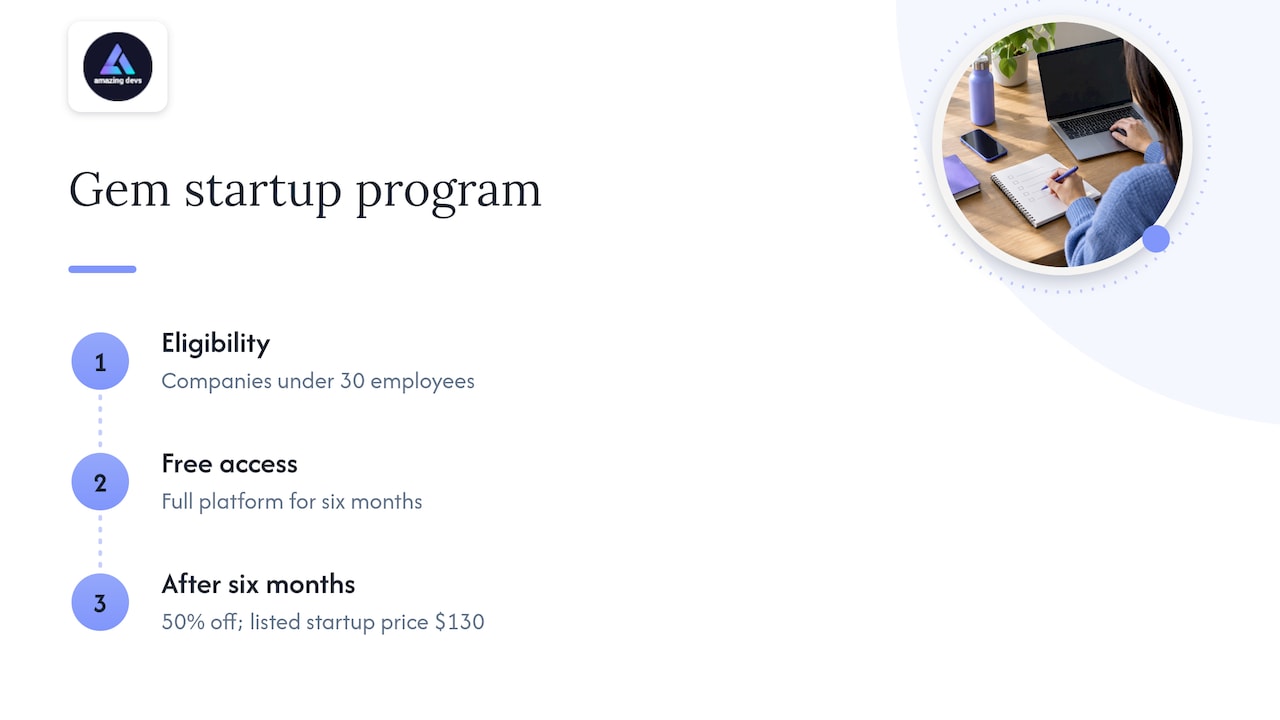
Gem is an all-in-one platform combining ATS, CRM, sourcing across more than 800 million profiles, interview scheduling and analytics. Enterprise pricing is custom, based on company headcount. Its startup program offers the full platform free for six months to companies under 30 employees, then 50% off, with a listed startup price of $130.
It suits a company with its own recruiters who proactively reach out to engineers. If you have no recruiter on staff, the tool still needs someone to run it.
Loxo: for agencies and executive search
Loxo is an AI-native ATS and CRM for recruiting firms. Core starts at $149 per user per month billed annually. The Professional tier adds sourcing on a talent graph of more than 850 million professionals, outreach tools and monthly credits per seat. Enterprise is a custom annual agreement. It manages clients as well as candidates, which is what agencies need.
Recruit CRM, Recruiterflow, Bullhorn and Crelate: agency staples
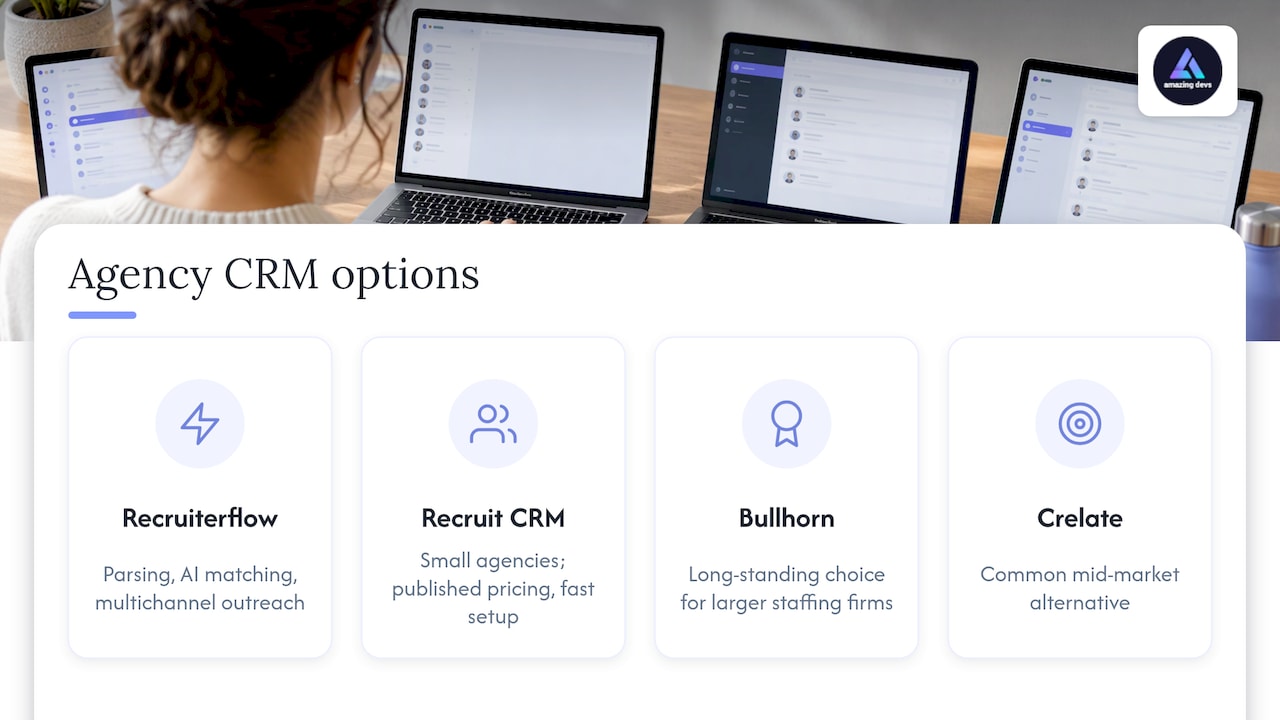
These four recur in agency comparisons. Recruiterflow lists resume parsing, AI candidate matching, multichannel outreach, two-way Google Workspace and Office 365 email sync and LinkedIn integrations. Recruit CRM is often chosen by small agencies for its published pricing and fast setup. Bullhorn is the long-standing choice for larger staffing firms. Crelate is a common mid-market alternative. HRpresso’s October 2026 comparison covers Bullhorn, Recruit CRM, Crelate, Loxo and Manatal with per-user prices, trials and team fit, which makes it a good place to check current numbers.
If you run an agency and also need to organize delivery work, a guide to the project management tools for recruitment agencies pairs well with a CRM.
Manatal: for the tightest budgets
Manatal’s Professional plan at $15 per user per month billed annually is the lowest published price in the comparison. It suits small teams that want a pipeline and candidate database without a large commitment.
SmartRecruiters and Beamery: for enterprise programs
SmartRecruiters sells four Talent Acquisition Suite tiers. Essential starts at $14,995 and includes ATS, CRM, onboarding, SMS, job distribution and scheduling. Higher tiers add AI hiring and screening features and advanced analytics. Beamery positions itself as an AI platform for workforce transformation, with a data platform, workforce intelligence and an agentic AI suite. Both are built for organizations with dedicated talent acquisition teams and implementation budgets.
How to choose: five questions
- Do you hire continuously or in bursts? A CRM pays off when you hire the same profiles repeatedly and can reuse a talent pool. For one or two engineering hires a quarter, the pool rarely gets warm enough to matter.
- Who will run it? Every tool above assumes a person doing sourcing, outreach and follow-up. Software organizes the work; it does not do it.
- Are you an agency or an employer? Agencies need client and job-order management. Employers need pipeline and hiring-manager workflow. Buying the wrong type costs months.
- Do you already have an ATS? If you do, check whether the CRM connects to it. Double entry quietly kills adoption.
- What is the total cost? Add seats, implementation, integrations and the recruiter hours. Compare that with what a placed developer costs you. Our breakdown of what it costs to recruit developers in 2026 gives a frame for that math.
A CRM also needs a consistent way to judge candidates. A template candidate scoring matrix keeps notes comparable across recruiters and hiring managers, whichever system you pick.
The gap a CRM does not close for developer hiring
A recruiting CRM keeps your candidate relationships organized. For engineering roles, the hard parts sit upstream and downstream of it:
- Finding developers who match the real skills, not just keywords. Our guide on skills-based sourcing of engineers with responsible AI shows how demanding that step is.
- Assessing them technically without burning your engineers’ week. We recommend capping technical screens at 90 minutes.
- Judging cultural and business fit, which a database field cannot capture.
- Contracting and onboarding, with the paperwork that comes with hiring across borders.
This is why startups and scaling companies often skip the tooling decision altogether. The question that matters is not which database holds your candidates but who delivers a vetted developer.
Perspective
We built Amazing Devs around a simple observation: most companies that go shopping for a recruiting CRM do not actually want a CRM. They want a developer who can start contributing.
A CRM is a good tool when you have recruiters, a steady flow of roles and the time to nurture a talent pool over months. If your team is a founder and a CTO, or an engineering manager who already carries a full roadmap, the stack becomes one more thing to run.
Our approach is to take the recruiting work itself. We source Brazilian developers, run a rigorous technical and cultural fit assessment, and manage the contract and the bureaucracy, so you meet candidates who are already matched to your needs. Our engineering team supports clients as projects move forward.
That is also why we see nearshore as the first option for teams that need to scale quickly and keep hiring overhead low: you get the outcome a CRM is meant to support, without building the machine around it.
Gabriel
Where Amazing Devs fits
If your reason for searching is to staff engineering, start with the outcome. Amazing Devs provides nearshore IT staff augmentation with Brazilian developers, including end-to-end sourcing, technical and cultural fit assessment, and contract management. It works for startups that need skilled developers at an affordable cost and for established companies adding capacity, and it covers AI-enabled and traditional software engineering roles.
The Team Extension Model adds developers to your existing team, and nearshore QA contractors cover testing. Read the nearshore staff augmentation page to see how an engagement works.
To talk through the profiles you need, start at getamazingdevs.com.
Which option fits which reader
| Your situation | Recommended route |
|---|---|
| Need developers soon, no recruiting team | Nearshore staff augmentation with Amazing Devs |
| Scaling an existing engineering team | Team Extension Model with Amazing Devs |
| In-house recruiters hiring continuously | Gem, or an ATS and CRM suite |
| Staffing or search agency | Loxo, Recruit CRM, Recruiterflow or Bullhorn |
| Very small team, tiny budget | Manatal |
| Enterprise talent marketing | Beamery, Avature or SmartRecruiters |
FAQ
What is the difference between a recruiting CRM and an ATS?
An ATS tracks candidates who applied for a specific job through screening, interviews and offer. A recruiting CRM manages relationships with prospects and past candidates who may not have applied. Indeed’s employer guide notes that integrated systems let data flow between the two without double entry.
How much does a recruitment CRM cost?
Published U.S. prices checked in October 2026 ranged from $15 to $215 per user per month, and enterprise platforms are quoted per contract. Add implementation and the recruiter time needed to run the tool when you compare options.
Do startups need a recruiting CRM?
Only when they hire the same profiles often and have someone to run outreach. A startup that needs a few engineers quickly usually gets further by working with a partner that delivers matched, vetted developers, which is what our nearshore model is built for.
Can a CRM replace a recruiter?
No. It stores and automates communication, but sourcing, assessing and persuading candidates still takes a person. Amazing Devs takes on that work for developer roles, including technical and cultural fit assessment and contract management.
Sources
- Best Recruiting CRM 2026: Per-User Prices and Trials, HRpresso
- Recruiting CRM vs ATS: What’s the difference?, Greenhouse
- Recruiting CRM vs. ATS: What’s the Difference?, Lever
- ATS vs CRM: What’s the Difference for Recruiting Teams?, Deel
- ATS and CRM: What Are the Differences?, Indeed
- Pricing, Gem
- Loxo Pricing
- Talent Acquisition Suite Pricing, SmartRecruiters
- Beamery
- Recruiterflow Software Reviews, Software Advice
- Avature vs Cornerstone (2026), RFP.wiki
- 7 Best Project Management Tools for Recruitment Agencies in 2026